

Saved Bookmarks
This section includes 7 InterviewSolutions, each offering curated multiple-choice questions to sharpen your Current Affairs knowledge and support exam preparation. Choose a topic below to get started.
| 1. |
Energy stored in capacitor is in the form of ...... |
|
Answer» ELECTRICAL potentialenergy |
|
| 2. |
A jet plane having a wing - span of 25 m is travelling horizontally towards east with a speed of 3600 km /hour . If the the Earth's magnetic field at the location is 4xx10^(-4) T and the angle of dip is 30^@ , then the potential difference between the ends of the wing is |
|
Answer» 4 V `B_(v)=Bsintheta=4xx10^(-4)xxsin30=2xx10^(-4)T` v = 3600km/hour = `3600xx5/18=1000ms^(-1)` `e=2xx10^(-4)xx1000xx25=5V` |
|
| 3. |
The focal length of an equiconvex lens in air i equal to either of its radii of curvature. The refractive index of the material of the lens is …........ |
|
Answer» `4/3` Forconvex LENS, `1/f=(mu-1)(1/R_1-1/R_2)` `1/R=(mu-1)(2/R)` `THEREFORE 1=2mu-2` `therefore2mu=3` `thereforemu=3/2=1.5` |
|
| 4. |
Which of the following time measuring devices is most precise'? |
|
Answer» A wall CLOCK |
|
| 5. |
यह एक सामान्य निरीक्षण है कि वर्षा के बादल, जमीन से लगभग 1 km की ऊंचाई पर हो सकते हैं। यदि वर्षा की एक बूंद गुरुत्वीय प्रभाव में इस ऊँचाई से स्वतंत्र रूप से गिरती है, तो km/h में इसकी चाल क्या होगी? (यदि g=10 m/s^2) |
|
Answer» 510 |
|
| 6. |
there in no current part of this circuit for time t lt o. Switch S is closed at t = 0. The rate at which the current through the inductor increases initially is |
|
Answer» zero So in initially, `V_(A) - V_(B) = ((6)/(1 + 5)) xx 1 = 1 V` (i) `V_(A) - V_(C) = ((6)/(2 + 4)) xx 2 = 2 V` (ii) from (i) and (ii), `V_(B) - V_(C) = 2 - 1 = 1 V` `rArr V_(B) - V_(C) = L(di)/(dt)` `rArr 1 = 0.1 (di)/(dt) rArr (di)/(dt) = 10 As^(-1)` Current through `6 W` resistor will remain CONSTANT because it is independently CONNECTED to `6 V`. After a long TIME, inductor will behave like a simple wire. `1 Omega` and `2 Omega` are in parallel, their equivalent is `(2)/(3) Omega` `5 Omega` and `4 Omega` are in parallel, their equivalent is `(20)/(9) Omega`. `V_(1) = ((2)/(3) xx6)/((2)/(3) + (20)/(9)) = (18)/(13) V,V_(2) = V - V_(1) = 6 - (18)/(13) = (60)/(13)V` `I_(1) = (V_(1))/(2) = (18)/(13 xx 2) = (9)/(13)A, I_(2) = (V_(2))/(4) = (60)/(13 xx 4) = (15)/(13) A` Current through inductor: `I = I_(2) - I_(1) = (15)/(13) - (9)/(13) = (6)/(13)A` 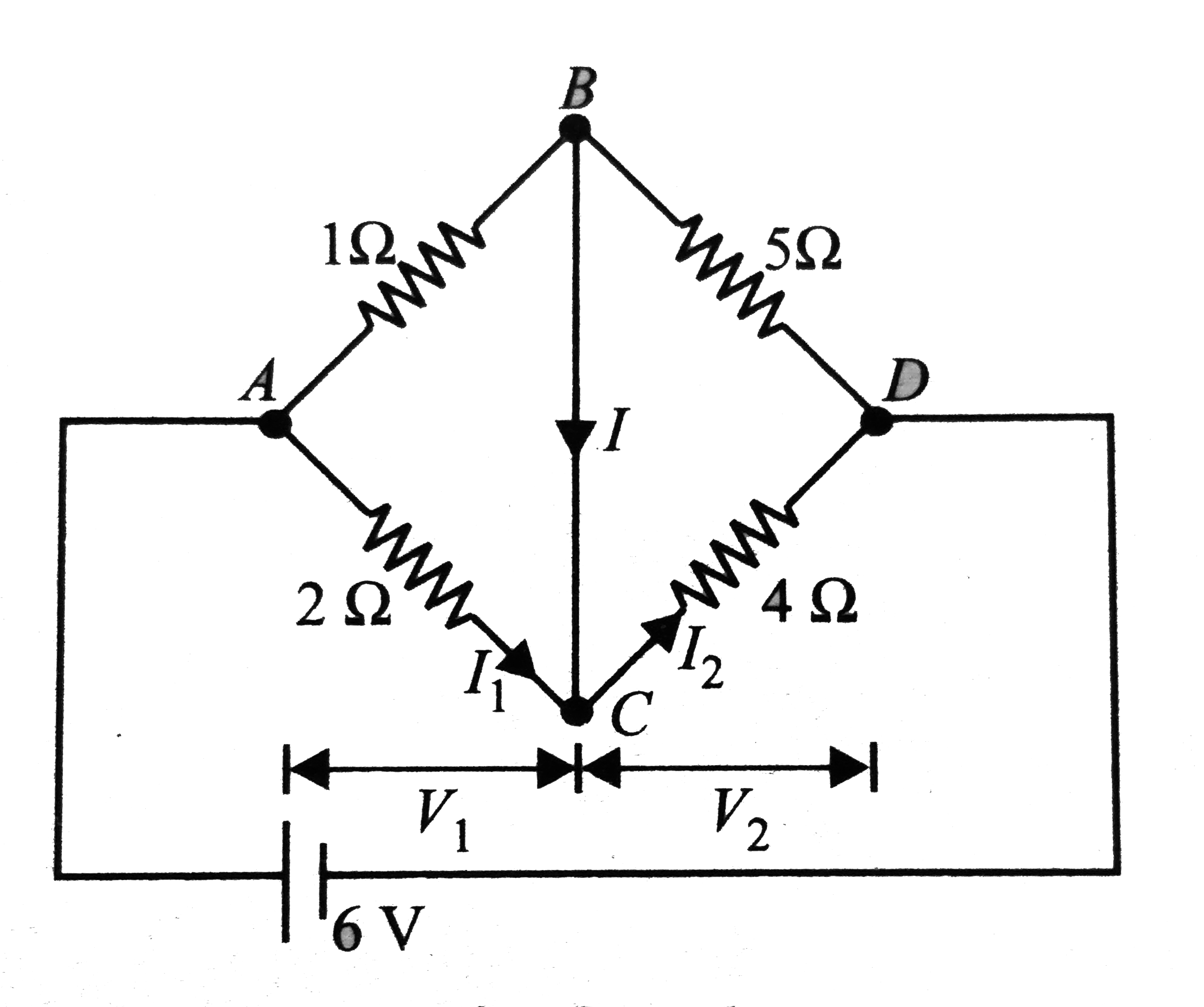
|
|
| 7. |
Two identical magnets are placed perpendicular to each other with their unlike poles in contact. If each magnet has a magnetic moment 'M', what is the magnetic moment of the combination? |
|
Answer» Solution :Magnetic moment is a vector It acts along South to NORTH . The RESULTANT of two perpendicular vectors is obtained by USING parallelogram law of vectors . Here `M_1 = M_2 = M ` `:.` New magnetic moment ` = sqrt( M^(2) + M^(2) + 2M. M cos THETA ) = sqrt( M^(2) + M^(2) + 0)` New magnetic moment = ` sqrt(2) M` |
|
| 8. |
Each small area oflight or shade is called a _____________ |
| Answer» Answer :A | |
| 9. |
A converging beam of light forms a sharp image on a screen. A lens is placed in the path of the beam, at 10cm from the screen. It is found that the screen has to be moved 8 cm further away from the lens to obtain a sharp image. Find the focal length and nature of lens. |
Answer» Solution : As SHOWN in figure, in this problem, object Ois virtual while image I REAL, so that u = 10 cm and v=(10+8)= 18 cm and hence from lens FORMULA, `(1)/(v) -(1)/(u ) =(1)/(f) ` we have `(1)/(18) -(1)/(10) =(1)/(f)` which on simplification gives `f= -(90)/(4) 22.5cm ` i.e., the lens is diverging (CONCAVE) of focal length 22.5 cm |
|
| 10. |
A pure semiconductor has equal electron and hole concentration of 10^(16) m^(-3) . Doping by indium increases n_(h) to 5 xx 10^(22) m^(-3) . Then the value of n_(e) in the doped semiconductor is |
|
Answer» a. `10^(6) // m^(3)` |
|
| 11. |
What is polarization of light ? Explain the polarization by reflection. |
|
Answer» Solution :Plane polarised light. Only transverse waves SHOW the property of polarisation. Polarised light by reflection. When unpolarised beam is reflected from a transparent (glass) surface, the reflected beam will become partially polarized depending on the angle of incidence. For one particular angle of incidence, CALLED polarizing angle (or Brewster.s angle) the reflected beam is completely polarized. The condition for this phenomenon to occur is SHOWN in the given. In incident light, double arrows represent radiation polarised in plane of paper and dots represent RADIATIONS polarised perpendicular to the plane. 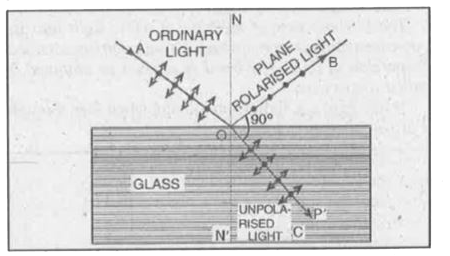 Explanation. In the figure we find that the vibrations perpendicular to the plane of paper are always parallel to the reflecting surface for all ANGLES of incidence and the other vibrations make different angles with the reflecting surface and at a particular angle of incidence called polarising angle, the vibrations parallel to the reflecting surface are reflected along OB and the other components are transmitted, hence reflected light is polarised. |
|
| 12. |
The distance of the closest approach of an alpha particle fired at a nucleus with kinetic energy K is r_0. The distance of the closest approach when the alpha particle is fired at the same nucleus with Kinetic Energy 2k will be |
|
Answer» `2r_0` |
|
| 13. |
Four metallic plates are charged as shown in figure. Now, match the following two columns. I overset(sigma)(|)Iioverset(-2 sigma)(|)IIIoverset(sigma)(|)IV |
|
Answer» |
|
| 14. |
In Bohr model of an atom,Which of the following is an integral multiple of h//2pi? |
|
Answer» KINETIC energy |
|
| 15. |
A TV transmission tower has a height of 240m. Signals broadcast from this tower will be received by LOS communication at a distance of (assume the radius of earth to be 6.4 xx 10^(6)m) |
| Answer» ANSWER :B::C::D | |
| 16. |
a. When a low flying aircraft passes over head, we sometimes notice a slight shaking of the picture on our TV screen. Identify the reasonbehind it. |
| Answer» Solution :Interference of the direct SIGNAL received by the antenna with the (WEAK) signal reflected by the PASSING aircraft. | |
| 17. |
An AC voltage is applied to a resistance R and an inductor L in series . If R and the inductive reactance are both equal to 3 Omega, the phase difference between the applied voltage and the current in the circuit is |
|
Answer» `(PI)/(6)` |
|
| 18. |
The ratio of the magnetic induction to the intensity of the magnetising field is called |
|
Answer» ABSOLUTE permeability |
|
| 19. |
A palne monochromatic ligth wave falls normally on a long rectangular slit behind which a screen is positioned at a distance b = 60 cm. First the width of the slit has adjucted so that in the middle of the diffraction pattern the lowest minimum was observed. After widening the slit by Deltah 0.70mm, the next minimum was obtained in the centre of the pattern. Find the wavelength of light. |
|
Answer» Solution :If the aperture has width `h` them the parameters `(v, -v)` associted with `(h//2,-(h)/(2))` are given by `v = (h)/(2) sqrt((2)/(b lambda)) = h//sqrt(2b lambda)` the intensity of light at `O` on the screen is obtained as the square of the amplitude `A` of the wave at `O` which is `A_(~) const UNDERSET(-v)overset(v)int e^(-ipiu^(2)//2) du` Thus `I = 2I_(0) ((C(v))^(2) + (S'(v))^(2))` where `C(v)` and `S(v)` have been defind above and `I_(0)` is the intensity at `O` due to an infinitey wide `(v = oo)` aperture for then `I = 2I_(1) (((1)/(2))(2) + ((1)/(2))^(2)) = 2I_(0) xx (1)/(2) = I_(0)`. By DEFINITION `v` corresponds to the first minimum of the intensity. This means `v = v_(1) ~~90` when we increase `h` to `h + Deltah`, the corresponding `v_(2) = (h + Deltah)/(sqrt(2b lambda)` relates to the second minimum of intensity. From the cornu's spiral `v_(2) ~~2.75` Thus `DELTA h = sqrt(2b lambda) (v_(2) - v_(1)) = 0.85 sqrt(2b lambda)` or `lambda = ((Deltah)/(0.85))^(2) (1)/(2b) = ((0.70)/(0.85))^(2) (1)/(2xx0.6)mu m = 0.565 mu m` 
|
|
| 20. |
Show below are the black body radiation curves at temperature T_1 and T_2(T_2gtT_1). Which of the following plots is correct? |
|
Answer»
|
|
| 21. |
Find the probability that a certain radioactive atom would get disintegrated in a equal to the mean life of the radioactive sample. |
|
Answer» Solution : SINCE , the Probability P(t) that a particular radioactive atom gets disintegrated in a time (from EQ.) is given by`P(t) = 1 - E^(-lamdat)` `:. ` Here ` t = lt t gt 1 = 1/lamda :. P(t) = 1 - 1//e` `~~ 1 -0.37 = 0.63` |
|
| 22. |
The transverse displamcement y(x,t) of a wavey(x,t ) on a string is given by yox, t) = . This represents a |
|
Answer» wave MOVING in -x direction with SPEED `SQRT((B)/(a))` |
|
| 23. |
Light of frequency vis incident on a photosensitive surface of threshold frequency v_(0)(v gt v_(0)). The value of kinetic energy of the emitted photoelectrons will be ______ |
|
Answer» Solution :`H(v-v_(0))` or less [Hint : Maximum kinetic ENERGY of the emitted photoelectrons `k_("max")=h(v-v_(0))`] |
|
| 24. |
A small body of mass 0.10kg is undergoing simple harmonic motion of amplitude 1.0 metre and period of 0.20 sec the maximum value of the force acting on it |
|
Answer» 99N |
|
| 25. |
In an organ (may be closed or open) of 99cm length standing wave is setup, whose equation is given by longitudinal displacement =(0.1 mm) cos(2pi)/0.8 (y+1 cm) cos 2pi(400 t) Where y is measured from the top of the tube in meters and t in second. Here lcm is the end correction. Equation of the standing wave in terms of excess pressure is (Bulk modulus of air B =5 xx 10^(5) N//m^(2)) |
|
Answer» <P>`P_(EX) = (125 pi N//m^(2)) SIN(2pi)/0.8 (y+ 1 cm) cos 2pi (400 t)` |
|
| 26. |
On the basis of Bohr's theory, calculate the velocity and time period of revolution of the electron in the innermost orbit (n = 1) of the hydrogen atom. Given : Bohr's Radius (r_(1)) = 0.53 Å. Data: n=1, r_(1)=0.53, Å=0.53xx 10^(-10) m, v= ?, T=? |
|
Answer» Solution :KINETIC energy of the electron `=(1)/(2)mv_(n)^(2)` `=(Ze^(2))/(8pi epsi_(0)r_(n))` `(1)/(2) mv_(n)^(2)=(Ze^(2))/(8 pi epsi_(0)[(n^(2)h^(2)epsi_(0))/(pi m Ze^(2))]) [ :.r_(n)=(n^(2)h^(2)epsi_(0))/(pi mZe^(2))]` `rArr v_(n)=(Ze^(2))/(2epsi_(0)nh)` For HYDROGEN atom Z = 1 and for n=1, `v_(1)=(e^(2))/(2epsi_(0)h)=((1.6xx10^(-19))^(2))/(2xx8.854xx10^(-12)xx6.656xx10^(-34))` `=2.1818xx10^(-10) ms^(-1)` [Note : Velocity can also be calculated using Bohr.s first postulate] Period = Time taken for one revolution `=T=(2pi r_(1))/(v_(1))` `[ :. "time"=("distance")/("velocity")]` `:.T=(2xx3.142xx0.53xx10^(-10))/(2.1818xx10^(6))` `T=1.5265xx10^(-16)s` |
|
| 27. |
This section contains a paragraph. Based upon this paragraph, three multiple- choice question (21-23) have to be answered. Each question has four choices (a,b,c and d), out of which only one is correct. The result obtained in electrostatics using Gauss's law can in same cases be used to obtain result in gravitational, and vice versa. This is because both follow the inverse- square law of distance. We use of the following three rules (1) For charge in electrostatics, the corresponding quantity in gravitation is mass. (2) Electric intensity of electrostatics corresponds to gravitational intensity, or acceleration due to gravity, in gravitation. (3)The constant k=(4piepsi_(0))^(-1) of electrostatics corresponds to -G in gravitation. The gravitation intensity near a thin infinite sheet wiht mass sigma per unit area has the magnitude |
|
Answer» `4piGsigma` |
|
| 28. |
In an organ (may be closed or open) of 99cm length standing wave is setup, whose equation is given by longitudinal displacement =(0.1 mm) cos(2pi)/0.8 (y+1 cm) cos 2pi(400 t) Where y is measured from the top of the tube in meters and t in second. Here lcm is the end correction. The air column is vibrating in |
|
Answer» FIRST OVERTONE |
|
| 29. |
This section contains a paragraph. Based upon this paragraph, three multiple- choice question (21-23) have to be answered. Each question has four choices (a,b,c and d), out of which only one is correct. The result obtained in electrostatics using Gauss's law can in same cases be used to obtain result in gravitational, and vice versa. This is because both follow the inverse- square law of distance. We use of the following three rules (1) For charge in electrostatics, the corresponding quantity in gravitation is mass. (2) Electric intensity of electrostatics corresponds to gravitational intensity, or acceleration due to gravity, in gravitation. (3)The constant k=(4piepsi_(0))^(-1) of electrostatics corresponds to -G in gravitation. The acceleration dut to gravity at the surface of the earth is g, and at a distance r from the centre of the earth is gr/R, where R is the radius of the earth. Inside a uniformly charged sphere of radius R and charge Q, the electric intensity at a distance r (rltR) from the centre has the magnitude |
|
Answer» `KQ{1-(r//R)^(2)}` |
|
| 30. |
An electric dipole coincides on Z-axis and its mid point is on origin of the co-ordinate system. The electric field at an axial point at a distance z from origin is vecE_(z)and electric field at an equatorial point at a distance y from origin is vecE_(y) Here, z=y gt gt a, so |vecE_(x)|/|vecE_(y)|=............... |
|
Answer» 3 `=int_(0)^(2pi)COS^(2)theta d theta =alambda_(0)pi =pialambda_(0)` |
|
| 31. |
This section contains a paragraph. Based upon this paragraph, three multiple- choice question (21-23) have to be answered. Each question has four choices (a,b,c and d), out of which only one is correct. The result obtained in electrostatics using Gauss's law can in same cases be used to obtain result in gravitational, and vice versa. This is because both follow the inverse- square law of distance. We use of the following three rules (1) For charge in electrostatics, the corresponding quantity in gravitation is mass. (2) Electric intensity of electrostatics corresponds to gravitational intensity, or acceleration due to gravity, in gravitation. (3)The constant k=(4piepsi_(0))^(-1) of electrostatics corresponds to -G in gravitation. The gravitational intensity at a distance r from a long thread having lambda mass per unit length has the magnitude |
|
Answer» `lambdaG//r` |
|
| 32. |
Assertion : No power loss associated with pure capacitor in ac circuit. Reason : No current is flowing in this circuit. |
|
Answer» If both ASSERTION and reason are true and reason is the CORRECT explanation of assertion Assertion is true. When a capacitor is connected to an a.c. circuit, `epsilon+(rms)=i_(rms)((1)/(C omega))` where `(1)/(C omega)` is the impedance DUE to capacitative resistance. The power consumed in this circuit is zero because the phase difference `phi` between emf and current in a pure capacitance a.c. circuit is `(pi)/(2)`. Power factor cos`phi = 0`. It is only for d.c. that a current does not flow. Reason is false. |
|
| 33. |
A glass rod has ends as shown in figure. The refractive index of glass is mu. The object O is at a distance 2R from the surface of larger radius of curvature. The distance between apexes of ends is 3R. Find the distance of image formed of the point object from right hand vertex. What is the condition on mu for formation of a real image |
|
Answer» |
|
| 34. |
A convex lens is in contact witha concave lens. The magnitude of the ration of their focallengths is 2//3. Their equivalent focal length is 30cm. What are their individual focal lengths? |
|
Answer» `-15,10` Focal length of their COMBINATION, `(1)/(f)=(1)/(f_(1))-(1)/(f_(2))` `rArr (1)/(30)=(1)/(f_(1))-(1xx3)/(2f_(1))` `rArr (1)/(30)=(1)/(f_(1))[1-(3)/(2)]=(1)/(f_(1))XX(-(1)/(2))` `:. f_(1)=-15CM` `:. f_(2)=(2)/(3)xxf_(1)=(2)/(3)xx15=10cm` |
|
| 35. |
Critical angle for a certain wavelength of light in glass is 30°. Calculate the polarising angle and the angle of refraction in glass corresponding to this. |
| Answer» SOLUTION :`i_p=tan^-1 2` | |
| 36. |
A digital signal |
|
Answer» is less RELIABLE than analog SIGNAL |
|
| 37. |
Find the binding energy of a nucleus cinsisting of equal numbers of protons and neutrons and having the radius one and a half times smaller than that of Al^(27) nucleus. |
|
Answer» Solution :The mass number of the given nucleus MUST be `27//((3)/(2))^(3)=8` THUS the nucleus is `Be^(8)`. Then the BINDING energy is `E_(b)= 4xx0.00867+4+x0.00783-0.00531 am u` `=0.06069am u=56.5MeV` On using `1 am u= 931 MeV` |
|
| 38. |
The modulation in which pulse. Duration varies in accordance with the modulating signal is called |
|
Answer» PAM |
|
| 39. |
टेपीटम पाई जाती है |
|
Answer» परागकोश भित्ति में |
|
| 40. |
Figure 26-21 shows wire section 1 of diameter D_1= 4.00R and wire section 2 of diameter D_2= 1.75R, connected by a tapered section. The wire is Copper and carries a current. Assume that the current is uniformly distributed across any cross-sectional area through the wire's width. The electric potential change V along the length L= 2.00 m shown in section 2 is 10.0 muV. The number of charge carners per unit volume is 8.49 xx 10^(28) m^(-3). What is the drift speed of the conduction electrons in section 1? |
|
Answer» |
|
| 41. |
A plane mirror of focal length f produces an image n times the object . If the image is real,what is the distance of the distance of the object from the miror? |
|
Answer» -1 |
|
| 42. |
Explain what would happen if in the capacitor gives in Exercise 8, a 3 mm thick mic sheet (of dielectric constant =6) were inserted between the plates, a. while the voltage remain connected. b. after the supply was disconnected. |
|
Answer» Solution :`a. C=(epsi_(0) A)/((d-t+1/tepsi_(0)))=(8.85 xx 10^(-12) xx 6)/(3 xx 10^(-3)) =106.2pF=1.106nF` b. `V=Q/C=(C_(0)V)/(d)=(epsi_(0)A)/d xx (V)/((epsi_(0)epsi_(0r) A)/d)=(100)/(6)=16.67V` |
|
| 43. |
From a solid sphere of mass M and radius R a cube of maximum possible volume is cut. Moment of inertia of cube about an axis passing through its centre and perpendicular to one of its faces is : |
|
Answer» `(MR^(2))/(16sqrt(2pi))` `implies a=(2)/(sqrt(3))R` `(M)/(M.)=((4)/(3)piR^(3))/(((2)/(sqrt(3))R)^(3))=sqrt(3)/(2)pi` `implies M.=(2M)/(sqrt(3pi))` `I=(M.a^(2))/(6)=(2M)/(sqrt(3pi))xx(4)/(3)R^(2)xx(1)/(6)` `I=(4MR^(2))/(9sqrt(3pi))` `v=(3000)/(60)=50Hz therefore omega=2piv=100pi" rad/s"` Angular acceleration `a=(omega-omega_(0))/(t)=(100pi-60pi)/(20)=2omega" rad/s"` 
|
|
| 44. |
A solid sphere of mass m rolls down an inclined plane without slipping from rest at the top of an inclined plane.The linear speed of the sphere at the bottom of the inclined plane is v .The kinetic energy of the sphere at the bottom is |
|
Answer» `(1)/(2)MV^(2)` `THEREFORE` Total K.E. `=(1)/(2)mv^(2)+(1)/(2)Iomega^(2)` `=(1)/(2)mv^(2)+(1)/(2)MK^(2).(v^(2))/(r^(2))=(1)/(2)mv^(2)1+(K^(2))/(r^(2))` For sphere `(K^(2))/(r^(2))=(2)/(5)` `therefore` Total `K.E=(1)/(2)mv^(2)1+(2)/(5)=(7)/(10)mv^(2)` |
|
| 45. |
Predict the directionof induced current in the situations describedby the following figures (a) to (d). |
|
Answer» Solution :(a) Along qrpq (b) Along prq, along YZX (C) Along yzx (d) Along zyx (e) Along xry (f ) No induced current since field LINES LIE in the plane of the loop. |
|
| 46. |
In electromagnetic wave, the average energy density is associated to: |
|
Answer» electric field only |
|
| 47. |
Find out frequency at which maximum intensity detected by observer O. If velocity of sound = 340 m//s^(-1)and frequency range of source 2000 Hz to 5000 Hz: |
|
Answer» 3350 HZ |
|
| 48. |
Show the variation of current versus voltage graph for GaAs and mark the I Non-liner region (ii) Negative resistance region. |
Answer» Solution :The relation between V and 1 is not UNIQUE. That is, there is more than one value of V for the same current I. material EXHIBITING such behaivour is GaAs (i.e., ALIGHT emitting diode) 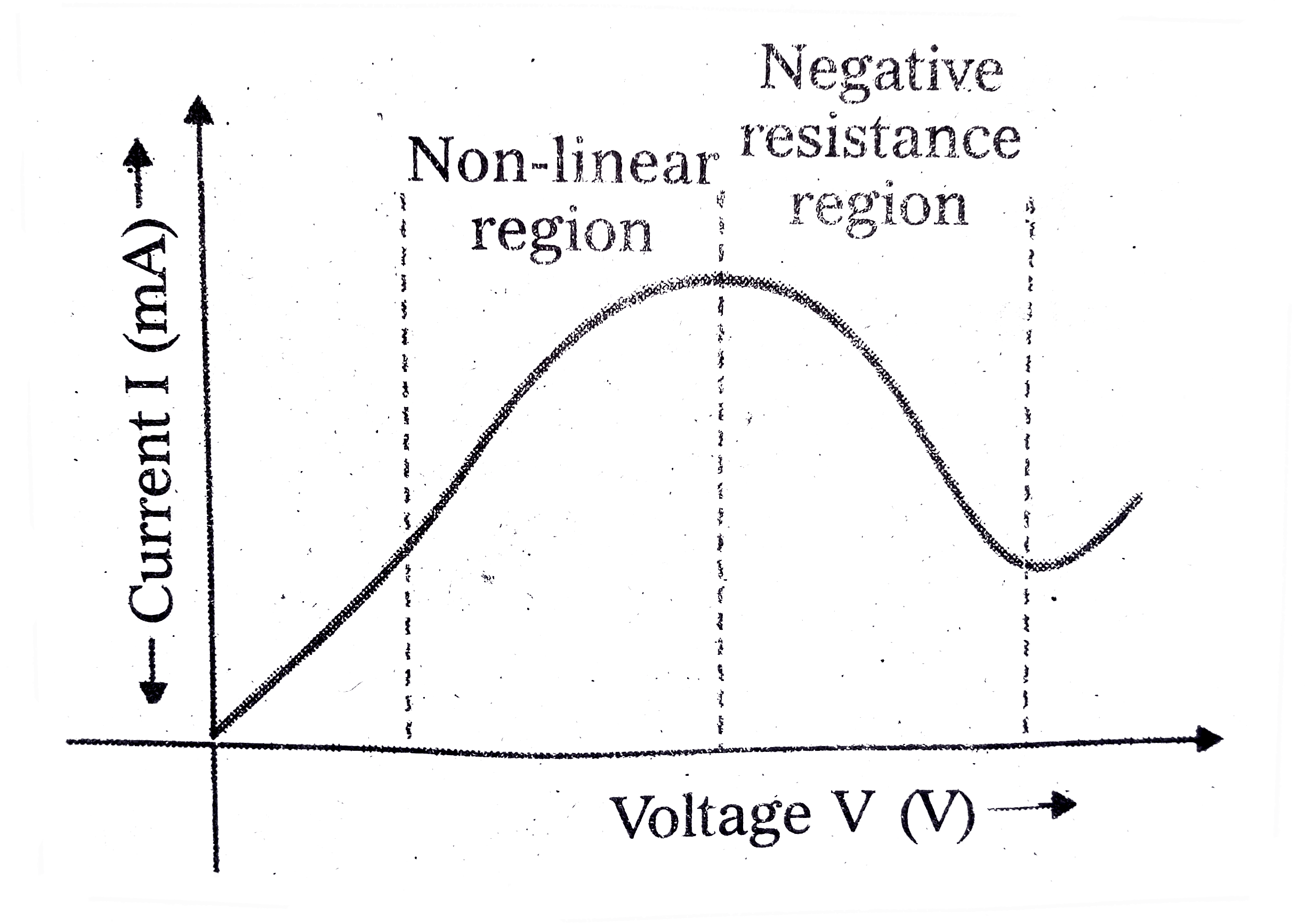
|
|
| 49. |
Consider the following statements A and B and identify the correct choice of the given answers (A): The width of the depletion layer in a P-n junction diode increases in forward bias (B) : In an intrinsic semi conductor the fermienergy level is exactly in the middle of the forbidden gap |
|
Answer» A is true, B is FALSE |
|


