

Saved Bookmarks
This section includes 7 InterviewSolutions, each offering curated multiple-choice questions to sharpen your Current Affairs knowledge and support exam preparation. Choose a topic below to get started.
| 1. |
The self - inductance of a coil having 200 turns is 10 milli henry. Calculate the magnetic flux through the cross-section of the coil corresponding to current of 4 milliampere. Also determine the total flux linked with each turn. |
|
Answer» Solution :Total magnetic FLUX linked with the COIL, `N PHI = LI = 10^(-2) XX 4 xx 10^(-3) = 4 xx 10^(-5) Wb` ` therefore `Flux per turn `phi = (4 xx 10^(-5))/(200) = 2 xx 10^(-7) Wb` |
|
| 2. |
What is depletion barrier? |
|
Answer» Solution :DUE to diffusion of charge carriers in p-n JUNCTION, the number of electron decreases in the n-section and the number of electron in p-section increases so that potential difference across junction is developed. The polarity of this potential is such as to oppose further flow of carriers so that a condition of EQUILIBRIUM exists.  Figure shows the p-n junction at equilibrium and the potential across the junction. The n-material has lost electrons and p-materialshas acquired electrons. This potential tends to prevent the movement of electron from the n-REGION into p-region it is called a barrier potential. This barrier is obtained in the depletion region, hence it is also called depletion barrier. |
|
| 3. |
A solid which is transparent to visible light an whose conductivity increases with temperatureis formed by …….. |
|
Answer» IONIC bonding |
|
| 4. |
If magnification of a telescope in relaxed state is 19 and length of telescope is 100 cm, then calculate the focal length of objective and eye piece. |
|
Answer» `f_0 = 80` CM and `f_e = 20` cm |
|
| 5. |
As shown in figure, there is a thick spherical shell with the walls coated with 'lamp black'. A point source which generates thermal energy at a constant rate 'P' is placed at the centre S of the shell. Derive an expression for the temperature T at point M in steady state, where SM = 1.5 R. Your expression would be as follows :T = ((P)/(sigma16piR^(2)))^(1//4)+((P)/(3xxpiKR)) Here K is the coefficient of thermal conductivity of material of shell and sigma is Stefan's constant. Find the value of x. |
|
Answer» <P> `dR=(dr)/(k4pir^(2))` `R_(EQ)=(1)/(4pik)underset(r)OVERSET(2R)(int)(dr)/(r^(2)),""R_(eq)=-(1)/(4pik)[(1)/(r)]^(2R)` `R_(eq)=-(1)/(4pik)[(1)/(2R)-(1)/(r )]=(1)/(4pik)((1)/(r)-(1)/(2R))=((2R-r))/(8pikRr)` `P=((T-T_(S))8pikRr)/((2R-r))=(T-T_(S))(24Rpik)` `T=T_(S)+((P)/(24Rpik))=((P)/(16pisigmaR^(2)))^((1)/(4))+((P)/(24Rpik))` `x=8` |
|
| 6. |
A long straight cable of length l is placed symmetrically along z - axis and has radius a(lt lt l). The cable consists of a thin wire and a co-axial conducting tube.An alternating current thin wire and returns along the coaxial conducting tube.The induced electricfield at a distance s from the wire inside the cable is vec(E )(s, t)=mu_(0)I_(0)v cos (2pi vt) ln((s)/(a))hat(k)Compare the conduction current I_(0) with the displacement current I_(0)^(d). |
|
Answer» Solution :Displacement current, `I_(d)=(a)/(2)((pi a)/(lambda))^(2)I_(0)SIN(2pi vt)=I_(0)^(d)sin(2pi vt)` so `I_(0)^(d)=(a)/(2)((pi a)/(lambda))^(2)I_(0)` `=((a pi )/(lambda))^(2)I_(0)xx ((a)/(2))` `therefore (I_(0)^(d))/(I_(0))=(((a pi)/(lambda))^(2)I_(0)xx ((a)/(2)))/(I_(0))` `=(a)/(2)((a pi)/(lambda))^(2)` `=(a^(3)pi^(2))/(2 lambda^(2))` Hence required ratio `(I_(0)^(d))/(I_(0))=(a^(3)pi^(2))/(2lambda^(2))` |
|
| 7. |
In a Young double slit interference experimentthe fringes pattern is observed on a screen placed at a distanceD from the slits . The slits areseparatedby a distance d and are illuminated by monochromaticlight of wavelength lambda. Find the distance from the central point where the intensity fallsto(a) half the maximum(b) on fourthof the maximum. |
|
Answer» `(Dlambda)/(4D),(Dlambda)/(3D)` |
|
| 8. |
In ...... atomic model there is continuous distribution of mass. |
|
Answer» THOMSON |
|
| 9. |
When the plane of the armature of an ac. generator is parallel to the field , in which it is rotating |
|
Answer» both the flux linked and induced EMF in the COIL AREA zero |
|
| 10. |
Two identical pith balls each of mass .m. holding charge .q. each are suspended by silk threads of equal length from same point. They move apart due to repulsion. If the separation between the two balls is 2x and each string makes small angle theta to the vertical, |
Answer» Solution : From fig `T cos theta = mg, T sin theta = F` `(F)/(mg) = tan theta = (x)/(sqrt(1^(2)-x^(2)))` If `theta` is small `Tantheta = sin theta ~~ theta = (x)/(1), (F)/(mg) (x)/(1)` Where `F= (1)/(4pi in_(0))(q^(2))/(4x^(2)) rArr (q^(2))/(16pi in_(0)x^(2) mg) = (x)/(1)` `rArr x= ((q^(2)1)/(16pi in_(0)mg))^(1//3)` `rArr` Tension in the string `T= sqrt(F^(2) + (mg)^(2))` In the above CASE if the BALLS are suspended in a liquid of density `rho` and the distance between the balls remains the same, then `(F)/(mg) =(F^(1))/(mg^(1)) rArr (F)/(F^(1)) = (mg)/(mg^(1)) rArr (mg)/(mg(1-(rho)/(d)))( because k = (F_(a))/(F_(m)))` `rArr (1- (rho)/(d)) = (1)/(K) or K = (d)/((d-p))` (d is density of material of the ball) `rArr` In the above case if the charges on teh two balls are different and the angles made by those two STRINGS to the VERTICAL are `theta_(1) and theta_(2)` respectively, then `theta_(1) = theta_(2)` (as F, mg are same ) if `m_(1) gt m_(2) " then " theta_(1)lt theta_(2)` `rArr` In the above application if the whole setup is kept in an artifical satellite (in zero gravity region) the angle between the two strings is `180^(@)` and tension in each string is `(1)/(4pi in_(0))(q^(2))/(41^(2))` |
|
| 11. |
Define 'magnetic declination' at a place on earth. |
| Answer» Solution :It is the angle subtended by the MAGNETIC MERIDIAN at that PLACE from the direction of GEOGRAPHICAL meridian. | |
| 12. |
It is not convenient to use a spherical Gaussian surface to find the electric field due to an electric dipole using Gauss.s theorem because: |
|
Answer» Gauss.s LAW FAILS in this case |
|
| 13. |
A long straight cable of length l is placed symmetrically along z - axis and has radius a(lt lt l). The cable consists of a thin wire and a co-axial conducting tube.An alternating current thin wire and returns along the coaxial conducting tube.The induced electricfield at a distance s from the wire inside the cable is vec(E )(s, t)=mu_(0)I_(0)v cos (2pi vt) ln((s)/(a))hat(k)Calculate the displacement current density inside the cable. |
|
Answer» Solution :Induced electric field at distance s (which is less then radius of coaxial cable) `vec(E )(s, t)=mu_(0)I_(0)v cos (2pi v t)ln ((s)/(a)) hat(K)` Now displacement current density. `J_(d) =in_(0)(dE)/(DT)` `= in_(0)(d)/(dt)[mu_(0)I_(0)v cos (2pi vt)ln((s)/(a))hat(k)]` `= in_(0)mu_(0)I_(0)v(d)/(dt)[cos (2pi v t) ln ((s)/(a))hat(k)]` `=(1)/(c^(2))I_(0)v^(2)xx 2pi[-sin (2pi vt)ln((s)/(a))hat(k)] "" [because mu_(0)in_(0) =(1)/(c^(2))]` `therefore J_(d)=+(n^(2))/(c^(2))xx 2pi_(0)sin(2 pi v t)ln ((a)/(s))hat(k) "" [because ln.(S)/(a)=-ln.(a)/(S)]` `=(1)/(lambda^(2))xx 2pi_(0)ln((a)/(s))sin(2pi vt)hat(k) "" [because lambda = (c )/(v)]` `therefore J_(d) = (2pi I_(0))/(lambda^(2))ln ((a)/(s))sin(2pi v t)hat(k) ""` .....(1) |
|
| 14. |
A long straight cable of length l is placed symmetrically along z - axis and has radius a(lt lt l). The cable consists of a thin wire and a co-axial conducting tube.An alternating current thin wire and returns along the coaxial conducting tube.The induced electricfield at a distance s from the wire inside the cable is vec(E )(s, t)=mu_(0)I_(0)v cos (2pi vt) ln((s)/(a))hat(k)Integrate the displacement current density across the cross - section of the cable to find the total displacement current I^(d). |
|
Answer» Solution :`I_(d)=INT J_(d)sds d theta` `= int_(s=0)^(s=a) J_(d) sds int_(0)^(2pi)d theta` `= int_(s=0)^(s=a) J_(d)sds xx 2pi [because int_(0)^(2pi)d theta = [theta]_(0)^(2pi) = 2pi]` `int_(s=0)^(a)[(2pi)/(lambda^(2))I_(0)LN ((a)/(s))sds sin(2pi vt)hat(k)]xx 2pi ""` [From equation (1)] `=((2pi)/(lambda))^(2)(I_(0)int_(s=0)^(a)ln((a)/(s))sds)sin(2pi vt)hat(k)` `=((2pi)/(lambda))^(2)I_(0)[int_(s=0)^(a)ln((a)/(s))(1)/(2)d(s)^(2)]sin (2pi vt)hat(k)` `=(a^(2))/(lambda)((2pi)/(lambda))^(2)I_(0)[sin (2pi vt)hat(k)] "" {int_(s=0)^(a)[ln((a)/(s)).d((s)/(a))^(2)]ds}` `=(a^(2))/(2)((2pi)/(lambda))^(2)I_(0)sin 2pi v t hat(k)xx(-(a)/(4)) "" {because int_(s=0)^(a)[ln((s)/(a))d((s)/(a))^(2)]ds=-(a)/(4)}` `therefore I_(d)=-(a^(3))/(8)((2pi)/(lambda))^(2)I_(0)sin(2pi vt)hat(k)` `=-(a)/(2)xx(a^(2))/(4)((2pi)/(lambda))^(2)sin (2pi vt)hat(k)` Negative sign shows that displacement current is in opposite direction of CONDUCTION current. Hence `(a)/(2)((2pi a)/(2lambda))^(4)I_(0)sin(2pi vt)hat(k)` `I_(d)`is in negative z - direction and`I_(c )` is in position z - direction. |
|
| 15. |
A whistle revolves in a circle with angular speed 0 = 20 rad/sec using a string of length 50 cm. If the frequency of sound from the whistle is 385 Hz, then what is the minimum frequency heard by an observer which is far away from the centre? (velocity of sound = 340 m/s) |
|
Answer» 385 Hz The MINIMUM frequency will be heard by the observer when the linear velocity of the whistle (source) will be in a direction as shown in the figure, i.e. when the source is receding.  The APPARENT frequency heard by the observer is then given by `u. = v (V/(V+v))` where, V and v are the velocities of sound and source respectively and v is the actual frequency. Now, `v. = 385 xx 340/(340 + 10) = 374 Hz` |
|
| 16. |
Mrs Rajlakshmi had a sudden fall and was thereafter unable to stand striaight . She was in great pain Her daughter Rita took her to the docter . The docter took a photograph of Mrs . Rajlakshmi 's bones and found that she had suffered a fracture . He advisedher to rest and take the required treatment.(a)Write two valuesdisplayed by Rita .(b) Mention the range of the wavelength of this electromagnetic radiation.( c) How is this radiation produced ?(d)Name the electromagnetic radiation used to take the photograph of the bones. |
|
Answer» Solution :(a)Rita has concern for her mother . She has general awareness . Shecares her mother. (b)The range of wave length ofX-rays varies from10 hm to`10^(-4)` hm. (c) X - rays are PRODUCED by bombarding a target of HIGH atomicnumber (z) with a BEAM offast moving electrons. (d)X Rays. |
|
| 17. |
For an ideal gas with initial pressure and volume P_(i)"and " V_(i), respectively, a reversible isothermal expansion happers, when its volume becomes V_(0). Then it is compressed to its original volume V_(i)by a reversible adiabatic process. If the final pressure is P_(f), then which of the following statement is true? |
|
Answer» `P_(f) = P_(i)` `P_(0)` is the pressure of the gas corresponding to volume `V_(0) `. For adiabatic compression , `P_(0) V_(0)^(gamma) = P_(f)V_(i)^(gamma)` …..(II) or , `(P_(i)V_(gamma))/V_(0)xx V_(0)^(gamma) = P_(f) V_(i)^(gamma) " or , " P_(i)/P_(f) = (V_(i)/V_(0))^(gamma -1) ` Since , `V_(i) lt V_(0) " so " P_(f) gt P_(i) ` |
|
| 18. |
On the basis of dimensions decide, which of the following relations for the displacement of a particle executing S.H.M is incorrect ? |
|
Answer» `y=asin((2pit)/(T))` `:.(c )` is correct. |
|
| 19. |
A.S.H.M. oscillator has period of 0.1 s and amplitude of 0.2 m. The maximum velocity is given by : |
|
Answer» `100" m s"^(-1)` and `v_("max")=r omega`. `v_("max")=0.2xx(2pi)/(0.1)=4pi" m"//"s"` So the correct choice is (B). |
|
| 21. |
Find the radiation pressure of solar radiation on the surface of the earth . Solar constant is 1.4xx10^(3)Wm^(-2) : |
|
Answer» `4.7xx10^(-5)` Pa |
|
| 22. |
A carbon resistance has coloured strips as shown in figure. What is its resistance? |
Answer» Solution :The CARBON resistor shown in the figure has STRIPS of various colours on its SURFACE. Yellow indicates the 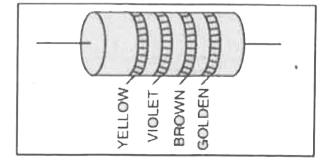 Number 4, VIOLET indicates 7, brown denotes `10^(1)`. Thus the value of the resistance of the carbon resistor is `47xx10^(1)` or `470ohm`. golden colour indicates 5% tolerance in its value. `therefore R=470Omegapm5%Omega` |
|
| 23. |
In the question number 59, the value of velocity of therevolving electron is |
|
Answer» `1.2xx10^6ms^(-1)` Here, `e=1.6xx10^(-19)C,m=9.1xx10^(-31)KG,r=5.3xx10^(-11)m`and `4piepsilon_0=(1)/(9XX10^(9))N^(-1)m^(-2)C^(2)` `therefore v=(1.6xx10^(-19))/sqrt((1)/(9xx10^(9))xx9.1xx10^(-31)xx5.3xx10^(-11))` `=2.2xx10^6ms^(-1)`. |
|
| 24. |
A particle that carries a charge ‘-q’ is placed at rest in uniform electric field 10 N/C. It experiences a force and moves. In a certain time ‘t’, it is observed to acquire a velocity 10hati - 10hatj m/s. The given electric field intersects a surface of area1 m^2 in the x-z plane. Find the Electric flux through the surface. |
|
Answer» Solution :Force on CHARGE `BAR(F)=qbar(E)` `:.` particle moves opposite to `bar(E )` with `vec(V)` UNIT vector in the direction of `bar(V)` is `(bar(i))/(sqrt2) - (barj)/(sqrt2)` unit vector in the direction of `barE` is `(bari)/(sqrt2) - (barj)/(sqrt2)` `bar(E) = 10 [(-i)/(sqrt2) + j/(sqrt2)] ` ie., `barA = 1 xx barj` Electric FLUX `phi = barE . barA = 5sqrt(2) Nm^2//C` |
|
| 25. |
The magnetic induction due to a bar magnet at an axial point is directed along the axis |
|
Answer» From S POLE to N pole |
|
| 26. |
Derived force on moving charge in uniform magnetic field with velocity vecv_. |
|
Answer» SOLUTION :1. CURRENT induced from moving charge q with velocity `VECV` form uniform sectional wire, `I=nAvq` `thereforeIdvecl=nAvqdvecl` 2. Magnetic force acting on `Idvecl` SMALL current carrying element in uniform magnetic FIELD `vecB` is given as, `dvecF=IdveclxxvecB` `=nAvecvqdlxxvecB` `thereforedvecF=nAqdl(vecvxxvecB)""...(1)` but nAdl = number density of charge in dl element. 3. Magnetic force on q electric charge, `vecF_(m)=(dvecF)/(nAdl)=(nAdlq(vecvxxvecB))/(nAdl)` `thereforevecF_(m)=q(vecvxxvecB)` |
|
| 27. |
The capacitor plates are fixed on an inclined plane and connected to a battery of emf E. The capacitor plates have plate area a, length l, and the distance between themis d. A dielectric constant K is inserted into the capacitor and tied to mass M by a massless string as shown in the figure Find the value of M for which the slab will stay in equilibriu. There is no friction between slab and plates. |
|
Answer» `m/2 + (E^2epsilon_0A(k-1))/(2lgd)` `T=MG` And `T=F+sin30^(@)` or `Mg=F+(Mg)/(2)` or `m=(m)/(2)+(F)/(g)=(m)/(2)+(E^(2)epsilonA(K-1))/(2lgd)` 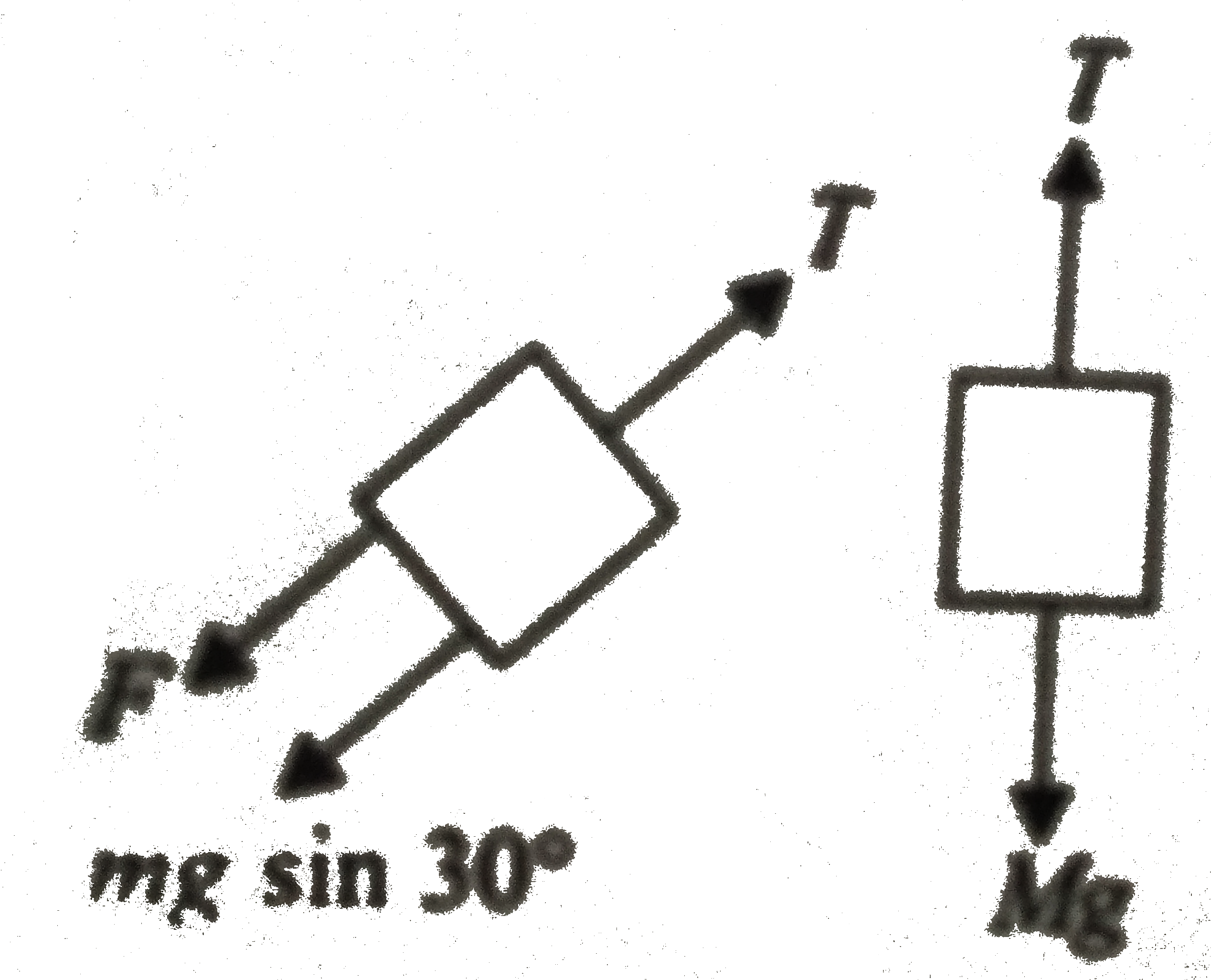
|
|
| 28. |
Which is greater : the angular speed of the earth's rotation or that of the hour hand of a clock? |
|
Answer» SOLUTION :If `omega_1 " and " omega_2` are the RESPECTIVE angular SPEEDS of the hour hand and the earth about its axis. `omega_1/omega_2=(2pi//T_1)/(2pi//T_2)=T_2/T_1=24/12=2` |
|
| 29. |
(A) : A light beam or a radio beam of same intensity will have same values of vecE and vecB (R) : A light beam or a radio beam of same intensity will have different values of vecE and vecB |
|
Answer» Both 'A' and 'R' are TRUE and 'R' is the correct EXPLANATION of 'A'. |
|
| 30. |
In Young's double slit experiment the two slits 0.15mm apart are illuminated by monochromatic light of wavelength 450nm. The screen is 1.0m away from the slits. (a) Find the distance of the second (i) bright fringe, (ii) dark fringe from the central maxima. (b) How will the fringe pattern change if the screen is moved away from the slits ? |
|
Answer» Solution :(a) Distance of `n^(th)` maxima from central maxima `x_(n)=(nlambdaD)/(d)`, where `, n=0`,`+-1`, `+2`…… Given : `n=2, d=0.15mm, lambda=450nm` and `D=1.0m` `x_(2)=(2xx450xx10^(-9)xx1.0)/(0.15xx10^(-3))=6XX10^(-3)m=6mm` (b) Distance of `n^(th)` minima from central maxima `y_(2)=((2n-1)lambdaD)/(2D)=((2xx2-1)450xx10^(-9))/(2xx0.5xx10^(-3))` `=4.5=10^(-3)m=4.5mm` When the screen is moved AWAY from the slits fringes become FARTHER apart. ( `:.` Fringe width `prop` distance of screen). |
|
| 31. |
A stuntwoman (mass=60kg) scales a 20-meter-tall rock face. What is her gravitational potential energy (relative to the ground)? |
|
Answer» Solution :Calling the GROUND b=0, we find `U_("GRAV")=MGH=(60kg)(10N//kg)(20m)=12,000J` |
|
| 32. |
For making any neutral body positively charged, we have to...... |
|
Answer» DEPOSIT ELECTRONS on its surface. |
|
| 33. |
Electromagnetic induction is not used in |
|
Answer» speedometer |
|
| 34. |
A number of identical light bulbs are connected to a battery. Will the brightness of bulbs increases or decreases when more bulbs areconnected in a parallel connection ? Will the battery last longer after connecting more bulbs ? |
|
Answer» Solution :In the parallel COMBINATION of light bulbs, connecting more bulbs in parallel will not affect the brightness of bulbs as VOLTAGE across each BULB still remains same and hence current `I=V/R`, drawn by each bulb will REMAIN same. but the battery will drain faster in this case as additions current needs to be supplied by the battery in extra parallel BRANCHES in which more light bulbs are added. |
|
| 35. |
Define radioactive decay constant. |
| Answer» SOLUTION :The DECAY constant of radioactive substance is defined as the RECIPROCAL of that time in which the NUMBER of atoms of substance BECOMES `1/(e^(th))` times the atoms present initially. | |
| 36. |
An object of mass 0.5 kg, moving in a circular path of radius 0.25m, experiences a centripetal acceleration of constant magnitude 9 m//s^(2). What is the object's angular speed? |
|
Answer» `2.3rad//s` `a_(c)=(v^(2))/(r)=((romega)^(2))/(r)=OMEGA^(2)r IMPLIES omega=sqrt((a_(c))/(r))=sqrt((9m//s^(2))/(0.25m))=6s^(-1)` |
|
| 37. |
An electron is moving with a velocity (2 hat(i) + 2hat(j))m//s is an electric field of intensity vec(E )= hat(i) + 2hat(j)- 8 hat(k) V//m and a magnetic field of vec(B)= (2 hat(j) + 3hat(k)) tesla. The magnitude of force on the electron is |
|
Answer» `14.4 xx 10^(-19)N` Electric field `= vec(E )= hat(i) + 2hat(j) - 8hat(k) V m^(-1)` Magnetic field `= vec(B) = 2hat(j) + 3HAT(k) T` `:.` The Lorentz FORCE is `vec(F) = q (vec(E ) + vec(v) xx vec(B))` `=(-1.6 xx 10^(-19)) [hat(i) + 2hat(j) -8hat(k) + (2hat(i) + 2hat(j)) xx (2hat(j) + 3hat(k))]` `=(-1.6 xx 10^(-19)) [hat(i) + 2hat(j) - 8hat(k) + 4hat(k) - 6hat(j) + 6hat(i)]` `=(-1.6 xx 10^(-19)) [7 hat(i) - 4hat(j) - 4hat(k)]` `|vec(F)| = 1.6 xx 10^(-19) xx 9 = 14.4 xx 10^(-19)N` |
|
| 38. |
A wheel with 10 metallic spokes, each 0.50 m long, is rotated with a speed of 120 rev/minute in a plane normal to the earth's magnetic field at the place. If the magnitude of the field is 0.40 gauss, what is the induced emf between the axle and the rim of the wheel? |
|
Answer» Solution :f= 120 rev/min= 2 rev/second, B= 0.40 gauss `= 0.4 xx 10^(-4)T`, Area swepty, by each spoker per second, `A= pi r^(2)f` Magnetic FLUX CUT by each spoke per second, `(d phi_(B))/(dt)= BA = B pi r^(2)f` INDUCED EMF, `e= B pi r^(2)f` (numerically) `e= 0.4 xx 10^(-4) xx (22)/(7) xx 0.5 xx 0.5 xx 2` `e= 6.29 xx 10^(-5)` volt |
|
| 39. |
The relation between n_(1) and n_(2), if behaviour of light rays is as shown in figure is : |
|
Answer» `n_(1)GT gt n_(2)` |
|
| 40. |
The number densities of electrons and holes in pure Si at 27^(@)Cis 2xx10^(16)m^(-3). When it is doped with indium, the hole density increases to 4xx10^(22)m^(-3), find the electron density in doped sillicon. |
|
Answer» Solution :For extrinsic or doped semiconductor `n_(e).n_(h)=n_(i)^(2) RARR n_(e)=(n_(i)^(2))/(n_(h))` Here, `n_(i)=2XX10^(16)m^(-3) and n_(h)=4XX10^(22)m^(-3)` `rArr""n_(e)=((2xx10^(16)m^(-3))^(2))/(4xx10^(22)m^(-3))=10^(10)m^(-3)` |
|
| 41. |
The block shown in the figure is in equilibrium in a liquid and one end of the spring is connected to the base of the vessel. Now the vessel is made to fall freely under gravity. The length of the spring from the equilibrium situation may: |
|
Answer» Increase SPRING can be in the state of extension, COMPRESSION, or natural length in EQUILIBRIUM. |
|
| 42. |
Read the following passage and then answer questions on the basis of your under standing of the passage and the related studied concepts. Passage: For an LCR series circuit driven with an alternating voltage of amplitude Vmand angular frequency oo, the current amplitude is given as I_(m) =V_(m)/z = V_(m)/sqrt(R^(2) + (X_(L)-X_(C))^(2)) =V_(m)/sqrt(R^(2) + (Iomega -1/(c omega))^(2)) If omega is varied then for a particular frequency omega_(0), X_( C) = X_(L) and then Z = R and hence, I_(m) = V_(m)/R is maximum. This frequency is called the resonant frequency. The resonant frequency omega_(0) = 1/sqrt(LC) = Resonance of a LCR series a.c. circuit is said to be sharping current amplitude Im falls rapidly on increasing/decreasing the angular frequency from its resonant value 0. Mathematically, sharpness of resonance is measured by the quality factor of the circuit, which is given as: Q = (omega L)/R = 1/R sqrt(L/C) (b) How does impedance of the circuit changes with omega |
| Answer» SOLUTION :Variation of impedance Z with `OMEGA` is shown here. | |
| 43. |
The speed of a certain monochromatic light, in a given transparent medium, is 2.25xx10^(8)ms^(-1). What is the (a) critical angle of incidence, (b) polarising angle for this medium ? |
|
Answer» Solution :(a) As per QUESTION speed of light in given medium `V=2.25xx10^(8)ms^(-1)` and we know that the speed of light in free space `c=3xx10^(8)ms^(-1)` `therefore `Refractive index of medium `n=(c)/(v)=(3xx10^(8))/(2.25xx10^(8))=(4)/(3)` `therefore` CRITICAL angle `i_(c)=SIN^(-1)((1)/(n))=sin^(-1)((3)/(4))=48.6^(@)` (b) The polarising angle `i_(p)=tan^(-1)(n)=tan^(-1)((4)/(3))=53.1^(@)`. |
|
| 44. |
The size of the image of an object,which is at infinity, as formed by a convex lens of focal length 20 cm is placed between the convex lens and the image at the distance of 26 cm from the convex lens, the new size of the image is |
|
Answer» `1.25` cm `I_(1)` acts as VIRTUAL object for CONCAVE lens. Concave lens forms the image of `I_(1)` at `I_(2)`.  Lens formula : `(1)/(v)-(1)/(u)=(1)/(f)` For concave lens, `(1)/(v)-(1)/(4)=-(1)/(20)` or `(1)/(v)=-(1)/(20)+(1)/(4)=(4)/(20)=(1)/(5)` or v= `5` cm = distance of `I_(2)` from concave lens. `:. " magnification of concave lens" =(v)/(u)=(5)/(4)=1.25` As size of image at `I_(1)` is `2` cm, therefore size of image at `I_(2)xx1.25=2.5` cm |
|
| 45. |
Read the following passage and then answer questions on the basis of your under standing of the passage and the related studied concepts. Passage: For an LCR series circuit driven with an alternating voltage of amplitude Vmand angular frequency oo, the current amplitude is given as I_(m) =V_(m)/z = V_(m)/sqrt(R^(2) + (X_(L)-X_(C))^(2)) =V_(m)/sqrt(R^(2) + (Iomega -1/(c omega))^(2)) If omega is varied then for a particular frequency omega_(0), X_( C) = X_(L) and then Z = R and hence, I_(m) = V_(m)/R is maximum. This frequency is called the resonant frequency. The resonant frequency omega_(0) = 1/sqrt(LC) = Resonance of a LCR series a.c. circuit is said to be sharping current amplitude Im falls rapidly on increasing/decreasing the angular frequency from its resonant value 0. Mathematically, sharpness of resonance is measured by the quality factor of the circuit, which is given as: Q = (omega L)/R = 1/R sqrt(L/C) (a) (a) Draw graphs showing variation of current amplitude of a LCR series circuit with frequency w of driving omega lt omega_(0) , alternating voltage. |
Answer» SOLUTION :(a) REQUISITE GRAPHS as SHOWN in FIG. 
|
|
| 46. |
In equation y=2acos2pix/lambdasin26pict/lambda. The positions of antinodes are |
|
Answer» x=0 |
|
| 47. |
Read the following passage and then answer questions on the basis of your under standing of the passage and the related studied concepts. Passage: For an LCR series circuit driven with an alternating voltage of amplitude Vmand angular frequency oo, the current amplitude is given as I_(m) =V_(m)/z = V_(m)/sqrt(R^(2) + (X_(L)-X_(C))^(2)) =V_(m)/sqrt(R^(2) + (Iomega -1/(c omega))^(2)) If omega is varied then for a particular frequency omega_(0), X_( C) = X_(L) and then Z = R and hence, I_(m) = V_(m)/R is maximum. This frequency is called the resonant frequency. The resonant frequency omega_(0) = 1/sqrt(LC) = Resonance of a LCR series a.c. circuit is said to be sharping current amplitude Im falls rapidly on increasing/decreasing the angular frequency from its resonant value 0. Mathematically, sharpness of resonance is measured by the quality factor of the circuit, which is given as: Q = (omega L)/R = 1/R sqrt(L/C) (d) How is a resonant circuit is utilised to tune a TV set at a particular channel ? |
| Answer» Solution : SIGNALS of DIFFERENT TV stations are received at different frequencies. The antenna of a TV set RECEIVES these signals and DRIVES a current in the TUNING circuit. However, only the signal corresponding to the resonant frequency is able to drive appreciable current and is further processed. When we tune a TV, we change the capacitance of the tuning circuit and hence the resonant frequency changes. When this frequency matches with the frequency of the signal from the desired TV channel, the tuning is complete. | |
| 48. |
What are ground waves? |
| Answer» Solution :These are radio waves which propagate ALONG the SURFACE of the EARTH. | |
| 49. |
Read the following passage and then answer questions on the basis of your under standing of the passage and the related studied concepts. Passage: For an LCR series circuit driven with an alternating voltage of amplitude Vmand angular frequency oo, the current amplitude is given as I_(m) =V_(m)/z = V_(m)/sqrt(R^(2) + (X_(L)-X_(C))^(2)) =V_(m)/sqrt(R^(2) + (Iomega -1/(c omega))^(2)) If omega is varied then for a particular frequency omega_(0), X_( C) = X_(L) and then Z = R and hence, I_(m) = V_(m)/R is maximum. This frequency is called the resonant frequency. The resonant frequency omega_(0) = 1/sqrt(LC) = Resonance of a LCR series a.c. circuit is said to be sharping current amplitude Im falls rapidly on increasing/decreasing the angular frequency from its resonant value 0. Mathematically, sharpness of resonance is measured by the quality factor of the circuit, which is given as: Q = (omega L)/R = 1/R sqrt(L/C) (c) What is the nature of reactance in the circuit when (i) omega lt omega_(0)and (ii) omega gt omega_(0) ? |
|
Answer» Solution :(i) For `omega LT omega_(0)`, the net reactance of the circuit is capacitor in nature because for `omega lt omega_(0), X_( C) = (1/(C omega))` is greater than `X_(L) = (L omega)` (II) For `omega gt omega_(0)` , the net reactance is inductance in nature because now `X_(L) gt X_( C)`. |
|
| 50. |
Consider a current carrying wire (Current l) in the shape of a circle. Note that as the current progresses along the wire, the direction of current density vecj changes in an exact manner,while the current j remains unaffected the agent that is essentially responsible for it is |
|
Answer» source of emf |
|