

Saved Bookmarks
This section includes InterviewSolutions, each offering curated multiple-choice questions to sharpen your knowledge and support exam preparation. Choose a topic below to get started.
| 39901. |
If a bimetallic strip made of iron and copper is heated ,then |
|
Answer» it GETS twisted |
|
| 39902. |
A police caar moving at 22 m .s^(-1)chases a motor cycle . The man in the car sounds his horn at 170 Hz while both of them move towards a stationary siren of frequency 165 Hz . Calculate the speed of motor cycle if the motor cyclist does not listen any beat . |
|
Answer» |
|
| 39903. |
Each of two men A and B is carrying a source of sound of frequency n . If A approaches B with a velocity u how many beats per second will be heard by B ? (Velocity of sound = c) |
|
Answer» Solution :Apparent frequency , n. ` (C + u_(0))/(c- u_(5)) xx n` The distance between A and B is dacreasing . So , the velocity of the listener ` u_(0) ` and that of the source ` u_(s) ` , are both positive When B is the listener, velocity of the listener, ` u_(0)=0 `, Velocity of the source ` A , u_(s)= u ` So, ` n_(8) = (c) /(c-u) xxn ` Evidently, ` n_(8) GT n` ` therefore ` Number of beats PER SECOND ` therefore ` Number of beats per second ` n_(g) - n = ((c)/(c- u) -1)xx n = (u)/(c-u) n` |
|
| 39904. |
The total mechanical energy of a harmonic oscillator of amplitude 1m and force 200 N"/"m is 150 J. Then |
|
Answer» the minimum PE is zero |
|
| 39905. |
Each of two men A and B is carrying a source of sound of frequency n . If A approaches B with a velocity u how many beats per sound will be heard by A and B |
|
Answer» Solution :APPARENT frequency , n. ` (C + u_(0))/(c- u_(5)) XX n` The distance between A and B is dacreasing . So , the velocity of the listener ` u_(0) ` and that of the source ` u_(s) ` , are both positive When A is the listener, velocity of the listener, ` u_(0) = u` , Velocity of the source ` B , u_(s) = 0 ` So, ` n_(A) = (c + u)/(c) xx n ` Evidently , ` n_(A) GT n` ` thereforeNumber of beats per socond ` = n_(A) - n = ((c + u)/(c) - 1) xx n = u/c n ` . |
|
| 39906. |
If a body coated black at 600K surrounded by atmosphere at 300 K has cooling rate r_(0), the same body at 900 K, surrounded by the same atmosphere, will have cooling rate equal to |
|
Answer» `16/3 r_(0)` `r = {((900)^(4)-(300)^(4))/((600)^(4)-(300)^(4))}r_(0) = 16/3r_(0)` |
|
| 39907. |
A car of weight W is on an inclined road that rises by 100m over a distance if 1 k and applies a constant frictional force (W)/(20)on the car. While moving uphill on the road at a speed of 10 ms^(-1), the car needs power P. If it needs power (P)/(2) while moving downhill at speed v then value of v is |
|
Answer» `20 ms^(-1)` |
|
| 39908. |
The displacement-time relation for a particle can be expressed as, y = 5[cos^2 (4pit) - sin^2 (4 pi t)] . The relation shows that: |
|
Answer» The PARTICLE is executing a SHM with amplitude 5 m |
|
| 39909. |
' It is more important to have beauty in the equations of physics then to have them agree with experiments''. The great British physicist P . A. M. Dirca held this view. Criticize this statement. Look out for some equations and results in this book which strike you as beautiful. |
|
Answer» Solution :The statement of great Dritish Physicist P. A. M. Dirac is partially ture. For example, `F = m a , E= mc^2` are some of the simple and beautiful equations of physics which have universal application. However, this is not the case always. The equations involved in general THEORY of RELATIVITY and some of the latest works of higher Physics are neither simple nor beautiful. They are rather difficult to UNDERSTAND. |
|
| 39910. |
A stone is thrown upwards with a speed y from the top of a tower. It reaches the ground with a velocity 3v. What is the height of the tower? |
|
Answer» Solution :From equation of motion v.`= u + at `….(1) `h = ut + 1/2 at^2` ` v.= av, u = v , a = + g` using EQN (1) 3V = v + gt `rArr` 3v - v = gt ` t=(2v)/(g)` substituting.t. VALUE in eqn (2) `h = v ( (2v)/(g) ) + 1/2 g ( (2v)/(g) )^2 = (2v^2)/(g) + 1/2 g ( (2v)/(g) )^2` ` h = (2v^2)/(g) + (2v^2)/(g)` ` = (4v^2)/(g) "" g = 10 ms^(-2)` ` = (4v^2)/(10) , h = (2v^2)/(5)` |
|
| 39911. |
Obtain the equation of frequency of stationary wave propuced in open pipe and show that all harmonics are possible in it. |
|
Answer» Solution :In open pipe antiodes are produced at both ends and CONSECUTIVE antinodes are obtained at `(lamda)/(2), lamda, (3lamda)/(2), …, (n lamda)/(2)` where,` n = 1,2,3,…` If wavelength is `lamda` for open pipe of length L, then stationary waves will only be produced if `L = ( n lamda )/(2)` `therefore lamda _(n) = (2L)/(n)` Frequency of stationlary waves in open pipe, `(v)/( v _(n )) = (2L)/(n) [ because v = lamda v implies lamda = (v)/(v ) ]` `therefore v _(n) = (nv)/(2L)...(1)` where v is wave SPEED. First 4 harmonics are shown for stationary waves in open pipe in figure,  If wp place `n =1 `in equatin (1), then fundamental or first harmonic is obtained, `therefore v _(2) = (v)/(2L)` Second harmonic is obtained by putting `n =2` in equation (1), `therefore v _(2) = (2v )/( 2L) = v/L OR 2 ((v )/(2L)) = 2v _(1)` Accordingly by putting `n = 3,4 ,...,n` in equation (1), THIRD, fourth, `...n ^(th)` harmonic can be obtained and corresponding (n-1) overtones are obtained. |
|
| 39912. |
The Moon Io orbits jupiter once in 1.769 days. The orbital radius of the Moon Io is 421700 Km. Caculate the mass of jupiter? |
|
Answer» Solution :Kepler.s THIRD law is USED to find the mass of the planet `T^(2) = (4pi^(2))/(GM) (R+h)^(2)` ` M = (4pi^(2))/(GT^(2)) (R+h)^(2)(4(3.14)^(2) xx (421700 xx10^(3))^(2))/(6.67 xx10^(11) xx (1.769xx86400)^(2))` ` = (39.4384 xx 7.499128631xx10^(25))/(6.67xx10^(-11) xx 2.336055469 xx10^(10))` ` = (295.7536 xx10^(25))/(1.5581 ) = 189.8169 xx10^(25)` `M = 1.898 xx10^(27)` kg |
|
| 39913. |
A particle of mass m is moving in a circular path of constant radius r such that its centripetal acceleration a is varying with time t as a = k^(2)rt^(2) where k is a constant. What is the power delivered to the particle by the forces acting on it. |
|
Answer» <P> Solution :`Asa_(c)=(v^(2)//R)so(v^(2)//r)=k^(2)rt^(2)`KINETIC energy `K = (1)/(2) mv^(2) = (1)/(2) mk^(2)r^(2)t^(2)` Now by work - Enetgy Theorem `W=DeltaK=(1)/(2)mk^(2)r^(2)t^(2)-0rArrP=(dw)/(dt)` `RARR P = (d)/(dt) = (1)/(2) mk^(2)r^(2)t^(2) =mk^(2)r^(2)t` |
|
| 39914. |
What is coefficient of static friction? |
| Answer» SOLUTION :Thecoefficientof STATICFRICTION is equaltotangentofthe angleof FRICTION | |
| 39915. |
A wire AB of radius 0.3 mm and length 300 cm is attached to a fixed support at its ends A and it hangs vertically. The wire carries a load 39.2N attached to its mid-point and also another load of 39.2N at its lower end B. IF Y for the material of the wire is 2 times 10^12 dyn.cm^-2, find the elongation of the end B. |
|
Answer» |
|
| 39916. |
In the above diagram m_2 gt gtm_1the acceleration of the cart is xg. Then 'x' is |
|
Answer» |
|
| 39917. |
In the relation dQ=dU+dW, the quantity which remains the same for all process is |
| Answer» Solution :Steeper , an isothermal curve. | |
| 39918. |
In a game of tug-of-war, if both the parties exert a force of T dyn from either side, what will be the tension in the rope? |
| Answer» SOLUTION :TENSION in the ROPE will be T DYN. | |
| 39919. |
Jumping on a cementedfloorreceives more injuries than on the sand given reason |
| Answer» SOLUTION :Jumpingon aconcretecemented floorismoredangerousthanjumpingon thesand.Sandbringsthe BODYTO restslowlythanthe concretefloo, so that THEAVERAGE forceexperiencedby the BODY will belesser. | |
| 39920. |
The mass of an object is (225 +- 0.05) gm calculate percentage error in measurement. |
|
Answer» Solution :mass `m=225+-0.05` Percentage ERROR in mass `=(DELTAM)/(m)XX100%` `=(0.05)/(225)xx100%=0.022%` |
|
| 39921. |
A man pushes a block of 30 kg along a level floor of constant speed with a force directed at 45^(@) below the horizontal. If the ceofficient of friction is 0.2. Then match the following from column-I and Column -II |
|
Answer» |
|
| 39922. |
The rise of water into a capillary tube placed vertically is h. When it is tilted through an angle, the vertical height of water raised will be: |
| Answer» Answer :C | |
| 39923. |
Temperature can be expressed as derived quantity in terms of any of the following |
|
Answer» LENGTH and MASS |
|
| 39924. |
A particle executes SHM of period T and amplitude l along a rod AB of length 2l. The rod AB itself executes SHM of the same period and amplitude in a direction perpendicular to its length. Initially, both the particle and the rod are in their mean position. The path traced out by the particle will be........... |
|
Answer» a circle of radius L The equation of motion of rod AB, `y= l cos (omega t + PHI)` where rod executes angular frequency (periodic time) in y-direction with amplitude of particle. For both, at mean position `t=0" and "x= y=0` then `phi = (pi)/(2)`. `therefore y= l cos (omega t+(pi)/(2))= -l sin omega t"..........."(2)` Frqom equation (1) and (2), `y= -x`, which is the equation to a straight line at angle `(pi)/(4)` to the rod. |
|
| 39925. |
Two masses m_(1) = 4.8 kg and m_(2) = 5 kg tied to a string are hanging over a light frictionless pully. What is the acceleration of masses when they are free to move ? |
|
Answer» 0.2 `m//s^(2)` `m_(2) g - T =m_(2)a ` and Addingthesetwoequations `(m_(2)-m_(1)) g =(m_(1) =m_(2)) a` `a= ((m_(2) - m_(1))/(m_(1) + m_(2))) g `  `=((5-4.8)/( 5+4.8)) 9.8` `=(0.2)/(9.8) xx 9.8` `a= 0.2 m//s^(2)` |
|
| 39926. |
In a clockwise system |
|
Answer» `hatjxxhatj=1` |
|
| 39927. |
A block of ice of mass 50kg is sliding on a horizontal plane. It starts with speed 5ms^(-1) and stop 3 after moving through some distance. The mass of ice that has melted due to friction between the block and the suface is (assuming that no energy is lost nad the surface is (assuming that no energy is lost and latent heat of fustion of ice is 80 calg^(-1)) |
|
Answer» 2.86 G J=4.2J `cal^(-1)` and m=? Heat lost i.e., `Q_(1)` = workd DONE, K = Kinetic energy i.e., `1/2mv^(2)= 1/2 xx50 xx5^(2)`=625 J and heat GAINED i.e., `Q_(2)=m^(')xxL = 80 xxm^(')xx4.2` `THEREFORE` `Q_(1)=Q_(2)` 625 = `m^(') xx 8 xx 42 rArr m^(')=1.86`g |
|
| 39928. |
If a particle is executing SHM on a straight line. A and B are two points at which its velocity is zero. It passes through a certain point P(AP lt PB) at successive intervals of 0.5 sec" and "1.5 sec with a speed of 3 m"/"s. The maximum speed of the particle is |
|
Answer» `3 m"/"s` |
|
| 39929. |
A body is projected horizontally from a height of 78.4 m with a velocity10ms^(-1). Its velocity after 3 second is : (g=10ms^(-2))(Take direction of projection onvec(i) andvertically upward direction onvec(i) ). |
|
Answer» `10 hat(i) - 30 hat(J)` |
|
| 39930. |
Solve the following and express the result to an appropriate number of significant figures. (ii) Subtract 63.54 kg from 187.2 kg |
|
Answer» SOLUTION :`187.2kg-63.54kg=123.66kg` = 123.7 kg (ROUNDED off of FIRST decimal PLACE) |
|
| 39931. |
What type of strain is produced when a spring is stretched? |
| Answer» Solution :When a spring is STRETCHED there is neither CHANGE in the length of the wire forming the coil nor change in its VOLUME. The change TAKES PLACE in the shape of coil producing shear strain. | |
| 39932. |
A block slides down an inclined plane inclination theta with constant velocity. It is then projected up the same plane with an initial velocity mu. How far up the incline will it remove before coming to rest? |
|
Answer» SOLUTION :`MU^(2)/(4gsintheta)` |
|
| 39933. |
A uniform chain of length L is placed on a smooth table of height h (hgtL) with a lenth I hanging from the edge of the table. The chain begins to slide done the table. When the end of the chain is about to level the edge of the table its velocity is |
|
Answer» `SQRT((t(L+l))/L)` |
|
| 39934. |
A man of mass 80kg carrying a load of 20kg walks up a stair case in 20s. If the number of steps is 40 and width and height of each step are 20cm and 15cm respectively. The efficiency of the man is |
|
Answer» 0.2 |
|
| 39935. |
The displacement x of a particle varies with time according to the relation x = a/b (1-e^(-bt)).Then |
|
Answer» At t = 1/6, the DISPLACEMENT of the particle in nearly (1/3) (a/b) |
|
| 39936. |
When 20 J of work was done on a gas, 40J of heat energy was released. If the initial internal energyof the gas was 70J, what is the final internal energy? |
| Answer» Answer :A | |
| 39937. |
a thermodynamic system is taken from the state i to statef along the path iaf. It is found that the heat absorbed by the system is 40 cal and work done by the system is 16.19 cal. Along the path i bf, the heat absorbed is 35 cal. (a) Find the work done along the path i bf. (b) If W = - 10 cal for the curved return path fi, what is for this path ?(c) Take U_(b) = 20 cal, what is U _(f)? (d) If U _(b) = 20cal, what is for the process ib? |
|
Answer» Solution :`1 cal = 4.2` Joule First law of thermodynamilcs is `Delta U = Q - W = U _(f ) - U _(i)` `Q = ( U _(f) - U _(f)) + W` ` Q = 40 cal = 40 xx 4.2` `= 168 J` `W = 16.19 cal` `= 16. 19 xx 4.2 = 68 J` `U _(f) - U _(i) = Q - W` `= 168 - 68 = 100 J` The CHANGE in internal ENERGY between i and f is 100 J, and is independent of the path followed, because U is a point function and not a path function (a) Work done along the path i b f ` W = Q - Delta U` `Q = 35 xx 4.2=147 - 100 = 47 J` (b) For the path `fi, Q = ? W =- 10 cal =- 42 J` `Q = W + ( U_(i)U _(f)) = W - (U _(f) - U _(i)) =0 42 -100 = 0 142 J` (c ) `U _(i) = 8 cal = 8 xx 4.2 = 33.6 J U _(f) = ?` `U _(f) - U _(i) = 100 J` (d) `U _(b) = 20 cal = 20 xx 33.6 = 133. 6 J` `U _(i) = 8 cal = 8 xx 4.2 = 33. 6 J` `DeltaU = U _(b) - U _(i) = 84 - 33. 6 = 50.4 J` The work done for the path ib is same as that for i b f so `W = 47 J `from (a) `Q = DeltaU + W = 50.4 + 47 = 97.4 J` |
|
| 39938. |
If two ships happen to move parallel and close to each other, they experience a force of pull forwards each other. Why? |
| Answer» SOLUTION :When the SHIPS come closer, the velocity of water between them INCREASES (being very narrow gap) and the pressure decreases. But the pressure on theouter SURFACE of each ship greater than this pressure between them. so the shops are pushed TOWARDS each other. | |
| 39939. |
A stone is suspended by a thread from a rigid support. Another thread is attached at the bottom of the stone If the lower thred is pulled suddenly which thread - upperor lawer - does break ? If the lower thread is pulled slowly which thread - upper or lower - does break? |
| Answer» Solution :Lower threadsince the applied force is not TRANSMITTED to the upper THREAD due to inertia . Upper thread SINCE the force applied will be transmitted to the upper thread and the total force on it is the sum of the applied force and the WIEGHT of the stone . | |
| 39940. |
How are metals used as semiconductors refined ? What is the principle of the method used like germanium, silicon etc. ? |
| Answer» SOLUTION :USED in.the CONSTRUCTION of CENTRIFUGAL GOVERNORS. | |
| 39941. |
Three particles each of mass 100g are placed at the vertices of an equilateral triangle of side length 10cm. Find the moment of inertia of the system about an axis passing through the centroid of the triangle and perpendicular to its plane. |
|
Answer» Solution :`m=100g=100xx10^(-3)KG`, side `a=10cm=0.1m` Moment of INERTIA `I=3m^(2)` `=3xx100xx10^(-3)((10)/(sqrt(3)xx10^(-2))^(2)=10^(-3)kkgm^(2)` |
|
| 39942. |
1000 cm^(3) of argon at 27^(@)C is adiabatically compressed so that the temperature is 127^(@)C. Calculate the resulting volume. Given gamma = 5//3. |
|
Answer» |
|
| 39943. |
Two satellites move along a circular orbit in the same direction at a small distance from each other. A container has to be thrown from the first satellite on the second a one. When will the container reach the second satellite earlier, if it is thrown in the direction of motion of the first satellite or in the opposite direction? The velocity of the container is small in comparison to that of the satellite. |
Answer» Solution :If the container is thrown in the direction opposite to the motion of the satellite, it will begin to move along an ellipse (say1) lying inside the circular orbit of the satellites. The period of revolution will be slightly LESS than that of te satellites. Therefore, they can met at the point of CONTACT of the orbits (circular orbit of satellite and the ELLIPTICAL orbit of the container) only after a reat number of revolution. On the other hand, if the container is thrown in the direction of the satellite, the container begins to move along an ellipse, like 2 in the figure. The velocity U should be such that during one revolution of the container, satellite `B` also makes one revolution and in ADDITION covers the distance `AB`. So the container shoud be thrown in the direction of the first satellite. 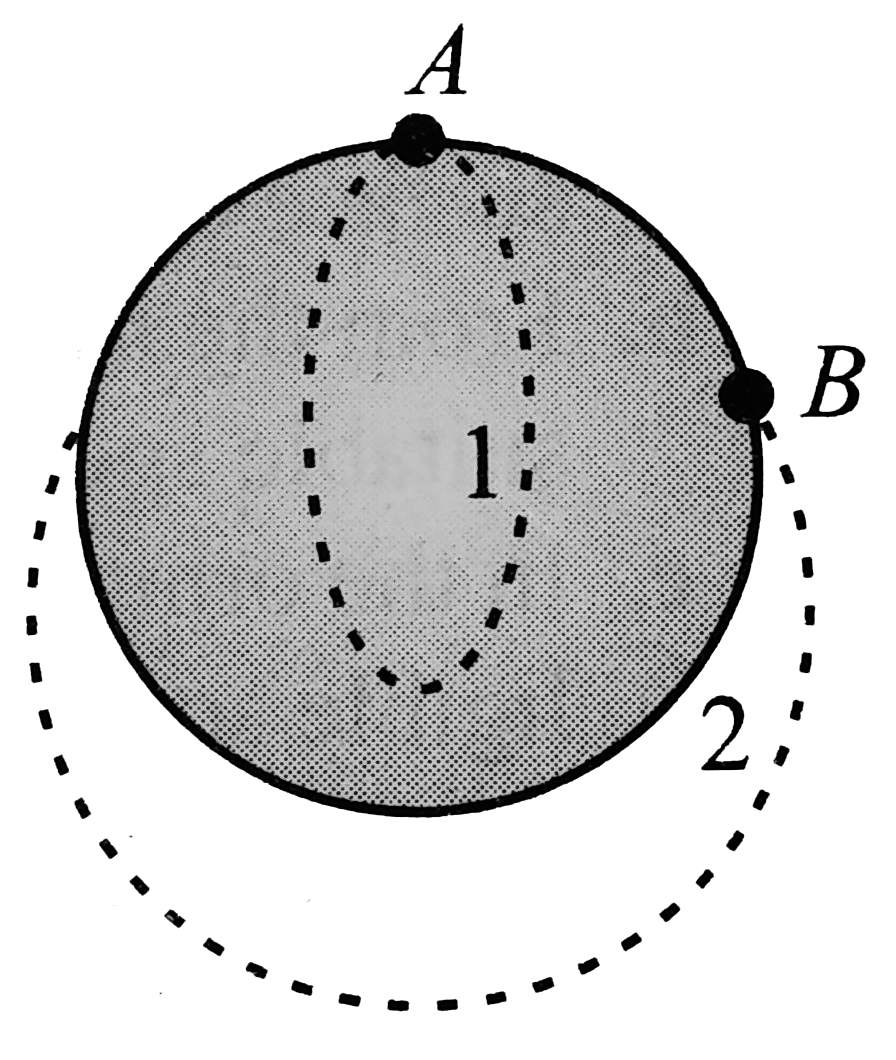
|
|
| 39944. |
Which of the following is the most precise device for measuring length : (a) a vernier callipers with 20 divisions on the sliding scale (b) a screw gauge of pitch 1 mm and 100 divisions on the circular scale. ("c") an optical instrument that can measure length to within a wavelength of light ? |
| Answer» SOLUTION :The MASS of JUPITER is very LARGE | |
| 39945. |
The position x of a particle varies with time t as x = at^2 - bt^3 . The acceleration of the particle will be zero at time t equal to |
|
Answer» `a/b` |
|
| 39946. |
Which of the following graph represents uniform motion |
|
Answer»
|
|
| 39947. |
When two right angled vectors of magnitude 7 units and 24 units combine , what is magnitude of their resultant? |
| Answer» SOLUTION :25 UNITS | |
| 39948. |
Rain drops are falling down ward vertically at 4 kmph. For a person moving forward at 3kmph feels the rain at |
|
Answer» 7 kmph |
|
| 39949. |
One mole of an ideal gas is taken through a cyclic process as shown in the V-T diagram. Which of the following statements is true ? |
|
Answer» The MAGNITUDE of work DONE by the gas is `RT_(0)ln2`. `W_(DA) = RT_(0) ln((2V_(0))/(V_(0))) = RT_(0) ln2` `W_(BC) = R(2T_(0))ln ((V_(0))/(2V_(0))) = -2RT_(0) ln 2` Total work done by the gas is `W = W_(AB) + W_(BC) + W_(CD) + W_(DA)` `= 0 - 2RT_(0) ln 2 + 0 + RT_(0) ln 2 = -RT_(0) ln 2` or `|W| = RT_(0) ln 2` 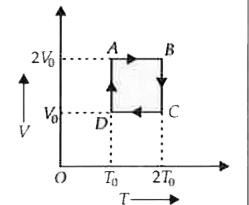
|
|
| 39950. |
A train approaches a stationary observer, the velocity of train being 1/20 of the velocity of sound.A sharp blast is blown with the whistle of the engine at equal intervals of a second.Find the interval between the successive blasts as heard by the observer. |
|
Answer» |
|


