Saved Bookmarks
This section includes 7 InterviewSolutions, each offering curated multiple-choice questions to sharpen your Current Affairs knowledge and support exam preparation. Choose a topic below to get started.
| 1. |
Two solid sphere of the same material have the same radius but one is hollow while the other is solid.Both spheres are heated to same temperature,then, |
|
Answer» The SOLID sphere EXPANDS more |
|
| 2. |
Which of the following has the maximum resistance? |
|
Answer» VOLTMETER |
|
| 3. |
The cross sectional area of a horizontal pipe is decreasing from 5 xx 10^(-2) m^2" to "1 xx 10^(-2) m^2?. Water is flowing with speed of 5 m/s through this pipe with a pressure of 5 xx 10^5 Pa through the larger cross section. The pressure at the smaller cross section of the pipe is n xx 10^(4) Pa. Find the value of n. |
|
Answer» <P> Solution :`a_(1)=5 xx 10^(-2) m^(2)``a_(2)=10^(-2) m^(2)` `v_(1)=5m//s` `p_(1)=5 xx 10^(5) pa` ACCORDING to equation of continuity `a_(1)v_(1)=a_(2)v_(2)` `v_(2)=(a_(1)v_(1))/(a_(2))` `=(5 xx 10^(-2) xx 5)/(10^(-2)) =25m//s` Accoring to Bernoulli.s theorem `p_(1)+1/2 pv_(1)^(2)=p_(2)+1/pv_(2)^(2)` `p_(2)=p_(1)+1/2 PV(1)^(2)-1/2pv_(2)^(2)` `p_(2)=p_(2)+1/2p(v_(1)^(2)-v_(2)^(2))` `=5 xx 10^(5) +1/2 xx 1000 ((5)^(2)-(25)^(2))` `=5 xx 10^(5) +500 (25-625)` `=5 xx 10^(5) +500 (-600)` =500000-300000=200000 Pa |
|
| 4. |
Plank's constant (h), speed of light in vacuum (c)and Newton's gravitational constant (G) are taken as three fundamental constants. Which of the following combinations of these has the dimensions of length? |
|
Answer» `(SQRT(HG))/(C^(3/2))` |
|
| 5. |
Tow liquids are at 40^@C and 30^@C . When they are mixed in equal masses, the temperature of the mixture is 36^@C . Ratio of their specific heats is |
|
Answer» `3:2` |
|
| 6. |
Two cars of unequal masses use similar tyres. If they are moving at the same initial speed, the minimum stopping distance |
|
Answer» is smaller for the HEAVIER car |
|
| 7. |
A particle executes SHM such that, the maximum velocity during the oscillation is numerically equal to half the maximum acceleration. What is the time period? |
|
Answer» Solution :GIVEN MAXIMUM velocity `V_("max") = 1/2 ` maximum acceleration `(a_("max"))` But `V_("max") = A OMEGA and a_("max") = omega^2`A `A omega = 1/2 . A omega^2 impliesomega = 2 `, Time period of the BODY `T= (2pi)/(omega) = (2pi)/(2) = pi` sec. |
|
| 8. |
Consider the situation of the previous problem. Let the water push the left wall by a force F_(1) andthe right wall by a force F_(2). |
|
Answer» `F_(1)=F_(2)` |
|
| 9. |
A particle of mass m is placed at each vertices of equilateral triangle. If the particle of 5 kg is placed at the centroid of triangle, then find the gravitational force on it. The distance between centroid to vertice is 2 m. |
|
Answer» |
|
| 10. |
When a comet orbits the sun in highly elliptical orbit does a comet have a constant linear velocity? |
| Answer» Solution :The COMET MOVES faster when it is close to the SUN (at perihelion) and moves slower when it is FARTHER away from the sun (aphelion). | |
| 11. |
Which of the following has the same dimensional formula as that of surface tension |
|
Answer» FORCE CONSTANT |
|
| 12. |
On which factor does the required amount of heat depend to increase temperature in substance ? |
|
Answer» Solution :In the first STEP, heat a given quantity of water to raise its temperature by, say `20^(@)C` and note the time taken. Again take the same amount of water and raise its temperature by `40^(@)C` using the same source of heat. Note the time taken by using a stopwatch. You will find it taken about TWICE the time and therefore, double the quantity of heat required raising twice the temperature of same amount of water. In the second step, now suppose you take double the amount of water and heat it, using the same heating arrangement, to raise the temperature by `20^(@)C`, you will find the time taken is again twice that required in the first step. In the third step, in place of water, now heat the same quantity of some oil, say mustard oil, and raise the temperature again by `20^(@)C`. Now note the time by the same stopwatch. You will find the time taken will be shorter. Therefore, the quantity of heat required for oil WOULD be less than that required by the same amount of water for the same rise in temperature. The above observation show that the quantity of heat required to warm a given substance DEPENDS on its mass, m, the change in temperature, `DeltaT` and the nature of substance. The change in temperature of a substance, when a given quantity of heat is ABSORBED or rejected by it, is characterised by a quantity called the heat capacity of that substance. Heat capacity S : Heat capacity is the ratio of heat given to substance `DeltaQ` and corresponding change in temperature `DeltaT`. `:.S=(DeltaQ)/(DeltaT)` Where `DeltaQ` is the amount of heat supplied to the substance to change its temperature from T to `T+DeltaT`. Value of heat capacity depends on type of material and its mass. Heat capacity of substance of same material but different mass can be different. Unit of heat capacity is `"J K"^(-1)` or `"Cal K"^(-1)`. |
|
| 13. |
A uniform rope of length l and mass.m. hangs over a horizontal table with two third part on the table. The coefficient of friction between the table and the chain is mu. The work done by the friction during the period the chain slips completely off the table is |
|
Answer» `2/9 mumgl` |
|
| 14. |
The density of air at N.T.P is 1.293 times 10^(-3) kg/litre. Calculate its gas constant. |
|
Answer» |
|
| 15. |
A block of mass m moving with speedv collides with another block of mass 2m at rest. The lighter block comes to rest after the collision. The coefficient of restitution is |
| Answer» Answer :A | |
| 16. |
A body is in contact with the vertical front part of the truck. The coefficient of friction between the body and the truck is mu. The minimum acceleration with which the truck should travel so that the body does not fall down is |
|
Answer» `MU//G` |
|
| 17. |
A body cools from 50°Cto 40°C in 5 min .Its temperature comes down to 33.3°C in next 5 min .the temperature of surrounding is |
|
Answer» 15°C |
|
| 18. |
A 5 kg is rotated in a vertical circle with a constant speed of 4ms^(-1) using a sting of length 1m, when the tension in the string is 31N, then the body will be |
|
Answer» at the lowest point |
|
| 19. |
Four identical thin rods each of mass M and length l from a square frame. Moment of inerita of this frame about an axis through the centre of the square and perpendicular to its plane is …………… |
|
Answer» `(2)/(3)ML^(2)`  Moment of inertia of a rod of mass M and length l about an axis passing through the midpoint of rod and perpendicular the length of rod is `I=(1)/(12)Ml^(2)` Now any rod of frame away from O to `(l)/(2)` then according to parallel axis theorem. Its moment of inertia `I_(1)=I+Md^(2)` `=(1)/(12)Ml^(2)+(Ml^(2))/(4)` `=(4ml^(2))/(12)=(1)/(3)ml^(2)` TOTAL moment of inertia of frame = sum of moment of inertia of all four rods `=4xx(1)/(3)Ml^(2)` `=(4)/(3)Ml^(2)` |
|
| 20. |
A sphere of mass 25 kg and radius 0.1 m is hung from the celling of a room with the help of a steel wire. The height of the ceiling from the floor is 5.21 m. When the sphere is hung just like a pendulam, its lower surface touches the floor of the room. What will be the velocity of the sphere at the lowest points of its oscillation? The young's modulus for steel =2 times 10^11 N.m^-2, the initial length of the wire =5 m and the radius of the wire=5 times 10^-4 m. |
|
Answer» Solution :According to fig.1.15 the elongation of the wire at the LOWEST position of the sphere (diameter=0.2 m), `l=5.21-(5+0.2)=0.01m` If the velocity of the sphere at the lowest POINTS of its oscillation is v, then the tension in the wire. `T-mg=(mv^2)/r` or,`T=mg+(mv^2)/r`.....(1) Here,m=mass of the sphere, r=distance of the centre of gravity of the sphere from the POINT of SUSPENSION =5.21 -0.1=5.11 m. Suppose x=radius of the wire. Then, `Y=(TL)/(pix^2l)or,T=(Ypix^2l)/L` From equation (1), we get `mg+(mv^2)/r=(Ypix^2l)/LOR,v^2/r=(Ypir^2l)/(mL)-g` or,`v^2=(Ypix^2lr)/(mL)-rg` `=((2times10^11)times3.14times(5times10^-4)^2times0.01times5.11)/(25times5)-5.11times9.8` =14.10365 `therefore v=3.76 m.s^-1` |
|
| 21. |
In the question number 67, the time taken by the ball to reach the ground is |
|
Answer» 2 s here, V = 0, u = `20 m s^(-1), a = - g = - 10 m s^(-2), t = t_1` As `v = u + at` `therefore0 = 20 + (-10)t_1` or `t_1 = 2 s` Taking vertical downward motion of the ball from the highest point to ground. Here, u = 0, `a = +g = 10 m s^(-2)`, S = 20 m + 25 m = 45 m, `t = t_2` As `S = ut + 1/2 at^(2)``therefore`45 = `0 + 1/2(10)t^(2)_2` `t^(2)_2 = 45 XX 2/10 = 90/10 = 9`or`t_2 = 3 s` Total time taken by the ball to reach the ground = `t_1 + t_2= 2 s + 3 s = 5 s` |
|
| 22. |
How do you account for the motion of your arms and legs ? |
|
Answer» Solution :The concept of torque accounts for the MOTION of our arms and legs. For example, when we bend our arm at the elbow, our forearm rotates about the elbow, which ACTS as fulcrum. The biceps produce the torque. Muscles, exert forces when they shorten and the tendons CARRY these forces to the required location. When we hold a metal block in our hand of the bent arm, the force of gravity on the block tends to straigten our arm by exerting a torque. To keep our arm bent, our biceps must produce an equal torque in the opposite DIRECTION. Obviously, the force exerted by the biceps, which is closer to the hinge (elbow) must be GREATER than the force of gravity on the block, which is farther from the elbow. |
|
| 23. |
Assertion: Vector addition is commutative. Reason: Two vectors may be added graphically using head- to-tail method or parallelogram method. |
|
Answer» i.e.,`vecA + vecB = vecB + vecA`, where `vecA and vecB` are TWO vectors Two vectors `vecA and vecB` may be ADDED graphically using head-to-tail method or parallelogram method. |
|
| 24. |
Water rises to a height of 6.6cm in a capillary tube of radius 0.2mm. The surface tension of water is (g=10ms^(-2)). |
|
Answer» `6.5xx10^(-3)N//m` |
|
| 25. |
Let a force vecF be acting on a body fre to rotate about a point O and let vecr the position vector of any point P on the line of action of th e force . The torque (vec(tau) ) of this force about point O is defined as ,vec(tau)=vecrxxvecF. Given , vecF=(2hati+3hatj-hatk)N "and" vecF=(hati-hatj+6hatk)m . find the torque of this force . |
|
Answer» Solution :`VEC(TAU)=vecrxxvecF=|(HATI,HATJ,HATK),(1,-1,6),(2,3,-1)|=hati(1-18)+hatj (12+1)+hatk(3+2)` `vec(tau)=(-17hati+13hatj+5hatk)N-m`. |
|
| 26. |
(A) Collision doesn.t require physical contact(B) Collision between sub atomic particles is elastic (C ) Collision between macroscopic bodies is generally inelastic. |
|
Answer» A and C are TRUE |
|
| 27. |
A glass capillary tube inner diameter 0.28mm is lowered vertically into water in a vessel. The pressure to be applied on the water in the capillary tube so that water level in the tube is same as that in the vessel in "Nm"^(-2) is (surface tension of water = 0.07 "Nm"^(-1), Atmospheric pressure = 10^(5) "Nm"^(-2) ) |
| Answer» Answer :D | |
| 28. |
Explain Reynolds Number. |
|
Answer» Solution :REYNOLDS number is a dimensionless number It depend on density of fluid `(rho)`,velocity of fluid , DIAMETER of tube (D) and coefficient of VISCOSITY `(eta)`. `N_(R)=(rhovD)/(eta)` From Reynolds number types of FLOW of liquid can be determined. |
|
| 29. |
1 atmospheric pressure - |
|
Answer» `1.000xx10^4Nm^-2` |
|
| 30. |
Two blocks of masses 2 kg and 4 kg are connected by a light string passing over a light smooth pulley clamped to the edge of a horizontal table. The 2 kg block is on the smooth horizontal table and the other block is hanging vertically. (i) Find the acceleration of the stem if it is released from rest. (ii) Find the tension in the string. |
|
Answer» `6.54 m//s^(2), 26 N` |
|
| 31. |
An equilateral glass prism is made of material of refrative index 1.500. Find its angle of minimum deviation. |
|
Answer» Solution :`A=60^@,MU=1.5, delta_(MIN)=?` Substituting in `mu=(sin((A+delta_(min))/2))/sin(A/2)` `1.5=(sin(60^@+delta_(min))/2)/((sin 60^@/2))` `1.5 sin 30^@ = sin ((60^@+ delta_(min))/2)` `sin((60^@+ delta_(min))/2)=1.5 times0.5000=0.7500` `(60^@+delta_(min))/2=48^@35.` `60^@+ delta_(min)= 97^@10 implies delta_(min)=37^@.10` |
|
| 32. |
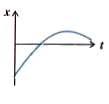
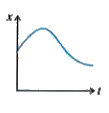
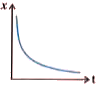
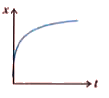
Among the four graph shown in the figure there is only one graph for which average velocity over the time interval (O,T) can vanish for a suitably chosen T. Which one is it ? |
|
Answer»
Hence, there are opposite velocities in the interval 0 to T so, average velocity can vanish in (b). This can be SEEN in the figure given below 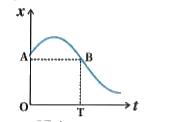 Here, `OA=BT` (same displacement) for two different points of time. |
|
| 33. |
50 g of copper is heated to increase its temperature by 10^(@)C. If the same quantity of heat is given to 10 gm of water, the rise in temperdture is (specific heat of copper= 420 JKg^(-1) K^(-1), specific heat of water = 4200 jkg^(-1) k^(-1)) |
| Answer» Answer :A | |
| 34. |
The unit of thermal capacity is |
|
Answer» joule/kelvin |
|
| 35. |
A steel wire 0.72 m long has a mass of 5.0 xx 10 ^(-3) kg. If the wire is under a tension of 60 N, what is the speed of transvers waves on the wire ? |
|
Answer» Solution :Linear density of MASS of a GIVEN wire, `mu = (M)/(L)` Speed of transverse wave on given wire, ` v = sqrt ((T)/(mu)) = sqrt ((T)/(M //L ))= sqrt ((TL)/(M))` `therefore v = sqrt((60 xx 0.72)/(5 xx10 ^(-3))) = 92.95 (m)/(s)` |
|
| 36. |
If a few spherical drops of a liquid coalesce to form a larger drop, will its temperature rise or fall? Explain. |
| Answer» SOLUTION :When a few spherical drops of a liquid coalesce to form a larger DROP, the surface AREA decreases. As a result, some surface energy is released. Thisis surface energy is CONVERTED into heat energy, thereby the temperature of the LARGE drop increases. | |
| 37. |
A particle of mass m is released from rest and follows a particle as a function of time? |
|
Answer»
|
|
| 38. |
Answer the following questions based on the P-T phase diagram of CO_(2): Describe qualitatively the changes in a given mass of solid CO_(2)at 10 atm pressure and temperature - 65 ^(@) Cas it is heated up to room temperature at constant pressure. |
| Answer» Solution :It turns to LIQUID phase and then to vapour phase. The fusion and BOILING points are where the HORIZONTAL line on P-T diagram at the constant pressure of 10 ATM intersects the fusion and vaporisation curves. | |
| 39. |
A caris moving towards a high cliff . The car driver sounds a horn of frequency f . The reflected sound heard by the driver has frequency2f . If V is the velocity of sound , what will be the velocity of the car ? |
|
Answer» |
|
| 40. |
The effective length of a simple pendulum is 1 m and the mass of its bob is 5 g. If the amplitude of motion of the pendulum is 4 cm, what is the maximum tension on the string to which the bob is attached? |
|
Answer» Solution :The VELOCITY of the bob is maximum at its position of equlibrium. The maximum velocity `v_(max)=omegaA=(2piA)/T`. At this position, centripetal force is also maximum, whose value is `F_(c)=(mv_(max)^(2))/L=(momega^(2)A^(2))/L` `""` [L = effective length of the pendulum] The resultant of the WEIGHT MG of the bob and tension F on the string BECOMES equal to this force `F_(c)`. `therefore" "F=mg+F_(c)=mg+(momega^(2)A^(2))/L=m(g+(omega^(2)A^(2))/L)` Again, `T=2pisqrt(L/g)`, so, `omega=(2pi)/T=sqrt(g/L)or,omega^(2)=g/L` `therefore" "F=m(g+(gA^(2))/L^(2))=mg(1+A^(2)/L^(2))` `=5xx980(1+4^(2)/100^(2))" "[becauseL=1m=100cm]` `=4908"dyn"=0.04908N~~0.05N` |
|
| 41. |
A steel rod of L_0 metre and coefficient of linear expansion 'alpha' rests on a smooth horizontal surface.The longitudinal strain developed in the rod is (when heated from 0^(@) C to 100°C ) |
| Answer» Answer :D | |
| 42. |
An electric kettle takes 4 A current at 220 V. How much time will it take to boil 1 kg of water from temperature 20^@C ? The temperature of boiling water is 100^@ C. |
|
Answer» 6.3 min `Q=ms DeltaQ=(1xx4200xx80)` J Power of kettle (P)=VI=(220 X 4) W `therefore` Time TAKEN= `Q/P` `=(1xx4200xx80)/(220xx4)` =381.81 s =6.36 min |
|
| 43. |
A body cools from 80^(0) C to 60^(0) C in 2 minutes. In how much time it cools from 60^(0) to 40^(0) C ? The temperature of the surroundings is 10^(0) C |
| Answer» Answer :B | |
| 44. |
A cr travelling at a speed of 36h^(-1)sounds its horn of frequency 500 Hz . It is heard by the dirver of another car which is travelling behind the frist car in the same directrion with a velocity of 20 ms *s ^(-1) . Another sound is heard by the driver of the secound car after reflection from a bridge ahead . What will be the frequencies of the two sounds heards heard by the drive of theSound travels in air with a speed of340 m * S(-1) . |
|
Answer» Solution :The drive of the secund car O is the listener . The frist car 5 and its image S. DUE to reflection on the BRIDGE ahead are two sources of sound . The direction of motion of O to torwerds S and S. So velocity of the listener ,` u_(0) = _ 20 m* S^(-1)`  Here , S is receging from O . So velocity of the source S ` `u_(s) = - 36 km * h^(-1)` ` = - (36 xx1000)/(60xx60) m * s^(-1) = - 10m * s^(-1)` . ` therefore ` APPARENT frequency to the listener due to S, ` n. = (V + u_(o)) /( V - u_(2)) xxn ` ` = (340 + 20) /(340 - (-10)) xx 500` ` (360)/(350) xx 500 = 514.3 Hz ` On the other hend , S. is approaching O . So, velocity of the source S. , ` u_(s) = + 10* s^(-1)` ` therefore ` Apparent frequency to the listener due to S. ` n. = (V + u_(0))/(V - u_(s)) xx n = (340 + 20)/(340 - 10) xx 500 ` ` = (360)/(330) xx 500 = 545.5 Hz ` So the driver of the secund car will hear the sounds of frequencies 514.3 Hz and545.5 Hz . |
|
| 45. |
Statements : (a) Centre of mass is that fixed point of a system of particles or a rigid body with in the boundaries of the system where the entire mass is concentrated.(b) Center of gravity of a body is the point through which the whole weight of the body acts. |
|
Answer» Both A and B are TRUE |
|
| 46. |
Explain the working of Carnot's heat engine with the help of graph. |
|
Answer» Solution :Working of Carnot.s engine : Step 1 : The working substance (ideal gas) is enclosed in a non-conducting wall and conducting bottom of a cylinder fitted with air tight non conducting piston. This is placed on the source having an infinite thermal capacity at a steady temperature. The top surface is conducting and the rest non conducting. As a result, the gas expands isothermally. The work done by the system, `W_(1)=muRT_(1)log""(V_(2))/(V_(1))` (Curve A B) Step 2 : The working substance is now placed on a non conducting platform, as a result of which no heat exchange takes place between the system and the surroundings. The system expands adiabatically at the expense of its internal energye. The gas cools. The work done by the system, `W_(2)=(muR)/(gamma-1)(T_(1)-T_(2))` (Curve B C) 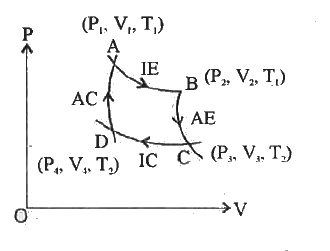 Step 3 : The working substance is now placed on the sink maintained at a steady low temperature `T_(2)K`. The symstem undergoes isothermal compression at this temperature. The pressure of gas increases and volume decreases without any chagne in the internal energy and specific heat of gas remains at infinity. `W_(3)=muRT_(2)log((V_(4))/(V_(3)))` (Curve C A) Step 4 : The working substance is placed on a non-conducting platform. Under thermal isolation, the system undergoes Extermal change in its intcrnal energy and its specific heat remains at Work zero. Adiabatic compression results in increase in the presssure and temperature at the expense of work being done on the For `eta_(1)=eta_(2),(T_(1))/(T_(2))=(T_(1)^(1))/(T_(2)^(1))and(Q_(1))/(Q_(2))=(Q_(1)^(1))/(Q_(2)^(1))`. For refrigerators (reverse Carnot.s engine) coefficient of performance `beta=(Q_(2))/(W)=(Q_(2))/(Q_(1)-Q_(2))` W- Work done on the system. `Q_(2)`- Heat extracted from the cold reservoir `Q_(1)`- Heat rejected to the surrounding. Coefficient oflinear expansion `alpha=(("change in length"))/(("original length)(rise in temperature"))` i.e., `alpha=((l_(2)-l_(2)))/(l_(1)(theta_(2)-theta_(1)))K^(-1)` Coefficient of superficial expansion `beta=2alpha=(DeltaA)/(A(theta_(2)-theta_(1)))K^(-1)` Coefficient of volume expansion `gamma=3alpha=(DeltaV)/(V(theta_(2)-theta_(1)))K^(-1)` First Law of Thermodynamies, `dQ=dU+dW`. `Q=mstheta," where "s=(Q)/(mtheta)JKG^(-1)K^(-)` Thermal capacity of a substance `=(ms)JK^(-1)` `C_(P)-C_(V)=RandC_(P)-C_(V)=R` `dS=(dQ)/(T)` where dS = change in entropy T= steady transition temperature. Classius - Clapeyron equation, `(dP)/(dT)=(L)/(T(V_(2)-V_(1)))` where L- latent heat rate of change of pressure with temperature per kg of substance. For `V_(2)gtV_(1)` as in the transition of liquid state to gasesous state, implies that increase of pressure increases the boiling point of liquids. For `V_(2)ltV_(1)` as in the case of melting of ice (water like substances) `V_(2)-V_(1)-veand((dP)/(dT))` is negative. This implies increase of pressure decreases the freezing point of liquide below `0^(@)C`. For `V_(2)-V_(1)=+ve` (wax like substances), increase of pressure increases the melting poin of solids. Expressions for adiabatic processes: `P_(1)V_(1)^(gamma)=P_(2)V_(2)^(gamma)` `T_(1)V_(1)^(gamma-1)=T_(2)V_(2)^(gamma-1)`. `T_(1)P_(1)(1-gamma)/(gamma)=T_(2)V_(2)(1-gamma)/(gamma)orT=KP(gamma-1)/(gamma)` Vander Waal equation for real gases: `(P+(mu^(2)a)/(V^(2)))(V-mub)=muRT` where `mu`= number of moles V= volume of the CONTAINER `mub`= volume of `mu` moles of gas `(mu^(2)a)/(V^(2))` = pressure due to INTERMOLECULAR collisions. Coefficient of performance of Carnot refrigerator, `beta=(Q_(2))/(Q_(1)-Q_(2))=(Q_(2))/(W)=("Heat extracted from cold reservoir")/("Work done by compressor motor")` 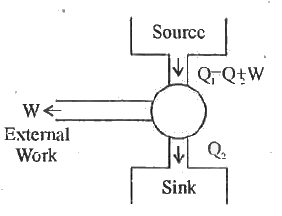
|
|
| 47. |
The earth is an approximate sphere. If the interior contained matter which is not of the same density everywhere, then on the surface of the earth, the acceleration due to gravity? |
|
Answer» will be directed towards the centre but not the same EVERYWHERE |
|
| 48. |
The molar specific heat at constant pressure ofan ideal gas is 7/2R.The ratio of specific heat at constant pressure to that at constant volume is ………. |
|
Answer» `8/7` `C_P-C_V=R` `7/2R-C_V=R` `THEREFORE 7/2R-R=C_V` `therefore C_V=5/2R` `therefore C_P/C_V=(7/2R)/(5/2R)=7/5` |
|
| 49. |
Mass of the moon is 1/81 of the earth but gravitational pull is 1/6 of the earth . It is due to the factthat |
|
Answer» RADIUS of the moon is 81/6 of the EARTH |
|