

Saved Bookmarks
This section includes InterviewSolutions, each offering curated multiple-choice questions to sharpen your knowledge and support exam preparation. Choose a topic below to get started.
| 1701. |
Why did N. G. Ranga urgue to interpret minorities in the economic terms in the Constituent Assembly? Explain. |
|
Answer» Solution :N.G. Ranga, a socialist who had been a leader of the PEASANT movement, urged that the term minorities be interpreted in economic terms. The real minorities were the poor and the downtrodden. He said that the people were so depressed and oppressed that they were not ABLE to take advantage of the ordinary civil rights. He welcomed the legal rights the Constinition. was granting to cach individual but pointed to its limits. In his OPINION it was mcaningless for the poor people in the villages to know that they now had the FUNDAMENTAL right to live, and to have full employment, or that they could have their meetings, their conferences, their associations and various other civil libertics. It was essential to create conditions where these constitutionally enshrined rights could be effectively enjoyed. The tribal traditional laws are violated and their lands are snatched by merchants. The tribals are treated like slaves. The money lenders exploited the poor tribals. The zamindars exploited poor villagers. The poor peasant and the tribals do not get EVEN basic education. For this they needed protection. Ranga said, "They need props. They need a ladder." |
|
| 1702. |
The Bolshevik Revoluation started in Russia during the region of |
|
Answer» Czar Alexander I |
|
| 1703. |
What is meant by mansabdari system? Discuss it main features. Explain the mansabdari system which was introduced by Akbar. |
|
Answer» Solution : The mansabdari system was introduced by Akbar. It was the steel framework of the Mughal empire. (i) It was an institutional mechanism. It organised the bureaucratic hierarchy along military lines and played an important role in expansion of the empire and control over local chieftains. (ii) It was unique as it aimed to bring the civil and military SERVICES in one payroll. Mansabs were given to anyone who rendered services to the state and were indicative of his personal status. (iii) Under the mansabdari system all holders of government offices held ranks consisting two designations: (a) The `zat. rank was the indicator of the position in the imperial hierarchy and salary of the officials—Mansabdar. (B) The sawar rank indicated the number of horsemen. It was required to maintain, the lowest rank was 10 and the highest was 5000, later increased to 7000 for the nobles. In 17th century mansabdars of 1000 zat or above were ranked as nobles (Umara) the plural of `amie. (iv) The great care was taken to ensure the mansabdars and conferred with their obligations. Akbar introduced `dagh. —branding of horses with the imperial mark and `chera.. (v) The nobles participated in army campaigns with their armies and also served as officers of the empire in the provinces. Every mansab-dar had to bring his confident for periodic inspec-tion. Mansabdars were regularly transferred to prevent them developing local roots. (vi) The contigents of the mansabdars were mixed. They were DRAWN from all groups as — Mughal, Pathan, Hindustani, Rajput. By this process Akbar tried to weaken the forces of tribalism and Parochialism. (vii) The emperor individually reviewed changes in rank, titles and official postings for all except the lowest officers. Akbar set spiritual relationship with a selected band of his nobility and treated them as his disciples. (viii) Salary to the mansabdars was to be paid in cash (naqdi) or jagirs (tankhwas). The mansabdar used to prefer to get jagirs given mansabdar merely responsible for collection of REVENUE from his jagir. He had right over the revenue as long as he was in imperial services. (ix) Some changes were opted in the mansabdari system under Jahangir and Shahjahan but fundamental system of DUAL rank continued as earlier. |
|
| 1704. |
Whatdo you mean by mires ? |
| Answer» SOLUTION :IT was a TYPE of landin Maharashtra, ALLOTTED in many VILLAGES. | |
| 1705. |
Mention the factors which led to the decline of Buddhism. |
|
Answer» Solution :The responsible factors that led to the decline of Buddhism were as follows : (i) The moral degeneration of the monks and nuns. (ii) Persecution of BUDDHISTS by some Brahmin RULERS like Pushyamitra Sangha, Sakas and Satavahana rulers , they preferred Hinduism. (III) Turkish invasion MONASTERIES which had stored the wealth attracted the greed of invaders. (iv) Brahmin SCHOLARS tried to reform their own religion . |
|
| 1706. |
On the given Political outline map of India, locate and label the following with appropriate symbols. (i) Vijayanagara : The imperial capital of Krishnadeva Raya. |
Answer» SOLUTION :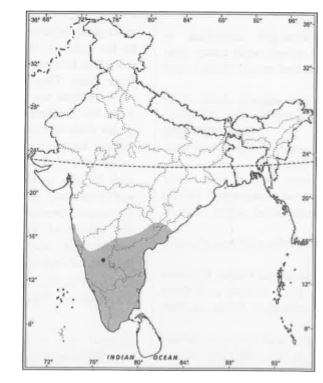
|
|
| 1707. |
On the given political outline map of India, locate and label the Mahajanapada and cities. (a) Vajji (b) Magadha (c) Kosala, (d) Kuru, (e) Panchala (f) Gandhara (g) Avanti, (h) Rajgiri, (i) Ujjaiyini, (j) Taxila, (k) Varanasi |
Answer» SOLUTION :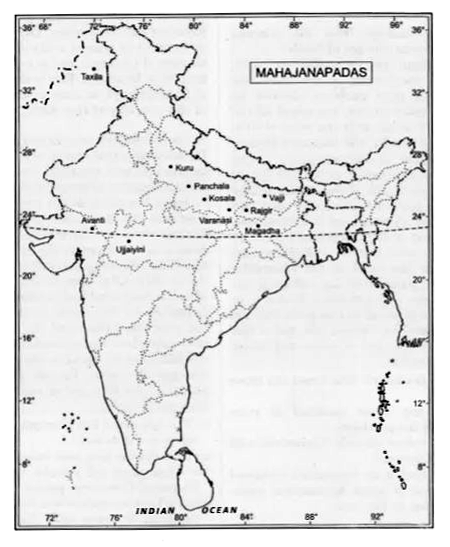
|
|
| 1708. |
Mention the significance of oral source of history.Give two points. |
|
Answer» Solution :(i) It GAVE account of HISTORY from the PERSPECTIVE of COMMON man who could not write books otherwise. (ii) It enabled historians to give a vivid picture of history. |
|
| 1709. |
How did Indian hill stations become racial enclaves for the Europeans in the 19h century? Explain two reasons |
|
Answer» Solution :(i) INTRODUCTION of the railways MADE hills accessible to wide range of people. (ii) Setting up of TEA and coffee plantation which CAUSED an influx of immigrant labour from the plain. |
|