

Saved Bookmarks
This section includes InterviewSolutions, each offering curated multiple-choice questions to sharpen your knowledge and support exam preparation. Choose a topic below to get started.
| 3751. |
What were the great urban centres that lined the shores of the Mediterranean? |
| Answer» SOLUTION :The great urban centres that lined the SHORES of the MEDITERRANEAN were Carthage, Alexandria and ANTIOCH. | |
| 3752. |
When did people of different corners of world begin to learn domestication of plants and animals? |
| Answer» SOLUTION :People of different corners of the world BEGAN to learn domestication of animals and plants around between 10,000 and 4,500 years ago. | |
| 3753. |
How did technological changes affect agriculture during 11th century? |
|
Answer» Solution :Technological changes affected agriculture in many ways: (i) Wooden ploughs were replaced with heavy iron-tipped ploughs. (ii) The method of HARNESSING animals to the plough improved which enabled animals to exert greater power. Horses were now better SHOD with iron horseshoes. It prevented foot decay. (iii) The increased use of wind and water energy for agriculture enhanced agricultural production. (iv) The most innovative change was the switch from a two-field to a three field system. Now, PEASANTS could use a field two years out of three if they planted it with one crop in autumn and a different crop in spring a year and a half later. (v) Now the farmers could plant one with wheat or rye, the second in spring to raise peas, BEANS and lentils and the other part was left fallow. As a result, there was an immediate increase in the amount of food produced fromeach unit of land. Food production almost doubled. There were better opportunities for cultivators. They could now PRODUCE more food for less land. The average size of peasants. farm shrank from about 100 acres to 20 to 30 acres. As a result of holding, smaller lands could be more efficiently cultivated. It also reduced the amount of labour. The new technological changes cost a lot of money. |
|
| 3754. |
What do you understand by Terra nullius? |
| Answer» SOLUTION :Terra nullius means belonging to no body. The govt. of Australia always termed the land of Australia terra nullius. The rights of the natives were ALSO UNDERMINED. Terra nullius was LEGALLY INVALID. | |
| 3755. |
Who designed flying shuttle loom? |
| Answer» Solution :FLYING shuttle loom was DESIGNED by JOHN KAY in 1733. | |
| 3756. |
Which causes were responsible for the rise of middle class? |
|
Answer» Solution :The causes responsible for the RISE of the middle class were: (i) In the crusade, a lot of feudal lords had been killed. (ii) The growth of commerce and trade made the trading class quite rich and prosperous. They, in turn, sought the favour of king and helped him, whenever needed. (iii) The wealthy MERCHANTS and rich traders got many towns and cities freed from the CLUTCHES of feudal control. (IV) The new cities soon grew into centres of trade, commerce and education and consequently gave rise to the new classes. (v) New classes of the rich merchants patronised art, science, LITERATURE and education. |
|
| 3757. |
Read the following passages and answer the questions that follow: In his novel Hard Times, Charles Dickens (1812-70), perhaps the most severe contemporary critic of the horrors of industrialisation for the poor, wrote a fictional account of an industrial town he aptly called Coketown. 'It was a town of red brick, or of brick that would have been red if the smoke and ashes had allowed it, but as matters stood it was a town of unnatural red and black like the painted face of a savage. It was a town of machinery and tall chimneys, out of which interminable serpents of smoke trailed themselves for ever and ever, and never got uncoiled. It had a black canal in it, and a river that ran purple with ill-smelling dye, and vast piles of building full of windows where there was a rattling and a trembling all day long, and where the piston of the steam-engine worked monotonouslyup and down, like the head of an elephant in a stare of melancholy madness. ' Q. Who was Charles Dickens? |
| Answer» SOLUTION :CHARLES Dicknes was a famous novelist who wrote a fictional account of an industrial town, COKETOWN. | |
| 3758. |
Read the following passages and answer the questions that follow: In his novel Hard Times, Charles Dickens (1812-70), perhaps the most severe contemporary critic of the horrors of industrialisation for the poor, wrote a fictional account of an industrial town he aptly called Coketown. 'It was a town of red brick, or of brick that would have been red if the smoke and ashes had allowed it, but as matters stood it was a town of unnatural red and black like the painted face of a savage. It was a town of machinery and tall chimneys, out of which interminable serpents of smoke trailed themselves for ever and ever, and never got uncoiled. It had a black canal in it, and a river that ran purple with ill-smelling dye, and vast piles of building full of windows where there was a rattling and a trembling all day long, and where the piston of the steam-engine worked monotonouslyup and down, like the head of an elephant in a stare of melancholy madness. ' Q. Highlight any four social problems mentioned here. |
|
Answer» Solution :(a) Constant flow a RURAL MIGRATION to cities in search of work, increased the population in the cities. (b) Increasing slums in industrial towns. (c ) Constant INCREASE in thefts, crimes, street bowls, etc. (d) BREAK down in family ties. |
|
| 3759. |
Read the following passages and answer the questions that follow: In his novel Hard Times, Charles Dickens (1812-70), perhaps the most severe contemporary critic of the horrors of industrialisation for the poor, wrote a fictional account of an industrial town he aptly called Coketown. 'It was a town of red brick, or of brick that would have been red if the smoke and ashes had allowed it, but as matters stood it was a town of unnatural red and black like the painted face of a savage. It was a town of machinery and tall chimneys, out of which interminable serpents of smoke trailed themselves for ever and ever, and never got uncoiled. It had a black canal in it, and a river that ran purple with ill-smelling dye, and vast piles of building full of windows where there was a rattling and a trembling all day long, and where the piston of the steam-engine worked monotonouslyup and down, like the head of an elephant in a stare of melancholy madness. ' Q. About which period and the country he is talking about in this passage? |
| Answer» SOLUTION :In this PASSAGE, he is talking about the industrialisation PHASE in BRITAIN from 1780s to 1850s. | |
| 3760. |
The Incas empire was highly centralised with the king representing the highest source of authority. Elaborate. |
|
Answer» Solution :(i) The Incas empire was centralised. The KING was the highest authority. Quechu was the language of the courth. Each people spoke Quechu language. A council of elders ruled each tribe independently. The tribe owed its allegiance to the ruler. Regarding population, there is no exact figure. but there were more than a million people in the empire who owed their allegiance to the ruler. (ii) The Incas were magnificent builders like the Aztecs. they built roads through mountains from Ecuador to Chile. their forts were built of stone slabs. they used labour-intensive technology to carve and move stones from NEARBY rock falls. many stones weighed more than 100 metric tons, but they did not have any wheeled vehicles. (iii) Agriculture was the main occupation of the people. they terraced hillisides and developed systems of drainage and irrigation to overcome the problem of infertility of soil. Cultivation in Andean highlands was much greater than what it is today. The Incas grew maize and potatoes. (iv) They were mainly interested in weaving and pottery. they were of high QUALITY. There was an ACCOUNTING system in place-the Quipu, or cords upon which knots were made to indicate specific mathematical units. it was the opinion of some SCHOLARS that the Incas wove a sort of code into these threads. (v) The organisation of the Inca empire had pyramid-like structure. if the inca chief was captured, the chain of command could quickly come apart. this was precisely what happend when the spaniards decided to invade their country. |
|
| 3761. |
When was humanism adopted in curriculum of the universities in Italy? |
| Answer» Solution :HUMANISM was adopted in CURRICULUM of the universities in Italy during 14th CENTURY. | |
| 3762. |
How was the reign of Augustus by 27 BC? Discuss. |
|
Answer» SOLUTION :The reign of Augustus initiated an era of relative peace known as the Pax Romana (The Roman Peace). Despite continuous wars or imperial expansion on the empire.s frontiers and one year-long civil war over the imperial succession, the Roman world was largely free from large-scale conflict for more than two centuries. Augustus dramatically enlarged the empire, annexing Egypt, Dalmatia, Pannonia, Noricum, and Raetia, expanded possessions in Africa and Germania, and completed the conquest of Hispania. Beyond the frontiers, he secured the empire with a buffer region of CLIENT states, and made peace with the Parthian empire through diplomacy. He reformed the Roman system of taxation, developed networks of roads with an OFFICIAL courier system, ESTABLISHED a standing army, and also the Praetorian Guard, created official police and fire-fighting services for ROME, and rebuilt much of the city during his reign. Augustus died in 14 AD at the age of 75. He might have died from natural causes. He was succeeded as emperor by his adopted son (also steps on and former son-in-law), Tiberius. |
|
| 3763. |
Compare the civilization of the Aztecs with that of the Mesopotamians. |
Answer» SOLUTION : 
|
|
| 3764. |
Name the first and second Khalifa of Muslims. |
| Answer» Solution :The first Khalifa of Muslim WORLD was ABU Bakr and the SECOND one was UMAR. | |
| 3765. |
How did Japan re - emerge as an economicpowerof world afterthe defeat in SecondWorld War ? |
|
Answer» Solution :After its defeact in SecondWorld War, theJapanese efforts of makinga colonail empire ended.The nuclear bombs were dropped on Hirsohimaand Nagasaki . It resulted in hugedestruction of masses. Many peopl thought that it was done justto shortenthe war. Japanwas totally demilitariesd during AMERICAN occupation. The newconstitution also came into being. Agriculturalreforms were alsodone . Re - ORGAINSATION of trade unions were also done . Political parties were also revived and the first post - war elections held in 1946 where women voted for the first time. Afterthe DEFEAT of Japan in the Second World War, Japanese economy also revived. It grew at a fast pace.Constitutions was alsodemocratised. There was close relation between the goverment , bureaucracy and industry. Americansupport to Japn strengthened its economy. Olympic Games were also held at Tokyo in 1964. IT was thesymbol of maturity of Japanese economy. Bullettrains were also started in 1964. It ran at the SPEED of 200 miles per hours. Theintroduction of bullet train added a new feather it its cap. It also INTRODUCED better goods at cheaper rates in the market. |
|
| 3766. |
On the given map of West Asia, mark and locate the following cities: (i) Mecca (ii) Medina(iii) Damascus (iv) Antioch(v) Edessa (vi) Armenia (vii) Bukhara (viii) Samarqand |
Answer» SOLUTION :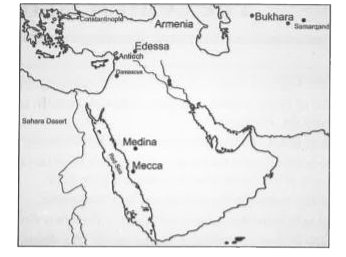
|
|
| 3767. |
Do you think Portuguese and Spaniards as the first explorers of America? |
| Answer» Solution :No, it was not so because VOYAGES of discovery were made by a NUMBER of people from different COUNTRIES such as Arab, china and India. HOWEVER, they settled in the lands VISITED by them. | |
| 3768. |
Write in brief about Tiananmen Square Massacre. |
| Answer» Solution :The struggle for power broke out in China after the DEATH of Mao Tse-tung. In this struggle, DENG Xioping emerged victorious. His liberal policies were fully opposed by the hardliners in the Communist Party. They were always putting pressure upon Deng to follow the rigid Communist policies. In 1988-89, Deng.s economic reforms proved a failure. The prices of the things went up. In May 1989, the students of Beijing assembled peacefully at the famous Tiananmen Square. They demanded more political reforms and democratic institutions to curb corruption in the party. They organised demonstrations to get their demands ACCEPTED. The students organised demonstrations on a large scale. But the government took it as a challenge and crushed the movement ruthlessly. Approximately, 3000 students were gunned down. This MASSACRE was condemned all over the world, but the Communist Government in China did not pay attention to it. | |
| 3769. |
What was the centre of Abbasid uprising? Why did it take place? Give reasons. |
|
Answer» Solution :The Umayyad dynasty was brought down by a well-organised movement called .Dawa.. It was then replaced by Abbasids in 750. The main centre of their uprising was the distant region of Khurasan. Main REASONS : (i) Mobilisation of the mixed Irannian POPULATION for various reasons. (ii) The Umayyad projected themselves rested on force and LOYALTY of Syrian troops which resented the Arab soldiers. (iii) The Aab civilians DISLIKED the Umayyad regime for failure of unfulfill their promises. (iv) Umayyad regime was portrayed as an evil by the Abbasids. |
|
| 3770. |
Describe the changes brought by the Renaissance in the contemporary life of the people. |
|
Answer» Solution :Renaissance brought the following changes in the contemporary life of the people: (i) Old AGE superstitions and social evils came to an end. (ii) New ideas and scientific beliefs BEGAN to gain much importance. (iii) It also laid emphasis on HUMANISM. (iv) People began to discard old values. (v) It inspired the contemporary writers and philosophers. (vi) Many universities were established to provide EDUCATION. (vii) Education and knowledge began to SPREAD quickly. |
|
| 3771. |
What was the view of the Christians about the earth? |
| Answer» SOLUTION :The Christians believed that the earth was at the centre of universe around which moved the celestial planets. It was a SINFUL place. The earth BECAME IMMOBILE because of the burden of SIN. | |
| 3772. |
Write a careful account of how the world appeared different to seventeenth century Europeans. |
| Answer» SOLUTION : Renaissance movement brought about rational and scientific approach in the life of mankind. But the world appeared quite DIFFERENT. Scientists used the methods of experimentation, observation and new thoughts. It was just contrary to Christian beliefs. Scientific discoveries of Copernicus, Galileo, Kepler and Isaac Newton brought about new changes in the world. The Italian scientist Galileo invented telescope. Newton gave the THEORY of gravitation. He systematised scientific valuations about the universe. Copernicus, tried to prove that the earth rotates round the sun. Marco Polo.s invention of the compass made voyage easier. The explorations of the sailors like Vasco DA Gama, Columbus etc. led to discoveries of new LANDS. Their explorations revolutionised trade. The invention of the printing press made books available to the people in various towns and cities. Rome, Florence and Venice became the centres of art and learning. Many artists, scholars and writers were patronised by the rich people in the cities and towns. Town became the centre of art and learning activities. Thomas Moore.s "Utopia" ridiculed the malpractices of the contemporary society. On above basis, it can be said that the world appeared different to 17th century Europeans. | |
| 3773. |
Define the territorial position of the Roman empire. |
| Answer» Solution :The continents of Europe and Africa are separated by a sea, CALLED the MEDITERRANEAN that stretches all the way from Spain in the west to Syria in the east and it was the heart of Rome.s empire. To the north, the boundaries of the empire were FORMED by two great RIVERS, the Rhine and the Danube and to the south, by the huge expanse of desert called the Sahara. This vast stretch of territory was the Roman empire. | |
| 3774. |
Name a few places where cave painting depicting the pictures of animals have been found. |
| Answer» SOLUTION :The CAVE painting depicting the pictures of animals such as BISON, horses, deer, mammoths, lions, panthers, bear, owl, ETC. have been found in Lascaux and Chauvet (Both in FRANCE) and in Altamira (in spain). | |
| 3775. |
Who was Ibn Rushd? |
| Answer» Solution : Ibn Rushd was the PHILOSOPHER of SPAIN. He made an attempt to RESOLVE the differences between philosophical knowledge and RELIGIOUS beliefs. | |
| 3776. |
How did long-term changes in population levels affect economy and society in Europe? |
|
Answer» Solution :Long-term changes in population levels affected the economy and society: (i) This change brought about a NEW change in agricultural production. Production reached at its peak. Good quality of goods was also produced. It increased the life expectancy RATE. (ii) A number of towns came into being. They also BECAME the CENTRE of trade and COMMERCE. Society became more advanced and civilised. |
|
| 3777. |
Do you think that industrialisation affects farming, transportation, communication and trade? |
|
Answer» Solution :Industrialisation definitely makes its impact on farming, transportation, communication and trade in the following ways: (i) Effects on Farming: After the industrial Revolution, farming was highly affected. The inventions of new machines for agriculture were made. Now the machinery took the place of mankind. The farmers could SOW, reap and harvest their products through machines. On the one side, production doubled but on the other side, the unemployment problem increased. (ii) Effects on Transport: Roads were built for safe and fast transportation of goods. After industrialisation, production of goods increased. So the businessmen had to send their goods to the different MARKETS. Navigational canals were dug up to carry the goods and passengers. The RAPID development of the means of transport made quite easy the transportation of finished goods. Now it became easier to send goods from one country to another. (iii) Effects on the Means of Communication: After Industrial Revolution, there occurred a change in the field of communication. Telegraphy and telephone were invented. Now it became easier to receive and send the message. Now people could establish contact with others in very short time. (iv) Effects on Trade: Trade was highly affected. As the products increased, it ALSO encouraged trade. The international trade grew fast. It became easier for any industrialised country to import raw material and to export the finished goods to any part of the world market. |
|
| 3779. |
If women got settled their marriages according to their wish, what values do they show? |
| Answer» Solution :Woman had RIGHT to FIND her LIFE partner according to her wishes and this step would never ever harm the society. However, it shows the independence of women and they can form a BETTER society, can contribute to make a good future of their family and society if they select their groom according to their choice. | |
| 3780. |
Discuss the features of the lifestyle of the native peoples of North America. |
|
Answer» Solution :The features of the lifestyle of the native peoples of North America were as follows: (i) Living of the people: In North America, the people lived in bands, in villages along the bank of the river valley. (ii) Diet: The people used to grow crops such as maize and different types of vegetation. They also ate fish and meat and went on HUNTING at far off places in search of wild buffaloes called bison. (iii) Economy: The people believed in subsistence economy. They used to grow as much crops as required to fulfil their basic needs. (iv) Land as a resource: They claimed their rights over the ownership of the land and were satisfied with the FOOD and shelter available. There was no conflict with them for securing their rights over the ownership of land. (v) Exchange of gifts: The natives of America used to live a life BASED on the principle of togetherness and mutual friendship. They did not INDULGE themselves into sale or purchase of GOODS. Thus, they used to exchange gifts amongst them. (vi) Language: The natives used to speak a number of languages. But names of these were not written down. (vii) Clothes: The natives of North America were skilled craftsmen and knew the art of weaving best quality of clothes. |
|
| 3781. |
Discuss the causes of the development of cities in medieval Europe. |
|
Answer» Solution :(i) The emergence of feudalism was accompanied by the decline of trade and towns with the gradual decline of feudalism, particularly from the 11th century ONWARD. (ii) Towards the end of the Middle Age, the rise of the middle class led to the emergence of towns. The economic prosperity of the class helped in the DEVELOPMENT of cities in MEDIEVAL Europe. (iii) East-west contact also encouraged trade and commerce. As a result, art and crafts centres were established. In COURSE of TIME, these centres became towns. |
|
| 3782. |
What do you understand by Guild? |
| Answer» Solution :GUILD was the basis of economic organisation. Each craft or industry was organised into a guild. It was also an association. Quality of the product, sale and its price were controlled by the Guild. The Guild hall was the distinct FEATURE of every town. In it, the heads of all trade organisations formally met. Guards PATROLLED the town walls and musicians were called to play at feasts and in CIVIC processions. Innkeepers LOOKED after travellers. | |
| 3783. |
What is Ethnography? |
| Answer» Solution :The STUDY of contempory ethnic is called ETHNOGRAPHY. It deals with EXAMINATION of their modes of livelihood, rituals, CUSTOMS and TRADITIONS. | |
| 3784. |
What do you know about Arab tribe? Write in short. |
|
Answer» Solution :The entire Arab society was divided into tribes known as Qabila, headed by a chief. The chief of Qabila (Tribe) was elected on the basis of his family, wisdom and courage. Besides these, his personality ALSO played a crucial ROLE. Each tribe had its own RELIGIOUS beliefs. They WORSHIPPED their own gods and goddesses in mosques. the tribes were nomadic, and kept on moving from one region to another in search of food and fodder for their camels. Some of them settled and practised trade or AGRICULTURE. Muhammad.s own tribe was Qurayash who had reigned its supermacy in Mecca. It established its control over Kaba, a cublic like structure in which idols were placed. Even the tribes outside Mecca considered the Kaba installed their own idols at this shrine, making anuual pilgrimage (Hajj) to the shrine. |
|
| 3785. |
Distinguish between Homo heidelbergensis and Homo neanderthalensis. |
Answer» SOLUTION :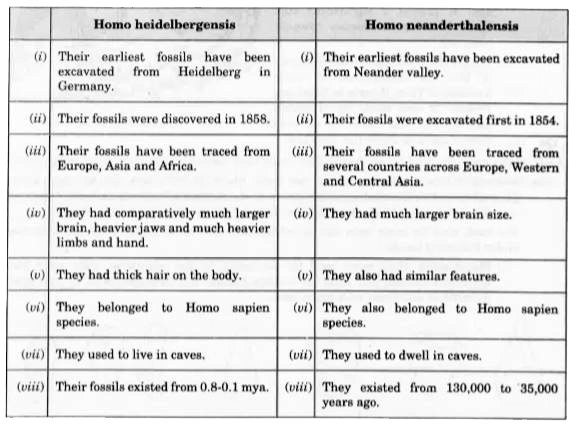
|
|
| 3786. |
Discuss the arguments advanced in fovour of the regional continuoty model of human origins. Do you think it provides a convincing explanation of the archaeological evidence? Give reasons for your answer. |
|
Answer» Solution :According to the Regional Continuity MODEL, the HOMO sapiens EVOLVED in different regions at different rates into modern humans. So there was a variation in the first appearance of modern humans in different parts of the world. It was baised on the regional DIFFERENCES in the FEATURES of present day humans. The advocates of this view found that the dissimilarities are due to the differences between the Homo erectus and Homo heidelbergensis populations of the same regions. The Regional Continuity Model does not give a convincing explanation of the archaeological evidence. |
|
| 3787. |
How did Britain's involvement in wars from 1793 to 1815 affect British industries? |
| Answer» Solution :Both Britain and FRANCE were at war between 1793 to 1815. The industries of Britain were badly affected with this war. That is why Britain was unable to GET capital formation and reinvestment during war PERIOD. It had to use borrowed capital to FIGHT rather than reinvestment. Due to war, factories were SHUT down. Trade declined. The prices of essential commodities were very high. So, this war affected British industries in many ways. | |
| 3788. |
What were the dynasties that ruled Iran in the third century? |
| Answer» Solution :he PARTHIANS and later the Sasanians RULED IRAN in the third CENTURY. | |
| 3789. |
Define the term the ‘Late Roman bureaucracy'. |
| Answer» SOLUTION :The .Late Roman bureaucracy. for both the higher and the middle echelons was a comparatively affluent group because it drew the BULK of its salary in gold and invested MUCH of this in buying up of landed property. There was, of course, a great deal of corruption, especially in the judicial system and in the administration of MILITARY supplies. The EXTORTION of the higher bureaucracy and the greed of the provincial governors were common. | |
| 3790. |
Discuss in detail the spanish policy towards the arawaks. What were its consequences? |
| Answer» Solution :The SPANISH people had much fascination for GOLD. But the ARAWAKS were not so. The arawaks were interested in glass beads and the art of weaving. The spanish exchanged their gold for glass beads with the arawaks. The arawaks were very humble and generous people. they were also very co-operating. they also co-operated with the spanish people in the beginning but after sometime, the behavious of spanish towards the arawaks changed. they became more furious and brutal towards them. it gave DISASTROUS RESULT. | |
| 3791. |
Name the various terms used for the native peoples of North and South America and the Caribbeans. |
| Answer» Solution :The VARIOUS TERMS used for native PEOPLES of North and South America and the CARIBBEANS were American-Indian, Amerind or Amerindian. | |
| 3792. |
What was the declaration of Copernicus about the earth? |
| Answer» Solution :The CHRISTIAN society believed that the EARTH was at the centre of UNIVERSE. But Copernicus rebutted this belief and TOLD that the earth including all the other heavenly bodies ROTATE round the sun. | |
| 3793. |
Write the names of some new machineries and technologies. |
| Answer» Solution :FLYING SHUTTLE loom, SPINNING jenny, water frame, steam engine, ETC. | |
| 3794. |
What do you understand by manor? Describe in brief. |
| Answer» Solution :The noble enjoyed a special status in the society. He had a complete control over his property. He was the LORD of all the people settled on his LAND. He occupied vast tracts of land which had its own dwellings, private fields, and pastures. His house was called manor. Peasants CULTIVATED his private lands. Whenever required in battle they were ALSO expected to act as FOOT soldiers. | |
| 3795. |
What do you understand by classical architecture? |
| Answer» Solution : During the period, the ROMAN history was read and the remains were dug up by archaeologists. It INSPIRED a NEW style of architecture that was REVIVAL of the imperial Roman style. It was called classical architecture. | |
| 3796. |
From where do we find the pieces of baked clay and burnt bone along with stone tools? |
| Answer» SOLUTION :We FIND the PIECES of baked clay and burnt bones from Chesowanja, KENYA and Swartkrans. These tools are dated between 1.4 and 1 mya. | |
| 3797. |
Define the term 'native'. |
| Answer» Solution :The TERM .native. refers to the birthplace of a person where he/she lives in. This term was used by the Europeans to describe the inhabitants of colonised COUNTRY. | |
| 3798. |
What is the meaning of Dim sum? |
| Answer» Solution :DIM SUM is the best KNOWN Cantonese cuisine, which literally means .TOUCH your heart.. | |
| 3799. |
Imagine and describe a day in the life of a craftsman in a medieval French town. |
|
Answer» Solution :STUDENTS are advised to answer this question with the help of their teachers. Following guidelines are given to complete this task: Craftsmen WORKED under the supervision of GUILDS. They were skilled PERSONS. Trading guilds controlled and SUPERVISED their activities and took great care of their needs. |
|
| 3800. |
Why do you think the Roman government stopped coining in silver? And which metal did it begin to use for the production of coinage? |
| Answer» Solution :The Roman GOVERNMENT stopped coining in silver because the Spanish silver mine BECAME EMPTY, thus causing dearth of silver in the Roman empire. Now the Roman government BEGAN to use gold for the production of COINAGE. | |