

Saved Bookmarks
This section includes InterviewSolutions, each offering curated multiple-choice questions to sharpen your knowledge and support exam preparation. Choose a topic below to get started.
| 2951. |
Calculate investmentexpenditure from thefollowing data about an economy which is in equilibrium : National Icome = 1000,MPs = 0.2, Autonomousconsumption expenditure = 100 |
|
Answer» Solution :`Y = C +I` (at EQUILIBRIUM ) or `Y = (barC + bY) +1` ` 1000 =100 + 0 .8(1000) +1"" (MPC = 1- MPS rArr 1- 0.2 =0.8)` `1000 = 100 + 800 +I` `I = 1000-900 = 100` Hence investmentexpenditure = 100. |
|
| 2952. |
Using supply and demand curves, show how an increase in the price of shoes affects the price of a pair of socks and the number of pairs of socks bought and sold. Or How will arise in price of complementary affect the equilibrium price of given commodity? Explain the chain of effects. |
|
Answer» Solution :(i) As we know, shoes and pair of socks are complementary good to each other. As, price of complementary goods are related with the demand of given com- modity. So, rise in price of shoes (complementary good) decreases the demand for given commodity pair of socks), and demand curve shifts leftward as SHOWN in given figure: ` (##FM_M_ECO_XII_P1_C12_E01_006_S01.png" width="80%"> (ii) In the given diagram, price is on vertical axis and quantity demanded and supplied is on horizontal axis. Initially, the equilibrium price is OP and equilibrium quantity is OQ. (iii)But DUE to rise in price of complementary good the demand curve of given commodity shifts leftward from DD to `D_(1)D_(1)` . (iv) With new demand curve `D_(1)D_(1)` there is excess supPply at initial price OP because at price OP demand is PB and supply is PA, so, there is excess supply of AB at price OP. (v) Due to this excess supply, competition among the producer will fall the price. Due to fall in price, there is downward movement along the demand curve (Expansion in demand) from B to C and similarly there is downward movement along the supply curve (Contraction in supply) from A to C. So, finally, the equilibrium price falls from OP to `OP_(1)`and equilibrium quantity also falls from OQ to `OQ_(1)` . So, due to rise in price of complementary goods, (a) Equilibrium price falls from OP to ` OP_(1)`and (b) Equilibrium quantity also falls from OQ to `OQ_(1)` . |
|
| 2953. |
Which economic sector is the highest contributionto GDP in India, Pakistan and China ? |
|
Answer» Agriculture |
|
| 2954. |
What are the different phases in the Law of Variable Proportions in terms of marginal product? Give reason behind each phase. Use diagram. |
|
Answer» Solution :The Law of Variable Proportions states that if more and more of variable factor (labour) is combined with the same quantity of fixed factor (capital), then initially the total product will increase but gradually after a point, the total product will become smaller and smaller. Also, a point will be reached thereafter, the marginal product of the variable factor will start falling and after this point the marginal product of any additional variable factor can be zero and even be negative. The following are the three phases (stages) of the Law of Variable Proportions. 1st Stage : Increasing returns to a factor This stage starts from the origin point O and continues till the point M on the TP curve. During this phase, TP increases at an increasing rate and is also accompanied by rising MP curve (in figure ii). The MP curve attains its maximum point (U) corresponding to the point of inflexion (K). Throughout this stagem AP continues to rise. Reason for Increasing returns to a factor (1) Underutilization of the fixed factor : In the first stage of production, there are not enough labour units to fully utilise the fixed factor. Therefore, the firm can increase its OUTPUT just by combining more and more of labour inputs with fixed factor, thereby, the output of the additional unit of labour (i.e. MP) tend to rise. (2) Division of labour : The increase in the labour input ENABLES the division of labour, which further increases the efficiency and productivity of the labour. (3) Specialisation of labour : Due to the division of labour, specialisation of INDIVIDUAL labour unit increases, which in turn raises the overall efficiency and productivity. CONSEQUENTLY, the MP curve rises and TP curve continues to rise. IInd Stage : Diminishing returns to a factor This stage starts from point K and continues till point B on the TP curve. During this stage, the TP increases but at a decreasing rate and attains its maximum point at B, where it REMAINS constant. On the other hand (in the figure ii), the MP curve continues to fall. When TP attains its maximum point, corresponding to it, MP becomes zero. AP, in this stage initially rises, attains its maximum point at Z and thereafter starts falling. Reason for decreasing returns to a factor (1) Fuller utilisation of fixed factor-In this stage, the fixed factor is utilised to its maximum level as more and more of labour inputs are employed. Imparfect substitutabilitybetween labour and capital, the variable factors are imperfect substitute for the fixed factor. Therefore, the firm cannot substitute labour for capital and as a result diminishing returns takes place. (2) Optimum proportion/ideal factor ratio : The optimum proportion (or ideal factor ratio) is a fixed ratio in which the labour and capital inputs are employed. These factors will be most efficient if they are employed as per the optimum proportion. If this proportion is disturbed (by combining more of labour inputs to the fixed units of capital), then the efficiency of the factors will fall, thereby leading to the diminishing returns to the factor. IIIrd Stage :Negative returns to a factor This stage begins from the point B on the TP curve. Throughout this point, TP curve is falling and MP curve is negative. Simultaneously, the AP curve continues to fall and approaches the X-axis (but does not touch it). Like the first stage, this stage is also known as non-economic zone as any rational producer would not operate in this zone. This is because the addition to the total output by the additional labour unit (i.e. marginal product) is negative. This implies that employing more labour would not contribute anything to the total product but will add to cost of the production in form of additional wage. Hence, the cost of the additional labour input is greater than the benefit of employing it. Reasons for negative returns to a factor (1) Over utilisation of the fixed factors : In the third stage of production, the variable factor is in excessive relative to the fixed factors. This leads to the over utilisation of the fixed factor, thereby negative returns to a setsin. (2) Negative marginal product : Throught this stage the TP curve is continuously falling, consequently, the additional product by the additional unit of labour becomes negative. This implies that in this stage of production, the cost of employing labour is substantially higher than its contribution to the total product. (3) Problem of management : With the increased number of labour untis employed, it becomes hard for the management of the firm to efficiently manage them. Thus, due to the mismanagement and lack of responsibility, inefficiency is infused in the system. Let us understand the various stages with the help of following schedule and graph. 
|
|
| 2955. |
What is a barter system? Explain the drawbacks of barter system |
| Answer» | |
| 2956. |
How are following treated in the estimation of domestic factor income ? Profit earned by a branch of a foreign bank in India. |
| Answer» SOLUTION :Yes, it will be included in the domestic FACTOR income as profits are earned WITHIN the domestic TERRITORY of India. | |
| 2957. |
What is 'deficient demand' ? Explain the role of 'Bank Rate' in removing it. OR What is 'excess demand'? Explain the role of 'Reverse Repo Rate' in removing it. |
Answer» Solution :Deficit demand refers to a situation where the actual or EQUILIBRIUM level of demand for output `(AD_(2))` is less than the full employment level of output `(AD_(1))`. That is, if `AD_(2)ltAD_(1)` (situation of Deficit Demand)  In the figure, `AD_(1)` and AS represents the aggregate demand curve and aggregate supply curve. The economy is at full employment equilibrium at point 'E', where `AD_(1)` intersects AS cuve. At this equilibrium point, or represents the full employment level of output and EY is the aggregate demand at the full employment level of output. Let us suppose that, the actual aggregate demand for output is only CY, which is lower than EY. This implies that actual aggregate output demanded by the economy CY falls short of the potential (full employment) aggregate output EY. Thus, the economy is FACING a deficiency in demand. This situation is termed as deficit demand. Bank rate refers to the rate at which the central bank provides loans to the commercial banks. In case of deficit demand, central bank reduces the bank rate, which reduces the cost of borrowings for the COMMERICAL banks. This implies that people can get loans at CHEAP rates from the commercial banks. This increases the demand for laons and credits in the market, THEREFORE, the consumption expenditure increases and finally the aggregate demand increases. OR Excess demand refers to a situation where the actual aggregate demand for output `(AD_(2))` is above the full employment level of output `(AD_(1))`, then there exists excess demand. That is, if `AD_(2)gtAD_(1)` (situation of Excess Demand)  In the figure, `AD_(1)` and AS represents the aggregate demand curve and aggregate supply curve respectively. The economy is at full employment equilibrium at point 'E', where `AD_(1)` intersects AS curve. At this equilibrium point, OY represents full employment level and EY is aggregate demand at the full employment level of output. Let us suppose that, the actual aggregate demand for output is FY, which is higher than EY. This implies that actual aggregate output demanded by the economy FY is more than the potential (full employment) aggregate output EY. Thus, the economy is facing surplus demand. This situation is termed as excess demand. Reverse repo rate refers to the rate at which the Central Bank borrows from the commercial banks. In situation of excess demand, the Central Bank would increase the reverse repo rate. An increase in the reverse repo rate reduces the money supply in the economy,thereby aggregate demand falls. |
|
| 2958. |
Identify the following as Normal Residents of India : Indian officials working in the Indian Embassy in China. |
| Answer» SOLUTION :NORMAL RESIDENTS. | |
| 2959. |
Explain the concept of law of supply |
Answer» Solution :It is based on certain assumptions. If these assumptions fulfil in the economy, Law of SUPPLY states that positive relationship exists between price of the COMMODITY and QUANTITY supplied of that commodity.  "Other things being constant (ceteris paribus), based on the price of the commodity" is called law of supply. It means due to rise in price of a commodity its quantity supplied also RISES and vice-versa. The assumptions are asunder : (a) Price of other commodity remains constant. (b) Technology of production should not change. (c ) Cost of production remains costant. (d) Goal of the firm remains constant. (E ) Taxation policy of the government should not change. 
|
|
| 2960. |
State the behaviour of marginal product in the law of variable proportions. Explain the causes of this behaviour. Or Giving reasons, explain the law of variable proportion. Or What are the different phases in the Law of Variable Proportions in terms of marginal product? Give reason behind each phase. Use diagram. |
|
Answer» Solution :The behaviour of MARGINAL product in the law of variable proportion is as under: (i) When Marginal product rises (till Point `P_1` ), Total product increases at an increasing rate (convex shape) (till point P). (ii) When Marginal product falls and remains positive (Till point `B_1`), total product increases at a diminishing rate (concave shape) (till point A). (iii) When Marginal Product is zero (at point `B_1`), Total Product is at its maximum and constant (At point B). (iv) When Marginal product becomes negative (after point `B_1`), total product falls (after point B).  Causes or Reasons of this Behaviour is as Under: (i) Phase I (a) Proper utilization of the fixed factor In the initial stage of production the units of variable input (i.e., labour) is so less that fixed inputs cannot be effectively utilized. Proper utilization of the fixed factor can be attained when more and more units of variable factor (labour units) are applied to the fixed factor (land), the fixed factor will be used intensively and output will increase rapidly. (b) Specialization and division of labour Initially there was only ONE labour working on all the 5 acres of landploughing, watering, ETC. As the number of labour units increases, each WORKER specialized in a particular activity leads to specialization of the variable units and this resulted in increased output. (ii) Phase II ( a) The non-optimal combination of variable factor with the fixed factor When a given quantity of a fixed factor is combined with more and more units of variable factor, the additional units of variable factor will have smaller and smaller quantity of fixed factor to work with them. As many workers share the same fixed factor, the share of each would obviously fall. THEREFORE, the cooperation of the fixed factor is not available to the same extent. Thus, an increase in the variable factor would add less and less to total output . (b) Imperfect Substitutes Diminishing return to factor occursbecause variable factor and fixed factor are imperfect substitutes to each other. Technically speaking, there is a limit to which variable factor can beapplied to fixed factor and that limit depends upon the efficiency of fixed factor. So, variable factor and fixed factor are imperfect substitutes to each other. (iii) Phase III (a) Efficiency of Variable Factor Fall In this stage the amount of variable factor becomes excessive relative to the fixed factor. This happens when too many LABOUR are engaged in cultivating on a given piece of land. Instead of helping each other in production they cause overcrowding and chaos and thus hamper each other.s work. In such a case, the contribution of additional labour to production is bound to be negative. Thus, the marginal returns become negative and the total returns start diminishing. ( b) Efficiency of Fixed Factor Fall Too much of a variable factors may also lead to the inefficiency of the fixed factor as well. In case of capital, which is a fixed factor, too much of labour may cause lot of wear and tear of machinery, frequent breakdowns and excessive cost of maintenance. This is bound to affect total production adversely. In such a situation it is advisable to reduce the units of the variable factor than to increase it with a view factor than to increase it with a view for getting maximum production. |
|
| 2961. |
What is the impact of decrease in margin requirements? |
| Answer» Solution :Decreases in MARGIN requirements encourages BORROWINGS and RAISES the aggregate DEMAND. | |
| 2962. |
If ED lt 1, in which portion the point would be located on a straight line deman curve ? |
| Answer» SOLUTION :In the LOWER HALF. | |
| 2963. |
Fiscal policy of the government refers to : |
|
Answer» TAXATION POLICY |
|
| 2964. |
If MPC=0 the value of multiplier is |
|
Answer» 0 |
|
| 2965. |
Name the two sources of demand or outflow of foreign echange. ltbr? OR Mention two reasons for the people to acquire foreign exchange. |
| Answer» SOLUTION : (i) IMPORTS of Goods and Serviec, (ii) PURCHASE of ASSETS in friegncountires | |
| 2966. |
Explain all the changes that will take place in an economy when aggregate demand in not equal to aggregate supply. |
Answer» Solution :The equilibrium level may take place before the STAGE of full employment also also it may take place after the stage of full employment.  In deficient demand, the equilibrium level takes place before the full employment level. This is the case of involuntary unemployment. This SIGNIFIES that deficiency of aggregate demand does not lead to the full use of given resources at the full employment level. Therefore, for reaching the stage of full employment where all the given resources are fully utilized, AD is required to be incorrected. In the figure (i) OZ is the full employment level and OY is the actual output level, where AD EQUALS to AS. In the case of excess demand, the equilibrium takes place after the stage of full employment. The level of equilibrium is higher and cannot be met by full use of resources and output does not increase, only price increases in this case. The necessary methods should be used for reducing the level of aggregate demand, for achieving the level of full employment. In figure (ii) OZ is the full employment level and OY is the actual level of employments at equilibrium, where AD is equal to AS. |
|
| 2967. |
Explain the functionof a Central Bankas a betweenCentral Bankand Commercial Banks. ORExplain banker to thegovernmentfunction of Cental Bank.ORExplain ‘Government’s Bank’ function of central bank. |
| Answer» Solution :Central bank functions as a banker to the government—both central and state governments. It CARRIES out all banking business of the government. Government KEEPS their cash balances in the current ACCOUNT with the central bank. SIMILARLY, central bank accepts receipts and makes payment on behalf of the governments.Also, central bank carries out exchange, remittance and other banking operations on behalf of the government. Central bank gives loans and advances to governments for temporary periods, as and when necessary and it also manages the public debt of the country. Remember, the central government can borrow any amount of money from RBI by selling its rupees securities to the latter. | |
| 2968. |
Explain how government budget can be used to influence distribution of income? |
| Answer» Solution :A government REDUCES the inequality in the distribution of income and WEALTH by imposing taxes on the rich and giving subsidies to the poor, or spending more on WELFARE of the poor. It will REDUCE income of the rich and raises the living standard of the poor, thus, leads to equitable distribution of income | |
| 2969. |
What does balance of payments accont of a country record? |
| Answer» Solution :BOP is an ACCOUNTING statement that RECORDS all the ECONOMIC transactions between the residents of a country and rest of the world in a given period. | |
| 2970. |
Why is gross domestic product at factor cost more than the net domestic product at factor cost ? |
|
Answer» |
|
| 2971. |
If a PPF shifts to the right, the new PPF will be parallel to the original. |
| Answer» Solution :FALSE: A NEW PPF need not be PARALLEL to the old one. It can take any possible shape. | |
| 2972. |
Example of a non-debt creating capital receipt |
|
Answer» BORROWINGS |
|
| 2973. |
What will be the effect of the following on the Balance of Payments: (i)'Make in India' Programme,(ii) Import of Pulses. |
|
Answer» (ii)IMPORT of pulses will lead to outflow of foreign exchange from the country, causing ADVERSE effect on balance of payment position. |
|
| 2974. |
Explain the relationship between Marginal product and Average Product. OR State the relation between Marginal product and average product. Use diagram. |
|
Answer» Solution :(i) AVERAGE Product increases as long as MARGINAL Product (MP) `gt` Average Product (AP). Alternatively, when MP `gt` AP, AP rises. (ii) Average Product is maximum and CONSTANT when Average Product (AP) = Marginal Product (MP). Alternatively, when AP = MP, AP is maximum. (iii) Average Product falls when Marginal Product `lt` Average product. (iv) Marginal Product can be zero and negative but Average product is never zero. 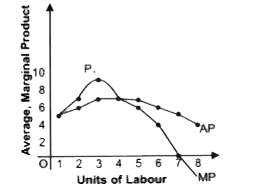
|
|
| 2975. |
Primary deficit in a government budget is __________: |
|
Answer» REVENUE EXPENDITURE - Revenue receipts |
|
| 2976. |
The categories of transactions that are included in the capital account of the Balance of Payments are |
|
Answer» INVESTMENTS from and to abroad |
|
| 2977. |
Price elasticity of supply for a commodity is 5. When price of the commodity rises from 9rs per unit to 10rs per unit, supply rises by 25 units. Calculate quantity supplied at 9rs per unit. |
|
Answer» <P> Solution : Price ELASTICITY of Supply `(ES)=(DELTAQ)/(DELTAP)xx(P)/(Q)` `5=(25)/(1)xx(9)/(Q)`, i.e., `Q=45` |
|
| 2978. |
Differentiatebetween National Income at Current Prices and NationalIncome at ConstantPrices. Which of the two presents a better view of the economic growth of economyand why ? |
|
Answer» Solution : National income at constant prices `= ("National income at CURRENT prices")/(" Price index of current YEAR")xx"Price index of base year (100) "` National income at constant prices REFLECTS the REAL growth of an economy because it increases onlywhen there is an increase inquantities of PHYSICAL goods andservices. National income at current prices may increase due toincrease in both price as well as quantities of goods and services during the year and thus it does not reflect the truepicture of economic growth. Only increase in physical goodsand services increase the availabilityof goods and services to people and raisinggeneral standard of living. |
|
| 2979. |
Which of the following is stock ? |
|
Answer» Savings |
|
| 2980. |
Define perfectly inelastic demand. |
| Answer» Solution :If PRICE changes, and quantity demand remains CONSTANT, ed = 0 and the result in KNOWN as PERFECTLY inelastic demand. | |
| 2981. |
A consumer consumes only two goods X and Y whose prices are Rs 4 and Rs 5per unit respectively . If the consumer choose a combination of the two goods with marginal utility of X equal to 5 and that of Y equal to 4 , is the consumer in equilibrium ? Give reasons. What will a rational consumer do in this situation ? Use utility analysis . |
|
Answer» <P> SOLUTION :The utility analysis in the above examination problem is the two commodity consumer equilibrium condition or law of equi - marginal utility . The condition for two commodity consumer equilibrium is ,Marginal utility of last rupee `((MU_x)/(P_x))`Marginal utility of last rupee `((MU_y)/(P_y))` In the above examination problem, `MU_x=5,P_(x)=4`, then `(MU_x)/(P_x) =5/4=1.25` `MU_y=4,P_y=5`, then `(MU_y)/(P_y) = 4/5 =0.8` The above example gives inequality as , `(MU_x)/(P_x) GT (MU_y)/P_y` In MEAS , marginal utility from the last rupee spent on commodity X is more than marginal utility from the last rupee spent on commodity Y. So , to attain the equilibrium consumer must increase the quantity of X, which decrease the `MU_x` and decrease the quantity of Y which will increase the `MU_y` . Increase in quantity of X and decrease in quantity of Y continue till`(MU_x)/P_x = (MU_y)/P_y` . |
|
| 2982. |
C = 100 + 0.4Y is the Consumption Function of an economy where C is Consumption Expenditure and Y is National Income. Investment expenditure is 1100. Calculate (i) Equilibrium level of National Income (ii) Consumption expenditure at equilibrium level of National Income |
|
Answer» Solution :Given, Y = NATION Income, Consumption Function, `C = 100 + 0.4Y`, INVESTMENT EXPENDITURE, I = 1,100 (i) Now, `Y = C + I` `:. Y = 100 + 0.4 Y + 1,100 or y - 0.4 y = 1200 or 0.6 Y = 1,200` `:.` Equilibrium level of National Income, `Y = 1,200 xx (10)/(6) = 2,000` (ii) Now, `C = 100 + 0.4Y or C = 100 + 0.4 (2,000)` Consumption, `C = 100 + 800 = 900` |
|
| 2983. |
Why market demand curve is flatter? |
| Answer» SOLUTION :Market demand CURVE is FLATTER than the individual demand CURVES because as price FALLS, proportionate rise in market demand is more than proportionate rise in individual. | |
| 2984. |
Give the meaning of baiance ot payments. |
| Answer» SOLUTION :BOP is a record of INFLOWS and outflows of FOREIGN exchange. | |
| 2985. |
Define money supply.Explain different measures of money supply used by RBI in india ? |
| Answer» | |
| 2986. |
Explain the distinction between ex-ante measures and ex-post measures. |
| Answer» Solution :EX ante refers to prediction that is MADE prior to either before all the variables are known, or GENERALLY before an event occurs.Ex POST refers to time after all the variables are known. | |
| 2987. |
Distinguish between variable cost and fixed cost. Give two examples of each. |
Answer» SOLUTION :
|
|
| 2988. |
Why MP curve cuts AP curve at its maximum point? |
| Answer» Solution :It happens because when AP rises, MP is more than AP. When AP FALLS, MP is LESS than AP. So, it is only when AP is constant and at its MAXIMUM POINT that MP is EQUAL to AP. Therefore, MP curve cuts AP curve at its maximum point. | |
| 2989. |
Explain the need for reduction in inequalities of income and wealth . Explain any two budgetary measures by which it can be done . |
|
Answer» SOLUTION :Inequalities of income and wealth reflect a SECTION ofsociety being deprived of even basic necessities. Thus ARISES the need for reducing them in the society. TWO budgetary measures by which it can be done : `*` Progressive taxation. `*` Increasing GOVERNMENT's expenditure . |
|
| 2990. |
Old age pension by the government increases the welfare of people. However, it is not included in the estimation of national income. Why ? |
| Answer» Solution :It is not INCLUDED in the ESTIMATION of national INCOME because it is a transfer PAYMENT. | |
| 2991. |
When is price (AR) different from MR ? |
| Answer» SOLUTION :Price (AR) is different from MR when more units of a COMMODITY can be SOLD by REDUCING the price as in monopoly and monopolistic competition. | |
| 2992. |
Discuss the issue of deficit reduction. |
|
Answer» Solution :The deficit in a government BUDGET can be REDUCED through the following steps : (i) Increase inReceipts : Government should take steps to increase its receipts by RAISING the rates of taxes or by imposing new taxes . (ii) Decrease in Expenditure: Government must aim to reduce its UNPRODUCTIVE and ADMINISTRATION expenditure . Moreover , private sector should be encourages to undertake capital projects to reduce its expenditure . |
|
| 2993. |
What causes an upward movement along the supply curve of a commodity ? |
| Answer» SOLUTION :Rise in PRICE and the rise in quantity supplied , i.e. EXPANSION in supply. | |
| 2994. |
All financial institutions are treatedas banking institutions. |
|
Answer» |
|
| 2995. |
AR can be symbolically written as |
|
Answer» MR/Q |
|
| 2997. |
Change in quantity demanded means an increase and decrease in demand and Change in demand curve means expansion and contraction in demand. |
|
Answer» |
|
| 2998. |
Ig aggregate demand exceeds aggregae supply, the income rises. |
| Answer» Solution :Excess of aggreagate demand will reduce the planned inventory and firms would TEND to increase the EMPLOYMENT and OUTPUT, which will RAISE the income. | |
| 2999. |
Gross domestic capital formation is always greater than gross fixed capital formation. |
| Answer» Solution :FASLE. Gross DOMESTIC CAPITAL FORMATION can be less than gross fixed capital formation if change in stock is negative. | |
| 3000. |
Whatare open market operations ? What is theireffect on availablityof credit ?ORExplainthe openmarketoperations method of credit controlused by a Central BankORHow does central bank control credit creation by commercial banks through open market opetanons.? Explain. |
| Answer» Solution :In NARROW sense-The Central Bank starts the purchase and sale of Government securities in the money market. But in the Broad Sense—the Central Bank purchases and sale not only Government securities but also of other proper and eligible securities like bills and securities of private concerns. When the banks and the private individuals purchase these securities they have to make payments for these securities to the Central Bank.This gives result in the fall in the cash RESERVES of the Commercial Banks, which in turn reduces the ability of CREATE credit. Through this way of WORKING the Central Bank is able to exercise a check on the expansion of credit.Further, if there is deflationary situation and the Commercial Banks are not creating as much credit as is desirable in the interest of the economy. Then in such situation the Central Bank will start purchasing securities in the open market from Commercial Banks and private individuals.With this activity the cash will now move from the Central Bank to the Commercial Banks. With this INCREASED cash reserves the Commercial Banks will be in a position to create more credit with the result that the volume of bank credit will expand in the economy. | |