

Saved Bookmarks
This section includes 7 InterviewSolutions, each offering curated multiple-choice questions to sharpen your Current Affairs knowledge and support exam preparation. Choose a topic below to get started.
| 1. |
The chemical reaction occurring between covalent moleculse a involves |
|
Answer» breaking of EXISTING bonds |
|
| 2. |
The chemical reaction given below : Cl_(2)(g)+SO_(2)(g) +2H_(2)O(l) rarr 2Cl^(-) (aq.) +3H^(+) (aq.)+ HSO_(4)^(-) (aq.) proceeds readily in aqueous acid solution. (i) Give the half-cell reactions. (ii) If a fully charged cell initially held 1 mole of Cl_(2) for how many days could it sustain a current of 0.05 ampere, assuming the cell becomes non0operative when 90% of initial Cl_(2) has been used up ? |
|
Answer» |
|
| 3. |
The chemical reaction Me_3C-Cl overset(H_2O)(rarr) Me_3C-OHis : |
|
Answer» ADDITION |
|
| 4. |
The chemical reaction in which the yield of the product cannot be increased by the application of high pressure is: |
|
Answer» `PCl_3 (G) + Cl_2 (g) ⇌PCl_5 (g)` |
|
| 5. |
The chemical reaction : BaO_(2(s))hArrBaO_((s))+1/2O_(2(g)),DeltaH=+ve. In equilibrium condition, pressure of O_(2) depends upon |
|
Answer» Increase MASS of BAO |
|
| 6. |
The chemical reaction, 2O_3rarr3O_2 proceeds as follows: O_3iffO_2+.........(fast)O+O_3rarr2O_2.......(slow)The rate law expression should be : |
|
Answer» `r=K[O_3]^2` |
|
| 7. |
The chemical recation 2O_(3) to 3O_(2) proceeds as follows : O_(3)overset ("Fast")(to)O_(2)+O & O+O_(3) overset ("Slow")(to)2O_(2) the rate law expression should be |
|
Answer» `r = K [O_3]^2` |
|
| 8. |
The chemical reaction, 2O_(3) rarr 3O_(2) proceeds as follows Step1 : O_(3) hArr O_(2)+O""…(fast) Step 2: O + O_(3) rarr 2O_(2)""…(slow) The rate law expression should be |
|
Answer» `r = K'[O_(3)][O_(2)]` `r = k[O][O_(3)]""`….(i) as `'O'` INTERMEDIATE its CONC. is calculated as `K = ([O_(2)][O])/([O_(3)]), ""[O] = (K[O_(3)])/([O_(2)])` Subtitute in(i) `r = (kK[O_(3)][O_(3)])/([O_(2)]) rArr r = K'[O_(3)]^(2)[O_(2)]^(-1)` |
|
| 9. |
The chemical reaction, 2AgCl_((s))+H_(2(g))to2HCl_((aq))+2Ag_((s)) taking place in a galvanic cell is represented by the notation |
|
Answer» `Pt|H_(2(g)),1"bar"|1M" "KCl_((AQ))//AgCl_((s))|Ag_((s))` the activities of SOLIDS and liquid are takes as unity and at low CONCENTRATIONS, the ACTIVITY of a solute is approximated to its MOLARITY. The cell reaction will be `Pt_((s))|H_(2(g)),1"bar"|H_((aq))^(+)1M|AgCl_((aq))1M|Ag_((s))`. |
|
| 10. |
The chemical reaction2AgCl_((s)) + H_(2(g)) to 2HCl_((aq)) + 2Ag_((s)) taking place in a galvanic cell is represented by the notation. |
|
Answer» `Pt(s) |H_2(G) , 1" BAR "| 1 M KCl(aq)| AGCL(s) | AG(s)` |
|
| 11. |
The chemical reaction , 2 Ag Cl (s) rarr 2HCl(aq) + 2Ag(s) taking place in a galvanic cell is represented by the notation . |
|
Answer» `Pt |H_2(g), 1 "bar" |1 M KCL(aq)|AgCl (s) |Ag(s)` The activites of solids and liquids are TAKEN as unity and at low concentratios, the activity of a solute is APPROXIMATED to its molarity . The cell reaction will be `Pt (s) | H_2 (g) , 1 "bar "|H^+ (aq) 1M | Ag Cl (aq) 1M | Ag(s)`. |
|
| 12. |
The chemical reacitivity of halogens is in the order |
|
Answer» `F_(2) GT Cl_(2) gt Br_(2)`<BR>`F_(2) gt Br_(2) gt Cl_(2) gt I_(2)` |
|
| 13. |
The chemical produced by bacteria, fungi is moulds which can inhibit the growth of other harmul microorganism is called |
|
Answer» antimaalarial |
|
| 14. |
The chemical process in the production of steel from haematite ore involves : |
|
Answer» OXIDATION |
|
| 15. |
The chemical passengers produced in ductless glands are called : |
|
Answer» LIPIDS |
|
| 16. |
The chemical part of the dye that absorbs light and produces colour is called |
|
Answer» Photochrome |
|
| 17. |
The chemical oxidation of tertiary hydrogen in alkanes leads to the formation of: |
|
Answer» Alcohol |
|
| 19. |
The chemical name of vitamin C is |
|
Answer» ASCORBIC acis 
|
|
| 20. |
The chemical name of vitamin B_(12) is………………….. |
| Answer» SOLUTION :CYANOCOBALAMIN | |
| 21. |
The chemical name of vitamin B_12 is ................. |
| Answer» SOLUTION :CYANOCOBALAMIN | |
| 22. |
The chemical name of vitamin B_(1) is : |
|
Answer» Ascorbic ACID |
|
| 23. |
The chemical name of melamine is:S |
|
Answer» `2,4`-Diamino-`1,3,5`-triazine |
|
| 24. |
Write the structure of isoprene and polyisoprene. |
|
Answer» 2 - CHLORO - 1, 3 - butadiene |
|
| 25. |
The chemical name of Horn silver is ____. |
|
Answer» Chlorargyrite |
|
| 26. |
The chemical name of bleaching powder is: |
|
Answer» CALCIUM CHLORO hypochlorite |
|
| 27. |
The chemical name of anisole is |
|
Answer» Propanone 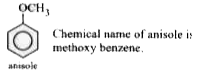 Chemical NAME of anisole is methoxy benzene. Chemical NAME of anisole is methoxy benzene.
|
|
| 28. |
The chemical messengrs transport message between a) Neuron to neuron b) Neuron to muscles c) Enzyme to receptor are d) Enzyme to enzyme Correct answers are |
|
Answer» a only |
|
| 29. |
The chemical messengers transport message between |
|
Answer» NEURON to neuron |
|
| 30. |
The chemical messengers produced in ductless glands are |
|
Answer» VITAMINS |
|
| 31. |
The chemical messengers produced in ductless glands are : |
|
Answer» Vitamins |
|
| 32. |
The chemical messenger produced in the endocrine (duct-less) glands are grouped as: |
|
Answer» Polypeptides |
|
| 33. |
The chemical messangers produced in ductless glands are called : |
|
Answer» LIPIDS |
|
| 34. |
The chemical inertness of nitrogen is due to |
|
Answer» half-FILLED '2p' ORBITALS of Nitrogen |
|
| 37. |
The chemical formula of Zeigler-Natta catalyst is |
| Answer» Answer :D | |
| 39. |
The chemical formula of 'tear gas ' is |
|
Answer» `CoCl_(2)` `CHCl_(3) +HNO_(3)to UNDERSET("(tear gas)")underset("chloropicrin")(C Cl_(3)NO_(2))+H_(2)O` |
|
| 40. |
The chemical formula of phosgene or carbonyl chloride is : |
|
Answer» `PH_3` |
|
| 41. |
The chemical formula of copper pyrite is:CuFeS2,Cu2S,Cu2O,CuCO3.Cu(OH)2 |
|
Answer» `CuFeS_` |
|
| 42. |
The chemical formula of azurite is: |
|
Answer» `2CuCO_3*CU(OH)_2` |
|
| 43. |
The chemical formula for tartar emetic is: |
|
Answer» |
|
| 44. |
The chemical extracted from the plant Rauwalfia serpentina is |
|
Answer» reserphine |
|
| 45. |
The chemical equilibrium of a reversible reaction is not influenced by |
|
Answer» pressure (ii) presence of a catalyst (iii) DIRECTION from which the equilibrium has been attained (iv) presence of INERT MATERIALS. |
|
| 46. |
The chemical elements are arranged in the order of increasing electronegativities in the sequence |
|
Answer» P, Si, Se, Br, N `therefore` Nitrogen is the most electronegative ELEMENT of the given elements. `therefore` The OBSERVED ORDER is Si, P, Se, Br, N. |
|
| 47. |
The chemical compounds used to remove dirt or oily materials from surface are called ..... |
|
Answer» CLEANSING AGENTS |
|
| 48. |
The chemical compounds released by one species of animals in order to influence the behaviour of the other members of the same species are called |
|
Answer» Pheromones |
|
| 49. |
The chemical composition of slag formed during the smelting process in the extraction of copper is :- |
|
Answer» `Cu_(2)O+FeS` |
|