

Saved Bookmarks
This section includes 7 InterviewSolutions, each offering curated multiple-choice questions to sharpen your Current Affairs knowledge and support exam preparation. Choose a topic below to get started.
| 1. |
Match the following : |
|
Answer» ANTIAROMATIC `to` planar, cyclic , (4n) `pie^(-)`, complete conjugation Non aromatic - cyclic structure with non-planar GEOMETRY with any hybridization |
|
| 2. |
Match the following : |
|
Answer» `T_2=298 K,T_1=273 K, E_a=65000 J, R=8.314` J/(mol K) (B)`2.5/20=1/8=(1/2)^nimplies n=3implies t=3xx0.693/0.0693=30` ( C )Zero order :`t_(1//2)=a/(2K) " " I order : t_(1//2)=0.693/K` `1/(2K_1)=0.693/K_2 implies K_2/K_1=2xx0.693` (D)`t_(1//2)prop(a)^(1-n)` or `(1-n)=(logt'_(1//2)-logt''_(1//2))/(loga'-loga'')` `t_(1//2)prop1/a^(n-1)implies 480/240=(0.0677/0.136)^(n-1)" " n=0` |
|
| 3. |
Match the following : |
|
Answer» |
|
| 4. |
Match the following : |
|
Answer» |
|
| 5. |
Match the following : |
|
Answer» |
|
| 6. |
Match the following : |
|
Answer» |
|
| 7. |
Match the followin {:(,"Column -I",,"Column -II (mole fraction of)"),((A),"1 mole " KClO_(3)+"2 mole "KClO_(4),(p),K^(+) "ions is 0.5"),((B),"1 mole "K_(2)CO_(3)+"1 mole "NaNO_(3),(q),HCO_(3)^(-)"ions is 0.166"),((C ),"1 mole "KHCO_(3)+"2 mole "KClO_(4),(r ),Na^(+) "ions is 0.2"),((D),"2 mole "NaClO_(4)+"1 mole "KHCO_(3),(s),ClO_(4)^(-) "ions is 0.33"),(,,(t),"No. of mole of oxygen atom in mixture = 11"):} |
|
Answer» |
|
| 8. |
Match the following : |
|
Answer» |
|
| 9. |
Match the folllwing acids with their pKa values: |
|
Answer» Acidic strength `RCOOHgtH_(2)CO_(3)GT"phenol"gt"Alchol"` Since picric ACID is stronger acid WHOSE pKa value is low |
|
| 10. |
Match the flame colours of the alkaline earth metal salts in the Bunsen burner. {:( (p), "Calcium" ,, 1. "Brick red"), ( (q) , "Strontium" ,, 2. "Apple green"), ((r) , "Barium" ,, 3. "Crimson"):} |
|
Answer» <P>p-1 , q - 3 , r- 2 |
|
| 11. |
Match the extraction processes listed in Column I with metals listed in Column II. {:(,"Column I",,"Column II"),((A),"Self reduction",(p),"Lead"),((B),"Carbon reduction",(q),"Silver"),((C),"Complex formation and displacement by metal",(r),"Copper"),((D),"Decomposition of iodide",(s),"Boron"):} |
|
Answer» |
|
| 12. |
Match the extraction processes listed in column I with metals listed in column II. |
|
Answer» a-p,R, b-p,r, c-Q , d-s |
|
| 13. |
Match the extraction process in column I with the metal in column II. |
| Answer» SOLUTION :A-q,s , B-q,s , C-r , D-p | |
| 14. |
Match the etraction processes listed in column-I with metals listed in column-II |
|
Answer» `A-2,B-1,C-4,D-3` |
|
| 15. |
Match the example given in Column I with the name of the reaction in Column II. |
|
Answer» |
|
| 16. |
Match the extraction processes listed in Column I with metals listed in Column II. {:("Column I","Column II"),(A. "Self reduction",p. "Lead"),(B. "Carbon reduction",q. "Silver"),(C. "Complex formation and displacement by metal ",r. "Copper"),(D. " Decomposition of iodide",s. "Boron"):} |
|
Answer» In head metal `{{:(,2PbS+3O_(2) to2PbO+2SO_(2)("Slef reduction")),(,2PO+PbS to 3Pb+SO_(2)):}` In copper metal `2Cu_(2)S+3O_(2) to 2Cu_(2)O+2SO_(2)` `Cu_(2)S+2Cu_(2) to 6Cu_(2)+2SO_(2)` (Slef reduction) (B) Carbon reduction p- Lead In lead metal `PbO+C to Pb+CO` `PbO+CO to Pb+CO_(2)` Carbon reduction process is used for the reduction of oxides of electropositive METALS like , Fe, Pb etc.This reduction is carried out with coal or coke on strongly heating. (C) Comlex formation and displacement by meta. Insilver metal Average `(Ag_(2)S)` MINERAL of Ag is treated iwth `0.7% NaCN` solution in presence of air, therefore, firstly soldium argentocyanide compled is formed whichon heating with zinc meta, therefore, by displacement silver is isolated `Ag_(2)S+4NaCN to 2Na[Ag(CN)_(2)]+NaS` `2Na[Ag(CN)_(2)]+Zn to underset("soluble")(Na_(2)[Zn(CN)_(4)])+2underset("ppt")(Ag)darr` (D) Decomposition of IODIDE _______ (S) BoronBydecomposition of iodide boron metal is isolated. `2BI_(3)overset("Wm heat")to 2B+3I_(2)` |
|
| 17. |
Match the entries of column I with appropriate entries of column II. Each entry in column I may have one or more than one correct option from column II. If the correct matches are A-p, s , B-r , C-p, q , D-s, then the correctly bubbled 4xx4 matrix should be as follows : {:(,,"Column I (Units/Property)",,,,,,"Column II (Quantity)"),((A),,"mol L"^(-1)s^(-1),,,,(p),,"Zero order rate constant"),((B),,"L mol"^(-1)s^(-1),,,,(q),,"First order rate constant"),((C),,"Does not depend upon initial concentration",,,,(r),,"Second order rate constant"),((D),,"Affected by temperature",,,,(s),,"Rate of reaction"):} |
|
Answer» |
|
| 18. |
Match the entries of column I with appropriate entries of column II. Each entry in column I may have one or more than one correct option from column II. If the correct matches are A-p, s , B-r , C-p, q , D-s, then the correctly bubbled 4xx4 matrix should be as follows : {:(,,"Column I",,,,,,"Column II"),((A),,"Rate constant of an exothermic reaction",,,,(p),,"increases with increase of themperature."),((B),,"Rate constant of an endothermic reaction",,,,(q),,"decreases with increase of temperature."),((C),,"Equilibrium constant of an exothermic reaction",,,,(r),,"not affected by adding catalyst."),((D),,"Equilibrium constant of an endothermic reaction",,,,(s),,"not affected by change of initial concentration."):} |
|
Answer» |
|
| 19. |
Match the entries of Column-I with appropriate entries of Column-II {:("COLUMN - I","COLUMN - II "),("A)" As_2S_3 " sol","p) Lyophobic colloid "),("B) Sulphur sol ","q) Macromolecular colloid "),("C) Starch ","r) Multimolecular colloid "),("D) Soap ","s) Associated colloid "):} |
|
Answer» SULPHUR sol - Multi molecular colloid Starch - Macro Molecular colloid Soap - ASSOCIATED colloid |
|
| 20. |
Match the entries of Column-I with appropriate entries of Column-II {:("COLUMN - I ","COLUMN - II "),("A) Physisorption ","p) Always unimolecular "),("B) Activated adsorption ","q) Multi molecular "),("C) Chemisorption ","r) High temperature is required "),("D) Desorption ","s) Low pressure is required "):} |
|
Answer» ACTIVATED adsorption - High temperature is REQUIRED CHEMISORPTION - Unilayered |
|
| 21. |
Match the entries of Column-I with appropriate entries of Column-II {:("COLUMN - I ","COLUMN - II "),("A) peptization ","p) preparation of sols "),("B) ultra centrifugation ","q) purification of sols "),("C) elctrodialysis ","r) preparation of metal sols "),("D) Bredig's arc method ","s) Movements of ions across the membrane in"),(," presence of electric field "):} |
|
Answer» Ultrafiltration - Purification of sols electro DIALYSIS - purification of sols & movement of lons Bredig.s ARC method - preparation of Metal sols |
|
| 22. |
Match the entries of Column-I with appropriate entries of Column-II {:("COLUMN - I ","COLUMN - II "),("A) Conversion of proteins into amino acids ","p) Shape selective catalysts "),("B) Conversion of Alcohols into gasoline ","q) Enzymatic catalysis "),("C) Polymerisation of ethylene ","r) Zeigler-Natta catalyst "),("D) Manufacture of margarine ","s) Heterogeneous catalysis "):} |
|
Answer» Conversion of Alcohols into gasoline - shape selective that in zeigler-Natta CATALYST Polymerisation of ethylene - Zeigler - Natta catalyst, Heterogeneous Manufacture of MARGARINE - HETEROGENOUS catalysis |
|
| 23. |
Match the entries of column I with appropriate entries of column II and choose the correct option out of the four option (a), (b), (c), (d) given at the end of each question. {:("Column I","Column II"),("(A)German silver and gold jewellery","(p)Elements"),("(B)Antimony and Bismuth","(q)Isomorphs"),("(C)"ZnSO_(4).7H_(2)O and FeSO_(4).7H_(2)O,"(r)Polymorphs"),("(D)Zinc blende and Wurtzite","(s)Mixtures"),("(E)Graphite and Diamond","(t)Metalloids"):} |
|
Answer» A-p, B-r, C-t, D-q, E-s |
|
| 24. |
Match the entries of column I with appropriate entries of column II and choose the correct option out of the four option (a), (b), (c), (d) given at the end of each question. {:("Column I","Column II"),("(A)femto","(p)"10^(9)),("(B)yotta","(q)"10^(-15)),("(C)giga","(r)"10^(-18)),("(D)atto","(s)"10^(24)):} |
|
Answer» A-q, B-p, C-r, D-s |
|
| 25. |
Match the entries of column I with appropriate entries of column II and choose the correct option out of the four option (a), (b), (c ), (d) given at the end of each question. {:(,"Column I",,"Column II"),(,"(Metal ion configuration in strong ligand field)",,("CFSE, "Delta_(0)" value")),(("A"),d^(4),(p),-1.6),(("B"),d^(5),(q),-1.8),(("C"),d^(6),(r),-2.0),(("D"),d^(7),(s),-2.4):} |
|
Answer» A-p, B-s, C-r, D-q |
|
| 26. |
Match the entries of column I with appropriate entries of column II and choose the correct option out of the four options (a), (b), ( c ), (d) given at the end of each question. {:(,,"Column I",,,,,,"Column II"),((A),,"Zero order reactions",,,,(p),,t_(1//2)prop(1)/([A]_(0))),((B),,"First order reactions",,,,(q),,t_(100%)=[A]_(0)//k),((C),,"Second order reactions",,,,(r),,"Involves at least two reactants"),((D),,"Pseudounimolecular reactions",,,,(s),,[A]=[A]_(0)e^(-kt)):} |
|
Answer» `A-s,B-q,C-p,D-r` |
|
| 27. |
Match the entries of column I with appropriate entries of column II and choose the correct option out of the four options (a), (b), ( c ), (d) given at the end of each question. {:(,,"Column I (Reaction)",,,,,,"Column II (Order)"),((A),,2" HI"to H_(2)+I_(2),,,,(p),,0),((B),,2" NH"_(3)to N_(2)+3" H"_(2),,,,(q),,1),((C),,2" H"_(2)"O"_(2)to 2" H"_(2)O+O_(2),,,,(r),,1(1)/(2)),((D),,COCl_(2) to CO+Cl_(2),,,,(s),,2):} |
|
Answer» `A-q,B-p,C-r,D-s` |
|
| 28. |
Match the entries of column I with appropriate entries of column II and choose the correct option out of the four options given. {:("Column I (Substance)","Column II (Solubility)"),("(A) "Li_(2)CO_(3),"(p) Increases continuously with increase of temperature"),("(B)KCl","(q) Decreases continuously with increase of temperature"),("(C) "Na_(2)SO_(4).10H_(2)O,"(r) First increases and then decreases"),("(D) "NH_(4)NO_(3),"(s) Increases but not continuously"):} |
|
Answer» A-s, B-r, C-p, D-q |
|
| 29. |
Match the entries of column I with appropriate entries of column II and choose the correct option out of the four options given. {:("Column I (Solutions mixed)","Column II (Noramolity after mixing)"),("(A) 100 cc of 0.2 N"H_(2)SO_(4)+" 100 cc of 0.1 N HCl","(p) 0.25 N"),("(B) 100 cc of 0.2 M "H_(2)SO_(4)+" 100 cc of 0.1 M HCl","(q) 0.067 N"),("(C) 100 cc of 0.1 M "H_(2)SO_(4)+" 100 cc of 0.1 M NaOH","(r) 0.15 N"),("(D) 100 cc of 0.1 M HCl "+" 50 cc of 0.2 N NaOH","(s) 0.05"):} |
|
Answer» A-r, B-s, C-p, D-q = 20 meq `"100 cc of 0.1 HCL "=100xx0.1" meq = 10 meq"` Total meq = 30, Total volume = 200 cc `therefore"Noramality"=("30 meq")/("200 cc")="0.15 N"` B. `"100 cc of 0.2 M "H_(2)SO_(4)=100xx"0.2 mmol"` = 20 mmol = 40 meq `"1000 cc of 0.1 M HCl "=100xx0.1" mmol"` 10 m MOL = meq `"Normality "=("50 meq")/("200 cc")="2.25 N"` C. `"100 cc of 0.1 M "H_(2)SO_(4)="10 mmol = 20 meq"` `"100 cc of 0.1 M NaOH = 10 mmol = 10 meq"` `"10 meq NaOH will neutralize 10 meq of "H_(2)SO_(4)` `H_(2)SO_(4)" left = 10 meq, Total volume = 200 cc"` `therefore"Noramality "=("10 meq")/("200 cc")=0.05N.` D. `"100 cc of 0.1 N HCl = 10 meq"` `"50 cc of 0.2 N NaOH = 10 meq"` `"10 meq of HCl will completely neutralize 10 meq of NaOH"` `"NACL formed in the solution = 10 meq"` Normality of NaCl in the solution `= ("10 meq")/("150 cc")=0.067 N` |
|
| 30. |
Match the entries of column I with appropriate entries of column II and choose the correct option out of the four options given. {:("Column I (van't Hoff factor)","Column II (Behaviour)"),("(A) "i gt 1,"(p) There is association."),("(B) "i lt 1,"(q) There is dissociation."),("(C) "i=1,"(r) Impossible"),("(D) "i=0,"(s) No association or dissociation"):} |
|
Answer» A-p, B-q, C-s, D-r |
|
| 31. |
Match the entries of column I with appropriate entries of column II and choose the correct option out of the four options given. {:("Column I","Column II"),("For a 5% solution of "H_(2)SO_(4)(d ="1.01 g mL"^(-1)),),("(A) Molarity of the solution","(p) 0.537"),("(B) Molality of the solution","(q) 0.0096"),("(C) Mole fraction of "H_(2)SO_(4),"(r) 0.05"),("(D) Mass fraction of "H_(2)SO_(4),"(s) 0.515"):} |
|
Answer» A-r, B-s, C-p, D-q As `d=1.01" g mL"^(-1)`, volume of 100 g solution `=(100)/(1.01)mL=99mL=0.099L` `"Molarity "=("5/98 MOL")/("0.099 L")="0.515 M"` Mole fraction `=(5//98)/(5//98+95//18)=(0.051)/(0.051+5.278)=0.0096` Mass fraction `=(5)/(100)=0.05`. |
|
| 32. |
Match the entries of column I with appropriate entries of coloumn II. Each entry in column I may have one or more than one correct option from column II. If the correct matches are A-p, s , B-r, C-p, q , D-s, then the correctly bubbled 4 xx 4 matrix should be as follows : {:(,"Column I",,"Column II"),((A),H_(3)PO_(3) overset(Delta)rarr,(p),"One of the products acts as a reducing agent."),((B),PCl_(3) + H_(2)O overset(Delta)rarr,(q),"One of the products is a tribasic non-reducing acid."),((C),NO_(2) + H_(2)O rarr,(r),"Dehydration"),((D),HNO_(3) + P_(4)O_(10) overset(Delta)rarr,(s),"In one of the products, central atom has +5 oxidation state."):} |
|
Answer» |
|
| 33. |
MatchtheentriesofcolumnI with appropriateentriesof column II andchoosethecorrectoption but ofthe fouroptions (a),(b), (c ), (d)givenattheend ofeachquestion.{:(, "Column I",,,"Column II"), ((A), "Zone refining",,(p),"Titanium"),((B),"Mond's process",,(q),"Lead"),((C),"Liquation",,(r),"Nickel"), ((D),"van - Arkel",,(s),"Germanium"):} |
|
Answer» A-r, B-p, C-s, D-q |
|
| 34. |
Match the entries of column I with appropriate entries of coloumn II. Each entry in column I may have one or more than one correct option from column II. If the correct matches are A-p, s , B-r, C-p, q , D-s, then the correctly bubbled 4 xx 4 matrix should be as follows : {:(,"Column I (Reaction)",,"Column II (Product)"),((A),Cu + dil. HNO_(3),(p),NO),((B),Cu + conc. HNO_(3),(q),NO_(2)),((C),Zn + dil. HNO_(3),(r),N_(2)O),((D),Zn + conc. HNO_(3),(s),Cu(NO_(3))_(2)),(,,(t),Zn(NO_(3))_(2)):} |
|
Answer» |
|
| 35. |
Match the entries of column I with appropriate entries of coloumn II. Each entry in column I may have one or more than one correct option from column II. If the correct matches are A-p, s , B-r, C-p, q , D-s, then the correctly bubbled 4 xx 4 matrix should be as follows : {:(,"Column I",,"Column II"),((A),SO_(2),(p),"Basic"),((B),H_(2)SO_(4),(q),"Acidic"),((C),HNO_(3),(r),"Reducing"),((D),NH_(3),(s),"Oxidising"):} |
|
Answer» |
|
| 36. |
MatchtheentriesofcolumnI with appropriateentriesof column II andchoosethecorrectoption but ofthe fouroptions (a),(b), (c ), (d)givenattheend ofeachquestion. {:(, "Column I",,,"Column II"), ((A), "Siderite",,(p),"Zinc"),((B),"Chalcocite",,(q),"Aluminium"),((C),"Calamine",,(r),"Copper"), ((D),"Bauxine",,(s),"Iron"):} |
|
Answer» A-s, B- R, C-p, D-q |
|
| 37. |
Match the entries of column I with appropriate entries of coloumn II and choose the correct option out of the four options (a), (b), (c) and (d) given at the end of each question. {:(,"Column I",,"Column II"),((A),SF_(6),(p),"Undergoes disoproportionation in alkaline medium"),((B),H_(3)PO_(2),(q),"Liberates"Cl_(2)"from KCl"),((C),P_(4),(r),"Does not undergo hydrolysis by water"),((D),F_(2),(s),"Reduces diazonium salts"):} |
|
Answer» A-r, B-s, C-q, D-p |
|
| 38. |
Match the entries of column I with appropriate entries of coloumn II and choose the correct option out of the four options (a), (b), (c) and (d) given at the end of each question. {:(,"Column I",,"Column II"),((A),"Helium",(p),"Ionization energy comparable to"O_(2)),((B),"Argon",(q),"Provides inert atmosphere in metallurgy"),((C),"Neon",(r),"Cryogenic"),((D),"Xenon",(s),"Advertising sign"):} |
|
Answer» A-q, B-s, C-p, D-r |
|
| 39. |
Match the entries of column I with appropriate entries of coloumn II and choose the correct option out of the four options (a), (b), (c) and (d) given at the end of each question. {:(,"Column I",,"Column II"),((A),PCl_(5),(p),"Angular"),((B),IF_(7),(q),"Pyramidal"),((C),H_(3)O^(+),(r),"Trigonal bipyramidal"),((D),ClO_(2),(s),"Pentagonal bipyramidal"):} |
|
Answer» A-r, B-s, C-q, D-p |
|
| 40. |
Match the entries listed in Column I with appropriate listed in Column II. {:(,"Column I",,"Column II"),((A),0.1 M BaCl_(2)" solution",(p),271 K),((B),0.1 M NaCl" solution",(q),270 K),((C ),0.1 M K_(3)[Fe(CN)_(6)]" solution",(r ),268 K),((D),0.1 M Al_(2)(SO_(4))_(3)" solution",(s),269 K):} Given : Freezing point of 0.1 M sucrose solution = 272 K |
|
Answer» `Delta T_(f)` for 0.1 M SUCROSE sol. `=1^(@)(T^(@)=273 K)` (A) `Delta T_(f)` for `0.1 M BaCl_(2)`, i.e., 0.3 M particle conc. `= 3^(@)` (B) `Delta T_(f)` for 0.1 M NACL, i.e., 0.2 M particle conc. `=2^(@)` (C ) `Delta T_(f)` for `0.1 M K_(3)[Fe(CN)_(6)]`, i.e.,0.4 M particle conc. `= 4^(@)C` (D) `Delta T_(f)` for `0.1 M Al_(2)(SO_(4))_(3)`, i.e., 0.5 M particle conc. `= 5^(@)C` |
|
| 41. |
Match the entries listed in Column I with appropriate entries listed in Column II.{:(,"Column I",,"Column II"),((A),"Hess' law",(p),2.303 log.(P_(2))/(P_(1))=(Delta_("vap")H)/(R)((T_(2)-T_(1))/(T_(1)T_(2)))),((B),"Combustion reaction",(q),Delta_("vap")H=88 JK^(-1) mol^(-1)xx"Boiling point in Kelvin"),((C),"Trouton's law",(r),"Exothermic"),((D),"Clausius-Cal-peyron equation",(s),DeltaH" remains the same irrespective steps"):} |
|
Answer» (B) Combustion reactions are exothermic. (C ) `(Delta_(vap)H)/("Boiling POINT in K")=88 J K^(-) mol^(-1)` (D)`2.303 log.(P_(2))/(P_(1))=(Delta_(vap)H)/(T)((T_(2)-T_(1))/(T_(1)T_(2)))` It is clausius-clapeyron equation. |
|
| 42. |
Match the entries listed in Column I with appropriate entries listed in Column II.{:(,"Column I",,"Column II"),((A),"Isothermal process",(p),((delU)/(delV))_(T)=0),((B),-nFoverset(Theta)E,(q),W=-DeltaU),((C),"Adiabatic reaction",(r),DeltaU=0),((D),"van der waals gas",(s),DeltaG^(Theta)),((E),"Ideal gas",(t),((delT)/(delP))_(H)ne0):} |
|
Answer» (B) In adiabatic process, q = 0. Therefore, from the first law of THERMODYNAMIC, `DeltaU=q-w and q=0` `therefore DeltaU=-w` (C ) In isothermal process, `DeltaU=0`, because internal energy is the function of temperature (D) `DeltaG^(Theta)=-nFE^(Theta)` (E) `((delT)/(delP))_(H)NE0` for real GASES. |
|
| 43. |
Match the entries listed in column I with appropriate properties listed in Column II {:(,"Column I",,"Column II"),((A),He,(i),"High electron affinity"),((B),Cl,(ii),"Most electropositive element"),((C),Ca,(iii),"Strongest reducing agent"),((D),Li,(iv),"Highest ionization energy"):} The correct match of contents in Column I with those in Column II |
|
Answer» `{:(A-iii,B-i,C-ii,D-iv):}` |
|
| 44. |
Match the entries listed in Column I with appropriate entries listed in Column II. {:(,"Column I",,"Column II"),((A),"Wilikinson's catalyst",(p),"Polymerisation of alkenes"),((B),V_(2)O_(5)"catalyst",(q),(Ph_(3)P)_(3)RhCl),((C),"Ziegler-Natta catalyst",(r),"Hydrogenation of alkenes"),((D),"Platinum catalyst",(s),"Manufacture of "H_(2)SO_(4)),(,,,"(contact process)"):} |
|
Answer» |
|
| 45. |
Match the entries listed in Column I with appropriate entries listed in Column II {:(A,K_(3)[Fe(CN)_(5)(CO)],p,"Complex having lowest bond length of CO ligand"),(B,K[PtCl_(3)(C_(2)H_(4))],q,"Follow rule of EAN"),(C,Na[Co(CO)_(4)],r,"Complex involvedin synergic bonding"),(D,V(CO)_(6),s,"Complex having highest bond length of Co ligand"):} |
|
Answer» `rarr` DUETO `+2` oxidation state of Fe extent of `d PI (Fe^(II)) rarr pi^(**) (CO)` is poor , hence C-O bondlength is not increased considerably as in `[Co(CO)_(4)]^(-)` and `[V(CO)_(6)]` `rarr `EAN of `Fe=26-2+5 xx2+2= 36 (KR)` `overset(II) (Fe)underset(sigma)overset(pi)hArrCO`, hence synergicbonding is present. (B) `K[PtCl_(3)(CH_(2) = CH_(2))]` EAN of `Pt=78-2+3xx2+2=84`, (At. no. of `Rn=86)` `overset(II) (Pt) underset(pi) overset(pi) hArr (CH_(2)=CH_(2))`, SYNERGIC bonding is present `Pt overset(pi)(larr) (CH_(2)=CH_(2))` 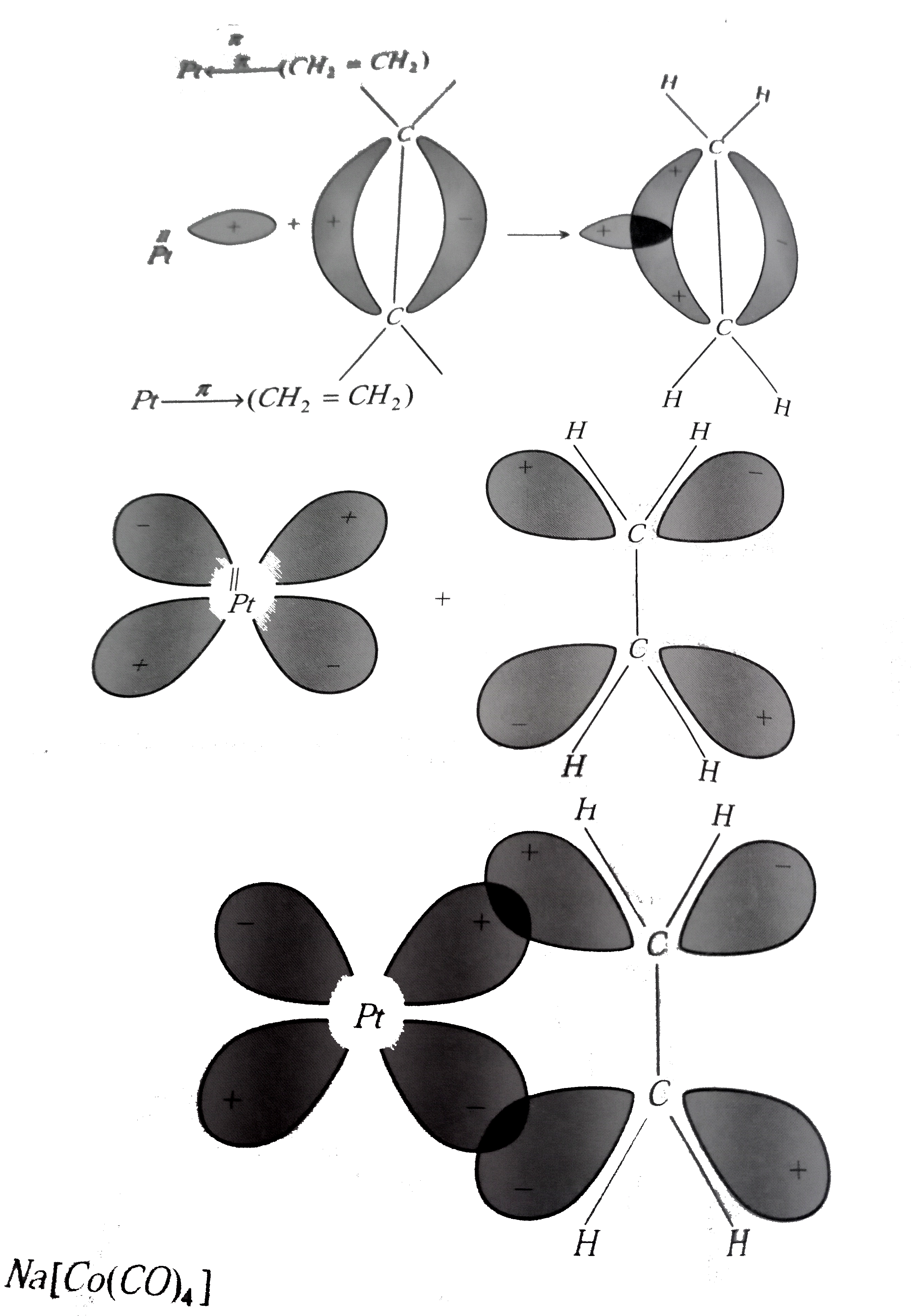 (C ) `Na[Co(CO)_(4)]` EAN of `Co=27+1+4 xx 2 = 36 (Kr)` `Counderset(sigma) overset(pi) hArr CO`, synergic bonding takes place `Co overset(sigma)(larr) CO` 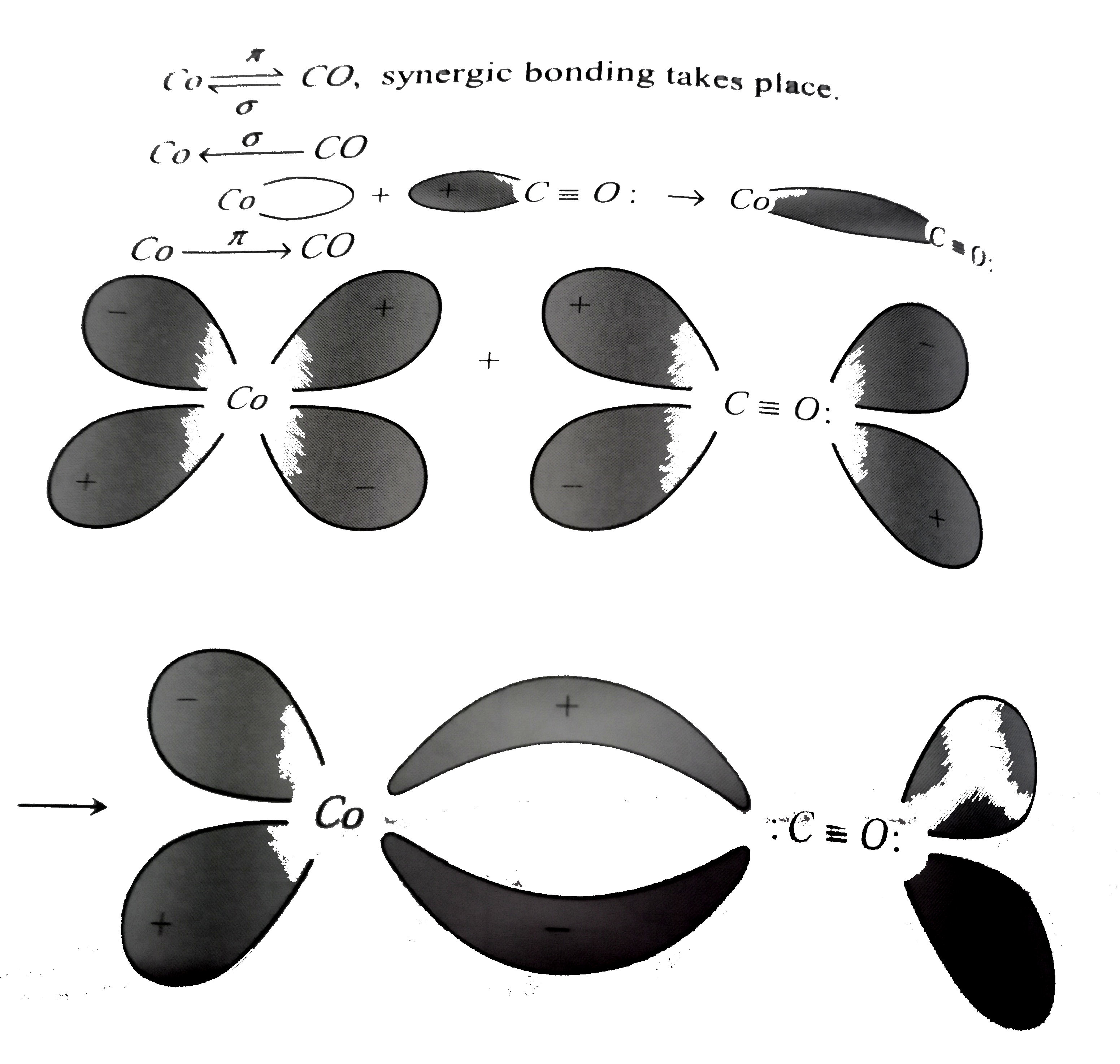
|
|
| 46. |
Match the entries in column I with entriesin Column II and then pick out correct options. Column IColumn II |
|
Answer» <P> |
|
| 47. |
Match the entires in Column I with the correctly related quantum number(s) in Column II. {:(Column I, Column II),("Orbital angular momentum of the electron in a hydrogen-like atomic orbital",p."Principal quantum number"),("A hydrogen-like one-electron wave function obeying Pauli's principle",q."Azimuthal quantum number"),("Shape size and orientation of hydrogen-like atomic orbitals",r."Magnetic quantum number"),("Probability density of electron at the nucleus in hydrogen-like atom",s"Electron spin quantum number"):} |
|
Answer» |
|
| 48. |
Match the effect of addition of 0.1 M KOH to 0.1 M, 50 ml H_3PO_4 Ka_1, Ka_2, Ka_3 are the I,II, III ionisation constant of H_3PO_4 : {:("Column-I","Column-II"),((A)"75 ml of KOH", (p)pH=P^(Ka_1)),((B)"25 ml ofKOH",(q)pH=P^(Ka_2)),((C )"150 ml of KOH",(r)pH=(P^(Ka_2)+P^(Ka_1))/2),((D)"100 ml of KOH",(s)pH=7+1/2[P^(Ka_3)+ logC]),(,(t)pOH=7-1/2[P^(Ka_3)+logC]):} |
|
Answer» 2.5 mmol of `KH_2PO_4` and 2.5 mmol of `K_2HPO_4` are present in a solution.So USING `pH=pKa_2+ log (["salt"])/(["ACID"])` But [salt]=[acid] hence pH=`pKa_2` At 25 ml of `KOH-` 2.5 mmol of `KH_2PO_4` and 2.5 mmol of `H_3PO_4` are present in a solution.So using `pH=pKa_1+log(["salt"])/(["acid"])` But [salt]=[acid] hence pH=`pKa_1` At 150 ml of `KOH-` `K_3PO_4` salt are present in a solution due to which salt hydrolysis will take place hence, `pH=7+1/2[p^k a_3+ log C]` At 100 ml of KOH- `K_2HPO_4` are present in a solution which WORK as amphoteric in a solution so, `pH=(P^Ka_2+P^Ka_3)/2` |
|
| 49. |
Match the description in Column I with graph provided in Column II. For n moles of ideal gas at temperature 'T'. Column IColumn II |
|
Answer» |
|