

Saved Bookmarks
This section includes 7 InterviewSolutions, each offering curated multiple-choice questions to sharpen your Current Affairs knowledge and support exam preparation. Choose a topic below to get started.
| 1. |
What happens when BeCl_2 reacted with LiAlH_4 :- |
| Answer» | |
| 2. |
Lithium metal has a body centred cubic structure. Its density is 0.53g cm^(-3) and its molar mass is 6.94g mol^(-1). Calculate the volume of a unit cell of lithium metal. |
|
Answer» SOLUTION :For bcc unit CELL, Z=2 DENSITY (d)=0.53 G `cm^(-3)` Molar mass, M=6.94 g `mol^(-1)` Mass of an atom = `(6.94)/(6.023 xx 10^(23)) = 1.152 xx 10^(-23)g` Mass of unit cell = `2 xx 1.152 xx 10^(-23) = 2.304 xx 10^(-23) g` Volume of unit cell = `("Mass")/("Density")=(2.304 xx 10^(-23))/(0.53) cm^3` `= 4.35 xx 10^(-23) cm^3` |
|
| 3. |
Lithium metal has a body centred cubic lattice structure with edge length of unit cell 353 pm. Calculate the density of the lithium metal. [Given : Atomic mass of Li = 7 g mol^(-1), N_A = 6.022 xx 10^(23) atom mol^(-1)) |
|
Answer» SOLUTION :`d= (ZM)/(a^3N_A)` Given : `Z= 2` for BCC `M = 7 G mol^(-1)` `a = 352 p m = 352 xx 10^(-10) cm` `N_A = 6.022 xx 10^(23) "ATOMS" mol^(-1)` `d = (2"atoms" xx 7 g mol^(-1))/((352 xx 10^(-10) cm)^(3) xx (6.022 xx 10^(23) "atoms mol"^(-1)))` `= 0.53 g cm^(-3)`. |
|
| 4. |
Answer any five of the following questions. Lithium metal has a body centred cubic lattice structure with edge length of edge unit cell 352 pm. Calculate the density of lithium metal. [Given: Atomic mass of Li = 7 "gmol"^(-1) , N_(A) = 6.022 xx 10^(23) atoms mol""^(-1) ]. |
|
Answer» SOLUTION :`d=(ZxxM)/(a^(3)xxN_(A))` =`(2xx7)/(3.52xx10^(-10))^(3)(6.022xx10^(23))` |
|
| 5. |
Lithium metal crystal has body-centred cubic structure. Its density is 0.53 g cm^(-3) and its molecular mass is 6.94 g mol^(-1). Calculate the volume of a unit cell of lithium metal. [NA = 6.023 xx 10^(23) mol^(-1)] |
|
Answer» Solution :For bcc structure `z=2`. Apply the relation : `d=(zxxM)/(a^(3)xxN_(A)) or a^(3)=(zxxM)/(d xxN_(A))` Substituting the VALUES, we GET `a^(3)=(2xx6.94)/(0.53xx6.023xx10^(23))` or `"VOLUME of unit cell "(a^(3))=(13.88)/(3.192)xx10^(-23)=4.348xx10^(-23)cm^(3)`. |
|
| 6. |
Lithium metal crystallizes in a body-centred cubic crystal. If the length of the side of the unit cell of lithium is 351pm, the atomic radius of the lithium will be |
|
Answer» 300.5 PM |
|
| 7. |
Lithium is the strongest reducing agent among the alkali metals due to the following factor. |
|
Answer» IONISATION energy |
|
| 8. |
Lithium is the strongest reductant is aqueous solutions. Why ? |
| Answer» Solution :Standard POTENTIAL for the reaction `LI^(+)(aq) + E^(-) to Li(s)` is `-3.05 V`. It is least among all reduction POTENTIALS. This is because of high stability of aqueous lithium cation due to greater hydration. SMALLER the reduction potential greater is the reduction ability of the metal. | |
| 9. |
Lithium is generally used as an electrode in high energy density batteries. This is because: |
|
Answer» LITHIUM is the LIGHTEST element |
|
| 10. |
Lithium iodide is: |
|
Answer» Ionic |
|
| 11. |
Lithium has a bcc structure.Its density is 530 kg m^(-3) and its atomic mass is 6.94 g mol^(-1) calculate the edge length of a unit cell of Lithium metal.(N_(A)=6.02xx10^(23)mol^(-1)) |
| Answer» Solution :`0.53=(2xx6.94)/(93xx6.02xx10^(23))=352 pm` | |
| 12. |
Lithium has a bcc structure. Its density is 530 kg.m^(-3) and its atomic mass is 6.94 g.mol^(-1) . Calculate the edge length of a unit cell of Lithium metal. (N_(A) = 6.02 xx10^(23) mol^(-1))- |
|
Answer» 154 pm |
|
| 13. |
Lithium has a bcc structure. Its density is 530 "kg m"^(-3) and its atomic mass is 6.94 "g mol"^(-1). Calculate the edge length of the unit cell of lithium metal (N_A = 6.022 xx 10^23 "mol"^(-1)) |
|
Answer» 527 pm a = 352 pm |
|
| 14. |
Lithium has a bcc structure. Its density is 530 kg n r3 and its atomic mass is 6.94 g mol^(-1).Calculate the edge length of a unit cell of Lithium metal. (NA = 6.02 xx 10^(23) mol^(-1)) |
| Answer» Answer :A | |
| 15. |
Lithium forms body centred cubic structrue.The length of the side of its unit cell is 351 pm.Atomic radius of the lithium will be |
|
Answer» 75 pm `r=(sqrt(3))/(4)a=(sqrt(3))/(4)xx351=152` pm |
|
| 16. |
Lithium forms a b.c.c. lattice. If the lattice constant is 3.50 xx 10^(-10)m and the experimental density is 5.30 xx 10^2 kg m^(-3), calculate the percentage occupancy of Li metal. (Li = 7) |
|
Answer» Solution :We have, theoretical DENSITY `=(zm)/(NV) = (zM)/(NA^(3_))` For a b.c.c. lattice: z = 2 and given that `a = 3.50 xx 10^(-10)` m and `M = 7 xx 10^(-3)` kg/mole. `d_("cal") = 2 xx (7 xx 10^(-3))/(6.022 xx 10^(23) xx (3.50 xx 10^(-10))^(3))` `=5.42 xx 10^(2) kg m^(-3)` `therefore` percentage occupancy `=(rho_("exp")/rho_("cal")) xx 100` `=(5.30 xx 10^(2))/(5.42 xx 10^(2)) xx 100 = 97.78%` |
|
| 17. |
Lithium metal crystallized in a body centred cubic crystal. If the length of the side of the unit cell of lithium is 351 pm, the atomic radius of the lithium will be : |
|
Answer» 152pm ` = sqrt( 3) a = 4r` or `r = ( sqrt( 3))/( 4)a ` ` :. r = ( sqrt( 3))/( 4) XX 351` = 151.98 `pm |
|
| 18. |
Lithium crystallizes in a body - centred cubic crystal .If the length of the unit cell if lithium is 315pm , the atomic radius of the lithium will be |
|
Answer» `300.5` PM `R =(sqrt(3)a)/(4) = (sqrt(3))/(4) XX 351 = 151.8` pm |
|
| 19. |
Lithium borohydride (LiBH_(4)), crystallises in an orthorhombic system with 4 molecules p er unit cell. The unit cell dimensions are : a = 6.81 Å, b = 4.43 Å , c = 717 Å. If the molar mass of LiBH_(4) is 21.76 g mol^(–1) . The density of the crystal is- (A) .668 g cm–3 (B) .585 g cm^(–3)(C) 1.23 g cm^(–3)(D) None |
|
Answer» Solution : (A) We know that, `rho=(ZM)/(NV)` :where V`axxbxxc` `(4XX(21.76 GMO^(-1)))/((6.023xx10^(23)MOL^(-1))xx(6.81xx4.43xx7.17xx10^(-24) cm^(3))` 0.668 `cm^(-3)` |
|
| 20. |
Lithium borohydride crystallizes in an orthorhombic system. With four molecules per unit cell. The unit cell dimensions are a = 6.8 A^@, b = 4.4 A^@ and c = 7.2 A^@. If the molar mass is 21.76, calculate the density of a crystal. |
|
Answer» |
|
| 21. |
Lithium borohydride crystallizes in an orthorhombic system with 4 molecule per unit cell .The unit cell dimensions are a=6.8overset@A,b=4.4overset@A and c=7.2overset@A.If the molar mass is 21.76 then the density of crystals is : |
|
Answer» `0.6708gcm^-3` |
|
| 22. |
Lithium aluminium hydride reacts with silicon tetrachloride to form : |
|
Answer» `LiCl, AlH_(3) and SiH_(4)` `4Li+O_(2)rarr underset("Lithium monoxide")(2Li_(2)O)` `2Na+O_(2)overset(575K)rarr underset("SODIUM peroxide")(Na_(2)O_(2))` `K+O_(2)rarr underset("Potassium SUPEROXIDE")(KO_(2))` |
|
| 23. |
Lithium aluminium hydride acts as |
|
Answer» OXIDISING AGENT `CH_(3) CHO +2H overset(LiAlH_(4))to CH_3CH_(2)OH` |
|
| 24. |
Lithinum is the strogest reductant in aqueous solutions. Why ? |
| Answer» Solution :STANDARD potential for the reaction `Li_((aq))^(+) +e^(-) rarr (Li)_((s))` is `-3.05` V. It is least AMONG all reduction potentials. This is because of high stability of aqueous LITHIUM cation due to GREATER hydration. Smaller the reduction potential is the reduction ability of the METAL. | |
| 26. |
List two major classes of antibiotics with an example of each class. |
|
Answer» SOLUTION :NARROW SPECTRUM : Penicillin. WIDE spectrum: Chloramphenicol |
|
| 27. |
List two major classes of antibiotics and give one example of each class. |
|
Answer» SOLUTION :NARROW SPECTRUM : Penicillin. Wide spectrum : CHLORAMPHENICOL. |
|
| 28. |
List the uses of neon and argon gases. |
|
Answer» Solution :Uses of Neon: (i) Neon is USED in discharge fluorescent bulbs for advertisement display purposes. (ii) Neon bulbs are used in botanical GARDENS and in green HOUSES. (III) Neon is used in voltage regulators and indicators. Uses of Argon : (i) Argon is used for filling electric bulbs. (ii) It is used to provide an inert atmosphere in high temperature metallurgical operations (or welding of METALS or alloys). (iii) Argon is used in rectifiers and in radio valves. |
|
| 29. |
List the uses of Helium, Neon and Argon gases. |
|
Answer» Solution : (a) Uses of He: (i) It is used for filling air ships and balloons. (ii) It is used for providing inert atmosphere. (b) Uses of Neon : (i) It is used in neon DISCHARGE lamps and neon signs which are used for adverising purposes. (ii) It is used in saftey devices for protecting ELECTRICAL instruments because it can carry EXCESSIVELY high currents under high voltage. (c) Uses of Argon. (i) It is used in producing inert atmosphere during welding and EXTRACTION of various metals. (ii) It is used for filling radio-valves, rectifiers and fluorescent tubes. (iii) It is widely used for filling incandescent metal filament electric BULBS. |
|
| 30. |
List the reactions of glucose which cannot be explained by its open chain structure. |
|
Answer» SOLUTION :(i) Despite having the aldehyde group, GLUCOSE does not give 2, 4 DNP test or Schiff.s test. (ii) It does not form hydrogensulphite addition product with `NaHSO_(3)`. The penta ACETATE of glucose does not react with hydroxylamine indicating the absence of free - CHO group. |
|
| 31. |
List the reactions of glucosewhichcannotbe explained by theopen chain structure . |
|
Answer» SOLUTION :Reaction of glucose whichcannotbe explainedby the openchain strctureare given as under . (i) Despite havingan aldehdic group , glucosedoes not give2,4-DNPH testand Schiff.s test. Also it DOESNOT form sodium hydrogensulphuphitecompound. (ii)Pentaacetate of glucosedoes notreact with hydroxyl showingthe absenceof ALDEHYDICGROUP . (iii) Glucoseexists in two forms , `alpha`-from and `beta` - form |
|
| 32. |
List the possible products, in order of devreasing yield, from the reaction of 3-bromo-2, 3-dimethyl pentane with alcoholic KOH. |
Answer» SOLUTION : The order of decreasing YIELD is `A gt B gt C`. According to Satyzeff RULE, more substituted alkene is more stable. |
|
| 33. |
List the important sources of sulphur |
| Answer» Solution :Sulphur occurs both in the free and combined STATES. Its important minerals are GYPSUM `(CaSO_4. 2H_2O)` galena (PBS),ZINC blende (ZnS) and COPPER pyrites `(CuFeS_2)`. | |
| 34. |
List the important uses of salt bridge. |
|
Answer» SOLUTION :Two functions of salt bridge in an electrochemical CELL are : 1. To COMPLETE the cell circuit. 2. To MAINTAIN the electrical neutrality of the solutions in two half-cells and to increase the life of a cell. |
|
| 35. |
List the important sources of sulphur. |
|
Answer» SOLUTION :Sulphur mainly OCCURS in the earth's crust in the combined state primarily in form of sulphates and sulphides. Sulphates : Gypsum, `CaSO_(4).2H_(2)O`, epsom salt, `MgSO_(4).7H_(2)O`, baryte, `BaSO_(4)`, etc. Sulphides. Galena, PbS, zinic blende, ZnS, copper pyrites, `CuFeS_(2)`, iron pyrites, `FeS_(2)`, etc. Traces of sulphur occur as `H_(2)S` and in organic materials such as eggs, PROTEINS, garlic, ONION, mustard, hair and wool. |
|
| 36. |
List the important oxoacids of phosphorus and their formulae . |
Answer» SOLUTION :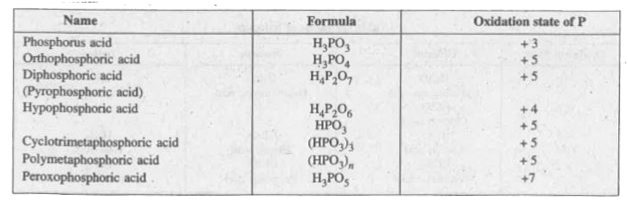 The structure of OXOACIDS of phosphorus R are given below : 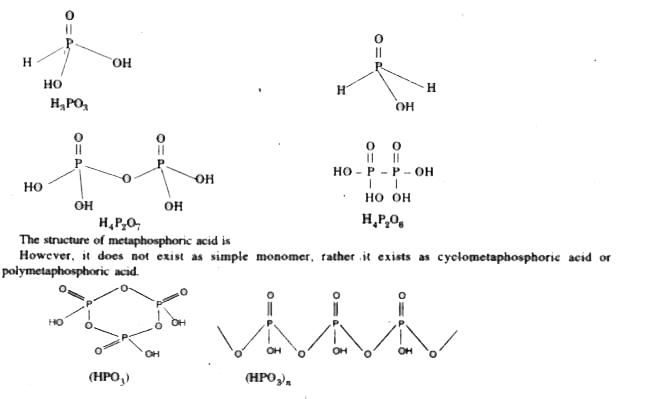
|
|
| 37. |
List the important sources of sulphur . |
|
Answer» Solution :Sulphur occurs in the earth.s CRUST in the combined state primarily in form of SULPHATES and sulphides . As sulphates : GYPSUM, `CaSO_4. 2H_2O `, Epsom salt , `MgSO_4. 7H_2O`, Baryte , `BaSO_4` , etc. As sulphides : Galena , PbS, Zinc blende , ZnS, Copper pyrites , `CuFeS_2,`, Iron pyrites , `FeS_2` , etc. Traces of sulphur occur as `H_2S` and in organic matter such as eggs, proteins , GARLIC, onion , MUSTARD , hair and wool. |
|
| 38. |
List the important oxoacids of phosphorus and give their structures. |
Answer» Solution : Oxoacids of phosphorus. Phosphorus FORMS a number of oxoacids as given below: 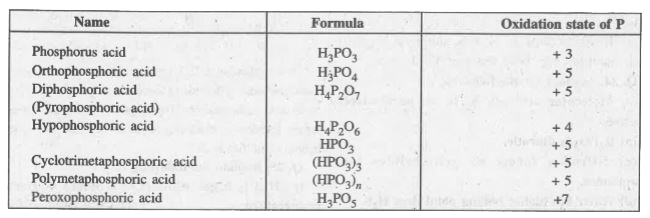 The structures of oxoacids of phosphorus are given below 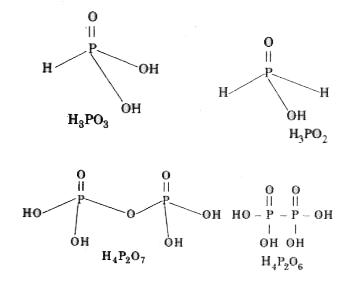 The STRUCTUREOF METAPHOSPHORIC ACID : However , it does not exist as simple monomer , RATHER it existsas cyclometaphosphoric acid or poly-metaphosphoric acid or polymetaphosphoric acid . 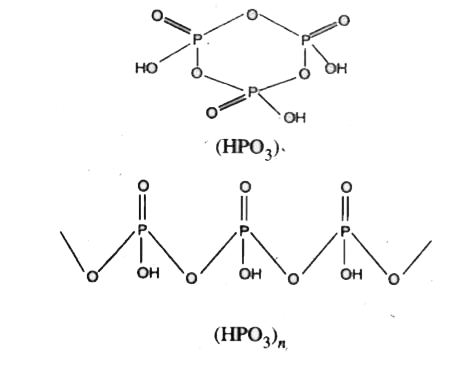
|
|
| 39. |
List the importance of proteins in biologicalprocesses. |
|
Answer» SOLUTION :Importance of proteins : Proteins are the functional units of living things : play vital role in all biological processes (i) All biochemical reactions occur in theliving systems are catalysed by the catalytic proteins called enzymes. (ii) Proteins such as keratin, collagen acts as STRUCTURAL BACK bones. (iii) Proteins are used for transporting. molecules (Haemoglobin), organelles (Kinesins) in the CELL andcontrol the movement of molecules in and out of the cells (Transporters). (iv) Antibodies help the body to fight VARIOUS diseases (v) Proteins are used as messengers to coordinate many functions. Insulin & glucagon controls the glucose level in the blood. (vi) Proteins act as receptors that detect presence of certain signal molecules and activate the proper response. ( vii) Proteins are also used to store metals such as iron (Ferritin) etc |
|
| 40. |
List the hydrogen halide acids in decreasing order of reactivity in the following reaction R-OH + HX to RX + H_2O |
|
Answer» HBr gtHI gtHClgtHF<BR>HIgtHBrgtHClgtHF |
|
| 41. |
List the expected products of hydrolysis of lactose. |
| Answer» SOLUTION :LACTOSE is a dissaccharide so on hydrolysi~ gives two monosaccharides. `C_(12)H_(22)O_(11)+H_(2)O overset(H^+)rarr underset("D(+)Glucose D(+)GALACTOSE ")(C_(6)H_(12)O_(6)+C_(6)H_(12)O_(6))` | |
| 42. |
List the class of alcohols in decreasing order of reactivity towards HX |
|
Answer» `3^@ gt 1^@ gt 2^@ gt ` MEOH |
|
| 43. |
List the cations which are capable of replacing aluminium in alums? |
| Answer» Solution :Cations of about of same size as that of `Al^(3+)` such as `Ti^(3+),Cr^(+3),Mn^(+3),Fe^(3+)` and `Co^(3+)` are capable of replacing ALUMINIUM in ALUMS. | |
| 44. |
List out the wrong among the following according to IUPAC and write the correct formula: (a)[Zn(OH)_4]K_2 , (b)[CoCl(NH_3)_4(H_2O)]Cl_2, (c)[Ag(CN)_2][Ag(NH_3)_2] and (d)[Pt(NH_3)_2Cl(NO_2)]. |
|
Answer» Solution :Formula (a), (b) and (c) are WRONG and only (d) is the CORRECT formula. To correct (a) and (c) formula of cation is to be written first. After correction, the correct formula for (a) and (c) are `K_(2)[ZN(OH)_(4)]` and `[Ag(NH_(3))_(2)][Ag(CN)_(2)]`. To correct (b), ligands are to be in alphabetical order irrespective of charge. After correction, the correct formula of (b) is `[CO(NH_(3))_(4)(H_(2)O)Cl]Cl_(2)` |
|
| 45. |
List -out the common refining methods. |
|
Answer» Solution :(i)DISTILLATION (II)Liquation (III)ELECTROLYTIC refining(iv)Zone refining |
|
| 46. |
List out the common refining methods. |
|
Answer» Solution :COMMON REFINING methods : (i) DISTILLATION (ii) Liquation (iii) Electrolytic refining (iv) Zone refining (V) Vapour phase method |
|
| 47. |
List out the commercial uses of iron. |
|
Answer» SOLUTION :(i) Iron is used in the manufacture of wrought iron and steel. (ii) Cast iron is used for casting STOVES, railway sleepers, toys, ETC. (iii) Stainless steel is used for CYCLES, automobiles, utensils, pens, etc. (iv) Chrome steel is used for cutting tools and crushing MACHINES. |
|
| 48. |
List out the allotropes of tin. |
|
Answer» SOLUTION :(i) Grye tin (II) White in (III) Reombic tin (IV) Sigma tin |
|
| 49. |
List main difference between soap and detergents. |
|
Answer» Solution :Differences between SOAPS and DETERGENTS The MAIN points of differences between soaps and detergents are given below : 
|
|
| 50. |
{:(,"LIST -I",,"LIST -II"),((P),Fe_(2)(C_(2)O_(4))_(3) to Fe_(2)(SO_(4))_(3)+3CO_(2),(1),0.5 M = 5N),((Q),Mg(MnO_(4))_(2) to MgSO_(4)+2MnSO_(4),(2),"nf as oxidant is infinity "),((R),K_(2)Cr_(2)O_(7) to K_(2)CrO_(4),(3),"1 mole = 6 equivalent"),((S),H_(2)O_(2) to H_(2)O + 1/2 O_(2),(4),"nf is 2 for each half reaction "):} |
|
Answer» <P>`{:(P,Q,R,S),(4,3,2,1):}` |
|