Saved Bookmarks
This section includes 7 InterviewSolutions, each offering curated multiple-choice questions to sharpen your Current Affairs knowledge and support exam preparation. Choose a topic below to get started.
| 1. |
Kl and CuSO_(4) solutions when mixed give : |
|
Answer» `CuI_(2) + K_(2)SO_(4)` |
|
| 2. |
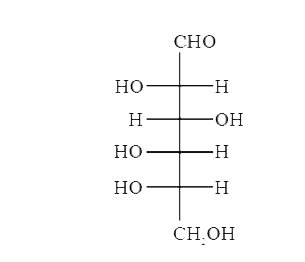
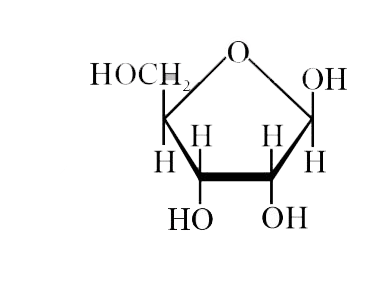
It is convenient at times to represent the cyclicstructures of a monosaccharide without specifying whether the configuration of the anomeric carbon atom is alpha" or "beta. When we do this, we shall use formulas such as the following : ~" Indicates " alpha " or "beta (three-dimensional view not specified) the given is enol form of |
|
Answer» D-glucose |
|
| 3. |
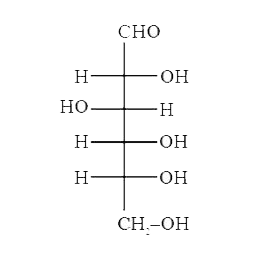
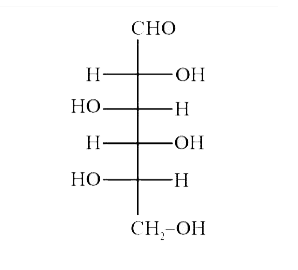
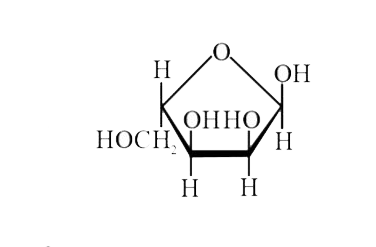
It is convenient at times to represent the cyclicstructures of a monosaccharide without specifying whether the configuration of the anomeric carbon atom is alpha" or "beta. When we do this, we shall use formulas such as the following : ~" Indicates " alpha " or "beta (three-dimensional view not specified) What is the structure of L-Glucose ? |
|
Answer»
|
|
| 4. |
Kl gives a precipitate with all the cations given below. Choose the cation |
|
Answer» `AG^+.Hg_(2)^(2+) PB^(2+)` |
|
| 5. |
Kl when heated with conc. H_(2)SO_(4) gives |
|
Answer» Hl `H_(2)SO_(4) +2HI +2H_(2)O +UNDERSET("Violet vapour")(I_(2)+SO_(2) uarr)` |
|
| 6. |
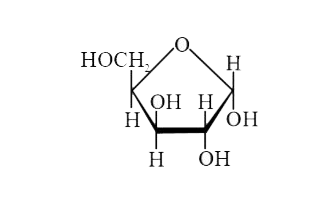
It is convenient at times to represent the cyclicstructures of a monosaccharide without specifying whether the configuration of the anomeric carbon atom is alpha" or "beta. When we do this, we shall use formulas such as the following : ~" Indicates " alpha " or "beta (three-dimensional view not specified) Which of the following represents the anomer of the compound shwon ? |
|
Answer»
|
|
| 7. |
Kjeldahl 's method cannot be used for the estimation of nitrogen in : |
| Answer» Answer :D | |
| 8. |
Kirchoff's equation is |
|
Answer» `LOG""(k_(2))/(k_(1))=(E_(a))/(2.303R)[(1)/(T_(1))-(1)/(T_(2))]` |
|
| 9. |
It is best to carry out reactions with sugars in neutral or acid medium and not in alkaline medium. This is because in alkaline medium sugars undergo one of the following changes |
|
Answer» Racemisaiton |
|
| 10. |
Kinetics of the reaction A (g)to 2" B"(g)+C(g) is followed by measuring the total pressure at different times. It is given that Initial pressure of A = 0.5 atm. Total pressure of A after 2 hours = 0.7 atm. Rate constant of the reaction =1xx10^(-3)s^(-1) What is the rate of reaction -(d[A])/(dt) when the total pressure is 0.7 atm ? |
|
Answer» `2.0xx10^(-4)" M s"^(-1)` Total PRESSURE after 2 hours `= (0*5 -p) + 2 p + p` `=0*5 + 2p` `therefore 0*5 + 2p = 0*7orp = 0*1` atm `therefore` Pressure of A after 2 hours `= 0*5 - 0*1 = 0*4` atm RATE CONSTANT in `s^(-1)` shows that it is a reaction of 1st order. `therefore` Rate after 2 hours `= k[A]= k P` `= (10^(-3)s^(-1))(0*4 " atm ") = 4*0 xx 10^(-4) " atm " s^(-1).` |
|
| 11. |
Kirchhoff's equation is |
|
Answer» `"log"(k_(2))/(k_(1))=(E_(a))/(2.303R)[(1)/(T_(1))-(1)/(T_(2))]` |
|
| 12. |
It is best to carry out reactions with sugars in neutral or acid medium not in alkaline medium. This is because in alkaline medium sugar undergoes one of the following changes. |
|
Answer» Decomposition |
|
| 14. |
It is an experiment fact that Cs_(2)[CuCl_(4)] is orange coloured but NH_(4)_(2)[CuCl_(4)] is yellow. It is further known that total paramagnetic moment of an unpaired electron is due to spin as well as due to nature of orbital, d orbital contributing more than s or p. Thus the total paramagnetic moment of orange compound is found to be more than that of yellow compound. Then which of the following is correct ? |
|
Answer» ANION of ORANGE compound is tetrahedral and that of yellow is square PLANAR |
|
| 15. |
Kinetic of acidic hydrolysis of ester is a pseudo Ist order reaction CH_(3)COOCH_(3)(aq)+H_(2)_(excees)(l) overset [H^(+)] rarr CH_(3)COOH(aq) + CH_(3)OH(aq) Rate law is given by r=K[H^(+)][H_(2)O][CH_(3)COOCH_(3)] K=1.8xx10^(-3)M^(-2)sec^(-1) where H^(+) ion concentration is given by acid catalyst in an experiment 1 M CH_(3)COOCH_(3) is hydrolyscd using 0.1 M HCI as catayst. Reaction mixture is titrated against standard NaOH solution at different times If initially 10 ml Of NaOH was required while after long time 100 ml of NaOH is required then find volume of NaOH required at 230.3 sec |
|
Answer» 91 ml |
|
| 16. |
It is advised to add H_(2)SO_(4) while preparing a standard solution of Mohr's salt to avoid |
|
Answer» Hydration |
|
| 17. |
It is an experimental fact that : DMG+Ni(II)"salt"+NH_(4)OH to "Red precipitate" Which of the following is wrong about this red precepitate ? |
|
Answer» It is a non-ionic complex |
|
| 18. |
Kinetic of acidic hydrolysis of ester is a pseudo Ist order reaction CH_(3)COOCH_(3)(aq)+H_(2)_(excees)(l) overset [H^(+)] rarr CH_(3)COOH(aq) + CH_(3)OH(aq) Rate law is given by r=K[H^(+)][H_(2)O][CH_(3)COOCH_(3)] K=1.8xx10^(-3)M^(-2)sec^(-1) where H^(+) ion concentration is given by acid catalyst in an experiment 1 M CH_(3)COOCH_(3) is hydrolyscd using 0.1 M HCI as catayst. Calculate the time at which ester concentration reduce to 0.25 M [l n2=0.7] (Given Density of pure H_(2)O=1 gm //ml) |
|
Answer» 70 SEC |
|
| 19. |
It is advised to store ehter in brown bottles with the addtions of a small quantity of ethanol. This is done to. |
|
Answer» prevent evaporation |
|
| 20. |
Kinetic theory of gases presumes that collision between the molecules to be perfectly elastic because |
|
Answer» collisions will not split the molecule |
|
| 21. |
It is a rearrangement reaction, its product gives 2,4-DNP test. The only CORRECT combination is : |
|
Answer» <P>(II)(i)(R) 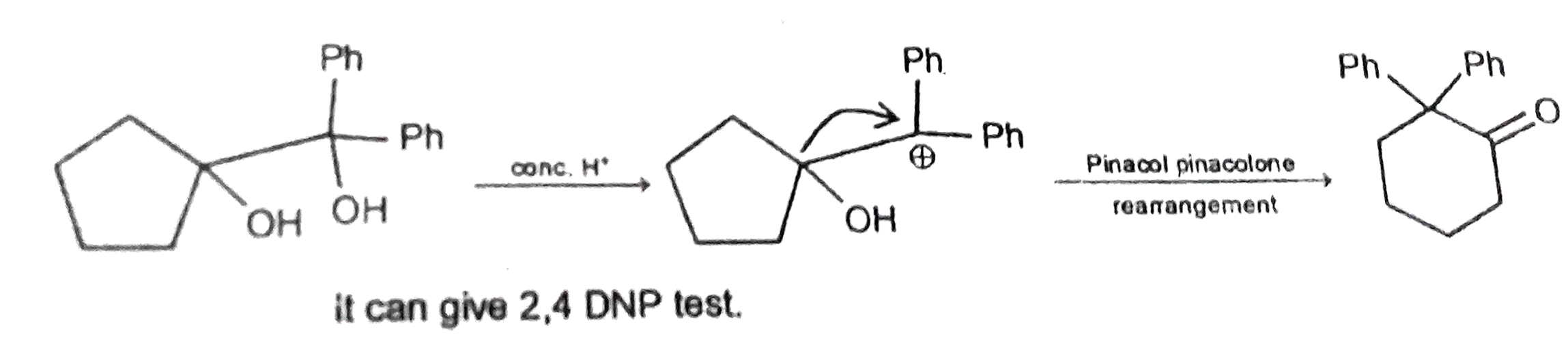
|
|
| 22. |
Kinetic theory of gases assumes thaat tiny particles called molecules : |
|
Answer» CONTAIN AVERAGE KE PROPORTIONAL to ABSOLUTE temperature |
|
| 23. |
It is a powerful acetylating agent for compounds containing -OH group and - NH group. |
|
Answer» `CH_(3)CONH_(2)` |
|
| 24. |
Kinetic energy of one mole of an ideal gas at 300 K in kJ is |
|
Answer» A) 3.74 `=(3)/(2)xx8.314xx300=3741.3` joule=3.74 KJ. |
|
| 25. |
It is a common observation that many compounds containing hydrogen attached to highly electronegative elements such as oxygen, nitrogen, or fluorine, often exhibit unexpected properties, such as relatively high melting points, boiling points, viscosity, solubility in water etc Such an unexpected behaviour can be explained on the basis of hydrogen bonding. When a hydrogen atom is attached to a highly electronegative element of small size such as F. N, 0. etc. the electronegative atoms strongly attracts the shared pair of electrons towards it self. As a result, the hydrogen atom becomes slightly positive and the electronegative element becomes slightly negative when two molecules of such a substance say HF come close to each other, the negatively charged fluorine atom of one molecule attracts the positively charged hydrogen atom of the other molecule. A hydrogen atom, thus links to highly electronegative atoms, one by a strong covalent bond and the other by weak electrostatic attraction as shown ahead overset(delta+)H-overset(delta-)F....overset(delta+)H-overset(delta-)F, the dotted line represents a hydrogen bond. Hydrogen chloride gas dissolves in water due to |
| Answer» Answer :D | |
| 26. |
Kinetic energy of 0.30 moles of He gas In a container of maximum capacity of 4 litres at 5 atmosphere, must be (R = 0.0821 atm litre "mole"^(-1) K^(-1)) |
| Answer» Answer :A | |
| 27. |
It is a common observation that many compounds containing hydrogen attached to highly electronegative elements such as oxygen, nitrogen, or fluorine, often exhibit unexpected properties, such as relatively high melting points, boiling points, viscosity, solubility in water etc Such an unexpected behaviour can be explained on the basis of hydrogen bonding. When a hydrogen atom is attached to a highly electronegative element of small size such as F. N, 0. etc. the electronegative atoms strongly attracts the shared pair of electrons towards it self. As a result, the hydrogen atom becomes slightly positive and the electronegative element becomes slightly negative when two molecules of such a substance say HF come close to each other, the negatively charged fluorine atom of one molecule attracts the positively charged hydrogen atom of the other molecule. A hydrogen atom, thus links to highly electronegative atoms, one by a strong covalent bond and the other by weak electrostatic attraction as shown ahead overset(delta+)H-overset(delta-)F....overset(delta+)H-overset(delta-)F, the dotted line represents a hydrogen bond. Which is most viscous ? |
|
Answer» `CH_3OH` |
|
| 28. |
Killngof mirobs in food by bombardment of gamma rays is |
|
Answer» irradiation |
|
| 29. |
It is a general principle that the less energy a system contains, it is _________ . |
|
Answer» LESS stable |
|
| 30. |
Cassiterite is an one of |
|
Answer» Mn |
|
| 31. |
It is a general principle that the less energy of a system then it is: |
|
Answer» More stable |
|
| 32. |
Kiesserite is an ore of: |
|
Answer» Cu |
|
| 33. |
It has been observed that BF_(3) does not hydrolyses completely whereas BCl_(3) or BBr_(3) get easily hydrolysed to form B(OH)_(3) and HX? Explain. |
| Answer» Solution :The greater stability of `B-F` bond as compared to `B-Cl` and `B-Br` bonds is due to additional `pi-` BONDING in `B-F` bonds of `BF_(3)` molecules.The `B-Cl` and `B-Br` bonds are RELATIVELY WEAK and are easily cleaved by water forming strong `B-OH` bonds instead of stable ADDITION product `(BF_(3).OH_(2))` formed by `BF_(3)`. | |
| 34. |
It has been observed that gaseous hydrogen chloride is a very poor conductor of electricity but a solutionof hydrogen chloride gas in water is a good conductor of electricity. This is due to the fact that |
|
Answer» Water is good conductor of electricity |
|
| 36. |
It has no alpha - hydrogen |
|
Answer» `CH_(3)CH_(2)OH` |
|
| 37. |
KI and surcose solution with 0.1 M concentration have osmotic pressure of 0.465 atm and0.245 atm respectively . Find the van't Hoff of KI and its degree of dissociation |
|
Answer» SOLUTION :For KI solution `pi` = I CRT ` 0.465 = I 0.1 xx R xx T ` For surcrose solution`pi` = CRT ` :. " " 0.245 = 0.1 xx R xx T ` Dividing (i) by (ii) , we GET ` I = (0.465)/(0.245) = 1.898 ` If `alpha`` {:("If "alpha" is he DEGREE of dissociation, ",KI,hArr,K^(+),+,I^(-)),("Initial","1 mole",,,,),("After disso.",1-alpha,,alpha,,alpha):}` Total moles after dissociation ` = (1-alpha) + alpha + alpha = 1 + alpha` `:. i = 1+alphaor alpha = i - 1 = 1.898 -1 =0.898 = 89.8 ` % |
|
| 38. |
KI dissolved in acetone undergoes S_(N^(2)) reaction with each of P,Q,R and S. the reaction rates vary as: . |
|
Answer» <P>`PgtQgtRgtS`  Relative reactivity order towards `S_(N^(2))` reaction is: (S) is maximum rective SINCE electron withdrawing CARBONYL group `(gtC=0)` increases the polarity of `C-Cl` bond (P) is reactive due to least STERIC HINDRANCE. (R) is more reactive than (Q) as there is comparatively less steric hindrance.t his means that Q is the least reactive as has been shown in the reaction rates. |
|
| 39. |
It has been found that the pH of a 0.01 M solution of an organic acid is 4.15. The concentration of the anion of the acid is : |
|
Answer» `4.15` `[H^(+)]//1M=[A^(-)]//1M=` ANTI log `(-pH)` = anti log `(-4.05)` `=7.09xx10^(-5)` `therefore [A^(-)]=[H^(+)]=7.08xx10^(-5)` |
|
| 40. |
It has been found that the pH of a 0.01 M solution of an organic acid is 4.15. Calculate the concentration of the anion, the ionization constant of the acid and its pK_a |
|
Answer» SOLUTION :`HAleftrightarrowH^+` `thereforepH=log[H^+]ORLOG[H^+]=-4.15=5.85` `[A^-]=[H^+]=7.08 times10^-5M` `K_a=([H^+][A^-])/([HA])=((7.08 times10^-5)(7.08 TIMES 10^-5))/10^-2=5.0 times 10^-7` `pK_a=-logK_a=-log(5.0 times10^-7)=7-0.699=6.301` |
|
| 41. |
KI solution is the reagent for : |
|
Answer» `Hg^(2+)` (C )`Ag^(+)+I^(-)toAgIdarr`(bright yellow) , (D)`Cu^(2+)+4I^(-)toCu_2I_2darr` (white) +`I_2` |
|
| 42. |
It has been found that minimum temperature recorded on a hill station is -10^(@)C. The amount of glycerine that must be added to 40dm^(3) water (used in car radiator) so that it does not freeze is: [DeltaH_("fusion") = 6.01 kJ mol^(-1)] |
|
Answer» 39.78 KG |
|
| 43. |
KHF_(2) is known but KHCl_(2)is not known. Gove reasons. |
|
Answer» Solution :SINCE F is much more ELECTRONEGATIVE than Cl, therefore, HF forms hydrogen bonding with `F^(-)` of KFto FORM `KHF_(2)`, i.e., `K^(+) F^(-) HF rarr K^(+) (F^(-) ........ H-F) or KHF_(2)` bit HCl does not form H-bonding with `Cl^(-)` of KCl to form salt of the type `KHCl_(2)` |
|
| 44. |
It has been estimated that the total power radiated by the sun is 3.8 xx 10^(26) J per second . The source of energy of stars is a thermonucleur fission reaction . Energy released in the process of fusion is due to mass defect . Q = Delta mc^(2) In a nuclear reaction , ""_(1)^(2) H + ""_(1)^(2) H to ""_(2)^(3) He + ""_(0)^(1)n . if the masses of ""_(1)^(2) H & ""_(2)^(3) He are 2.014741 amu and 3.016977 amu respectively . then the Q-value of the reaction is nearly : |
|
Answer» 0.00352 Me v `DELTA m = (2 xx 2.01474) - [3.016977 + 1.0086] = (4.029482 - 4.025577)` = `0.003904999` amu , `Q = Delta m xx 931.5 MeV = 3.6375 Me V = 3.63 MeV` |
|
| 45. |
K_(H) value for Ar(g),CO_(2)(g),HCHO(g) and CH_(4)(g) are 40.39, 1.67,1.83xx10^(-5) and 0.413 respectively. Arrange these gases in the order of their increasing solubility. |
|
Answer» `HCHO lt CH_(4) lt CO_(2) lt Ar` |
|
| 46. |
K_(H)" value for Ar(g)," CO_(2)(g),HCHO(g) and CH_(4)(g) are 40.39, 1.67, 1.83xx10^(-5) and 0.413 respectively. |
|
Answer» `HCHOltCH_(4)ltCO_(2)LTAR` |
|
| 47. |
It has been estimated that the total power radiated by the sun is 3.8 xx 10^(26) J per second . The source of energy of stars is a thermonucleur fission reaction . Energy released in the process of fusion is due to mass defect . Q = Delta mc^(2) B.E. per nucleon of ""_(1)^(2) H and ""_(2)^(4) He and 1.1 MeV and 7 MeV respectively . If two deutrons nuclei react to form a single helium nucleus , then the energy released is : |
|
Answer» 13.9 Mev |
|
| 48. |
K_(H) (Henry's constant) value of H_(2) and O_(2) 69.16 k bar, 34.84 k bar respectively at 293K. Which one of them is highly soluble in water. |
| Answer» SOLUTION :OXYGEN GAS. | |
| 49. |
It has been estimated that the total power radiated by the sun is 3.8 xx 10^(26) J per second . The source of energy of stars is a thermonucleur fission reaction . Energy released in the process of fusion is due to mass defect . Q = Delta mc^(2) Mass equivalent to energy 931 Mev is |
|
Answer» `6.023 XX 10^(-27)` kg |
|
| 50. |
K_(H) value for Ar_((g)), CO_(2(g)), HCHO_((g)) and CH_(4(g)) are 40.39, 1.67, 1.83xx10^(-5) and 0.413 respectively. Arrange these gases in the order of their increasing solubility. |
|
Answer» `HCHO lt CH_(4)lt CO_(2)lt Ar` |
|