

Saved Bookmarks
This section includes 7 InterviewSolutions, each offering curated multiple-choice questions to sharpen your Current Affairs knowledge and support exam preparation. Choose a topic below to get started.
| 2. |
Keto-enol tautomerism is observed in : |
|
Answer» `C_(6)H_(5)overset(O)overset(||)(C)-H` |
|
| 3. |
Keto-enol tautomerism is not observed in: |
|
Answer» `C_(6)H_(5)COC_(6)H_(5)` |
|
| 4. |
Isoprene is a valuable subtance for making |
|
Answer» Propene |
|
| 5. |
Isoprene is a valuable substance for making |
|
Answer» propene |
|
| 6. |
Kerosene is used as fuel because it is |
|
Answer» LESS volatile |
|
| 7. |
Write the structure of isoprene (2-methyl -1,3-butadiene). |
|
Answer» STARCH |
|
| 8. |
Isopentane on monochlorination gives....isomers and out of them ....... Are optically active. |
|
Answer» `3,1` 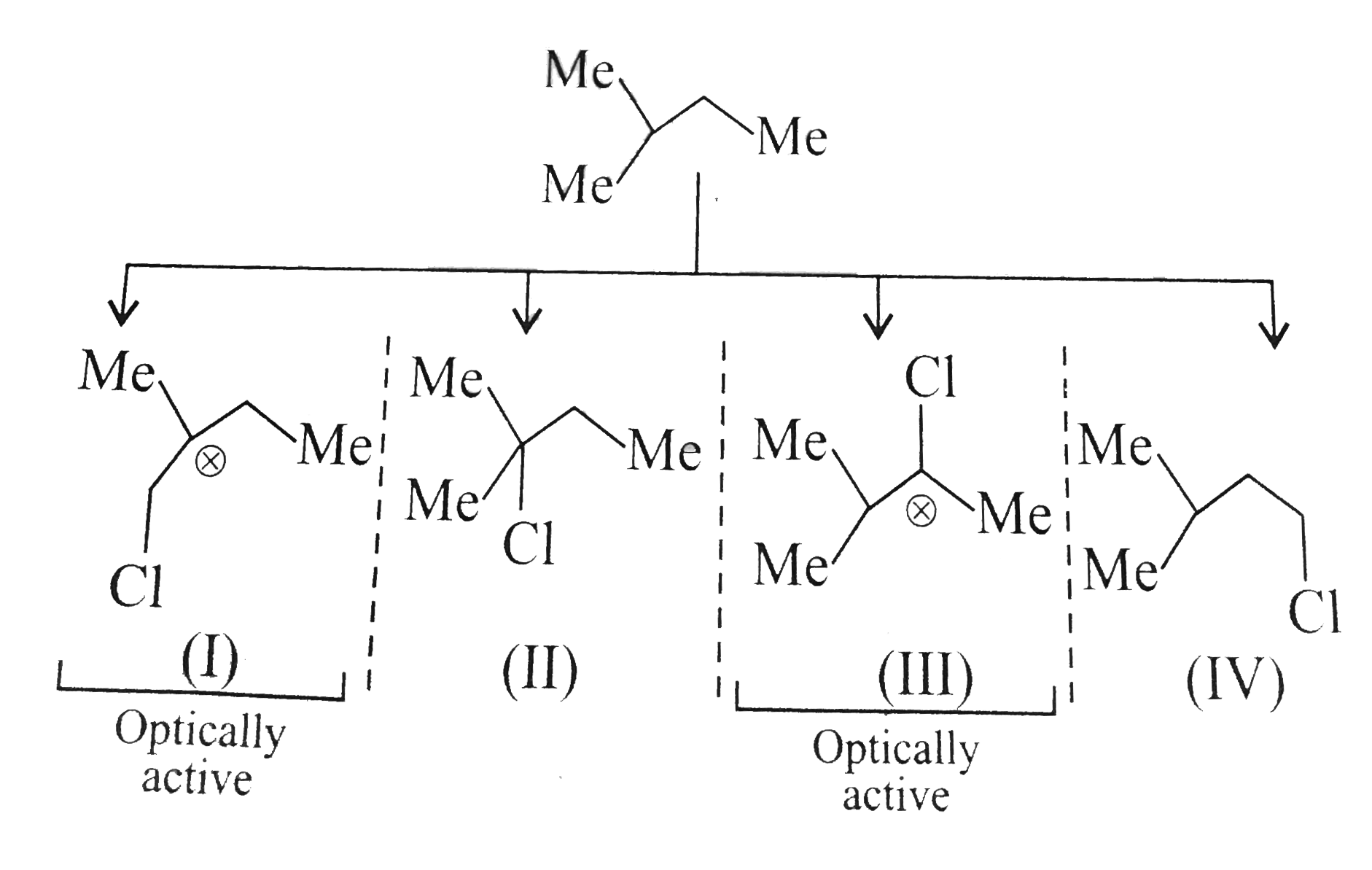
|
|
| 9. |
Keratin presen t in hair is, |
|
Answer» FIBROUS protein |
|
| 10. |
Isopentane, (CH_(3))_(2)CHCH_(2)CH_(3) can form four isomeric monochloro derivatives. How many of these are optically active? |
|
Answer» 1 |
|
| 11. |
Kerosencesi a mixtureof : |
|
Answer» Aromatichydorcarbons |
|
| 12. |
Isonitriles on reduction give |
|
Answer» `1^(@)` amine |
|
| 13. |
Keratin, a structural protein is present in: |
|
Answer» Hair |
|
| 14. |
Keratin, glucosemannose, starch , cellulose . |
| Answer» SOLUTION :Kertain, COLLAGEN , GLYCINE, ALANINE, INULIN , insulin. | |
| 16. |
Keen observation of the rates of reaction about the series of steps leading to the formation of products is called the reaction mechanism . The reaction between H_(2) and I_(2) to form hydrogen iodide was originally postulated as a simple one step reaction H_(2) + I_(2) to 2 HI Rate = k [H_(2)][I_(2)] but the formation of HI has been explained on the basis of the following mechanism ({:( I_(2) , to , 2 I "(fast)" , ... (i) ), ( H_(2) + I , to , H_(2) I "(fast)" , ... (ii)) , (H_(2) I + I , to , 2HI "(slow)" , ... (iii) ):})/("overall" H_(2) + I_(2) to 2 HI For the reaction 2NO_(2) + F_(2) to 2 NO_(2) F following mechanism has been provided NO_(2) + F_(2) overset("slow")(to) NO_(2)F + F NO_(2) + F overset("fast")(to) NO_(2)F Thus rate expression of the above reaction can be written as |
|
Answer» `r = k[NO_(2)]^(2) [F_(2)]` |
|
| 17. |
Keen observation of the rates of reaction about the series of steps leading to the formation of products is called the reaction mechanism . The reaction between H_(2) and I_(2) to form hydrogen iodide was originally postulated as a simple one step reaction H_(2) + I_(2) to 2 HI Rate = k [H_(2)][I_(2)] but the formation of HI has been explained on the basis of the following mechanism ({:( I_(2) , to , 2 I "(fast)" , ... (i) ), ( H_(2) + I , to , H_(2) I "(fast)" , ... (ii)) , (H_(2) I + I , to , 2HI "(slow)" , ... (iii) ):})/("overall" H_(2) + I_(2) to 2 HI For the reaction 2NO(g) + 2H_(2)(g)to N_(2)(g) + 2H_(2)O(g) the rate expressions can be written in the following ways (d[N_(2)])/(dt) = k_(1) [NO] [H_(2)] , (d[H_(2)O])/(dt) = k [NO] [H_(2)] - (d[NO])/(dt) = k'_(1) = [NO] [H_(2)] , - (d[H_(2)])/(dt)= k''_(1) [NO][H_(2)] The relationship between k , k_(1) , k'_(1) , k''_(1)is |
|
Answer» ` k = k_(1) = k'_(1) = k''_(1)` `(1)/(2) k'_(1) [NO] [H_(2)] = (1)/(2) k''_(1) [NO][H_(2)] = k_(1) [NO][H_(2)]` = `(1)/(2) k[NO][H_(2)] therefore k'_(1) = k''_(1) = 2k_(1) = k` |
|
| 18. |
Isomorphism. |
| Answer» SOLUTION :A phenomenon in which TWO or more crystalline substances show same scrystalline structure is CALLED isomophism and the crystals are said to be isomorphous. For example, `K_(2)SO_(4)` and `K_(2)SeO_(4)`. | |
| 19. |
Kerain, collagen, glycine, alanine, inulin, insulin. |
| Answer» SOLUTION :INULIN. It is a carbohydrates WHEREAS others are proteins. | |
| 20. |
K_(e ) for the reaction N_(2)(g)+O_(2) hArr 2NO(g) at 300 K is 4.0xx10^(-6). K_(p) for the above reaction will be (R=2 " cal mol"^(-1)K^(-1)) |
|
Answer» `2.4xx10^(-3)` |
|
| 21. |
Isomers whose molecular structures are non-superimposable mirror images of each other are called : |
|
Answer» DIASTEREOMERS |
|
| 22. |
KE of one mole of He at 0°C is |
|
Answer» 84.43 cal |
|
| 23. |
Isomers which can be interconverted through rotation around a single bond are |
|
Answer» Conformers |
|
| 24. |
The kinetic energy of any gas molecule at 0^@C is : |
|
Answer» 819.0 cal |
|
| 25. |
Isomers which can be interconverted through rotation around a single bond are: |
|
Answer» POSITION isomerws |
|
| 26. |
K_(e ) " for " PCl_(5)(g) hArr PCl_(3) (g)+Cl_(2)(g) is 0.04 at 250^(@)C. How many moles of PCl_(5) must be added to a 3L flask to obtain a Cl_(2) concentration of 0.15 M |
|
Answer» 4.2 MOLES `PCl_(5) HARR PCl_(3)+Cl_(2)` `(x-0.45)/(3) "" (0.45)/(3) (0.45)/(3)` Eqb. CONC. `K_(e )=([PCl_(3)][Cl_(2)])/([PCl_(5)])` `therefore 0.04=(0.15xx0.15)/((x-0.45)//3) "" therefore x=2.1` moles |
|
| 27. |
Isomers which can be inter converted through rotation around a single bond are |
|
Answer» POSITION of ISOMERS |
|
| 28. |
KCN reacts readily to give a cyanide with |
|
Answer» Ethyl alcohol |
|
| 29. |
Isomers of propionic acid are |
|
Answer» `HCOOC_(2)H_(5)` and `CH_(3)COOCH_(3)` |
|
| 30. |
KCN reacts to form cyanide with : |
|
Answer» Ethanol |
|
| 31. |
KCN is used for the separation of : |
|
Answer» `NA^(+) and K^(+) ` |
|
| 32. |
Isomers in coordination chemistry include many types. In structural isomers hydrate or solvent isomers, ionisation isomers and coordination isomers have same overall formula but have different ligands attached to the central atom or ion. The term linkage isomerism or ambidentate isomerism are used for cases of bonding through different through different atoms of the same ligand. Stereoisomers have the same ligands, but differ in the geometric arrangement of the ligands. Ma_(3).b_(3) complex has two geometrical forms(I) Facial (II) Meridonial then which of the following statement is incorrect ? |
|
Answer» In facial isomer THREE same ligands occupy ADJACENT positions on OCTAHEDRON FACE |
|
| 33. |
KCN is used for separting |
|
Answer» `CO^(2+)` and `Ni^(2+)` |
|
| 34. |
Isomers in coordination chemistry include many types. In structural isomers hydrate or solvent isomers, ionisation isomers and coordination isomers have same overall formula but have different ligands attached to the central atom or ion. The term linkage isomerism or ambidentate isomerism are used for cases of bonding through different through different atoms of the same ligand. Stereoisomers have the same ligands, but differ in the geometric arrangement of the ligands. Which of the following is not correctly matched against indicated isomerism ? |
|
Answer» `[Co(NH_(3))_(4)(H_(2)O)Cl]Br,:"Ionisation isomerism"` |
|
| 35. |
KCN is used for separating: |
|
Answer» `Co^(2+)` and `NI^(2+)` |
|
| 36. |
KCN is used for separating |
|
Answer» `CO^(+2)` and `Ni^(+2)` c) `Co^(2+)+2CN^(-) to Co^(2+) underset("Reddul brown ppt")([CN]_(2)darr)""`d)` Ni^(+2)+2CN^(-) to underset("green ppt")(Ni(CN)_(2)darr)` |
|
| 37. |
Isomers have essentially identical : |
|
Answer» STRUCTURAL formula |
|
| 38. |
KCN is highly poisonous while K_(4)[Fe(CN)_(6)] is not. Why ? |
|
Answer» Solution :KCN ionizes to give `CN^(-)` ions which combine with the protein (cytochrome 'c') present in the BLOOD and thereby block the oxygen binding site of the ENZYME resulting into DEATH `KCNrarrK^(+)+CN^(-)` `K_(4)[Fe(CN)_(6)]` ionizes as `K_(4)[Fe(CN)_(6)]rarr4 K^(+)+[Fe(CN)_(6)]^(4-)` The complex ion `[Fe(CN)_(6)]^(4-)` does not ionize to give `CN^(-)`ions. Hence, it is not toxic. |
|
| 39. |
KClO_(3) to KCl + O_(2)(unbalanced), If in above reaction 5 moles of KClO_(3) was heated, then find moles of O_(2) produced on completion of reaction. |
|
Answer» `7.5` |
|
| 40. |
Isomers have essentially identical. |
|
Answer» STRUCTURAL formula |
|
| 41. |
Isomerism shown by CH_(3)-(CH_(2))_(3)-O-CH_(3) CH_(3)-CH_(2)-O-CH_(2)-CH_(2)-CH_(3) CH_(3)-underset(CH_(3))underset(|)(CH)-O-CH_(2)-CH_(3) is |
|
Answer» POSITION isomerism |
|
| 42. |
KClO_3 on heating decomposes to give KCl and O_2 What is the volume of O_2 at N.T.P liberated by 0.1 mole of KClO_3 ? |
|
Answer» |
|
| 43. |
Isomers are different compounds that have the same |
|
Answer» empirical formula |
|
| 44. |
Isomerisom present in CrCl_(3)6H_(2)O is………….. |
|
Answer» SOLVATE isomerism |
|
| 45. |
KClO_(3) overset( "conc. HCl") ( rarr) X_("(g)") + Y_("(g)") X= ? Y= ? |
|
Answer» `O_(2) + Cl_(2) + ClO_(2)` |
|
| 46. |
Isomerization of glucose products |
|
Answer» galactose |
|
| 47. |
Isoomerisms exhibited by [Cr(NH_(3))_(2)(H_(2)O)_(2)Cl_(2)]^(+) are |
|
Answer» Isonisation, OPTICAL |
|
| 48. |
KCl, KNO_(3) etc. are preferred in a salt bridge because they have equal____. |
| Answer» SOLUTION :TRANSPORT NUMBER | |
| 49. |
Isomerism shown by 2,3-dichlorobutane is |
|
Answer» DIASTEREOMERISM 2nd and 3rd carbons are Chiral. |
|
| 50. |
KCl is added to Fe(OH)_3 sol? |
| Answer» Solution :`FE(OH)_3` GETS COAGULATED. | |