Saved Bookmarks
This section includes 7 InterviewSolutions, each offering curated multiple-choice questions to sharpen your Current Affairs knowledge and support exam preparation. Choose a topic below to get started.
| 1. |
In the sequence of reaction: C_6 H_5 NH_2 overset(NaNO_2) underset(HCl) to X overset(H_3 PO_2) underset(Cu^+) to Y. The product Y is: |
|
Answer» `C_(6)H_(5)CHO` 
|
|
| 2. |
In the sequence of reaction . CH_3-CH_2-CH=CH_2 underset((ii)H_2O_2//NaOH)overset((i)B_2H_6//THF)to A overset("conc." H_2SO_4)to B overset(H_3O^+)to C In above reaction A and C are respectively |
|
Answer»
|
|
| 3. |
In the sequence of reaction: phi-OH overset(NaOH) to A overset((i) CO_2, 415K) underset((ii) H_3 O^+) to B overset(Ac_2 O) to C The Product C is |
|
Answer» SALICYCLIC acid 
|
|
| 4. |
In the sequence of following reactions : P underset((2)Sn//HCl)overset((1)Br_(2))toQunderset((2)H_(2)O //H_(3)PO_(2))oversetoverset((1)NaNO_(2)//HCl)("273278K")rarrRunderset(OH^(-))overset(KMnO_(4))to the starting compound P is : |
|
Answer» o- bromotoluene 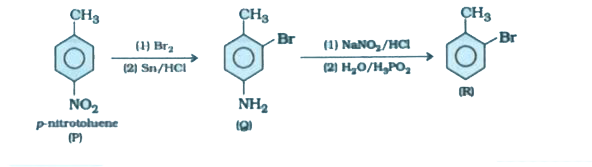
|
|
| 5. |
In the sequence of following reaction the starting compound .P. is |
|
Answer» <P>p - NITRO TOLUENE 
|
|
| 6. |
In the sequence of following nuclear reactions ._(92)X^(238) overset(-alpha)rarr Y overset(-beta)rarr Z overset(-beta)rarr L overset(-nalpha)rarr ._(84)M^(218) the value of n will be |
|
Answer» 3 |
|
| 7. |
In the sequence of following reactions : The starting compound 'P' is |
|
Answer» <P>m - nitrotoluene 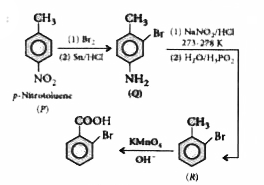
|
|
| 8. |
In the sequence given above Z is |
|
Answer»

|
|
| 9. |
In the separation of ZnS and PbS by froth floatation process, which depressant is used? |
| Answer» SOLUTION :SODIUM CYANIDE. | |
| 10. |
In the separation of Cu^(2+) and Cd^(2+) in II group qualitative analysis of cations tetramine copper (II) sulphate and tetramine cadium (II) sulphate react with KCN to form the corresponding cyano complexes. Which one of the following pairs of the complexes and their relative stability enables the separation of Cu^(2+) and Cd^(2+)? |
|
Answer» `K_(3)[Cu(CN)_(4)]` is PERFECT and `K_(2)[Cd(CN)_(4)]` is inperfect COMPLEX |
|
| 11. |
In the separation of Cu^(2+) and Cd^(2+) in 2nd group qualitiative analysis of cations, tetrammine copper (II) sulphate and tetrammine cadmium (II) sulphate react with KCN to form the corresponding cyano complexes. Which one of the following pairs of the complexes and their relaive stability enalbles the separation of Cu^(2+) ad Cd^(2+) ? |
|
Answer» `K_2[CU(CN)_4]` more stable and `K_2[Cd(CN)_4]` LESS stable |
|
| 12. |
In the second group of qualitative analysis, H_(2)S is passed through a solution acidified with HCl in order to |
|
Answer» Increase the CONCENTRATION to `S^(2-)` ions |
|
| 13. |
In the same time required for 5 litres of carbon monoxide to diffuse through a porous barrier, only 2 litres of an unknown gas will pass through . The molecular mass of unknown gas is : |
|
Answer» 70 `( rate ( CO_(2)))/( "rate( unknown gas )")= ( 5//t)/( 2 //t)` `= sqrt(("M ( unknown gas)")/(44))` `= ( 25)/( 4) = ( "M ( unknown gas)")/( 44)` `:. ` M (unknown gas ) = `( 25 XX 44)/( 4) = 175` |
|
| 14. |
In the ring test of NO_(3)ion, Fe^(2+) ion reduces nitrate ion to nitric oxide, which combines with Fe_(aq)^(2+)ion to form brown complex. Write the reactions involved in the formation of brown ring. |
|
Answer» Solution :`NO_(3)^(-) + 3FE^(2+) + 4H^(+) to NO + 3Fe^(3+) + 2H_(2)O` `[Fe(H_(2)O)_(6)]^(2+) + NO to [Fe(H_(2)O)_(5)(NO)]^(2+) + H_(2)O` |
|
| 15. |
In the ring test of NO_3^(-) ion, Fe^(2+) ion reduces nitrate ion to nitric oxide, which combines with Fe^(2+) complex. Write the reactions involved in the formation of brown ring. |
|
Answer» SOLUTION :The reactions INVOLVED are : `NO_3^(-) + 3FE^(2+) + 4H^(+) to NO + 3Fe^(3+) + 2H_2O` `[Fe(H_2O)_6]^(2+) + NO to underset("Brown COMPLEX ")([Fe(H_2O)_5(NO)]^(2+))+H_2O` |
|
| 16. |
In the ring test of NO_(3)^(-) ion, Fe^(2+) ion reduces nitrate ion to nitric oxide, which combines with Fe^(2+) (aq) ion to form brown complex. Write the reactions involved in the formation of brown ring. |
| Answer» Solution :`{:(underset("Nitrate ion")(NO_(3)^(-)(AQ))+3Fe^(2+)+4H^(+)(aq) rarr underset("Nitric OXIDE")(NO(g))+3Fe^(3+)(aq)+3H_(2)O(L)),(""[Fe(H_(2)O)_(6)]^(2+) + NO(g) rarr underset("(Brown COMPLEX)")underset("Pentaaquanitrosonium iron (I)")([Fe(H_(2)O)_(5)NO]^(2+))+H_(2)O):}` | |
| 17. |
In the ring test for nitrate, which complexcompound is formed? |
| Answer» SOLUTION :`[FE(O_2O)_5NO]SO_4` | |
| 18. |
In the ring test for identification of nitrate ion, what is the formula of the compound responsible for the brown ring formed at the interface of two liquids ? |
| Answer» SOLUTION :`[FE(H_2O)_5NO]^(2+)SO_(4)^(2-)` | |
| 19. |
In the ring test for identification of nitrate ion, what is the formula of the compound responsible for the brown ring formed at the interface fo the two liquids ? |
|
Answer» Solution :The formula of the COMPOUND respondible for brown ring in the ring test for identification of nitrate ION is : `[Fe(H_(2)O)_(5)NO]^(2+) SO_(4)^(2-)`, Pentaaquanitrosoniumiron (I) SULPHATE |
|
| 20. |
In the reversible reaction a catalyst is the substance which |
|
Answer» increases the rate of the forward reaction |
|
| 21. |
In the reversible reaction, 2NO_(2)overset(k_(1))underset(k_(2))iff N_(2)O_(4), the rate of disppearance of NO_(2) is equal to |
|
Answer» `(2k_(1))/(k_(2))[NO_(2)]^(2)` `=k_(1)[NO_(2)]^(2) -k_(2)[N_(2)O_(4)]` `therefore` Rate of DISAPPERANCE of `NO_(2)` `= (d[NO_(2)])/(dt) = 2 k_(1)[NO_(2)]^(2) - 2k_(2) [N_(2)O_(4)]` |
|
| 22. |
In the reversible reaction2NO_(2) underset(k_(2))overset(k_(1))(hArr)N_(2)O_(4) the rate of disappearance of NO_(2) is equal to |
|
Answer» `(2k_(1))/(k_(2))[NO_(2)]^(2)` |
|
| 23. |
For the equilibrium reaction H_(2(g))+I_(2(g))hArr 2HI_((g)) |
| Answer» Answer :C | |
| 24. |
In the reversible reaction 2HIhArrH_(2)+I_(2),K_(p) is |
| Answer» Answer :C | |
| 25. |
In the reverberatory furnace : |
|
Answer» The flames donot COME in contact with the CHARGE |
|
| 26. |
In the reversible gaseous reaction , A + 2B hArr C+3D The partial pressure of A B C and D are 0.20 , 0.10 , 0.30 ,0.50 atm respectively at equilibrium. The numerical value of K_p is : |
|
Answer» 11.25 |
|
| 27. |
In the respect of the equation k=Ae^(-E_(a)//RT) is chemical kinetics, which one of the following statement is correct ? |
|
Answer» K is equilibrium constant |
|
| 28. |
In the resonating structure of aniline, the number of sigma and pi bonds are respectively |
|
Answer» `12, sigma, 3 PI` 
|
|
| 29. |
In the replacement reaction gtunderset(|)(C)-I+Mfto gt underset(|)(C)-F+MI the reaction will be most favourable if M happens to be |
|
Answer» Na |
|
| 30. |
In therelationship molecular formula = empirical formula xx n . The 'n' may have : |
|
Answer» Any value |
|
| 31. |
In the reduction,R -CHO + H_2 rarrRCH_OH the catalyst used is : |
|
Answer» Ni |
|
| 32. |
In the reduction of nitrobenzene, which of the following is the intermediate ? |
|
Answer» `C_(6)H_(5)N=O` |
|
| 33. |
In the reduction of KMnO_(4) (molar mass = 158) in the presence of dil . Sulphuric acid to manganese salt , the equivalent weight of KMnO_(4) is : |
|
Answer» 158 |
|
| 34. |
In the reduction of HNO_3 to N_2O the number of mole of electrons involved per mole of HNO_3 is: |
|
Answer» 8 |
|
| 35. |
In the reduction of dichromate by FE(II), THE number of electrons involved per chromium atom is: |
|
Answer» 3 |
|
| 36. |
In the redox reaction xKMnO_(4)+NH_(3)toyKNO_(3)+MnO_(2)+KOH+H_(2)O |
|
Answer» x=4 , y =6 |
|
| 37. |
In the redox reaction : KMnO_4 + NH_3 to KNO_3 + MnO_2 + KOH + H_2O the stoichiometric coeffcients of potassium permanganate and ammonia are repectively : |
|
Answer» 4,6 |
|
| 38. |
In the redox reaction 2MnO_4^(-) + 5C_2 O The ion acting as autocatalyst is: |
|
Answer» `MnO_3` |
|
| 39. |
In the reaction with CH_3I, the most reactive nucleophile among the following is |
|
Answer» ` F^(-) ` |
|
| 40. |
In the reactions, where enthalpy value determination is difficult by experiments, the enthalpy value can be calculated by |
| Answer» Solution : Hess.s law | |
| 41. |
In the reactions, K_(2)Cr_(2)O_(7)+KCl+"conc."H_(2)SO_(4)overset("heat")(rarr)Aoverset(NaOH)(rarr)B. 'A' is reddish brown gas soluble in NaOH forming B. A and B are |
|
Answer» |
|
| 42. |
In the reactions C(s)+CO_(2)(g)hArr2CO(g) the equlibrium pressure is 12 atm. If 50% of the CO_(2) reacts, then |
|
Answer» `K_(p)` will be equal to 4 `[thereforeP_(CO_(2))=1/2P_(CO)]` `3/2P_(CO)=12impliesP_(CO)=(2xx12)/(3)=8` `impliesK_(p)=((P_(CO))^(2))/((P_(CO_(2))))=(8xx8)/(4)=16""["Initially only" CO_(2)` was present, therefore initial pressure =8] Hence CHOICES (B), (c), (d) are correct while (a) is incorrect. |
|
| 43. |
In the reactions : |
|
Answer» A is an ALDEHYDE , B is ketone ANDC is an ALKENE |
|
| 44. |
In the reaction,2Na_2S_2O_3 +I_2 rarrNa_2S_4O_6 +2NaI the oxidation state of sulphur is : |
|
Answer» Decreased |
|
| 45. |
In the reaction,C +4HNO_3 rarrCO_2 +2H_2O +4NO_2,HNO_3 acts as : |
|
Answer» An OXIDISING agent |
|
| 46. |
In the reaction2H_2+O_2 to 2H_2O, which is the catalyst and catalyst poison ? |
|
Answer» Solution :(i)` 2H_2 + O_2 OVERSET(Pt) to 2H_2O`Pt - CATALYST (II) `CO` act as catalytic poison for Pt catalyst . |
|
| 47. |
In the reaction , Zn(s)+PbCl_(2)(aq)toPb(s)+ZnCl_(2)(aq)the reducing agent is |
|
Answer» PB (s) |
|
| 48. |
In the reaction ZnO + C to Zn + CO 'C' acts as |
|
Answer» an acid |
|
| 49. |
In the reaction x A rarr yB, log{-(d[A])/(dt)}=log{+(d[B])/(dt)}+0.3 Then, x:y is |
|
Answer» `2:1` |
|
| 50. |
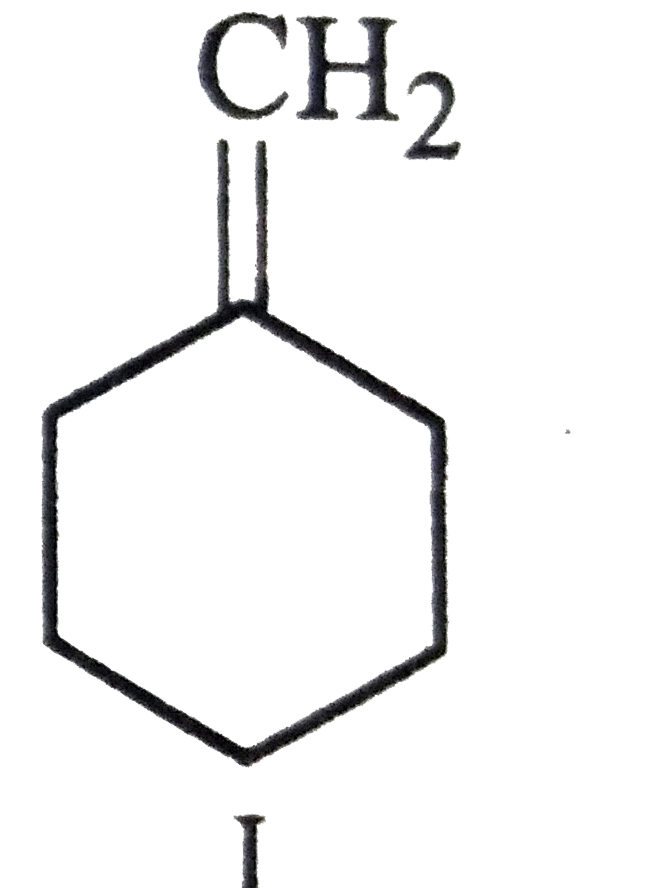
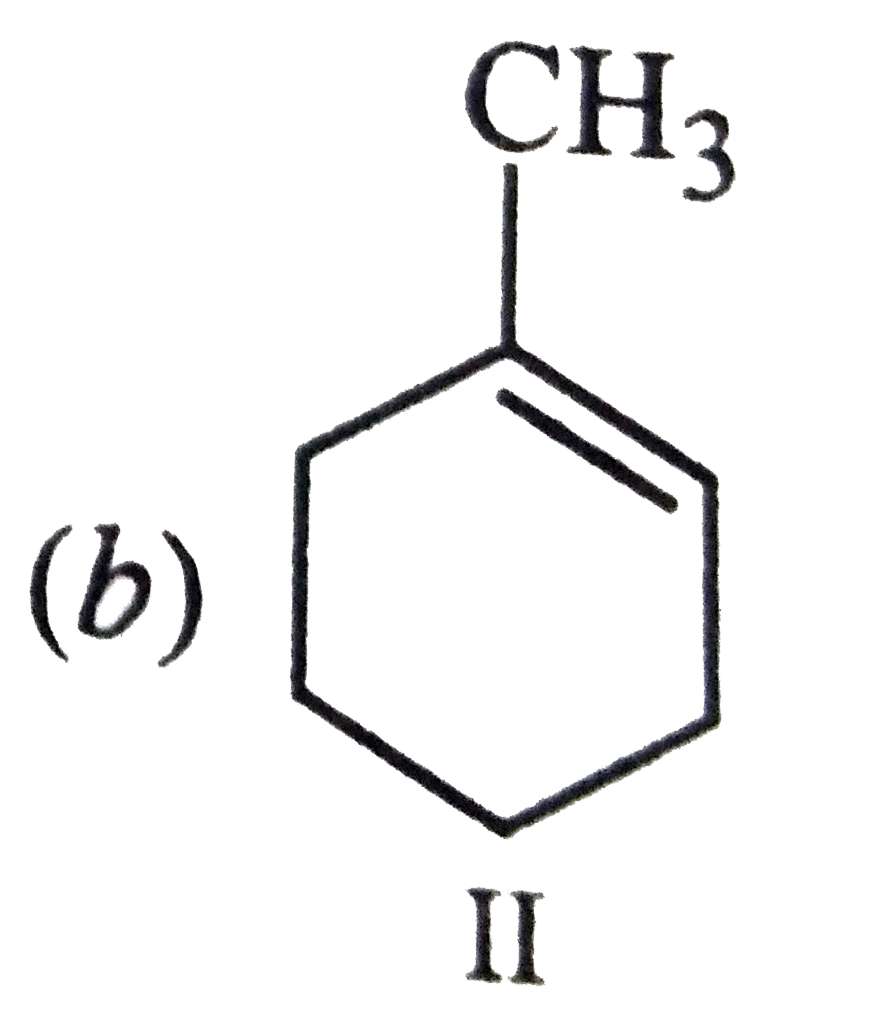
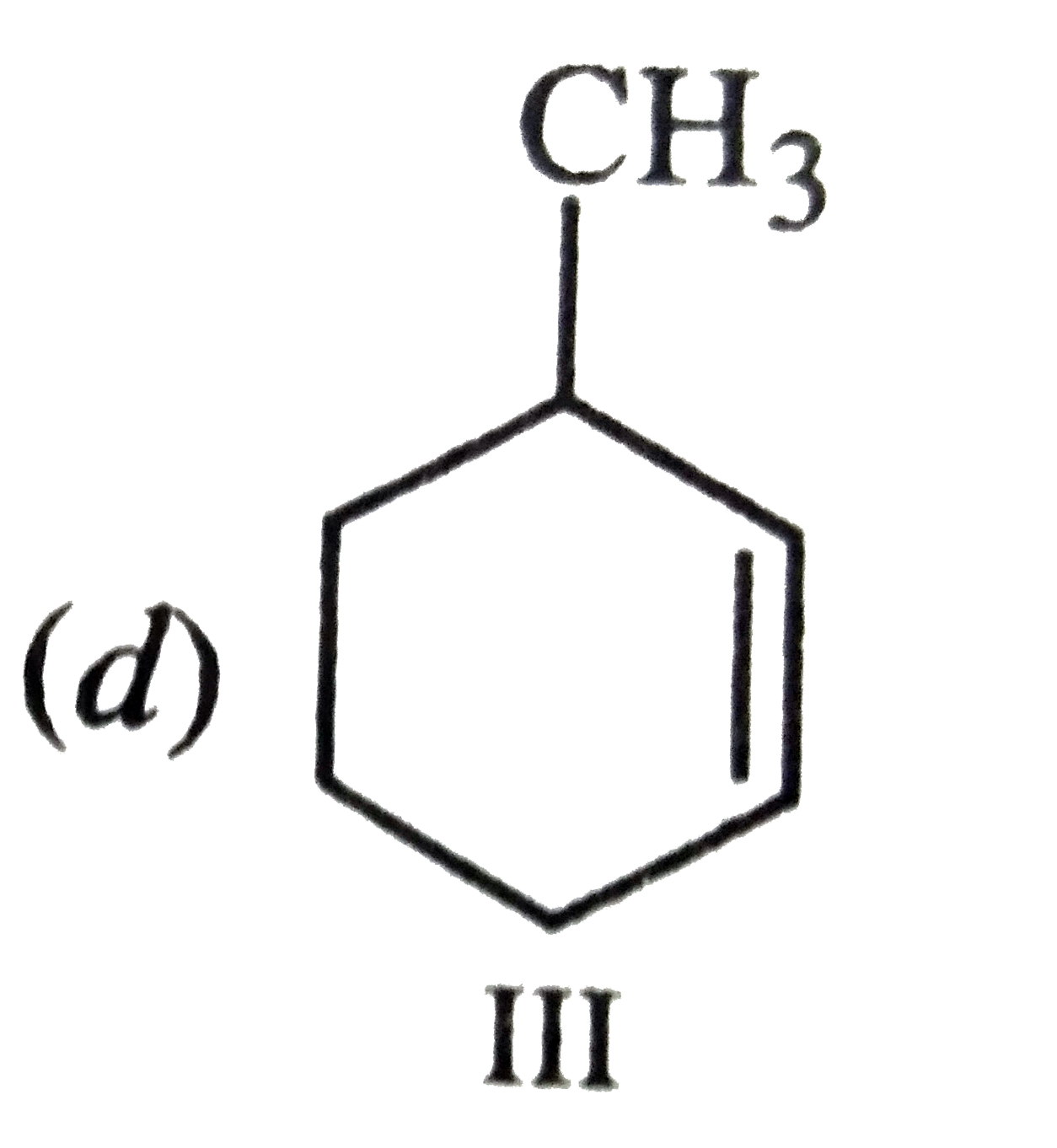
In the reaction with HCl, an alkene reacts in accordance with the Markownikov's rule to give a product 1-chloro-1-methylcyclohexane. The possible alkene is: |
|
Answer»
|
|