

Saved Bookmarks
This section includes 7 InterviewSolutions, each offering curated multiple-choice questions to sharpen your Current Affairs knowledge and support exam preparation. Choose a topic below to get started.
| 1. |
In the above problem: |
|
Answer» WORK DONE by gas in `I^(st)` sample `GT` work done by gas in `II^(ND)` gas |
|
| 2. |
In the above problem (243) what would be to the state of equilibrium during the course of effusion? |
|
Answer» REMAINS same |
|
| 3. |
In the above Maxwellian plot at two different temperatures which of the following statements may be true? |
|
Answer» Area under the two plots is the same |
|
| 4. |
In the above molecule, the chiral centres are |
|
Answer» both X and y |
|
| 5. |
In the 5f series highest oxidation state is exhibited by |
|
Answer» U and NP |
|
| 6. |
In the |
|
Answer» |
|
| 7. |
In the 3d series, the .enthalpy of atomisation of zinc is the lowest (126kJmol^-1). Why? |
| Answer» Solution :In the 3d series, zinc ALONE has no unpaired electrons arid its outer ELECTRONIC CONFIGURATION is `3d^(10)4s^2`. SO zinc has the least interatomic interaction and*weakest metallicbonding. Therefore, the ENTHALPY of ATOMISATION is the lowest for zinc. | |
| 8. |
In th reaction CH_3COOC_2H_5 + H_2O to CH_3COOH + C_2H_5OH............... is actas auto catalyst . |
| Answer» SOLUTION :`CH_3COOH` | |
| 9. |
In the |
|
Answer» `CH_(3)CN` |
|
| 10. |
In tetrahedral permagnate ion pi bonding type between metal and oxygen is : |
|
Answer» <P>`p^(PI) - p^(pi)` |
|
| 11. |
In test of NO_(3)^(-) ion, the dark brown ring complex is forme,d which is true of thic complex? |
|
Answer» the colour is due to CHARGE transfer SPECTRA |
|
| 12. |
In test of NO_(3)^(-) in the dark brown ring complex is formed, which is true of this complex |
|
Answer» COLOUR in due to charge transfer phenomenon `NO_(3)^(-)+H_(2)SO_(4)toHSO_(4)^(-)+HNO_(3)` `6FeSO_(4)+2HNO_(3)+3H_(2)SO_(4)to3Fe_(2)(SO_(4))_(3)+4H_(2)O+2NO` `[Fe(H_(2)O)_(6)]SO_(4)+NOto[UNDERSET("Brown ring")(OVERSET(o+)barFe(H_(2)O)_(5)overset(o+)NO)]SO_(4)^(2-).H_(2)O` |
|
| 13. |
In tertiary aminesthe valencyof nitrogenatom is |
|
Answer» 3 |
|
| 14. |
In terms of SI base units , ohm stands for |
|
Answer» `(kg m^(2)) //(As)` `Omega = (V)/(A) = ("WORK")/("charge") xx (1)/(A) = (F xx l )/(A xx s) xx (1)/(A)` `= (m xx a xx l)/(A^(2) s) = (kg ms^(-2) xx m)/(A^(2) s) = (kg. m^(2))/(A^(2) .s^(3))` |
|
| 15. |
In terms of polar of the following order is correct ? |
|
Answer» `NH_(3)ltH_(2)OgtHFltH_(2)S` |
|
| 17. |
In terms of relative stability, which of the following is in general, wrong : |
|
Answer» 1. tertiary free radicals are more STABLE than SECONDARY. |
|
| 18. |
In terms of osmotic pressure (pi) and volume of the solution (V) containing n moles of the solute, van't Hoff factor (i) at temperature T = …………….. . |
| Answer» SOLUTION :`pi=i(N)/(V)RT or i=(PIV)/(NRT)` | |
| 19. |
In terms of band theory write the differences between conductor and insulator. |
| Answer» Solution :In conductors small energy GAP between CONDUCTION and VALENCE BAND. In INSULATOR, large gap between conductionband and valence band. | |
| 20. |
In terms of band theory, what is the difference (i) between a conductor and an insulator (ii) between a conductor and a semiconductor ? |
|
Answer» Solution :(i) As PER Band.s THEORY, the FORBIDDEN GAP between valance and conduction band in insulator is very large while in conductor, these bands overlap and have no forbidden gap. (ii) The forbidden gap in SEMICONDUCTORS are small while in conductors there is no forbidden gap. |
|
| 21. |
In terms of band theory, what is the difference (i) between a conductor and an insulator, (ii) between a conductor and a semiconductor ? |
|
Answer» Solution :(i) In a conductor, the energy GAP between the valence band and CONDUCTION band is very small or there is an overlapping between conduction and valence BANDS. In an insulator, this gap is LARGE. (ii) If the energy gap between valence and conduction bands is small, it is a semiconductor. If the gap is very small (or there is overlapping between the valence and conduction bands),it is a conductor. |
|
| 22. |
In terms of band theory, explain the difference between a conductor and a semiconductor and give one example of each. |
|
Answer» Solution :Conductor : Solids which have conductivities in the range of `10^(4)` to `10^(7)"ohm"^(-1)m^(-1)` are called conductors. Metals have conductivities of the order of `10^(7)"ohm"^(-1)m^(-1)`. The ATOMIC orbitals of metal atoms form molecular orbitals which are close in energy to each other so as to form a band. If the band is partially filled or it overlaps with a higher energy unoccupied conduction band, then electrons can easily flow to the conduction band. Semiconductor : Solids which SHOW conductivity in the range `10^(-20)` to `10^(-10)ohm^(-1)m^(-1)` are called SEMICONDUCTORS. The gap between the valence band and conduction band is small. Therefore, some electrons jump to the conduction band and show some conductivity. The FOLLOWING figure illustrates. 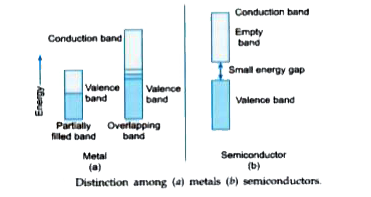
|
|
| 23. |
In te gas phase reaction, C_(2)H_(4)+H_(2)hArr C_(2)H_(6), the equlibrium constant can be expressed in units of |
|
Answer» `"LITRE"^(-2)"MOLE"^(-1)` `="litre/mole. or litre mole"^(-1)` |
|
| 24. |
In temporary poisoning, catalytic poisons act by: |
|
Answer» Coagulating the catalyst |
|
| 25. |
In swern method of oxidation of alcohols to aldehyde/ketones ______ is used as an oxidising agent. |
|
Answer» dimethyl sulfoxide |
|
| 26. |
In Swarts reactiion reagent used is are/ |
| Answer» Answer :D | |
| 27. |
In sulphonation _____ acts as an electrophile. |
|
Answer» |
|
| 28. |
In sulphate ion the oxidation state of sulphur is +6 and the hybridization state of sulphur is: |
|
Answer» `sp^2` |
|
| 29. |
In sulphatizing roasting of Zns, products are |
|
Answer» `ZN O+ SO_2` |
|
| 30. |
In sulphate ion the oxidation state of sulphur is +6 and the hybridization state of sulphur is |
|
Answer» SP |
|
| 31. |
In successive emission of alpha and beta particles, how many alpha and beta particles should be emitted for the nautral (4n +1) series, conversion of ._(94)Pu^(241)" to" _(92)U^(233) |
|
Answer» `ALPHA, beta` `241 = 233 + 4x` `x = 2` `94 = 92 + 2 XX 2 - y` `y = 2` `2alpha and 2 beta` particles |
|
| 32. |
In stoichiometric defects, the ratio of positive and negative ions as indicated by chemical formula of the compound ....... |
|
Answer» DECREASES |
|
| 33. |
In strongly acidic solution reduction of nitrobenzene with metal and acid gives |
|
Answer»
|
|
| 34. |
In step-III if Pb(CH_(3)CO O)_(2) is added without acidifying the solution with CH_(3)CO OH then possibel product may be : |
|
Answer» `PbCrO_(4)` |
|
| 35. |
In stoichiometric defects, the ratio of positive and negative ions as indicated by chemical formula of the compound |
|
Answer» decreases |
|
| 36. |
In steam distillation of toluene, the pressure of toluene vapour is |
|
Answer» EQUAL to PRESSURE of barometer |
|
| 37. |
In starting a car, the battery delivers roughly 50 amperes. (i) During the 5 seconds that it might take to start a car, totally how many grams of Pb and PbO_2are consumed in the battery? (ii) If the car were run strictly from batteries, totally how many grams of Pb and PbO_2would be consumed per mile if 50 amperes made it go at 5 mph? The cell reaction isPb+PbO_2 + 2H_2SO_4 to 2PbSO_4 + 2H_2O |
|
Answer» SOLUTION :The REACTION INVOLVES 2 MOLES of electrons 0.5782g |
|
| 38. |
In starch molecule alpha-D-glucose molecule consist of |
|
Answer» AMYLOSE and agar |
|
| 39. |
In spectrochemical series, chlorine is above water i.e., ClgtH_(2)O, this is due to |
|
Answer» Good `pi`-acceptor properties of Cl |
|
| 40. |
In some cases large number of colliding reactant molecules have energy more than threshold energy even then the reaction is slow. Why ? |
| Answer» Solution :Because resultant MOLECULES do not COLLIDE in PROPER orientation. | |
| 41. |
In some cases, it is found that a large number of colliding molecules have energy more than threshold value, yet the reaction is slow. Why ? |
| Answer» Solution :This is because of IMPROPER orientation of the COLLIDING molecules at the time of collision. | |
| 42. |
In solution of H_(2)SO_(4)when SO_(3) is bubbled, a compound 'A' is formed, which further reacts with H_(2)O to give H_(2)SO_(4). Explain this process with equation ? |
|
Answer» Solution :`H_(2)SO_(4)` absorbs `SO_(3)` forming oleum (A) which reacts with `H_(2)O` to form `H_(2)SO_(4)` `H_(2)SO_(4) + SO_(3) RARR UNDERSET("Oleum, A")(H_(2)S_(2)O_(7))overset(H_(2)O)rarr 2H_(2)SO_(4)` |
|
| 43. |
In Solvay ammonia process, sodium bicarbonate is precipitated due to |
|
Answer» pressure of `NH_3` `underset("brine") (NaCl) + NH_4HCO_3 to underset("Sodium bicarbonate")(NaHCO_3) + NH_4Cl` |
|
| 44. |
In solution, the complex, [Pt(NH_3)_6]Cl_4 gives |
|
Answer» 4 ions |
|
| 45. |
In solution ,the molecular size of particles is |
|
Answer» less than `10^(-9)` m |
|
| 46. |
In solids CO_(2) solid NH_(3) the molecules are held together by strong ………………… |
| Answer» SOLUTION :DIPOLE - dipole INTERACTIONS | |
| 48. |
In solid state xenon atoms are held together by : |
|
Answer» HYDROGEN bonds |
|
| 49. |
In solid state PCl_(5) is a ______________. |
|
Answer» COVALENT solid `2PCl_(5)hArr[PCl_(4)]^(+)"(tetrahedral) "+[PCl_(6)]^(-)"(octahedral)."` |
|


