

Saved Bookmarks
This section includes 7 InterviewSolutions, each offering curated multiple-choice questions to sharpen your Current Affairs knowledge and support exam preparation. Choose a topic below to get started.
| 1. |
Cannizzaro's reaction is performed by |
|
Answer»
|
|
| 2. |
If the enthalpies of formation of C_3H_8(g), CO_2(g) and H_2O(l) at standard conditions are -104 kJ mol^-1, -394 kJ mol^-1 and -286 kJ mol^-1 respectively then the standard anthalpy of combustion of 66 g of C_3H_8(g) will be |
|
Answer» `- 2222 KJ` |
|
| 3. |
If the enthalpy change for the reaction CH_4(g)+Cl_2(g)rarrCH_3Cl(g)+HCl(g), triangleH=-25 kcal. Bond energy of C-H is 20kcal/mol greater than the bond energy of C-Cl and bond energies of H-H and H-Cl are same in magnitude, then for the reaction: 1//2H_2(g)+1//2Cl_2(g)rarrHCl(g) triangleH is |
|
Answer» `-22.5 kcal/mol` |
|
| 4. |
In a calorimeter, the temperature of the calorimeter increases by 6.12 K, the heat capacity of the systemm is 1.23 kJ/g/deg. What is the molar heat of decomposition for the ammonium nitrate? |
|
Answer» `-7.53kJ//mol` Heat evolved=`1.23xx6.12` Molar heat of decomposition`=1.23xx6.12xx80` `=602" kJ "mol^(-1)"(as heat is evolved)" `,brgt `=-602kJ" "mol^(-1)` |
|
| 5. |
In a buffer solution consisting of NaCN and HCN, [NaCN] = 0.18(M) and [HCN) = 0.16(M). If 2 millimoles of HCl is added to 100mL of this buffer solution (assuming volume of the solution remains the same because of the addition of HCl), then pH of the buffer will- |
|
Answer» INCREASE by 0.021 unit |
|
| 6. |
If the enolate ion combines with the carbonyl group of an ester, we get |
|
Answer» ALDOL 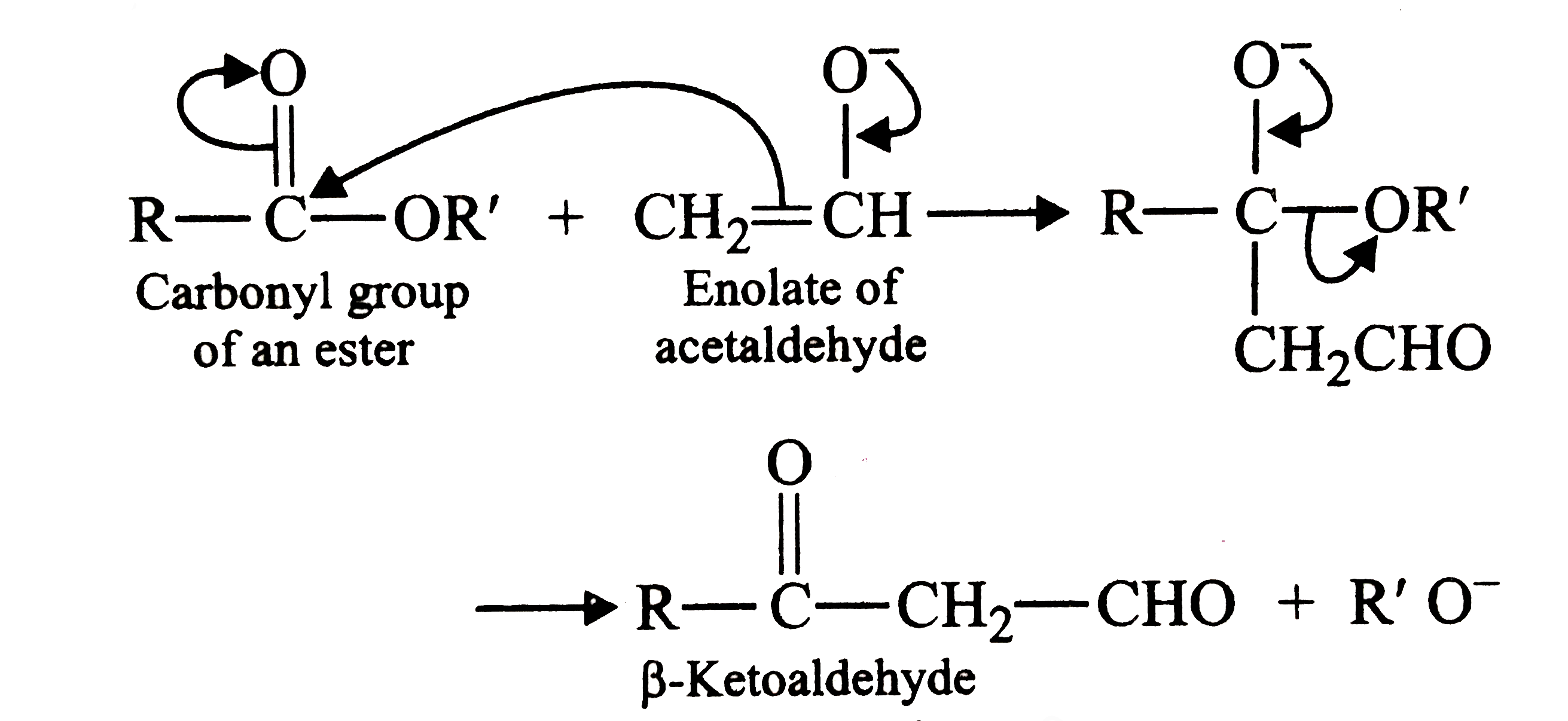 If fact, EITHER `beta`-ketoaldehyde or `beta`-diketone can be FORMED. Since `beta`-diketone is not included in the option, therefore `beta-`ketoaldehyde is the RIGHT choice. |
|
| 7. |
If the enolate ion combines with carbonyl group of ester, we get |
|
Answer» Aldol 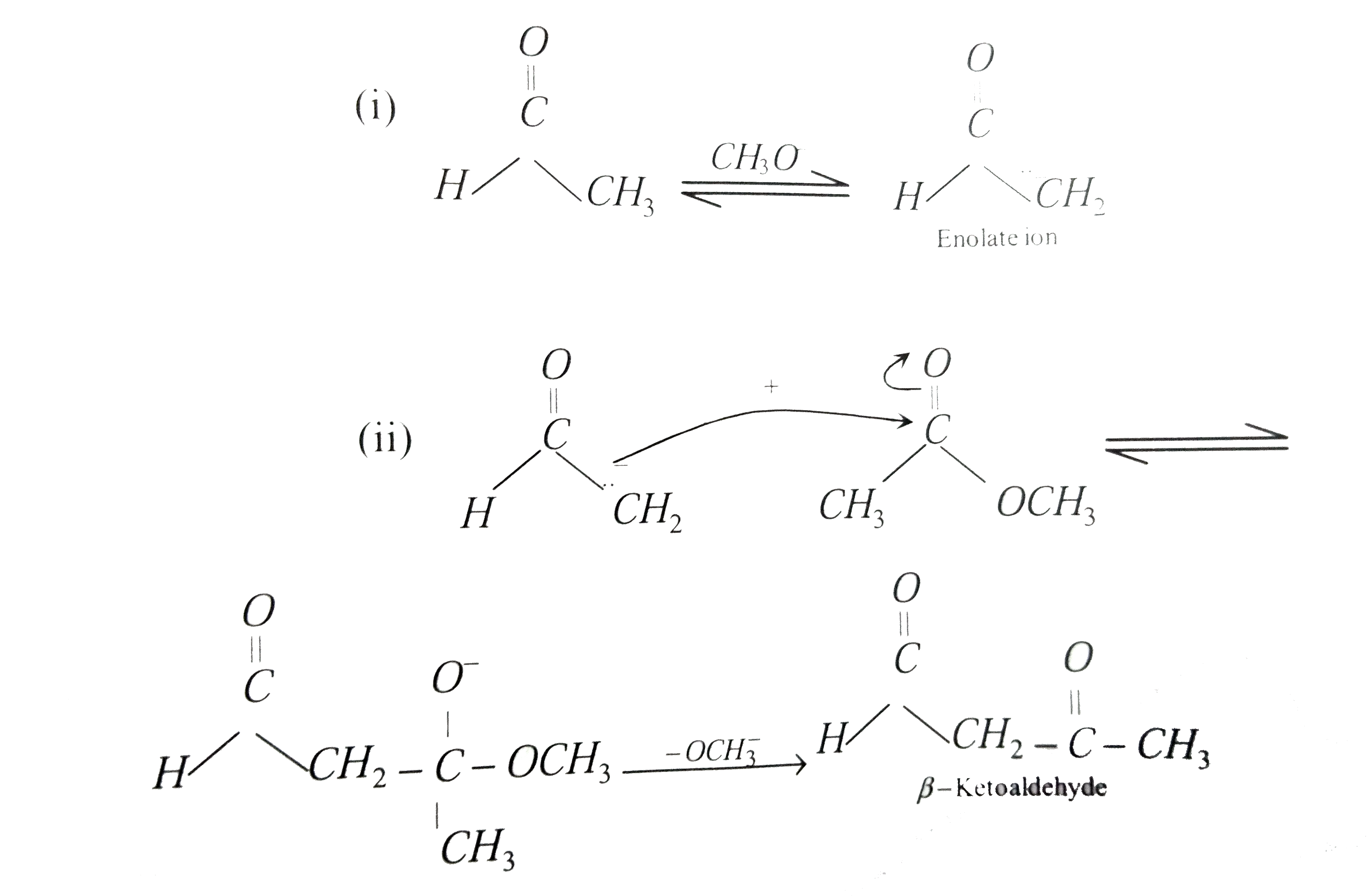
|
|
| 8. |
In a calomel electrode glass tube is filled with |
|
Answer» PASTE of calomel in HG and SATURATED KCl solution |
|
| 9. |
If the energy released by burning 1 g of carbon is about 8000 cal (or approximately 3 xx 10^(11) erg) then the amount of energy released by converting 1 g of carbon ( or any other matter) completely to nuclear energy would be approximately equivalent to the energy produced by ..... g of carbon |
|
Answer» `9 xx 10^(20)` |
|
| 10. |
In a buffer solution consisting of a weak acid its salt, the ratio of concentration of salt to acid is increased tenfold, then the pH of the solution will: |
|
Answer» INCREASE by ONE |
|
| 11. |
If the energy absorbed by each X_2 molecule of a gas is 3.5xx10^-19 J and the bond energy of X_2 is 180.6 kJ mol^-1 then the kinetic energy per atom will be |
|
Answer» `2.5xx10^-19J` |
|
| 12. |
In a buffer solution comprising a weak base (B) and its ion (BH^+), [B]=[BH^+]. If K_b for the weak base=10^(-5) Then find the pH value of the buffer solution. |
|
Answer» |
|
| 13. |
If the elevation in boiling point of a solution of 10 gm of solute (mol wt.=100) in 100 gm of water is DeltaT _(b), the ebullioscopic constant of water is |
|
Answer» 10 `therefore K _(b) =(K_(b) XX 100xx100)/( 10xx1000) = Delta T_(b)` |
|
| 14. |
In a buffer solution composed of NaCN and HCN (pK_1=9.4), [NaCN]=0.2(M) and [HCN]=0.4(M). An aqueous solution solutioncontains Zn^(2+),Ca^(2+),Mn^(2+) and Cr^(3+) ions, each of which has a concentration of 0.1 (M). If 500mL of the buffer solution is added to 500mL of this aqueous solution, then the ions that will precipitate in theresulting solution K_(sp)[Zn(OH)_2]=4.6xx10^(-17) ,K_(sp)[Ca(OH)_2]=8xx10^(-6) , K_(sp)[Mn(OH)_2]=4.46xx10^(-14) and K_(sp)[Cr(OH)_3]=6.67xx10^(-31)] are - |
|
Answer» `Zn^(2+)` |
|
| 15. |
If the elevation in boiling point of a solution of non-volatile, non-electrolyticand non-associating solute in a solvent ( K_(b)=x "K kg mol"^(-1) ) is y K, then the depression in freezing point of the same concentration would be ( K_(f) of the solvent = z "K kg mol"^(-1)) |
|
Answer» `(2 X z)/(y)` `DeltaT_(f)=K_(f)xxm` or `DeltaT_(f)=z xx m`(ii) Since m is same, DIVIDING eq. (ii) by eq. (i) `(DeltaT_(f))/(y)=z/x` or `Delta_(f)=(yz)/(x)` |
|
| 16. |
If the e.m.f of a galvanic cell is negative , it implies that : |
|
Answer» the CELL reaction is spontaneous |
|
| 17. |
If the electronic configuration of an element is 1s^(2)2s^(2)2p^(6)3p^(6)3d^(2)4s^(2), the four electrons involved in chemical bond formation will be : |
| Answer» Answer :D | |
| 18. |
In a breeder reactor, which of the following is converted to fissionable fuel ? |
|
Answer» U-235 |
|
| 19. |
If the electronegativity difference between bonding atoms is 1.7 then the chemical bond is nearly |
|
Answer» 50% IONIC |
|
| 20. |
In a bomb calorimeter, the heat of reaction is measured at : |
|
Answer» CONSTANT VOLUME |
|
| 21. |
If the electronegativity difference between two atoms is 2.0, the percentage covalent character of the molecule is : |
|
Answer» `46%` |
|
| 22. |
If the E_(cell)^(o) for a given reaction has a negative value, then whih of the following gives the correct relationships for the value of DeltaG^(@) and K_(eq) |
|
Answer» `DeltaG^(@)gt0,K_(eq)lt1` |
|
| 23. |
In a body centred cubic cell an atom at the body of centre is shared by- |
| Answer» Answer :A | |
| 24. |
If the E_(cell)^(@) for a given the correct relationships for the values of DeltaG^(@) and K_(eq)? |
|
Answer» `DeltaG^(@) gt0,K_(eq) lt 1` and `DeltaG^(@)=-RT" ln "K_(eq)`. . . (II) From (i), if `E_(cell)^(@)` is negative, `DeltaG^(@)` will be POSITIVE, i.E., `DeltaG^(@)gt0` From (ii), `DeltaG^(@)` can be positive only if `K_(eq)lt1`. |
|
| 25. |
In a body centred cubic arrangement, the number of atoms per unit cell is- |
|
Answer» 8 |
|
| 26. |
If the E_(cell)^(@) for a given reaction has negative value, which of the following gives the correct relationships for the value of DeltaG^(@) and K_(eq) |
|
Answer» `DELTAG^(@)lt0,K_(eq)lt1` `DeltaG^(o)=-NFE^(@)=+ve,` so `DeltaG^(o)gt0` `DeltaG^(@)=-2.303RT` log K So, `K lt 1` |
|
| 27. |
If the E_("cell")^(@) for a given reaction has a negative value, which of the following gives the correct relationships for the value of DeltaG^(@) and K_(eq)- |
|
Answer» `DELTAG^(@) gt 0, K_(eq) LT1` |
|
| 28. |
If the E_("cell")^(@) for a given reaction has a negative value, then which of the following gives the correct relationships for the values of Delta G ^(@) and K_(eq), |
|
Answer» `DELTAG^(@)gt 0, K _(aq) gt1` `DeltaG^(@)gt 0` Further `Delta G^(@)=-RTln K_(eq)` `therefore Delta G^(@) gt 0 and K _(aq) lt 0` |
|
| 29. |
If the E^(0) of a metal is large and negative, the metal is a ……….. |
| Answer» SOLUTION :POWERFUL REDUCING AGENT | |
| 30. |
If the distance between Nat and C ions in sodiumchloride crystal is Xpm, the length of the edge of the unit cell is |
|
Answer» 4 X pm `p_(CI^(-))=(Xsqrt2)/(2)` In a face-centred cubic LATTICE, anions touch each other ALONG the face diagonal of the cube. `a=(4r_(SIGMA))/sqrt(2)=(4Xsqrt2)/sqrt(2.2)=2X` |
|
| 31. |
If the dissociation constant of an acid HA is 1 xx 10^(-5) the Ph of a 0.1 M solution of theacid HA will be approximately: |
|
Answer» 3 |
|
| 32. |
In a body-centred cubic arrangement the ion A occupies the centre while the ions of B occupy the corners of a cube. The formula of the crystal is: |
| Answer» ANSWER :A | |
| 33. |
If the dispersion medium is an alcohol, the colloid is termed as______. |
|
Answer» aquasol |
|
| 34. |
In a body-centred and face-centred arrangement of atoms of an element, what will be the number of atoms present in respective unit cells ? |
| Answer» Solution :BCC :2 , FCC : 4 ATOMS | |
| 35. |
In a body centred cubic arrangement the ion A occupies the centre while the ,ions B occupy the corners of a cube the formula of the crystal is: |
|
Answer» AB |
|
| 36. |
If the disintegration constant of an isotope is .1237 xx 10^(-4) "years"^(-1), then its half-life period will be |
|
Answer» 280 years |
|
| 37. |
In a body centered unit lattice of A_(2) type |
|
Answer» The edge length is equal to `(4R)/sqrt(3)` Here, AB is the body diagonal `(AB)^(2)=(FD)^(2)+("edge")^(2)=(BC)^(2)+(AC)^(2)` `=2("edge")^(2)+("edge")^(2)=3("edge")^(2)` `(4R)^(2)=3a^(2)=16R^(2)`=(Body Diagonal)`.^(2) RARR 4R=sqrt(3)a` `rArr a=(4R)/sqrt(3)` Hence, CHOICE (a) is correct. (c) Also 2R=d=nearest neighbouring distance `rArr` `a=(2d)/sqrt(3)` Hence, choice (c) is correct. (b) is wrong because the SPHERES are not touching each other. (d) Edge, length: Choice (d) is also wrong because `a^(2)=(16R^(2))/(3)` 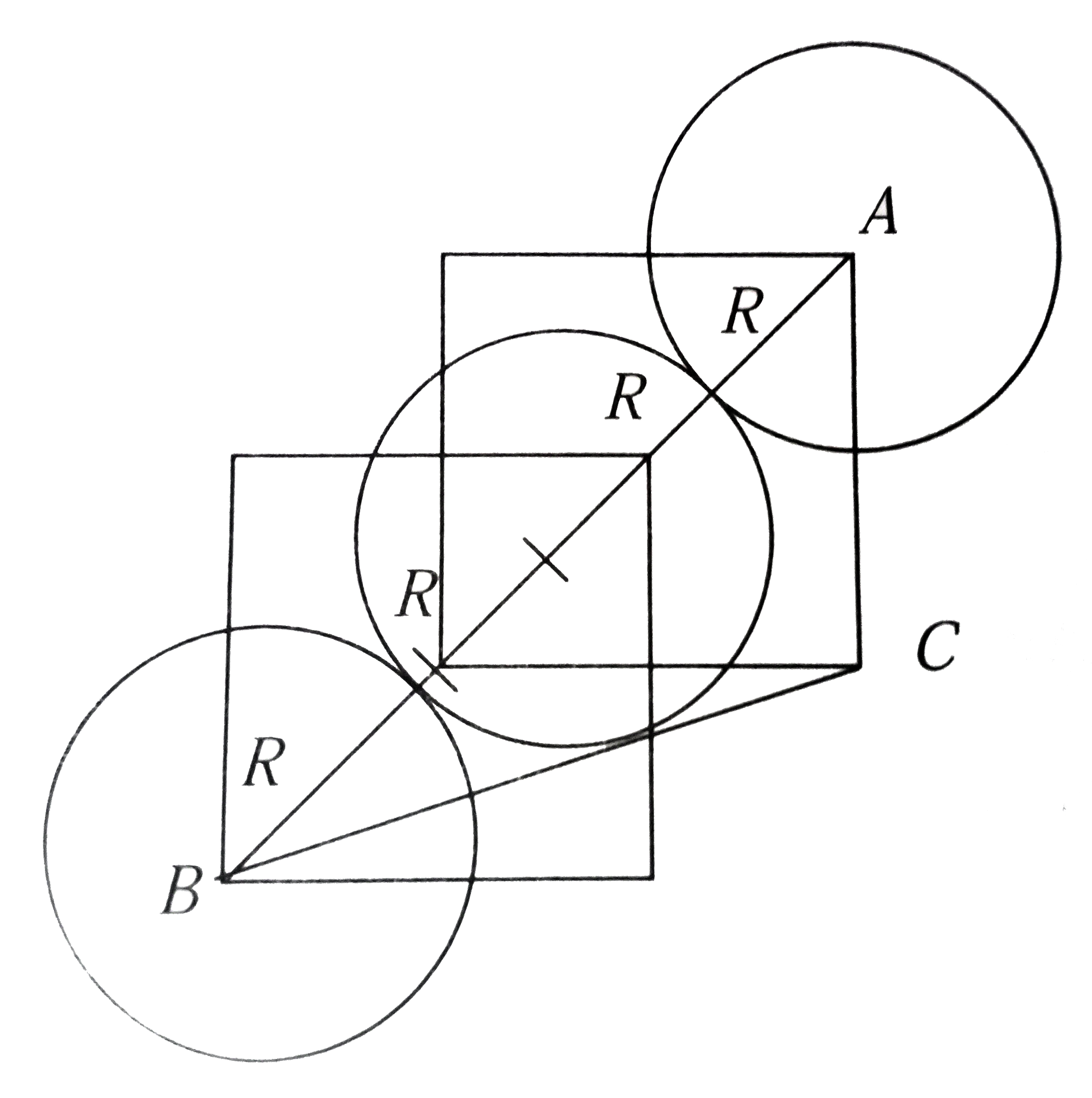
|
|
| 38. |
If the disintegration constant is 6.93 xx 10^(-6) yr^(-1), then half-life of ._(6)C^(14) will be |
|
Answer» `10^(2) YR` |
|
| 39. |
In a bimolecular reaction , the steric factor P was experimentally determined to be 4.5 , the correct option (s) among the following is (are) |
|
Answer» <P>The ACTIVATION energy of the reaction is unaffected by the value of the steric factor (b) `P = (K_("actual"))/(K_("THEORETICAL"))` So , `A_("actual") gt A_("theoretical")` |
|
| 40. |
If the dipolemoment of toluene and nitrobenzene are 0.93 D and 3.93 D what is the dipolemoment of p-nitrotoluene ? |
|
Answer» 3.50 D |
|
| 41. |
If the density of the solvent is 2.5 kg dm^(-3) . The 2 molal solution of a solute in this solvent will be molal solution of a solution of a solute in this solvent will be |
| Answer» SOLUTION :`M = m XX d = 2 xx 2.5 = 5` | |
| 42. |
In a binary solution, mole fraction of one component is 0.068. What is the mole fraction of another component? |
|
Answer» SOLUTION :In a solution, sum of mole fraction i.e., `x_(A)+x_(B)=1` if `x_(A) or x_(B)=0.068` `THEREFORE x_(B)=1-x_(A)` `=1-0.068` `=0.932` |
|
| 43. |
In a bimolecular reaction. The steric factor P was experimentally determined to be 4.5. the correct option(s) among the following is (are) |
|
Answer» The ACTIVATION ENERGY of the reaction is UNAFFECTED by the VALUE of the steric FACTOR. |
|
| 44. |
If the density of some lake water is "1.25 g mL"^(-) and contains "92 g of Na"^(+) ions per kg of water, calculate the molality of Na^(+) ions in the lake. |
|
Answer» Solution :`"No. of moles in 92 g of Na"^(+) " ions "=("92 g")/("23 g MOL"^(-1))="4 moles(as atomic MASS of NA = 23)"` As these are present in 1 kg of WATER, by definition, MOLALITY = 4M. |
|
| 45. |
If the density of some lake water is 1.25 g mL""^(-1)and contains 92 g of Na^+ ions per kg of water, calculate the molality of Na^+ions in the lake. |
| Answer» SOLUTION :Molalityof `Na^(+)` ionsin thelake `=( 92 //23 )/(1 )=4` | |
| 46. |
If the density of some lake water is 1.25 g mL^(-1)and contains 92 g of Na^+ ions per kg of water, calculate the molarity of Na^+ions in the lake. |
|
Answer» Solution : Number of moles in 92 g of `Na^+`IONS ` = (92 g)/(23 g "mol"^(-1)) = 4` mole (as atomic mass of Na = 23) Volume of 1000 g (1 kg) of solution = ` = (1000)/(1.25)= 800 ML^(-1)` Number of moles of `Na^+`in 1000 `mL^(-1)`of solution = ` 4/800 xx 1000 = 5 `moles Molarity = 5M |
|
| 47. |
If the density of some lake water 1.25g mol^(-1) is and contains 92 g of Na^(+) ions per kg of water, calculate the molality of Na^(+) ions in the lake. |
|
Answer» Solution :Number of MOLES present in 92 g of `Na^(+)` IONS `= (92 g)//(23 g//mol)` = 4 mol Therefore, MOLALITY of `Na^(+)` ions in the lake `= (4 mol)/(1 KG)=4 m` |
|
| 48. |
In a basic aqueous solution chloromethane undergoes a substitution reaction in which Cl is replaced by OH^(-) as. CH_3Cl(aq)+OH^(-) hArrCH_3OH(aq)+Cl^(-)(aq) The equilibrium constant of above reaction K_c=1xx10^(16).If a solution is prepared by mixing equal volumes of 0.1 M CH_3Cl and 0.2M NaOH (100% dissociated) then [OH^(-)] concentration at equilibrium in mixture will be : |
|
Answer» 0.1 M At equilibrium constant is very large so REACTION will be ALMOST 100% complete. |
|
| 49. |
If the density of pure water is 0.999gcm^(3). The molarity of prue water will be |
|
Answer» more than 55.5 HENCE MOLARITY`= 999/18 = 55.5 M |
|


