Saved Bookmarks
This section includes 7 InterviewSolutions, each offering curated multiple-choice questions to sharpen your Current Affairs knowledge and support exam preparation. Choose a topic below to get started.
| 1. |
Identify the optically inactive compound from the following: |
|
Answer» `[Co(EN)_(3)]^(3+)` |
|
| 3. |
Identify the optically active compounds from the following : |
|
Answer» `[Co(en)_(3)]^(3+)` |
|
| 4. |
Identify the optically active compounds from the following |
|
Answer» `[CO(en)_(3)]^(3+)` |
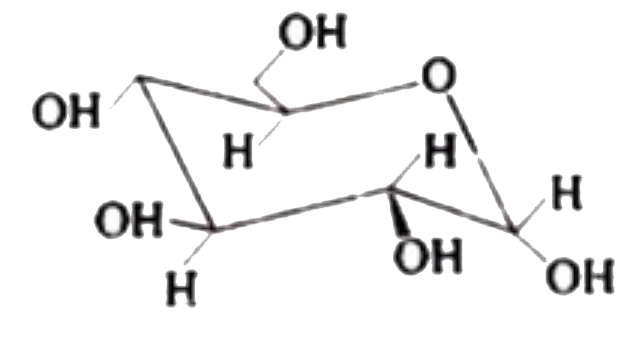
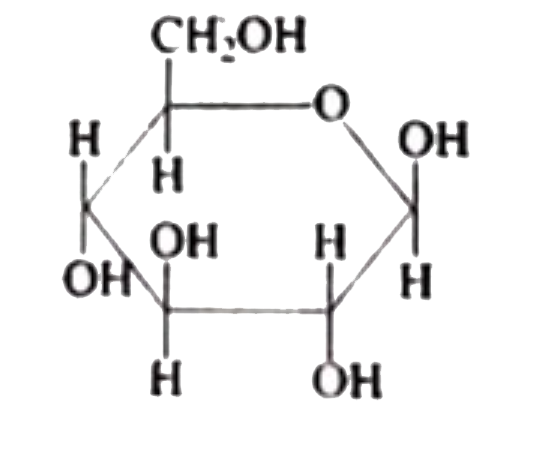
|
| 5. |
Identify the number of reagents that can be used for the following conversion R- COOHtoR- CH_(2)OH LiAIH_(4)//ether, CrO_(3)//H_(2)SO_(4) , SeO_(2) : B_(2) H_(6)//THF: H_(2)//Ru: MnO_(2)//(CH_(3))_(2)CO, CuO-Cr_(2)O_(3) |
|
Answer» |
|
| 6. |
Identify the one which does not belong to the class to which the other three belong based on hydrolysis |
| Answer» Answer :B | |
| 7. |
Identify the nuclear reaction that differs from the rest |
|
Answer» Positron emission There is no change in n/p ratio due of `gamma`-emission |
|
| 8. |
Identify the nucleoside from the following: |
|
Answer»
|
|
| 9. |
Identify the nuclear reaction that differs from the rest: |
|
Answer» POSITRON EMISSION (Neutron/Proton, ratio) of the parent ELEMENT. |
|
| 10. |
Identify the non-stoichiometric defects. |
|
Answer» SCHOTTKY defects |
|
| 11. |
Identify the non-stoichiometric defecti) Schottky defect ii) Frenkel defect iii) Interstitial defect iv) Metal deficiency defect |
|
Answer» |
|
| 12. |
Identify the non - reducing sugar. |
|
Answer»
|
|
| 13. |
Identify the non-narcotic analgesic from the following |
|
Answer» DIAZEPAM |
|
| 14. |
Identify the non-magnetic mineral from the following. |
|
Answer» `SnO_(2)` |
|
| 15. |
identify the non-feasible reaction. |
|
Answer» `CH_(3)-C-=CH+NH_(2)^(-)hArrCH_(3)-C-=overset(UNDERSET(_)(* *))(C)+NH_(3)` |
|
| 16. |
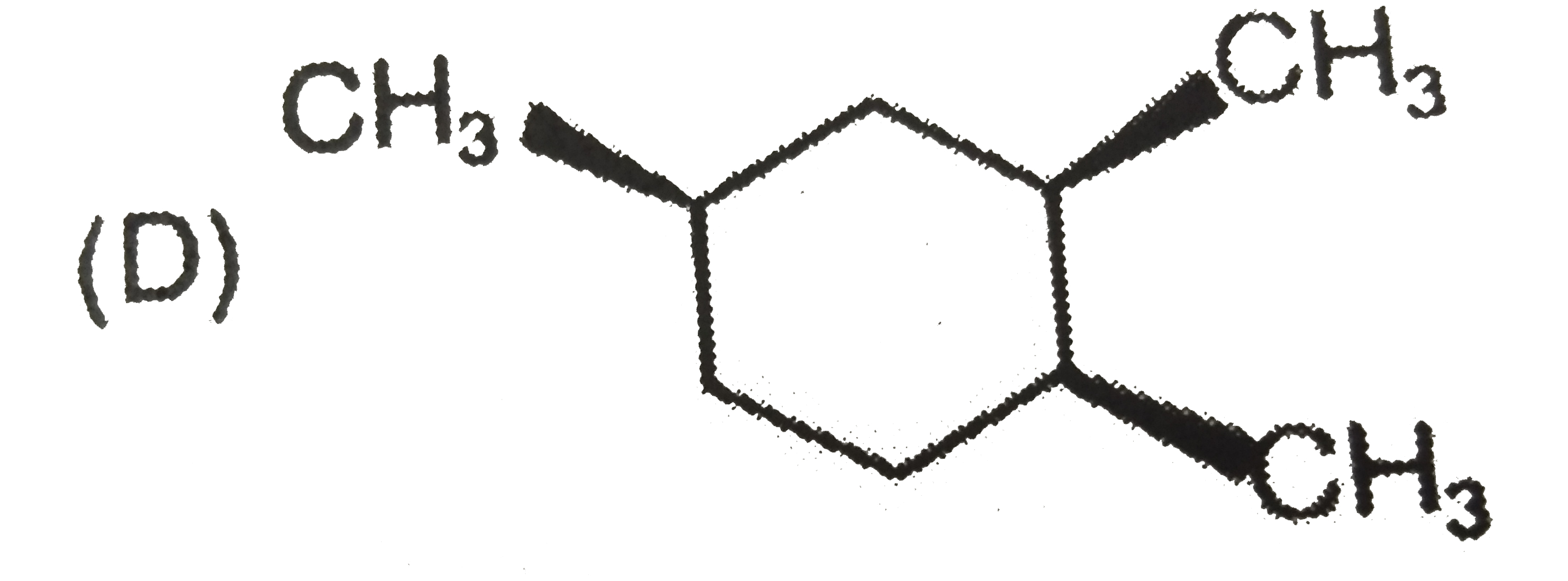
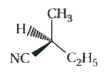
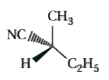
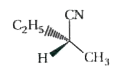
Identify the most stable stereoisomer : |
|
Answer»
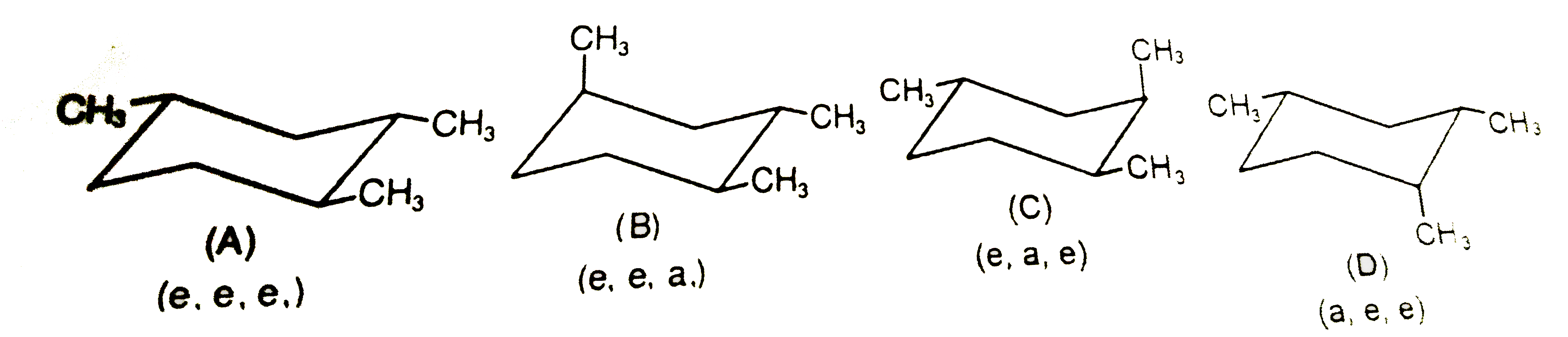
|
|
| 17. |
Identify the narcotic which is used as an analgesic |
| Answer» Solution :morphine | |
| 18. |
Identify the most stable conformer of glycol. |
Answer» SOLUTION : GAUCHE form of GLYCOL is most STABLE. This is due to intramolecular hydrogen BONDING |
|
| 19. |
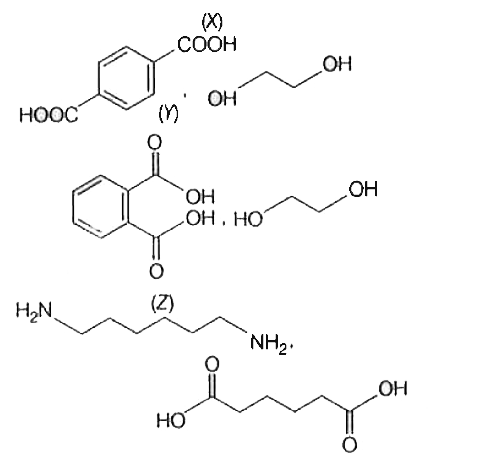
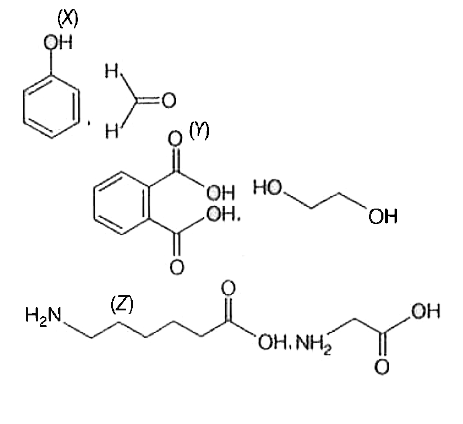
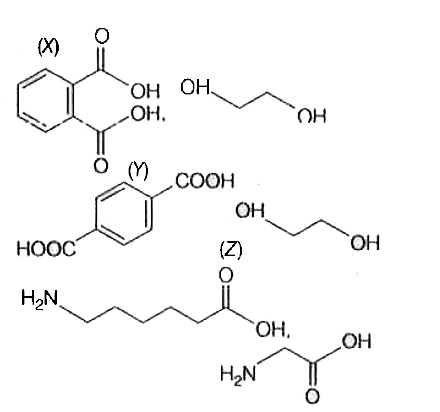
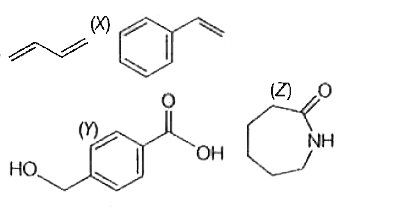
Identify the monomers used in the manufacture of glyptal (X), dacron (Y) and nylon 2-nylon 6 (Z). |
|
Answer»
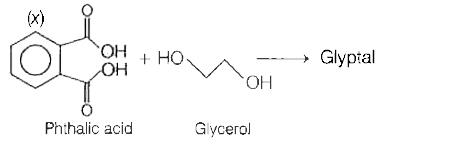 DACRON (y) 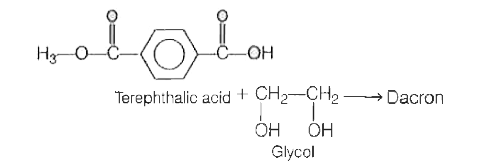 NYLON- Nylon - 6(Z) `underset("AMINO caproic acid")(2NH_2-(CH_2)_5-COOH)+underset("(Glycine)")(NH_2.CH_2.COOH)rarr"Nylon- 2, Nylon- 6"` |
|
| 20. |
Identify the monosaccharide containing only one asymmetric carbon atom in its molecule. |
|
Answer» RIBULOSE Asymmetric ATOM glyceraldehyde |
|
| 21. |
Identify the monomers in the following polymers: (i) (ii)-[CH_2-overset(CN)overset|CH]-_n |
Answer» SOLUTION :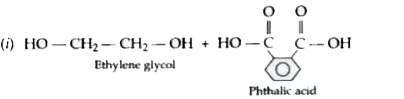 (II) `CH_2= CHCN` VINYL CYANIDE |
|
| 22. |
Identify the monomer of nylon-2. |
|
Answer» ADIPIC + HEXAMETHYLENE tetramine |
|
| 23. |
Identify the monomers in the following polymer : [-HN(CH_2)_6NHCO(CH_2)_4CO-] |
| Answer» SOLUTION :HEXAMETHYLENEDIAMINE and ADIPIC ACID | |
| 24. |
Identify the monomer used in the preparation of synthetic rubber |
|
Answer»
|
|
| 25. |
Identify the molecularity and write the rate law for each of the following elementary reaction : NO_((g))+O_(3(g))rarrNO_(3(g))+O_((g)) |
|
Answer» SOLUTION :`NO_((G))+O_(3(g))rarr NO_(3(g))+O_((g))" Molecularity is 2."` Rate LAW : `=k[NO]xx[O_(3)]` |
|
| 26. |
Identify the missing chemicals (A) to (K). |
|
Answer» Solution :A = `MgSO_(4)`B=Hydrogen `(H_(2))` C = `MG(OH)_(2)2` D=`Na_(2)SO_(4)` E = MgOF=`H_(2)O` G = `MgCl_(2)` K=`NO_(2)` J = `CO_(2)`K=`NO_(2)` `L=O_(2)` |
|
| 27. |
Identify the method by which Me_(3)C CO_(2)H can be prepared. |
|
Answer» Treating 1 mol of MECOME with 2 moles of MeMgI. |
|
| 28. |
Identify the method that gives benzyl alcohol ? |
|
Answer»  Cannizzaro reaction INVOLVES the base induced disproportionation of twomolecule of a non-enolizablealdehyde to give a primary alcohol and carboxylic SALT. Thus, option (c) is correct. |
|
| 29. |
Identify the major products P, Q and R in the following sequence of reactions |
|
Answer» |
|
| 30. |
Identify the medine that is used to treat stress, anxiety depression and schizophrenia. |
|
Answer» VALIUM |
|
| 31. |
Identify the metal that occurs in free state. |
|
Answer» Al |
|
| 32. |
Identify the major product of the following reaction: |
Answer» SOLUTION : . .
|
|
| 33. |
Identify the major product obtained when anisole reacts with bromine in ethanoic acid |
|
Answer» `(AAK_MCP_37_NEET_CHE_E37_010_A01)` |
|
| 34. |
Identify the major product in the following reaction: |
Answer» SOLUTION :
|
|
| 35. |
Identify the major product in the given reaction : |
|
Answer»
|
|
| 37. |
Identify the major product obtained on monobromination (Br_2//FeBr_3) of meta-methylanisole and accout for its formation. |
Answer» SOLUTION : Both `-CH_3 and -OCH_3` are o-/p-directing GROUPS. THEREFORE the possible positions of attack which are facilatated by these group are indicated by arrown as shown below .  Attack by the electrophile `(Br^+)` is disfavoured `C_2` because this position is most CROWDED. Again. -I effect of `-OCH_3`group does not favourattack at `C_6` . so most favourable attack occurs at `C_4` , thereby PRODUCING 4-bromo-3-methylanisole as the majorproduct. |
|
| 38. |
Identify the low spin complex in the following[CoF_(5)]^(3-)[Ni(CN)_(4)]^(2-) |
| Answer» SOLUTION :`[NI(CN)_(4)]^(2-)` | |
| 39. |
Identify the major and minor products obtained by the reaction between 2-bromo butane and alcoholic KOH. |
Answer» SOLUTION :
|
|
| 40. |
Identify the main product of the following reactions. Suggest whether the reaction S_N^1 or S_N^2. |
Answer» SOLUTION :
|
|
| 41. |
Identify the ligands and central metal ion in [Co(NH_3)_2(en)_2]^(3+) ,Calculate the oxidation number and coordination number of metal ion. |
| Answer» Solution :In`[CO(NH_3)_2(en)_2]^(3+)`, ligands are ammonia and ethylene DIAMINE. OXIDATION number of COBALT = +3. Central metal ion is `Co^(3+)` and it is surrounded by two mondentate ligands `NH_3` and two bientate ligands ethylene diamine. THUS coordination number of `Co^(3+)` is 6. | |
| 42. |
Identify the lewis acid in K_(4)[Fe(CN)_(6)]? |
|
Answer» `FE^(3+)` |
|
| 43. |
Identify the Lewis acid and the Lewis base in the following reactions. (i) CaO+CO_2 to CaCO_3 |
| Answer» SOLUTION :(i) ` CaO-` LEWIS BASE:`CO_(2)-` Lewis acid | |
| 44. |
Identify the lewis acid and the lewis base in the following reactions. Cr^(3+)+6H_2O to [Cr(H_2O)_6]^(3+) |
| Answer» Solution :In the hydration of ion each of six water molecules donates a pair of electron to `Cr^(3+)` to FORM the hydrated cation, hexaaquachromium (III) ion, THUS, the LEWIS ACID is `Cr^(3+)` and the lewis base `H_2O` | |
| 45. |
Identify the lewis acid and the lewis base in the following reactions. CaO+CO_2 to CaCO_3 (ii) CH_3-O-CH_3+AlCl_3 to |
|
Answer» Solution :`CaO+CO_2 to CaCO_3` (a) CaO- Lewis base, All metals oxides are lewis BASES (B) `CO_2`- lewis acid , `CO_2` contains a polar DOUBLE bond. (ii)  (a) `CH_3-O-CH_3`- Lewis base, Electron rich SPECIES (b) `AlCl_3`- Lewis acid, `ALCl_3` is electron deficient MOLECULE. |
|
| 46. |
Identify the least stable ion amongst the following . |
|
Answer» `Li^(-)` `Be^(-) = 1s^2, 2s^2, 2p^1` (very less stable, DUE to SINGLE electron no exchange is possible) `B^(-) = 1s^2, 2s^2, 2p^2` (very less stable, due to single electron no exchange is possible). `C^(-) = 1s^2, 2s^2, 2p^3` (stable due to presence of half-filled 2p - sub - shell) |
|
| 47. |
Identify the least basic compound among the following: |
|
Answer» `NH_3` |
|
| 49. |
Identify the leastbasic compound among the following: |
|
Answer» `H_2O` |
|
| 50. |
Identify the isomerism in each of the following paris CH_(3)OCH_(2)CH_(3) and CH_(3)OCH_(2)CH_(2)OHCH_(3)CH(OH)CH_(2)OH and CH_(2)OHCH_(2)CH_(2)OH CH_(3)-underset(CH_(3))underset(||)CH-CH_(2)-OH and CH_(3)-CH_(2)-CH_(2)-CH_(2)OH |
|
Answer» Solution :Functonal isomerism: (a) dimethoxy, (b) 2-methoxy ETHANOL POSITION isomerism - diol positition is changed. (a) propane -1,2-diol, (b) propane-1,3-diol CHAIN isomerism - carbon chain is changed (a) isobutyl ALCOHOL , (b) n-butyl alcohol |
|