

Saved Bookmarks
This section includes 7 InterviewSolutions, each offering curated multiple-choice questions to sharpen your Current Affairs knowledge and support exam preparation. Choose a topic below to get started.
| 1. |
Hybridisation of 'P' in PO_4^(3-) is same as that of : - |
|
Answer» N in `NO_3^(-)` 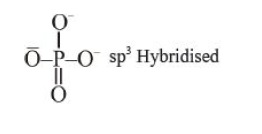
|
|
| 2. |
Hybridisation of Xenon in Xenon hexafluoride is ____. |
| Answer» SOLUTION :`sp^3d^3` | |
| 3. |
Hybridisation of P in phosphine is,……………….. . |
|
Answer» `SP^(3)d` |
|
| 5. |
Hybridisationof chromiumionsand dichromateions is |
| Answer» Answer :B | |
| 6. |
The hybridisation of metal ion in square planar complexes in |
|
Answer» `sp^2` |
|
| 8. |
Hybridisation of central sulphur in all oxo anions of sulphur is |
|
Answer» `SP ^(3)d` |
|
| 9. |
Hybridisation of central atom changes for which of the following molecule when undergoes dimerization? |
|
Answer» `CF_3` |
|
| 12. |
Hybridisation of carbon atom in the functional group of an organic carboxylic acid is |
| Answer» Answer :B | |
| 13. |
Hybridisation is the chemists attempt to explain the observed molecular shape by constructing hybridised atomic orbitals with the appropriate inter orbital angles. The molecule for which d eviation form normal bond angle is observed, VSEPR theory suggest electron pair repulsive interaction (lp - lp gt lp - bp - bp). While from hybridisation point of view that is departure from normal hybridisation beacuse the angle between any equivalent hybrid orbitals determine the fraction of s and p character of the hybrid and vice - versa. An element 'A' has outer shell electronic configuration is 5s^(2)5p^(6). If A form covalent compoun AF_(2) with fluorine. The orbitals used by 'A' for bonding are |
|
Answer» d-orbitals 
|
|
| 14. |
Hybridisation is a theoretical concept, as state of hybridisation can not be detected ever the spectroscopically: unlike intermediates or transition state in various reactions but it corrects the predictions which are based on overlapping of pure atomic orbitals. VSEPR theory predicts precisely shape and bond angle in a given molecule. Which of the following molecule /ions which are not planr? |
|
Answer» `[IF_(4)]^(-)` (B) `[IF_(4)]^(+)rarr` SEE SAW (C ) `[NH_(2)]^(-)rarrV//` Bent planar |
|
| 15. |
Hybridisation involves the mixing of orbitals having comparable energhies of same atom. Hybridised orbitals perform efficient overlapping than overlapping by pure s, p or orbitals. Consider the following compounds and select the incorrect statement from the following : NH_(3),PH_(3),H_(2)S,SO_(2),BF_(3),PCl_(3),IF_(7),P_(4),H_(2) |
|
Answer» Six molecules out of given compounds involves hybridisation (b) Hypervalent compounds `(SO_(2),SO_(3),IF_(7))` (C ) Non-planar molecules `(NH_(3),PH_(3),PCl_(3),IF_(7),P_(4))` (d) `SO_(2)` [one(` p pi- p pi`) bond and one `(d pi- p pi)` bond], `SO_(3)` [ one `(p pi-p pi)` bond and two `(d pi - p pi)` bonds] |
|
| 16. |
Hybridisation is the chemists attempt to explain the observed molecular shape by constructing hybridised atomic orbitals with the appropriate inter orbital angles. The molecule for which d eviation form normal bond angle is observed, VSEPR theory suggest electron pair repulsive interaction (lp - lp gt lp - bp - bp). While from hybridisation point of view that is departure from normal hybridisation beacuse the angle between any equivalent hybrid orbitals determine the fraction of s and p character of the hybrid and vice - versa. In which species number of lone pair on iodine and number of d-orbitals used in hybridisation by iodine are same |
|
Answer» `ICl_(2)^(+)` 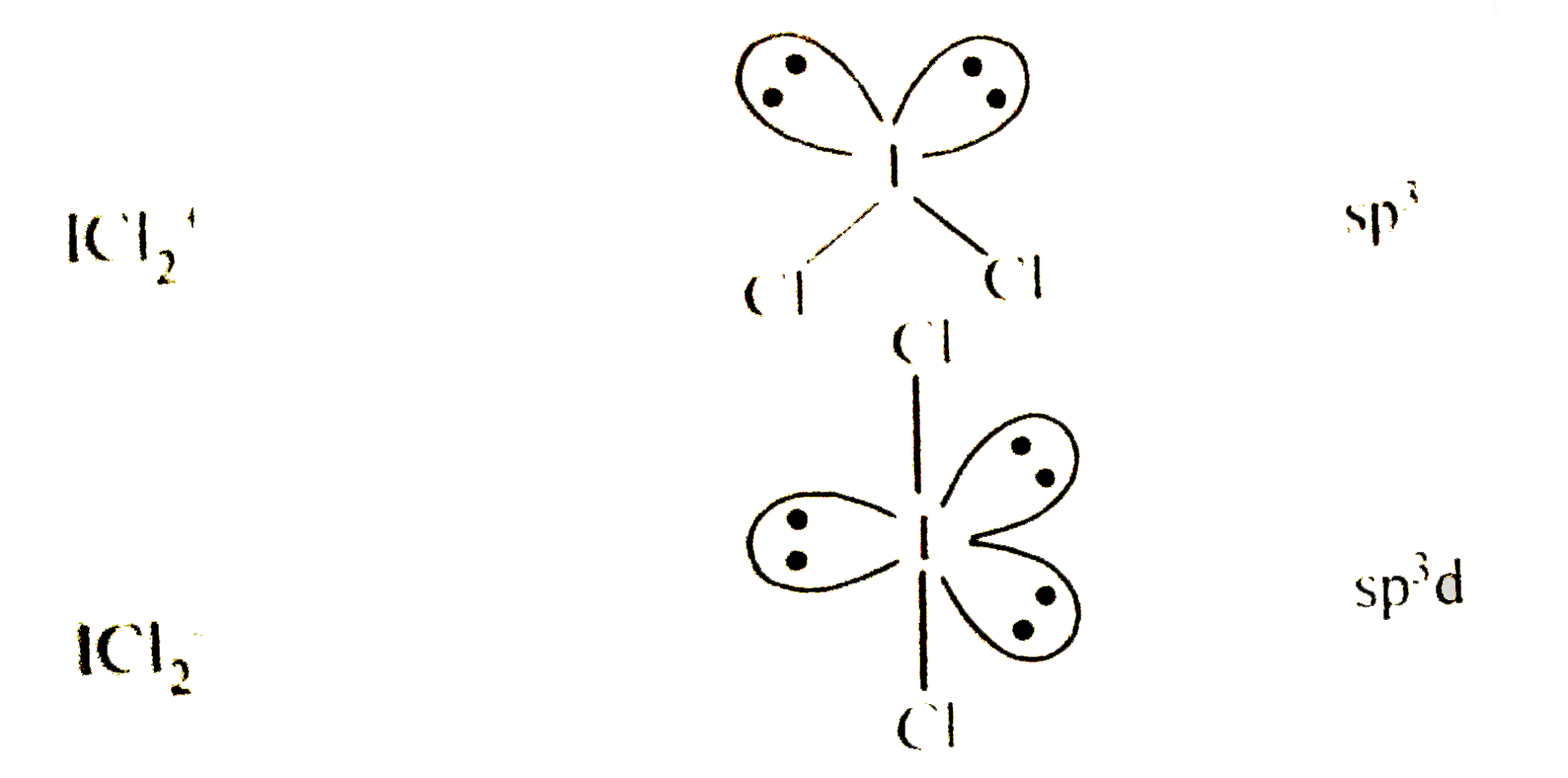 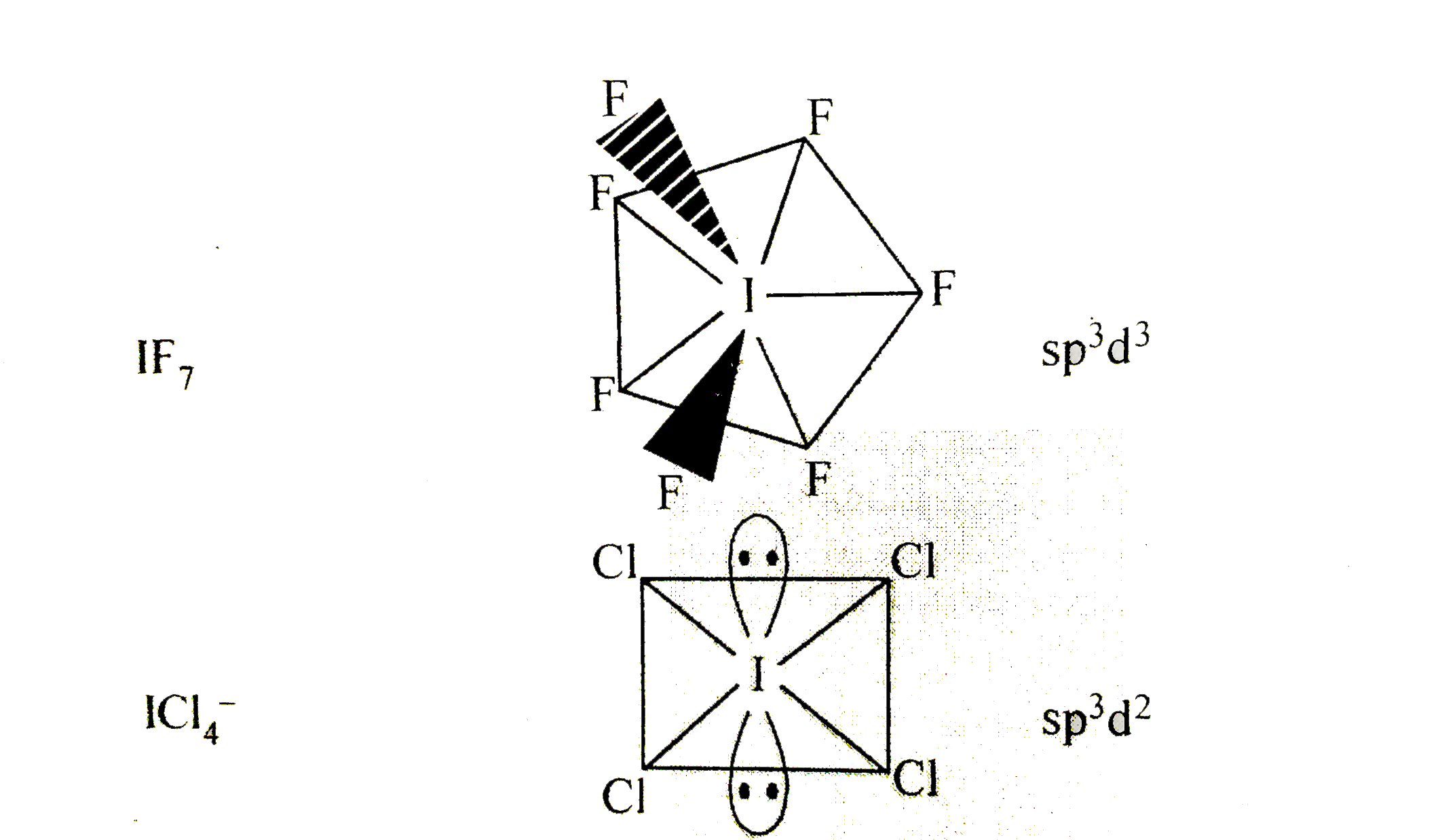
|
|
| 17. |
Hybridisation involves the mixing of orbitals having comparable energhies of same atom. Hybridised orbitals perform efficient overlapping than overlapping by pure s, p or orbitals. Which of the following is not correctly match between given species and type of overlapping ? |
|
Answer» <P>`XeO_(3)` : Three `(d PI - p pi)` bonds 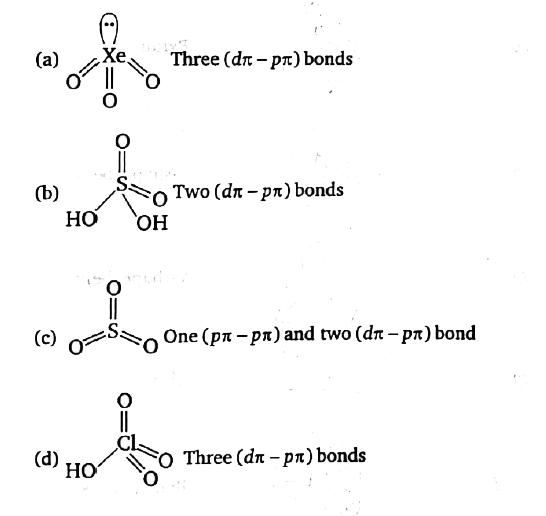
|
|
| 18. |
Hybridisation involves: |
|
Answer» ADDITION of ELECTRON pair |
|
| 20. |
hy does PCI_(3) fume in moisture ? |
|
Answer» Solution :In PRESENCE of moisture `(H_(2)O), PCI_(3)` undergoes hydrolysis giving fumes of HCI. `PCI_(3) + 3H_(2)O rarr UNDERSET("PHOSPHOROUS acid")(H_(3)PO_(3))+ 3HCI` |
|
| 21. |
A weak acid HX has the dissociation constant 1 xx 10^(-5)M. It forms a salt NaX on reaction with alkali. The percentage hydrolysis of 0.1M solution of NaX is |
|
Answer» |
|
| 22. |
HX is a weak acid (K_(a)=10^(-5)). It forms a salt NaX (0.1 M) on reacting with caustic soda. The degree of hydrolysis of NaX is |
|
Answer» `0.01%` |
|
| 23. |
Hw may spatial orientations are possible in the following compound ? |
|
Answer» 2 |
|
| 24. |
HVZ reaction of acetic acid leads to the formation of |
|
Answer» `CH_3 COOH` |
|
| 25. |
HVZ reaction leads to the formation of |
|
Answer» Chlorosubsititued ACIDS |
|
| 26. |
HVZ reaction leads to the formation of: |
|
Answer» ACETIC ACID |
|
| 27. |
Write HVZ reaction. |
|
Answer» `alpha`-halo ACID |
|
| 28. |
HVZ reaction is used to prepare : |
|
Answer» `ALPHA` -HALO ACID |
|
| 29. |
HVZ reaction is characteristic reaction of |
|
Answer» `alpha - H` ATOM |
|
| 30. |
HVZ reaction is specific for, |
|
Answer» REPLACEMENT of `BETA`-hydrogens |
|
| 31. |
Human stomatch produces acid X which helps in digestion |
|
Answer» MUST be pure water |
|
| 33. |
Human cannot use cellulose as food- Why ? |
| Answer» Solution :HUMAN cannot USE cellulose as food because our digestive system do not CONTAIN the necessary enzymes such as glycosidases (or) cellulases that can hydrolyse the cellulose. But animals contain cellulose enzyme in their digestive system and they can DIGEST cellulose. So cellulose can USED as food for animals but not for human. | |
| 35. |
Humancannotusecelluloseas food- Why ? |
| Answer» SOLUTION :Human cannotuse celluloseas foodbecauseour digestive SYSTEM do notcontainthenecessaryenzymes suchasglycosidases (or) cellulosethat can hydrolyse the celluose.Butanimalscontain CELLULOSE enzymein theirdigestivesystemand they candigest cellulose. So cellulosecan usedas foodfor animalsbutnot forhuman . | |
| 36. |
HSO_(4)^(-) + OH^(-) rarr SO_(4)^(2-) + H_(2)O Which is correct about conjugate acid base pair |
|
Answer» `HSO_(4)^(-)` is conjugate acid of BASE `SO_(4)^(2-)` |
|
| 38. |
H^(Theta) always act as |
|
Answer» Nucleophile |
|
| 39. |
HPO_3 has the ability to form metaphosphates , wich can be polymerised. Calogon is a salt of HPO_3 . How many time it is polymerised ? |
|
Answer» Solution :SODIUM Hexametaphosphate `HPO_3+NaOH rarrNaPO_3 RARR (NaPO_3)_(6) implies6` times polymerisation |
|
| 40. |
HPO_3 + H_2O overset(Heat)rarr ? The product is: |
|
Answer» `H_4P_2O_7` |
|
| 41. |
HPO_3 act as |
|
Answer» REDUCING AGENT |
|
| 42. |
Howmany of the following compounds are dissolve in aqeous solution of NaOH (i) Phenol (ii) Cyclohexanol (iii) 2, 4-di nitro phenol (iv) Benzoic (v) Benzene sulphonic acid (vi) P-cresol (vii) P-methoxy phenol (viii) alpha- naphthol (ix) N-methyl aniline |
|
Answer» |
|
| 43. |
Howmany of the following compounds are dissolve in aqeous solution of NaOH (1) Phenol (2) p-cresol (3) Benzoic acid (4) Benzene sulphonic acid (5) Aniline (6) P-toluedine (7) Picric acid (8) Squaric acid |
|
Answer» |
|
| 44. |
Howw many of the following are ores of zinc : Ainc red Calamine , Willemite ,Hemimorphite,Siderite ,phyrolusite ,olivine ,Anglesite |
|
Answer» |
|
| 45. |
Howmany metals are present in the ore chalcopyrite, from which 80% of the world's copper production comes. |
|
Answer» |
|
| 46. |
How many of the following alloys contain 'Al' metal Magnalium , Duralumin , Brass , Bronze , Rolled gold , Nickeloy, Nickel steel, Invar, Alnico, Solder |
|
Answer» |
|
| 47. |
Howmany metals are commercially extracted by pyrometallurgy from the given metals?( Cu, Fe, Sn, Au, K, Na ) |
|
Answer» |
|
| 48. |
Name any two ores of zinc. How is zinc extracted from zinc oxide? |
| Answer» SOLUTION :When zine oxide is HEATED with COKE at 1673 K, coke REDUCED zinc oxide to zinc `ZnO + C rarr Zn + CO`. | |
| 49. |
How XeF_4 is prepared ? |
| Answer» Solution :It is prepared by heating a 1:5 mixture of XENON and fluorine in a NICKEL tube heated to `400^@` C and 6 ATMOSPHERIC PRESSURE for a few hours | |