

Saved Bookmarks
This section includes 7 InterviewSolutions, each offering curated multiple-choice questions to sharpen your Current Affairs knowledge and support exam preparation. Choose a topic below to get started.
| 1. |
How many octahedral and tetrahedral holes are present per unit cell in a face centred cubic arrangement of atoms ? |
|
Answer» 8,4 |
|
| 2. |
How many O-H groups are present in phloroglucinol ? |
|
Answer» 3 |
|
| 3. |
How many O-atoms are shared per SiO_(4) tetrahedral in silicate anion of beryl mineral |
|
Answer» 4 |
|
| 4. |
How many octahedral and terahedral holes are present per unit cell in a face -centred cubic arrangement of atoms? |
|
Answer» 8,4 |
|
| 5. |
How many numbers of sigma" and "pi bonds are in cyclotrimetaphosphoric acid molecules respectively ? |
|
Answer» 12 and 6 |
|
| 6. |
How many O-atoms are shared for SiO_(4) tetrahedral in silicate anion of beryl mineral |
|
Answer» 4 |
|
| 7. |
How many numbers of possible stereoisomers are there of 2, 3, 4-trichlo pentanoic acid ? |
|
Answer» 8 i.e., 2,3,4 - trichloropentanoic ACID has THREE dissimilar chiral centres and hence has `2^(3)=8` STEREOISOMERS. |
|
| 8. |
How many number of statements (s) are correct ? (i) XeF_(6) and IF_(5) both are distorted octahedral (ii) Bond angle of BeCl_(2) is greater than NO_(2)^(+) (iii) All bond length are equal in NO_(3)^(-) (iv) Bond order of CO_(3)^(2-) and NO_(3)^(-) is equal (v) Dipole moment of CH_(3)Cl gt CH_(3)F (vi) EA of Cl gt EA of F (vii) Radius of Zr ~~ radius of Hf (viii) Ionisation energy of Tl is greater than Al (ix) (x) Ionorganic benzene and benzene both have sp^(2) hybridised atoms. |
|
Answer» |
|
| 9. |
How many number of tetrahedral voids in a closed packed structure having 6 xx 10^(24) atoms? |
|
Answer» `6 xx 10^(25)` `= 1.2 xx 10^(24)`. |
|
| 10. |
How many number of statement are true regarding CH_(2)F_(2) molecule. (i) It is sp^(3) hybridised (ii) It is non planar. (iii) It is polar. (iv) All bond angles are 109^(@) 28' (v) /_ F hat(C )F bond angle is greater than /_ F hat(C )H bond angle. (vi) /_ Hhat(C )H gt /_ H hat(C )F gt /_ F hat(C )F (vii) Number of /_ F hat(C )H bond angles are two. (viii) It is perfectly tetrahedral. |
|
Answer» |
|
| 11. |
How many number of sigma - bond pi - electron, chlorine atom and hydrogen atom is structural formula of DDT, respectively ? |
| Answer» Answer :B | |
| 12. |
How many number of P - O - P bonds in P_4 O_(10) ? |
|
Answer» <P> Solution :In `P_(4)O_(10)` SIX P - O - P BONDS are present
|
|
| 13. |
How many number of moles of R-MgX consumed per mol for one mole of following compound ? |
|
Answer» |
|
| 14. |
How many number of molecules have sp^(3)d hybridisation of central atom in their transition state during hydrolysis process? PCl_(3),PCl_(5),SiCl_(4),SF_(4),C Cl_(4),BF_(3),BCl_(3),TeF_(6),BeCl_(2) [If your answer is 5 then write the answer as 0005.] |
|
Answer» |
|
| 15. |
How many number of isomers are possible for the compound with molecular formula C_(2)BrCIFI? |
Answer» SOLUTION :SIX ISOMERS are POSSIBLE.  
|
|
| 16. |
How many number of lone pairs are present in central atom of C//f_(3) ? |
Answer»  LONE PAIRS LONE PAIRS
|
|
| 17. |
How many number of hybrid orbitals of Chorine are present in ClO_(4)^(-)? |
Answer»  In `ClO_(4)^(-)` hybridisation of `Cl_(2)` is `sp^(3)` (i.e., 4 ORBITALS ) In `ClO_(4)^(-)` hybridisation of `Cl_(2)` is `sp^(3)` (i.e., 4 ORBITALS )
|
|
| 18. |
How many number of hybrid orbitals are present in SO_(2)? |
|
Answer» |
|
| 19. |
How many number of elcetrons haven m = 0 value in chromium. |
|
Answer» 11 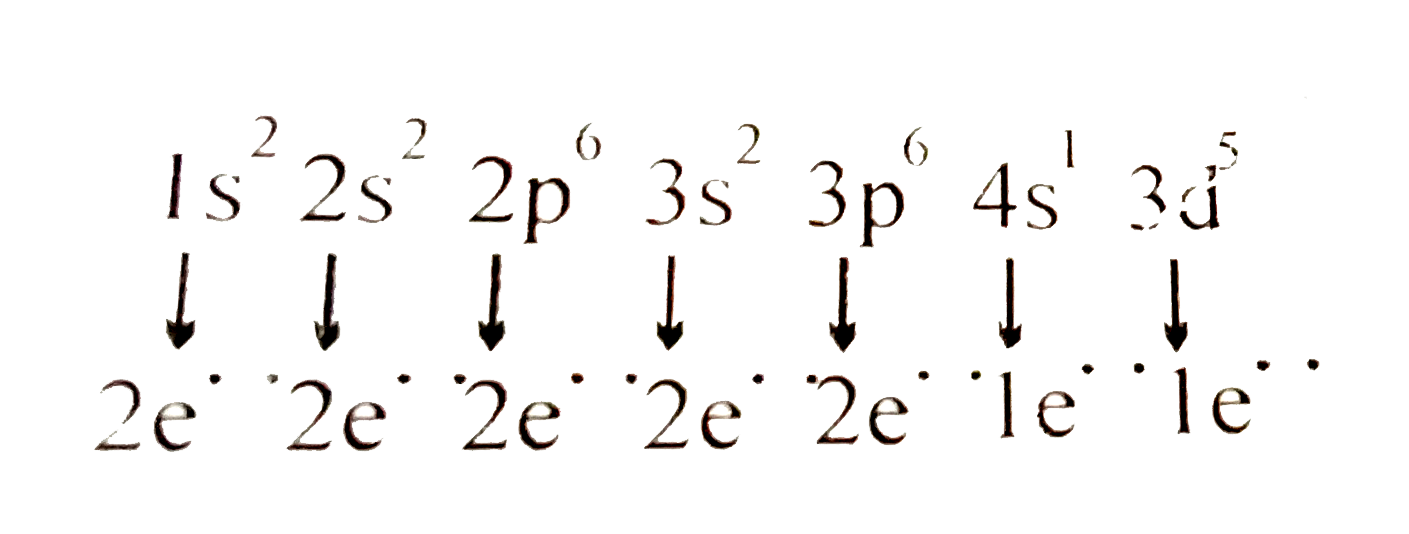
|
|
| 20. |
How many number of carbon atoms are present in 1-phenyl ethanol ? |
|
Answer» 6  1-phenyl ethan-1-ol |
|
| 21. |
How many number of bond pairs are present in NO_(3)^(-) ? |
Answer» Solution : `{:("T - bond pairs =3"),(PI - "bond pairs "UL(=1)),("4-bond pairs"):}` `{:("T - bond pairs =3"),(PI - "bond pairs "UL(=1)),("4-bond pairs"):}`
|
|
| 22. |
How many number of atoms are there in a cube based unit cell having one atom on each corner and two atoms on each body diagonal of cube- |
|
Answer» 8 |
|
| 23. |
How many number of alkenes are possible by dehydration of 3-bromo-3-cyclopentylhexane using alcoholic KOH? |
|
Answer» |
|
| 24. |
How many nubmer of chiral centres present in the following compounds? |
|
Answer» |
|
| 25. |
How many non-axial d-orbitals are involved in hybridisation of CrO_(2)Cl_(2)? |
|
Answer» |
|
| 26. |
How many no. of active Hydrogen atoms are present in compound (mol. Mass 90) 0.45 g of which when treated with Na metal liberates 112m l of the H_(2) gas at STP. |
|
Answer» |
|
| 28. |
How many nitro groups are present in picric acid? |
| Answer» Solution :There are THREE (3) nitrogroup PRESENT in PICRIC acid. | |
| 29. |
How many .nearest. and. next nearest. neighbours respectively potassium have in bcc lattice ? |
|
Answer» 8,8 |
|
| 30. |
How many 'nearest' and' next nearest' neighbours respectively potassium have in bcc lattice ? |
|
Answer» 8,8 |
|
| 31. |
How many n-octene can show geometrical isomerism? |
|
Answer» |
|
| 32. |
How many monovalent oxygen atoms are preset in the mineral kinoite (overset(+2)(Ca_(2))overset(+2)(Cu_(2))Si_(3)O_(10)*2H_(2)O)? |
|
Answer» |
|
| 33. |
How many more co-ordination isomers are possible of the compound [Cu(NH_(3))_(4)][PtCl_(4)] ? |
|
Answer» |
|
| 34. |
How many monpocarboxylic acidsarepossiblewhich onedecarboxylation from iso - pentane? |
|
Answer» Solution :`CH_(3)-UNDERSET(CH_(3))underset(|)CH-CH_(2)-COOH,CH_(3)-underset(CH_(3))underset(|)CH-overset(COOH)overset(|)CH-CH-CH_(3),` `CH_(3)-underset(CH_(3))underset(|)overset(COOH )overset(|) C-CH_(2)-CH_(3),HOOC-CH_(2)-underset(CH_(3))underset(|)CH -CH_(2)-CH_(3)` FOur isomers monocarboxyylic ACIDS are possible . |
|
| 35. |
How many monosaccharides are obtained by hydrolysis of sucrose? |
|
Answer» 1 |
|
| 36. |
How manymonochoro structural isomers areexpectedinfree radicalmonochlorination of 2- methylbutane ? |
|
Answer» |
|
| 37. |
Howmany monochlorostrutural isomersareexpected infreeradical monochloronation of 2- methybutane ? |
|
Answer» 2 |
|
| 38. |
How many monochloro derivatives are possible when 3-methylheptane is subjected to free radical chlorination? |
|
Answer» All the carbon atoms are DIFFERENT and hence EIGHT monochloro derivatives are possible. |
|
| 39. |
How many monochloro derivatives arepossible when 3-methylheptane is subjected to free radical chlorination ? |
|
Answer» All the carbon atoms are different and hence eight monochloro derivatives are possible. |
|
| 40. |
Howmany monochlorinatedproductsare possible for thefreeradicalchorinationof 2,2- dimethylbuttane ? |
|
Answer» |
|
| 41. |
Howmany monocarboxylic acidsarePossible, whichone decarboxylationgiveneopentane? |
|
Answer» SOLUTION :Only onecarboxylic acidis possible . `CH_(3)-underset(CH_(3))underset(|)OVERSET(CH_(3))overset(|)C-CH_(2)-COOH` |
|
| 42. |
How many monobromo alkenes are produced during the reaction? |
Answer» 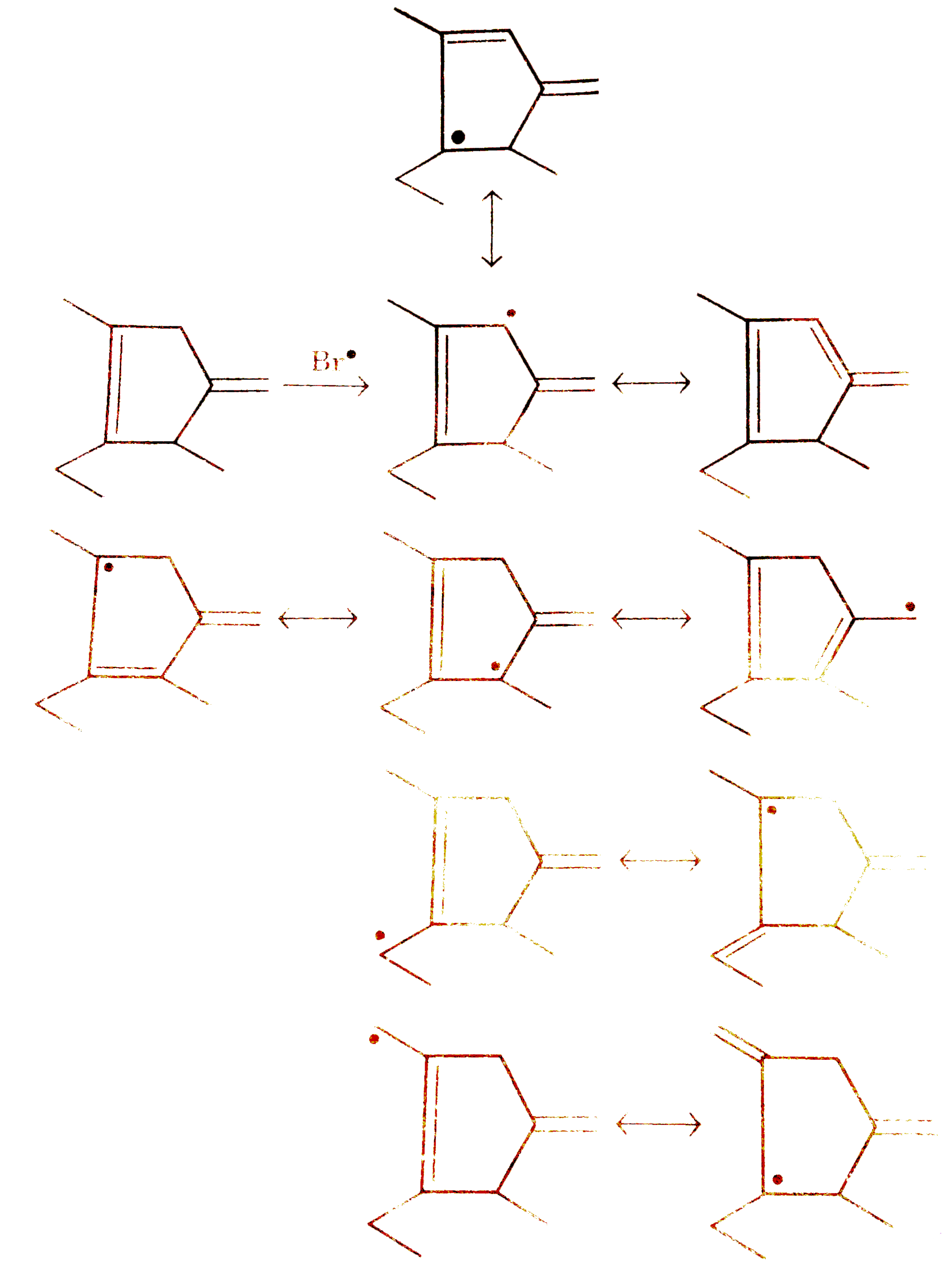 So 10 STRUCTURAL isomeric PRODUCTS are FORMED and TOTAL products including stereoisomers are 33. 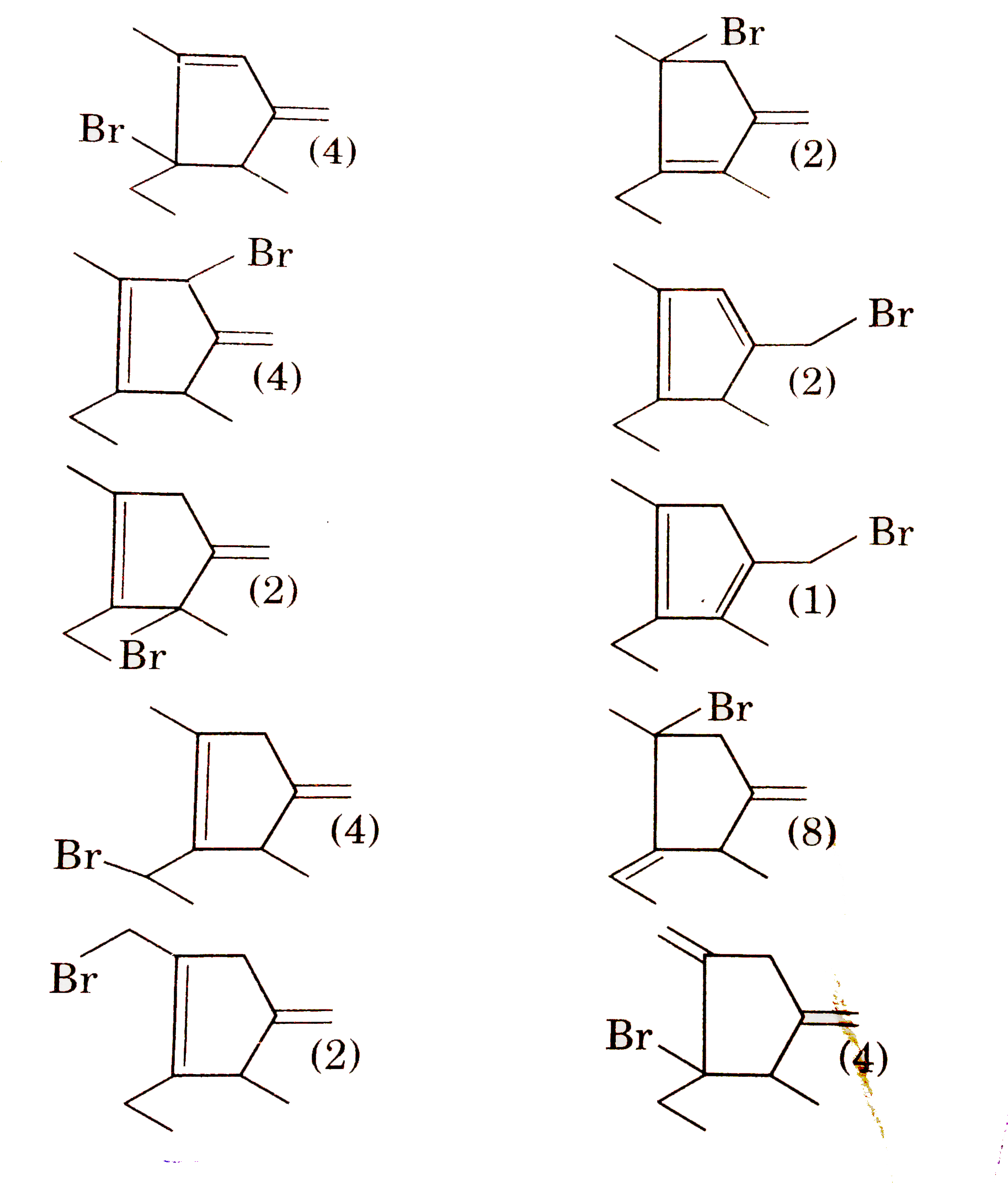
|
|
| 43. |
How many moles of sucrose should be dissolved in 500gms of water so as to get a solution which has a difference of 104^(@)C between boiling point and freezing point. (K_(f)=1.86 K Kg "mol"^(-1).K_(b)=0.52K Kg "mol"^(-1)) |
|
Answer» `1.68` Freezing point of solution `=` Freezing point `-DeltaT_(f)=0-DeltaT_(f)` Diffrence in temperature (given) `=100+DeltaT_(B)-(-DeltaT_(f))` `104=100+DeltaT_(b)+DeltaT_(f)=100+"molality"xxK_(b)+"molallity"xxK_(f)` `=100+"molality"(0.52+1.86)` `therefore "Molality"=(104-100)/(2.38)=(4)/(2.38)=1.68m` and molality `=("moles"xx1000)/(W_(gm(solvent))),1.68=("moles"xx1000)/(500)` `therefore` Moles of SOLUTE `=(1.68xx500)/(1000)=0.84` moles. |
|
| 44. |
How many moles of water are present in 180 g of water |
|
Answer» 1 mole |
|
| 45. |
How many moles of water are present in one litre of water? |
|
Answer» |
|
| 46. |
How many moles of platinum will be deposited on the cathode when 0.60 F of electricity is passed through a 1.0 M solution of Pt^(4+) ? |
|
Answer» 0.60 mol |
|
| 47. |
How many moles of R will be produced when 8 mol of P and S mol of Q are allowed to react according to the equation? 2P+QrarrR |
|
Answer» |
|
| 48. |
How many moles of P_(4)O_(6) and P_(4)O_(10) will be produced by the combustion of 12.4 g of phosphorous (atomic mass 31) in 12.8 g ofoxygen, leaving no P_(4) or O_(2) ? |
|
Answer» 0.1 and 0.3 mol Moles of `O_(2)= (12.8)/(32)=0.4` Let x moles of `P_(4)` from `P_(4)O_(6)` . Then, moles of `O_(2)` REQUIRED `= x xx 3+(0.1- x) xx 5=0.4` (given) `implies x = 0.05` |
|
| 49. |
How many moles of OH^(-) are involved in the balanced equation ? C_(2)H_(5)OH + I_(2) overset(OH^(-))rarrCHI_(3) + HCOO^(-) + I^(-) + H_(2)O |
|
Answer» |
|
| 50. |
How many moles of O-atoms are there in 1 mole CaCO_(3) |
|
Answer» `2N_(A)` |
|