

Saved Bookmarks
This section includes 7 InterviewSolutions, each offering curated multiple-choice questions to sharpen your Current Affairs knowledge and support exam preparation. Choose a topic below to get started.
| 2. |
How many enantiomeric pairs can be obtained by monobromination of isopentane? |
|
Answer» 3 |
|
| 3. |
How many enantiomeric pairs are possible in bromochlorocyclopentane? |
Answer» 
|
|
| 4. |
How many enantiomer pairs are obtained by monochlorination of 2, 3-dimethylbutane |
|
Answer» Nil 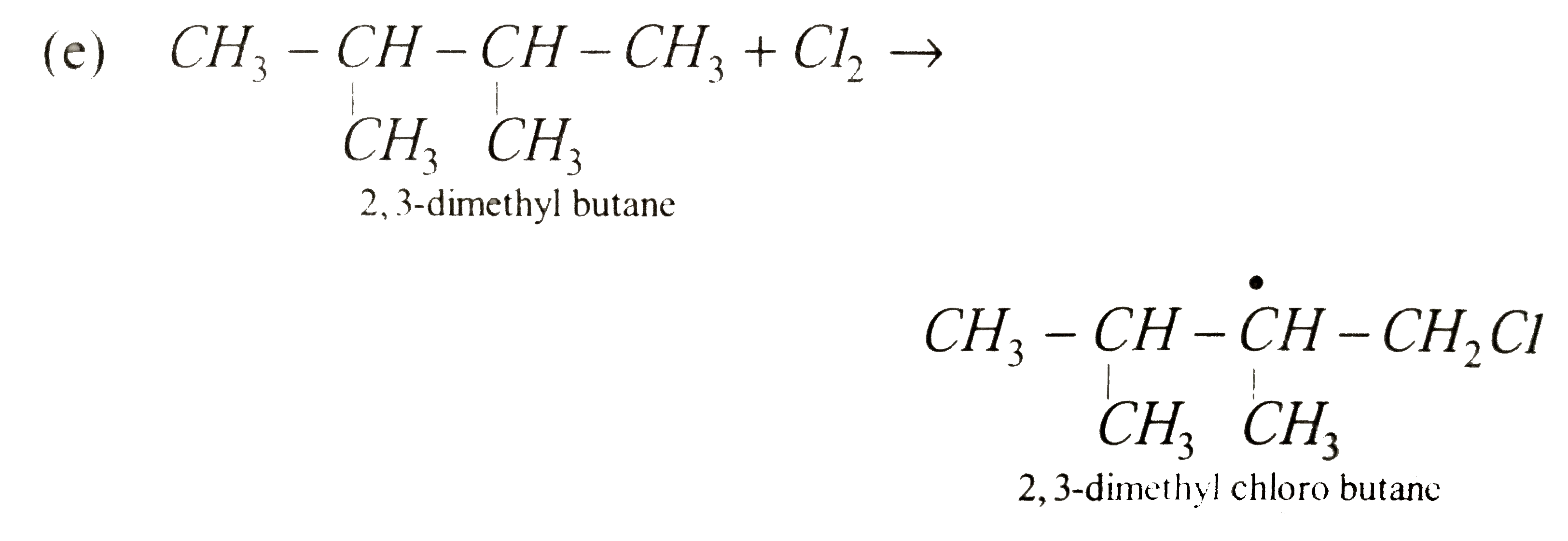 Due to the presence of CHIRAL carbon it shows the optical activity and its mirror IMAGE are non superimposable so it shows one enantiomer PAIR. 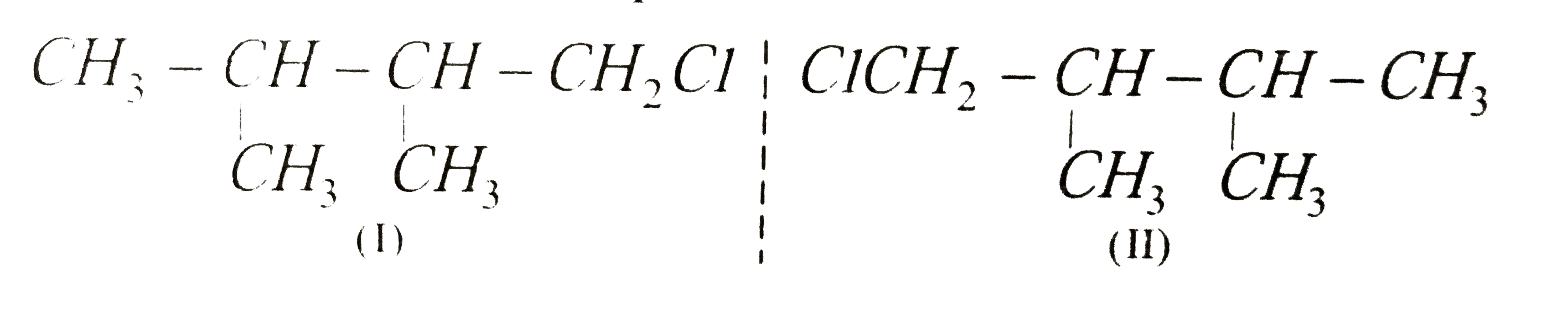
|
|
| 5. |
How many elements are there in 3d-series elements ? |
| Answer» SOLUTION :There are 10 elements in 3d-block SERIES from SC (21) to ZN (30). | |
| 6. |
How many elements are included in group 1: |
|
Answer» 4 |
|
| 7. |
How many electrons should X_(2)H_(4) liberate so that in the new compound X shows oxidation number of -1//2(E.N. X gt H) |
|
Answer» Solution :Structure of `SO_(3)` or DOT structure of `SO_(3)` `UNDERSET(1)O=underset(3)underset(O)underset(DARR)Srarrunderset(2)O` Formal charge on `O^(1)=6-(2+4)=0` Formal charge on `O^(2)=6-(1+6)=-1` Formal charge on `O^(3)=6-(1+6)=-1` Formal charge on `S=6-(4+0)=+2` 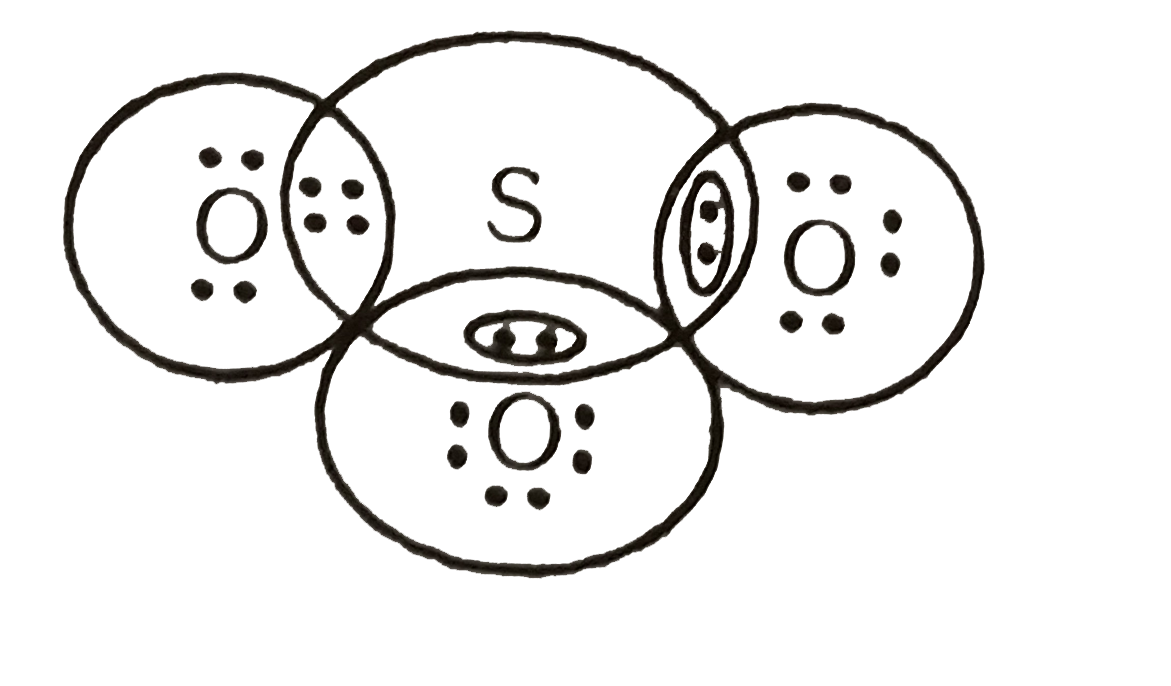
|
|
| 8. |
How many electrons would reflect in the nernst equation of the conversion of one mole of Mn_3O_4 in the MnO_2 ? |
|
Answer» |
|
| 9. |
How many electrons per second pass through a cross-section od a copper wire carrying 10^(-5)A ? (charge of 1 electron is 1.0 xx 10^(-19) coulomb ). |
|
Answer» `1.6 xx 10^(-36)` `therefore` Number of ELECTRONS PASSING through wire of `10^(-5)` C=`(10^(-5)xx6.023xx10^(23))/(96,500)` |
|
| 10. |
How many electrons occupy the bonding molecular orbitals of a C:N triple bond? |
|
Answer» |
|
| 11. |
How many electrons in chromium (Z=24)have l=0? |
|
Answer» 8 No. of ELECTRONS is s-orbitals=7. |
|
| 12. |
How many electrons in an atom with atomic number 104 can have ( n +1) = 8 ? |
|
Answer» 24 |
|
| 13. |
How many electrons in an atom can have n=3,l=2,m=-1? |
|
Answer» 2 |
|
| 14. |
How many electrons in a given atom can have the following quantum numbers? n=3,l=2,m=+2,s=-1//2 |
|
Answer» 1 No. of unpaired electrons =6 |
|
| 15. |
How many electrons flow when a current of 5 amperes is passed through a solution for 193 seconds ? |
|
Answer» Quantity of charge passed (Q)`=(5 amp)xx(193 s)=965 C` By PASSING 96500 C (1F) of charge, the electrons flowing `=6.022xx10^(23)` By passing 965 C of charge, the electrons flowing `=(6.022xx10^(23))/((96500C))xx(965C)=6.022xx10^(21)` |
|
| 16. |
How many electrons flow through a metallic wire if a current of 0.5 A is passed for 2 hours? (Given 1F=96,500 C mol^(-1)) |
|
Answer» Solution :Charge flowing through the METALLIC wire`=Ixxt=0.5xx2xx60xx60C=3600C` But charge flowing=no. of electrons flowing `XX`charge on each ELECTRON `therefore3600=nxx1.60xx10^(-19)` or `n=(3600)/(1.60xx10^(-19))=2.25xx10^(22)`. |
|
| 17. |
How many electrons can have l=2and n=5? |
|
Answer» 32 |
|
| 18. |
How many electrons are there in one coulomb: |
|
Answer» `6.02xx10^(21)` |
|
| 19. |
How many electrons are present in t_(2g) set of d-orbitals of central metal cation in [Fe(H_(2)O)_(5)(NO)]SO_(4) brown ring complex? |
|
Answer» <P> `overset(+1)(Fe)(3d^(7))` in `(overset(+1)(Fe)(H_(2)O)_(5)(NO)]^(2+),Delta_(0) lt P` 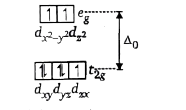 Number of electrons in `t_(2g)` set of d-orbitals=5 |
|
| 20. |
How many electrons are lost and gained by 2 g of Cl^(-) ions and 1 g of Zn^(2+) ions as the result of electrolysis respectively ?(Cl = 35.5, Zn = 65) |
|
Answer» Solution :Number of equivalents of `Cl^(-)` ions `= ("weight")/("eq. wt.")` `= (2)/(35.5)` Number of equivalent of `Zn^(2+)` ions `= (1)/(65//2) = (2)/(65)`. Now,1 MOLE (1F) of electric charge discharges 1 equivalent of matter. MOLAR of electric charge involved in CASE of `Cl^(-) = (2)/(35.5)` Mole of electric charge involved in case of `Zn^(2+) = (2)/(65)`. As 1 mole of electric charge corresponds to AV. no. of electrons, thus, no. of electrons lost by `Cl^(-) = (2)/(35.5) xx 6.022 xx 10^(23)` and no. of electrons gained by `Zn^(2+) = (2)/(65) xx 6.022 xx 10^(23)`. |
|
| 21. |
How many electrons are present in 18mL of water? |
|
Answer» Solution :18mL WATER=18g water=1 mole water=`6.02xx10^(23)` MOLECULES, each molecule consists 10 electrons (8 electrons per oxygen atom, 2 electrons for TWO hydrogen atoms). TOTAL electrons `=10xx6.02xx10^(23)=6.02xx10^(24)`. |
|
| 22. |
How many electrons are present in 1.6 g of methane? |
|
Answer» Solution :GRAM molecular mass of METHANE, ltbr. `(CH_(4))=12+4=16g` Number of moles in 1.6g of methane. `=(1.6)/(16)=0.1` Number of MOLECULES of methane in 0.1 mole `=0.1xx6.02xx10^(23)` `=6.02xx10^(22)` One MOLECULE of methane has =6+4=10electrons So, `6.02xx10^(22)` molecules methane have `10xx6.02xx10^(22)` electrons `=6.02xx10^(23)` electrons |
|
| 23. |
How many electrons are involved in reduction of KMnO_4 in basic reduction? |
|
Answer» |
|
| 24. |
How many electrons are involved in the oxidation by KMnO_4 in acid medium ? |
|
Answer» 5 |
|
| 25. |
How many electrons are involved in oxidation by KMnO_4 in basic medium |
|
Answer» one |
|
| 26. |
How many electron are present in 2xx10^(-3) moles of ._(8)^(18)O^(2-)? |
|
Answer» `1.2xx10^(21)` |
|
| 27. |
How many electrons can have the values n=2, l=1,and s=+1//2 in the configuration 1s^(2)2s^(2)2p^(3)? |
|
Answer» 1 |
|
| 28. |
How many EDTA (ethylenediaminetetraacetic acid) molecules are required to make an octahedral complex with a Ca^(2+) ion ? |
|
Answer» One |
|
| 29. |
How many EDTA (ethylenediaminetetraacetic acid) molecules are required to make an octahedral complexwith Ca^(2+) ion? |
|
Answer» Six |
|
| 30. |
How many EDTA molecules are required to make an octahedral complex with a Co^(2+) ion ? |
| Answer» ANSWER :D | |
| 31. |
How many EDTA (ethylenediaminetetraacetic acid) molcules are required to make an octahedral complex with a Ca^(2+) ion? |
|
Answer» six |
|
| 32. |
How many double bonds are present in the repeating structural units of polythene ? |
|
Answer» |
|
| 33. |
How many double bond are showing GI :- |
|
Answer» 1 |
|
| 34. |
How many different tripeptide chains can be prepared by combining three amino acid A, B and C in different order ? |
|
Answer» 6 |
|
| 35. |
How many different six carbon hydrocarbons on reductive ozonolysis give the same product shown below? |
|
Answer» |
|
| 36. |
How many different ketones on treatment with Grignard's reagent followed by hydrolysis can give 2-cyclopentyle butanol ? |
|
Answer» |
|
| 37. |
How many different proteins containing 100 amino acids can be made from the 20 naturally occurring amino acids? |
|
Answer» `100^(20)` |
|
| 38. |
How many different isomers exist for the octahedral complex [Co(NH_(3))_(4)Cl_(2)]^(+) ? |
|
Answer» 1 |
|
| 39. |
How many different condensation products would be form by the given reaction? CH_(3)-overset(O)overset(||)(C )-OC_(2)H_(5)+CH_(2)-overset(O)overset(||)(C )-OC_(2)H_(5) overset(C_(2)H_(5)overset(-)(O)overset(+)(N)a)underset(C_(2)H_(5)OH)rarr |
|
Answer» |
|
| 40. |
How many different condensation products would be formed by above reaction? |
|
Answer» |
|
| 41. |
How many different carboxylic acids are obtained when all the isomeric arenes having the molecular formula C_(8)H_(10) are oxidised with alk. KMnO_(4) followed by acidification? |
|
Answer» |
|
| 42. |
How many different codons are possible? |
|
Answer» 16 |
|
| 43. |
How many differentacyclicisomers of C_(6)H_(12)onhydrogenationwithH_(2)//Ni givethesame 3- methylpentane ? |
|
Answer» |
|
| 44. |
How many differentacyclicisomers of C_(5)H_(8) on catalytichydrogenation give the samen- pentane ? |
|
Answer» |
|
| 45. |
How many dichlorodiphenyl with molecular formula C_12H_8Cl_2 of each bezene ring containing only one (-Cl) group are possible : |
|
Answer» |
|
| 46. |
How many dichloro products (including stereoisomers) will be formed when R-2- chloropentane reacts with Cl_(2) in presence is UV radiation? |
|
Answer» |
|
| 47. |
How many defects exists in the arrangement of constituent particles of 7.45 g KCl ? [K = 39, Cl = 35.5 g/mole] |
|
Answer» `10 xx 10^(23)` 1 mol KCl = `10^6` Schottky pairs `therefore` 0.1 mol KCl = `10^5` Schottky pairs |
|
| 48. |
How many d pi - p pi bonds are present in gamma-SO_(3)? |
Answer»  Out of `12pi` bonds 8 are `d PI-p pi` bonds. |
|
| 49. |
How many cyclic isomers of molecular formulaC_(7)H_(15) can form 1 methylcyclohexan-l-olon reaction with H_(2)O /acetone/ Ag‘ {consider only structural isomers)? |
Answer» 
|
|
| 50. |
How many 'd' electrons are present in Cr^(2+) ion? |
|
Answer» 4 |
|