Saved Bookmarks
This section includes 7 InterviewSolutions, each offering curated multiple-choice questions to sharpen your Current Affairs knowledge and support exam preparation. Choose a topic below to get started.
| 1. |
Glyptal is a polymer of |
|
Answer» malonic ACID + ETHYLENE GLYCOL 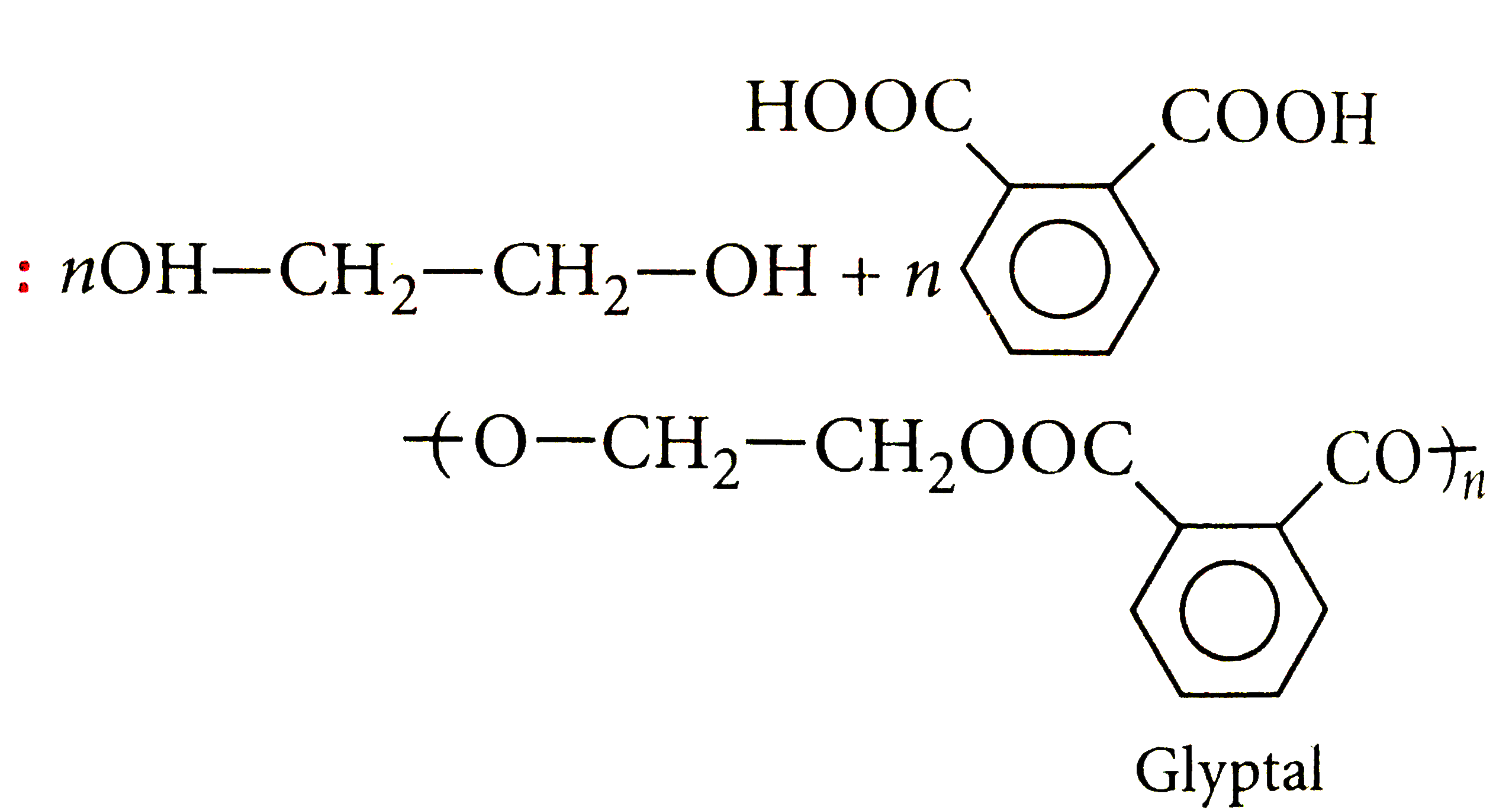
|
|
| 2. |
Glyptal is a polymer of : |
|
Answer» ETHYLENE GLYCOL and PHTHALIC ACID |
|
| 3. |
Glypltal or alkyds is polymer of: |
|
Answer» ETHYLENE GLYCOL and PHTHALIC ACID |
|
| 4. |
Glyoxal is |
|
Answer» `CH_(2)O-CH_(2)O` |
|
| 6. |
Glyeogen is |
|
Answer» Structurally similar to AMYLOPECTIN but extensively branched |
|
| 8. |
Glycoside linkage is : |
|
Answer» An ACETAL linkage |
|
| 10. |
"Glycol" overset(773 K) to 'A'. Identify 'A' |
|
Answer»
|
|
| 11. |
Glycol reacts with PCI_3 and gives ethylene dichloride . What will be the product, if it reacts with P+I_2: |
|
Answer» ETHYLENE iodide |
|
| 12. |
Glycol oon intramolecular Cannizzaro reaction in presenncof strong alkali gives: |
|
Answer» glycol |
|
| 13. |
Glycol on heatingwith PI_(3)mainly given Aglycol on heating with HI mainly gives B A and B are : |
|
Answer» `CH_(2)=CH_(2)" and "CH_(3)CH_(2)-I` |
|
| 14. |
Glycol on oxidation with _______ gives oxalic acid : |
|
Answer» ACIDIC `KMnO_4` |
|
| 15. |
Glycol is |
|
Answer» MONOHYDRIC ALCOHOL |
|
| 16. |
Glycol is prepared industrially by the following reactions: |
|
Answer»
|
|
| 17. |
Glycol forms diethylene glycol on heating with |
|
Answer» ANHY, `ZnCl_2` |
|
| 19. |
Glycogen on hydrolysis gives : |
|
Answer» STARCH |
|
| 20. |
Glycogen is closely related with |
|
Answer» polyethene |
|
| 21. |
Glycogen is called animal starch |
| Answer» | |
| 22. |
Glycogenis anexample of : |
|
Answer» POLYSACCHARIDE |
|
| 23. |
Glycogen is an example of : |
|
Answer» Polysaccharide |
|
| 24. |
Glycogen is a branched chain polymer of alpha-D-glucose units in which chain is formed by C1-C4 glycosidic linkage whereas branching occurs by the formation of C1-C6 glycosidic linkage. Structure of glycogen is similar to …………. |
|
Answer» AMYLOSE |
|
| 25. |
Glycogen is a branched chain polymer of alpha-D-glucose units in which chain is formed by C_(1)-C_(4) glycosidic linkage whereas branching occurs by the formation of C_(1)-C_(6) glycosidic linkage. Structure of glycogen is similar to______________ . |
|
Answer» AMYLOSE |
|
| 26. |
Glycogen is a branched polymer of : |
|
Answer» `ALPHA` GLUCOSE |
|
| 27. |
Glycogen is a branched chain polymer of alpha-D-glucose units in which chain is formed by C_1-C_4 glycosidic linkage whereas branching occrus by the formation of C_1-C_6 glycosidic linkage. Structure of glycogen is similar to .......... |
|
Answer» Amylose |
|
| 28. |
Glycogen is |
|
Answer» a strutcural polysaccharide |
|
| 29. |
Glycogen is : |
|
Answer» A polysaccharide FOUND in both ANIMALS |
|
| 30. |
Glycogen is _______. |
|
Answer» a POLYMER of -------D-glucose units |
|
| 32. |
Glycogen and amylopectin have : |
|
Answer» Same structure |
|
| 33. |
Glycogen , a naturally occurring polymerstored in animals is a |
|
Answer» MONOSACCHARIDE |
|
| 34. |
Glycine reacts with nitrous acid to give : |
|
Answer» Glycine NITRITE |
|
| 35. |
Glycine is optically inactive. Why? |
| Answer» SOLUTION :Glycine is DENOTED by the FORMULA, `H_2N-CH_2-COOH`. Glycine has no ASYMMETRIC CARBON, so it is optically inactive. | |
| 36. |
Glycine may be classed as all of the following except |
|
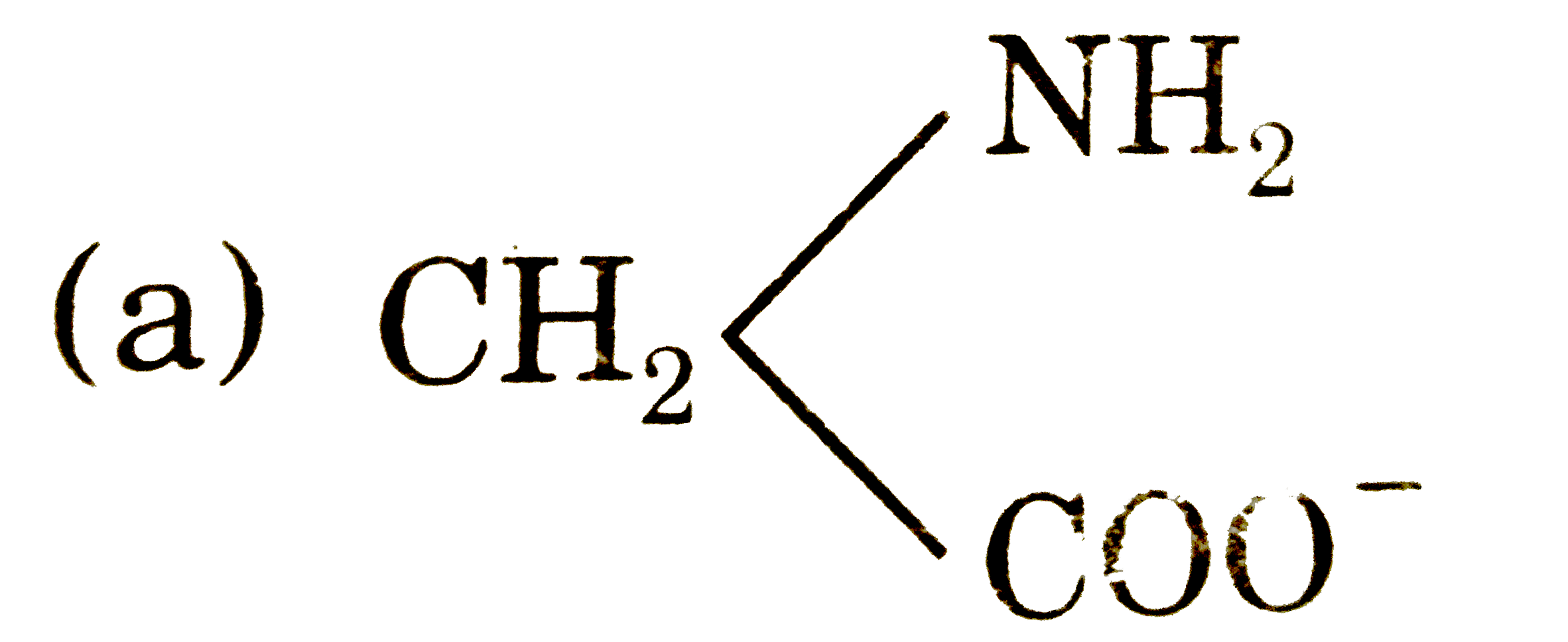
Answer» A base `underset(("Glycine"))(H_(2)N-underset(H)underset(|)OVERSET(H)overset(|)(C)-COOH)` |
|
| 37. |
Glycine (H_(2)N-CH_(2)-COOH) is one of the proteinogenic amino acid. Find moles of glycine in it's 7.5 gm |
|
Answer» 0.1 MOLE |
|
| 39. |
Glycine exists as (H_3N+ CH_2COO-) while anthranilic acid (P-NH_2-C_6H_4-COOH) does not exist as dipolar ion. |
| Answer» Solution :`-COOH` is too weakly acidic to TRANSFER `H^+` to the weakly basic `-NH_2` attached to the electron withdrawing benzene ring. When attached to an aliphatic carbon, the `-NH_2` is sufficiently basic ACCEPT `H^+` from `-COOH` group. | |
| 40. |
Glycine exists as a zwitterion but o- and p- aminobenzonic acids do not. Explain. |
Answer» Solution :In o- or p -aminobenzoic acids , the lone PAIR of ELECTRONS on the `NH_2` group is dontateed towards the benzene ring. As a result , acidic character of `-COOH` group and BASIC character of `-NH_(2)` group DECREASES. Therefore the weakly acidic `-COOH`group cannot transfer a `H^(+)` ion to the weakly basic `-NH_2` group. Thus, o-or p-aminobenoic acids do not exist as zwitterions.  However , in glycine , no such electron -WITHDRAWING benzene ring is present . As a result , `-NH_2` group is sufficiently basic and hence accepts a proton form `-COOH` group to form a zwitterion. `underset("Glycine")(H_2N-CH_2-COOH) hArrH_(3)overset(+)N-CH_2-COO^(-)` . |
|
| 41. |
Glycine and e-amino caproic acid polymerises to give ............ |
|
Answer» glycyl amine |
|
| 42. |
Glycine, alanine, histidine, cultamine, proline, serine. |
| Answer» Solution :HISTIDINE. It is an essential amino acid WHEREAS others are non essential amino ACIDS. | |
| 44. |
Glycin has the structural formula NH_(2)-CH_(2)-COOH. Glycine has two dissociation constant for which K_(a)" and " K_(b) are 1.6xx10^(-10)" and "K_(b) is 2.5xx10^(12). Calculate the isoelectric point of glycine [Hint : If your answer is 5.12 then fill 0512 in OMR sheet. If your answer is 8.02 then fill 0802 in OMR sheet] |
|
Answer» `=(9.7958+2.39)/2=6.09` `pK_(a1)=-logK_(a)""pK_(B1)=-logK_(b)` `pK_(a1)=-log1.6xx10^(-10)""pK_(b1)=-log2.5xx10^(-12)` `pK_(a1)=9.79""pK_(b1)=11.6` `pK_(a1)+pK_(b1)=14` `pK_(a2)+11.6=14` `pK_(a2)=2.3979` |
|
| 45. |
Glycinato ligand is : |
| Answer» Answer :D | |
| 46. |
Glyceryl ester of long chain fatty acids are called ......... |
|
Answer» SOAP |
|
| 47. |
Glycerol was distilled with oxalic and crystals and the products were led into fehling solution and warmed . Cuprous oxide was precipitated . It is due to |
|
Answer» CO `HCOOH +` Fehlingsolution `to underset("red ppt.")(Cu_(2))O+CO_(2)+H_(2)O` |
|
| 48. |
Glycerol was distilled with oxalic acid crystals and theproducts were led into Fehling solution and warmed. Cuprous oxide was precipitated. It is due to : |
| Answer» Answer :D | |
| 49. |
Glycerol tristearate (stearin) can not undergo, which of the following reaction ? |
|
Answer» Sponification |
|