

Saved Bookmarks
This section includes 7 InterviewSolutions, each offering curated multiple-choice questions to sharpen your Current Affairs knowledge and support exam preparation. Choose a topic below to get started.
| 1. |
From the following data, mark the option (s) where DeltaH is correctly written for the given reaction. Given: H^(+)(aq)+OH^(-) (aq) rarr H_(2)O(l)""DeltaH= -57.3 kJ DeltaH_("solution") of HA(g)= -70.7 kJ/mol Delta_("solution") of BOH(g)=20 kJ/mol DeltaH_("ionization") of HA=15 kJ/mol & BOH is a strong base |
|
Answer» `{:("Reaction",DeltaH_(R)" (kJ/mole)"),(HA(aq)+BOH(aq) rarr BA(aq)+H_(2)O,-42.3):}` `DeltaH=-57.3+DeltaH_("ion")HA` `=-42.3` OPTION (A) correct `HA(g)+BOH(g) rarr BA(aq)+H_(2)O` `DeltaH=DeltaH_("solution")HA+DeltaH_("solution")BOH-57.3+15` `=-93` option (B) correct `HA(g) rarr H^(+) (aq)+A^(-) (aq)` `DeltaH=DeltaH_("solution")+DeltaH_("ions")=-55.7 kJ` option (C) is correct `:. BOH` is strong base `:. DeltaH_("ion")=0` `:. B^(+) (aq)+OH^(-)(aq) rarr BOH(aq) DeltaH=0` |
|
| 2. |
Gelatin is used as an ingredient in the manufacture of icecreame for |
|
Answer» CAUSING the MIXTURE to solidly |
|
| 3. |
From the following data, C(s , graphite) + O_(2) (g) to CO_(2) (g) H_(2) (g) + (1)/(2) O_(2) (g) to H_(2) O (l) Delta H_("reaction")^(@) = -286 kJ/mole 2 C_(2) H_(6) (g) + 7O_(2) (g) to 4 CO_(2) (g) + 6H_(2) O (l) Delta H_("reaction")^(@) = -3120 kJ/mole Calculate the standard enthalpy of formation of C_(2) H_(6) (g) ( in kJ/mole) |
| Answer» SOLUTION :`-85` kJ/mole | |
| 5. |
From the following data for the decomposition of N_(2)O_(5) in carbon tetrachloride solution at 321 K, show that the reaction is of the first order and calculate the rate constant. {:("Time (in minutes)",,,,:,,,10,,,15,,,20,,,25,,,oo),("Vol. of "O_(2)" evolved "("in "cm^(3)),,,,:,,,6.30,,,8.95,,,11.40,,,13.50,,,34.75):} |
|
Answer» Solution :If the reaction is of the first order, it MUST obey theequation : `k=(2.303)/(t)log""(a)/(a-x)=(2.303)/(t)log""(V_(oo))/(V_(oo)-V_(t))` In the present case, we are given that `V_(oo)=34.75" cm"^(3)` The value of k at each INSTANT can be calculated as follows : `{:("t(min)",,,V_(t),,,V_(oo)-V_(t),,,k=(2.303)/(t)log""(V_(oo))/(V_(oo)-V_(t))),(10,,,6.30,,,34.75-6.30=28.45,,,k=(2.303)/(10min)log""(34.75)/(28.45)=0.01997min^(-1)),(15,,,8.95,,,34.75-8.95=25.80,,,k=(2.303)/(15min)log""(34.75)/(25.80)=0.01985min^(-1)),(20,,,11.40,,,34.75-11.40=23.35,,,k=(2.303)/(20min)log""(34.75)/(23.35)=0.01987min^(-1)),(25,,,13.50,,,34.75-13.50=21.25,,,k=(2.303)/(25min)log""(34.75)/(21.25)=0.01967min^(-1)):}` Since the value of k comes to be nearly CONSTANT, hence given reaction is of the first order. The AVERAGE value of the constant `=0.01984" minute"^(-1)` |
|
| 6. |
Gelatin is mostly used in making ice-cream in order to |
|
Answer» prevent formation of a COLLOID |
|
| 7. |
From the following data calculate the value of Avogadro constant. Charge of an electron = 1.6 xx 10^(-19) coulomb.(1 faraday = 96500 coulombs) |
|
Answer» SOLUTION :Since 1 faraday, i.e, 96500 coulombs, is the charge of 1 mole of electrons, i.e., Av. No. of electrons. `THEREFORE` Av. Constant `= ("charge of 1 mole of electrons")/("charge of one electron")` `= (96500)/(1.6 xx 10^(-19)) = 6.03 xx 10^(23)`. |
|
| 8. |
Gelatin is often used as an ingredient in the manufacture of ice-cream. The reason for this is |
|
Answer» CAUSING the mixture to solidly |
|
| 9. |
From the following data, calculate the enthalpy change for the combustion of cyclopropane at 298 K. The enthalpy of formation of CO_2(g), H_2O(l) and propene (g) are -393.5, -285.8 and 20.42 kJ "mol"^(-1)respectively. The enthalpy of isomerisation of cyclopropane to propene is –33.0 kJ "mol"^(-1) |
| Answer» SOLUTION :`-2091.32 KJ` | |
| 10. |
Gelatin is mostly used in making icecream in order to........... |
|
Answer» prevent making of COLLOID |
|
| 11. |
From the following data at 25^(@) C {:("Reaction" ,, Delta_(r) H^(@) kJ//mol) , ((1)/(2) H_(2) (g) + (1)/(2) O_(2) (g) to OH (g) ,, 42), (H_(2) (g) + (1)/(2) O_(2) (g) to H_(2) O (g) ,, -242), (H_(2) (g) to 2 H (g) ,, 436) , (O_(2) (g) to 2 O(g) ,, 495):} Which of the following statement(s) is/are correct : Statement(a) : Delta_(r) H^(@)for the reaction H_(2) O (g) to 2 H(g) + O(g) is 925 kJ/mol Statement (b) : Delta_(r) H^(@)for the reaction OH(g) to H_(2) (g) + O(g)is 502 kJ/mol Statement(c) : Enthalpy of formation of H(g) is – 218 kJ/mol Statement(d) : Enthalpy of formation of OH(g) is 42 kJ/mol |
| Answer» Answer :D | |
| 12. |
Gelatin is mostly added during preparation of Icecream. This helps to: |
|
Answer» PREVENT colloid FORMATION |
|
| 13. |
From the following data answer the questions Reaction A+B rarr P {:([A]M,,[B]M,,Initially rate (M sec^(-1)),,,),(,,,,at 300K,at 400K,,),(2.5xx10^(-4),,3.0xx10^(-5),,5.0xx10^(-4),2.0xx10^(-3),,),(5.0xx10^(-4),,6.0xx10^(-5),,4.0xx10^(-3),,,),(1.0xx10^(-3),,6.0xx10^(-5),,1.6xx10^(-2),,,):} The energy of activation for reaction (kcal//mol) is (log 2=0.3) |
|
Answer» `1.68` |
|
| 14. |
Gelatin is generally added to Ice cream. Give reason. |
| Answer» Solution :ICE cream is a EMULSION of milk or cream in water (O/W TYPE). Gelatin is added as an EMULSIFIER to stabilize the emulsion. | |
| 15. |
From the following compounds/ions, how many are electrophiles? CH_(3)^(+), NH_(4)^(+).BF_(3).NH_(3).NH_(2)-NH_(2).PC_(3).PCl_(3).SbCl_(5).GaCl_(3).AlCl_(3).F^(-),.CN^(+).CH_(3)-Cl("C" atom of halide) |
|
Answer» |
|
| 16. |
Gelatin is generally added to ice-cream . Why ? |
| Answer» Solution :Ice- CREAM is water in oil TYPE emulsion and gelatin acts as EMULSIFIER . | |
| 17. |
From the following compounds which does not react with C_(6)H_(5)SO_(2)Cl ? |
|
Answer» `CH_(3)NH_(2)` |
|
| 19. |
From the following choose the incorrect statement about crystalline solids. i) Melt at sharp temperature. ii) They have definite heat of fusion. iii) They are isotropic iv) They have long range order. |
|
Answer» |
|
| 20. |
From the following choose the incorrect statement about crystalline solids. |
|
Answer» MELT at SHARP temperture |
|
| 21. |
From the following bond energies : {:(H-H "bond energy :" 431.37 kJ mol^(-1)),(C=C "bond energy :" 606.10 kJ mol^(-1)),(C-C "bond energy : "336.49 kJmol^(-1)),(C-H "bond energy :" 410.50kJ mol^(-1)):} calculate the bond energy of the following reaction : H-overset(overset(H)(|))( C)= overset(overset(H)(|))(C )-H + H - H rarr H - underset(underset(H)(|))overset(overset(H)(|))(C )- underset(underset(H)(|))overset(overset(H)(|))(C)- H |
|
Answer» `- 243.6 KJ//mol` `= [B.E_(C = C) + B.E_(H - H) + 4 xx B.E_(C - H)]` `= [B.E_(C - C) + 6 xx B.E_(C - H)]` `= (606.10 + 431.37 + 4 xx 410.5) - (336.49 + 6 xx 410.50)` `= - 120.2 kJ mol^(-1)` |
|
| 22. |
From the following bond energies H-H bond energy : 431.37 kJ mol^(-1)C=C bond energy : 606.10 kJ mol^(-1)C-C bond energy : 336.49 kJ mol^(-1) C-H bond energy : 410.50 kJ mol^(-1) Enthalpy for the reaction. underset(H)underset(|)overset(H)overset(|)(C)=underset(H)underset(|)overset(H)overset(|)(C)+H-HrarrH-underset(H)underset(|)overset(H)overset(|)(C)-underset(H)underset(|)overset(H)overset(|)(C)-H will be |
|
Answer» 1523.6 KJ `MOL^(-1)` `=-120.0 kJ mol^(-1)`. |
|
| 23. |
From the Ellingham graphs on carbon, which of the following statements is false |
|
Answer» `CO_(2)` is more stable thenCO at less than 983 K |
|
| 24. |
From the Ellingham graphs on carbon, which of the following statements is false? |
|
Answer» `CO_2` is more stable than CO at LESS than 983 K |
|
| 25. |
From the Ellingham diagram, predict the temperature above which C can reduce Al_(2)O_(3). |
| Answer» Solution :CARBON can REDUCE `Al_(2)O_(3)" above "2000""^(@)C` approximately. | |
| 26. |
From the Ellingham graph between Gibbs energy and temperature , out of C and CO which is a better reducing agent for ZnO ? |
|
Answer» Carbon |
|
| 27. |
From the Ellingham graphs on carbon , which of the following statements is false ? |
|
Answer» `CO_(2)` is more stable than `CO` at less than 983 K 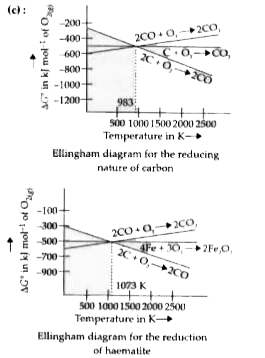 Below 983 K , `DELTA G^(@)` for the formation of `CO_(2)` is more negative than `DeltaG^(@)` for the formation of CO , so `CO_(2)` is more stable . At temperature above 983 K , `Delta_("formation")^(@)` of CO is more negative than `Delta G_("formation")^(@)` of `CO_(2)` , so CO is more stable . So statement (c) is false . `Delta G_("formation")^(@)` of `CO_2` from `CO` is more negative than `Delta G_("formation")^(@)` of `Fe_(2) O_(3)` . This MEANS that `Fe_(2) O_3` can be reduced by CO below 1073 K . |
|
| 28. |
From the Ellingham diagram, predict the temperature above which aluminium can reduce MgO. |
| Answer» SOLUTION :ALUMINIUM can REDUCE MgO above `1300""^(@)C` approximately. | |
| 29. |
From the Elligham diagram, indicate the lowest temperature at which carbon reduces ZnO. |
| Answer» SOLUTION :CARBON can redeuce ZnO at that TEMPERATURE above which (ZN, ZnO) line intersects with `(C, CO)` line. | |
| 30. |
From the electrochemical series given in the text, determine the approximate value of E^@ for X^(2+) (aq)+2e to X(s) The metal X dissolves in hydrochloric acid producing H_2 but does not replace either Zn^(2+) or Fe^(2+). |
| Answer» SOLUTION :`-0.44 V LT E^@ lt 0.00V` | |
| 31. |
From the electrochemical series given in the text, determine the approximate value of E^@ for X^(2+) (aq)+2e to X(s) The metal X dissolves in nitric acid but not in hydrochloric acid . It can displace Ag^+ but not Cu^(2+) |
| Answer» SOLUTION :`0.34 V LT E^@ lt 0.80V` | |
| 32. |
From the electrochemical series, Cu can displace Ag from silver nitrate solution Write down the reaction taking place at the cathode |
| Answer» SOLUTION :`AG^+(AQ)+e^-to Ag(s)` | |
| 33. |
From the electrochemical series, Cu can displace Ag from silver nitrate solution Write Nernst equation for the above cell reaction |
|
Answer» Solution :Cell REACTION is `CU(s)+AG(aq)to Cu^(2+)(aq)+2Ag(s)` `therefore `Nernst equation can be written as `E(cell)=E_(cell)^@-(2.303RT)/(nF)log[[Cu^(2+)]]/[Ag^+]^2`OR `E(cell)=E_(cell)^@-0.059/2log[[Cu^(2+)]]/[Ag^+]^2`at 298 K |
|
| 34. |
From the electrochemical series, Cu can displace Ag from silver nitrate solution Write down the reaction taking place at the anode |
| Answer» SOLUTION :`CU(s)to Cu^(2+)(AQ)+2E^-` | |
| 35. |
From the electrochemical series, Cu can displace Ag from silver nitrate solution Represent the cell constructed with silver and copper electrodes |
| Answer» SOLUTION :`CU(s)//Cu(^2+)(AQ)////AG^+(aq)//Ag(s)` | |
| 36. |
From the concentrations of C_(4)H_(9)Cl (butyl chloride) at different times given below, calculate the average rate of reaction, C_(4)H_(9)Cl+H_(2)OtoC_(4)H_(9)OH+HCl,during different intervals of time {:(t//s,,,[C_(4)H_(9)Cl]//molL^(-1),,,t//s,,,[C_(4)H_(9)Cl]//molL^(-1)),(0,,,0*100,,,300,,,0*0549),(50,,,0*0905,,,400,,,0*0439),(100,,,0*0820,,,500,,,0*0335),(150,,,0*0741,,,700,,,0*0210),(200,,,0*0671,,,800,,,0*017):} |
|
Answer» SOLUTION :Average rate of REACTION in the interval `t_(1)` to `t_(2)=(-"{"[C_(4)H_(9)Cl]_(t_(2))-[C_(4)H_(9)Cl]t_(1)"}")/(t_(2)-t_(1))` `{:("TIME//s",,,[C_(4)H_(9)Cl]//MOLL^(-1),,,"Time interval",,,"Average Rate "(molL^(-1)s^(-1))),(0,,,0*100,,,""-,,,""-),(50,,,0*0905,,,0-50,,,(-(0-0905-0-100)molL^(-1))/((50-0)s)=1*96xx10^(-4)),(100,,,0*0820,,,50-100,,,(-(0*0820-0*0905)molL^(-1))/((100-50)s)=1*70xx10^(-4)),(150,,,0*0741,,,100-150,,,(-(10*0741-0*0820)molL^(-1))/((150-100)s)=1*58xx10^(-4)),(200,,,0*067,,,150-200,,,(-(0.067-0*074)molL^(-1))/((200-150)s)=1*40xx10^(-4)),(300,,,0*0549,,,200-300,,,(-(0*0549-0*067)molL^(-1))/((300-200)s)=1*22xx10^(-4)" & so on."):}` |
|
| 37. |
From the concetration of C_(4)H_(9)Cl (butyl chloride) at different times given below, calculate the average rate of reaction: C_(4)H_(9)Cl+H_(2)O rarr C_(4)H_(9)OH+HCl during different intervals of time. |{:([C_(4)H_(9)Cl] (mol L^(-1)),t (s)),(0.100,0),(0.0905,50),(0.0820,100),(0.0741,150),(0.0671,200),(0.0549,300),(0.0439,400),(0.0210,700),(0.017,800):}| |
|
Answer» Solution :First determine the difference in the concentration over difference intervals of time and thus determine the average rate by dividing `Delta[R]` by `Delta t`. Average rate of hydrolyiss of butyl CHLORIDE 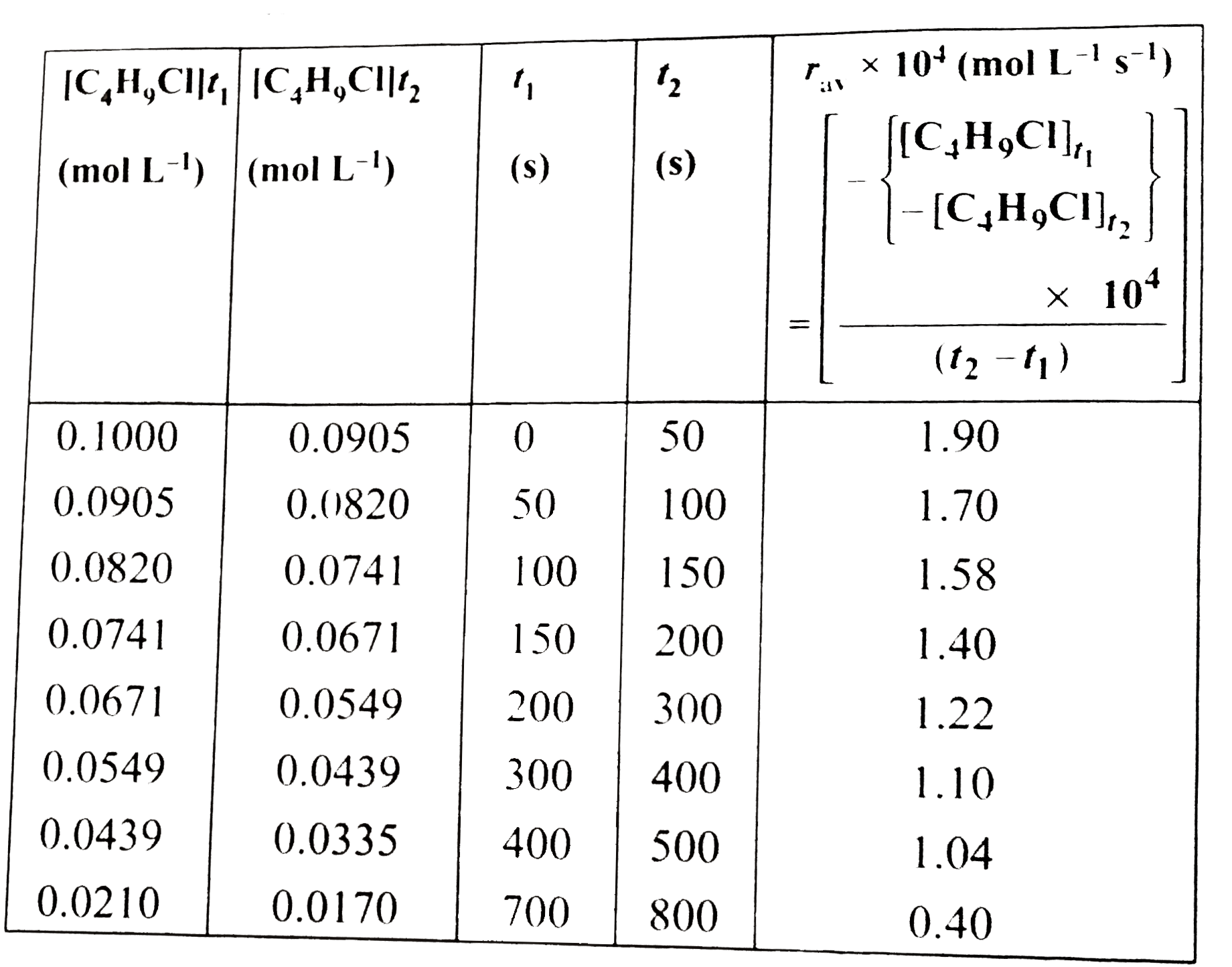 It is clear that the average rate falls form `1.90 xx 10^(-4) mol L^(-1)s^(-1)` to `0.4 xx 10^(-4) mol L^(-1) s^(-1)`. However, the average rate cannot be used to predict the rate of a reaction at a particular instant as it WOULD br constant for the time interval for which it is calculated. So to express the rate at a particular moment of time, the instantaneous rate is determine. It is obtained when we conisder the average rate at the smallest time interval say `dt` (i.e., when `Delta t` APPROACHES zero). Hence, mathematically, for an infinitesmally small `dt`, instantaneous rate is given by: `r_(av) = (-Delta[R])/(Delta t) = (Delta[P])/(Delta t)` As `t rarr 0, ot r_("inst") = (-d[R])/(dt) = (d[P])/(dt)`...(i) It can be determined graphically by drawing a tangent at time `t` on either isdes of the curves for concentration of `R` and `P` vs time `t` calculatingits slope. So in ILLUSTRATION 4.1, `r_(inst)` at `600 s`, for example, can be calculated by plotting the concentration of butyl chloride as a function of time. A tangent is drawn that touches the curve at `t = 600 s`. 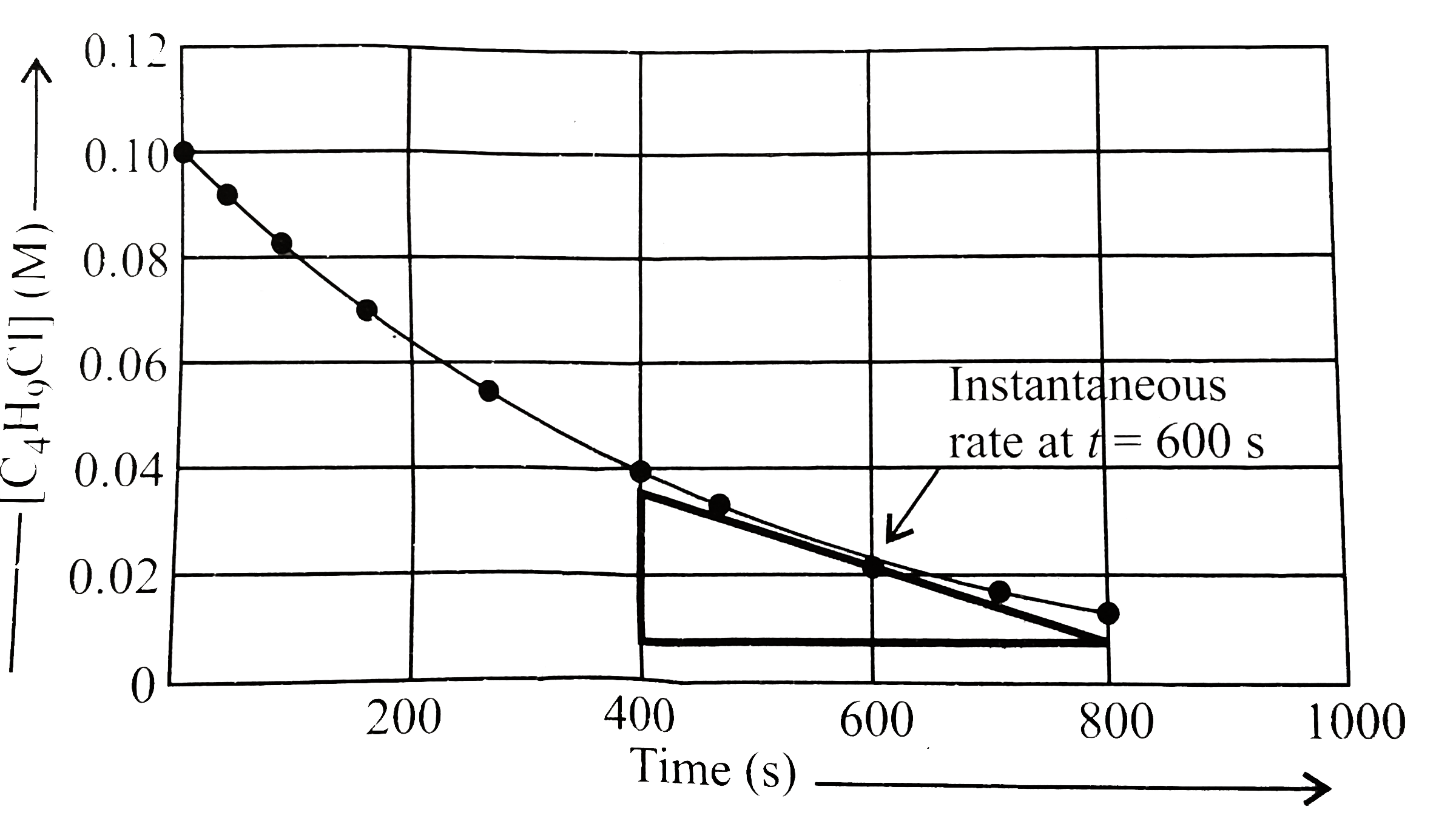 The slope of this tangent gives the instantaneous rate. So,`r_("inst")` at `600 s = ((0.0165 - 0.037)/((800-400)s))mol L^(-1)` `= 5.12 xx 10^(-5) mol L^(-1) s^(-1)` At `t = 250s, r_("inst") = 1.22 xx 10^(-4) ,ol L^(-1) s^(-1)` `t = 350 s, r_("inst") = 1.0 xx 10^(-4) mol L^(-1) s^(-1)` `r = 450 s, r_("inst") = 6.4 xx 10^(-5) mol L^(-1) s^(-1)` |
|
| 38. |
From spent Nuclear Fule Plutonium wasts is removed with |
|
Answer» `O_(2)F_(2)` |
|
| 39. |
From separate solution of four sodium salt NaW, Nax, NaY and NaZ had pH 7.0 , 9.0 , 10 . 0 and 11.0 respectively , when each solution was 0.1 M , theweakest acid is :- |
|
Answer» HW |
|
| 40. |
From sodium argentocyanide Na[Ag(CN)_2], silver is precipitated by adding a powder of : |
|
Answer» Tin |
|
| 41. |
From sodium argento cyanide Nal A CN, silver is proe pitated by adding a powder of |
|
Answer» Gold |
|
| 42. |
From S to Po, the tendency to show -2 oxidation state |
|
Answer» REMAINS UNCHANGED |
|
| 43. |
From methyl alcohol we get : |
|
Answer» NEOPRENE rubber |
|
| 44. |
From Ma_(3)b_(3), when one b is replaced by c, the total no. of geometrical isomer possible are |
|
Answer» |
|
| 45. |
From La (OH)_(3)to Lu _(OH)_(3) which of the following is wrong statement ? |
|
Answer» IONIC character decreases |
|
| 46. |
From Kirchoff's equation which factor affects the heat of reaction |
|
Answer» Pressure |
|
| 47. |
From La to Lu ionisation potential |
| Answer» Answer :B | |
| 48. |
From sodium aurocyanide Na[Au(CN)_2], gold can be precipitated by adding powder of: |
|
Answer» Zn |
|
| 49. |
From given compounds how many have tetrahedral shape, not sp^(3) hybridised and coloured W.r.t. underline atoms. MnO_(4)^(-), Cr_(2)O_(7)^(2-), VO_(4)^(3-),[Fe(H_(2)O)_(5)NO]^(+2), CrO_(2)Cl_(2) |
|
Answer» |
|


