Saved Bookmarks
This section includes 7 InterviewSolutions, each offering curated multiple-choice questions to sharpen your Current Affairs knowledge and support exam preparation. Choose a topic below to get started.
| 1. |
For the test of halides, the soda extract is acidfied with |
|
Answer» DIL `H_(2)SO_(4)` |
|
| 2. |
For the system A_((g))+2B_((g))hArrC_((g)), the equlibrium concentrations are (A) 0.06 mole/litre (B) 0.12 mole/litre (C ) 0.216 mole/litre. The K_(eq) for the reaction is |
|
Answer» Solution :For reaction `A+2BhArrC` `K=([C])/([A][B]^(2))=(0.216)/(0.06xx0.12xx0.12)=250.` |
|
| 3. |
For the system at equlibrium, which of the following are correct |
|
Answer» `LOGK=(1)/(2.303R)(DeltaS-(DeltaH)/(T))` `TDeltaS-DeltaH=2.303RTlogKimplies` `(TDeltaS-DeltaH)/(2.303RT)=logKimplies(1)/(1.303R)[DeltaS-(DeltaH)/(T)]=logK` Hence choice (a) is correct. On changing temperatue K changes and not Q. Also `LOG""(K_(2))/(K_(1))=(DeltaH)/(2.303R)[(T_(2)-T_(1))/(T_(1)T_(2))]` For endothemic reactions on increasing T, K increase hte concentration of products. Thus choice (c) is correct while (b) and (d) are not correct. |
|
| 4. |
For the system 3A+2BhArrC, the expression for equilibrium constant is |
|
Answer» `([3A][2B])/(C)` |
|
| 5. |
For the synthesis of Laevorotatory solution, the only correct combination is : |
|
Answer» (IV)(iv)(Q) |
|
| 6. |
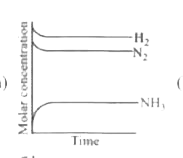
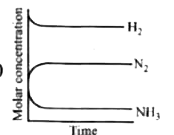
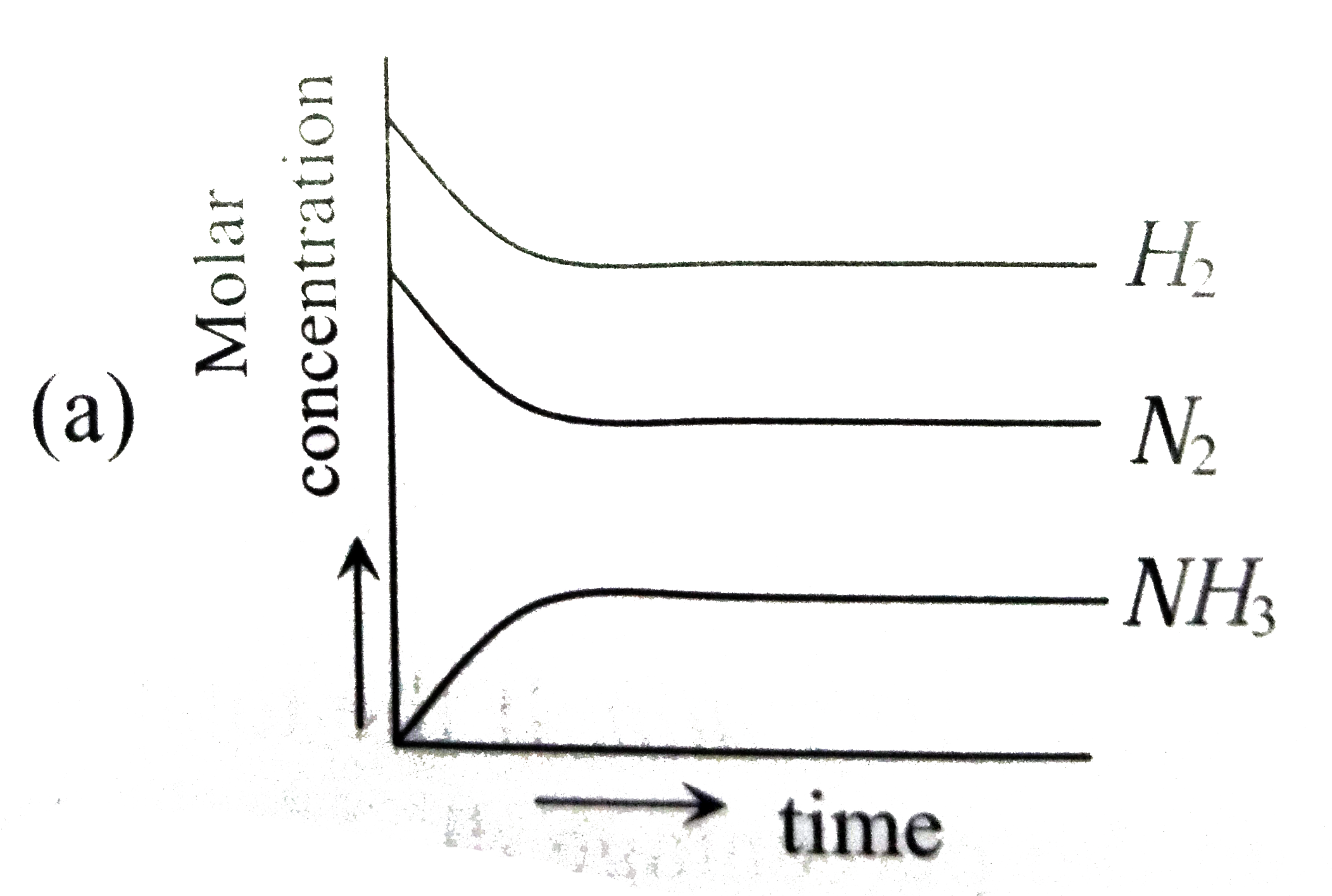
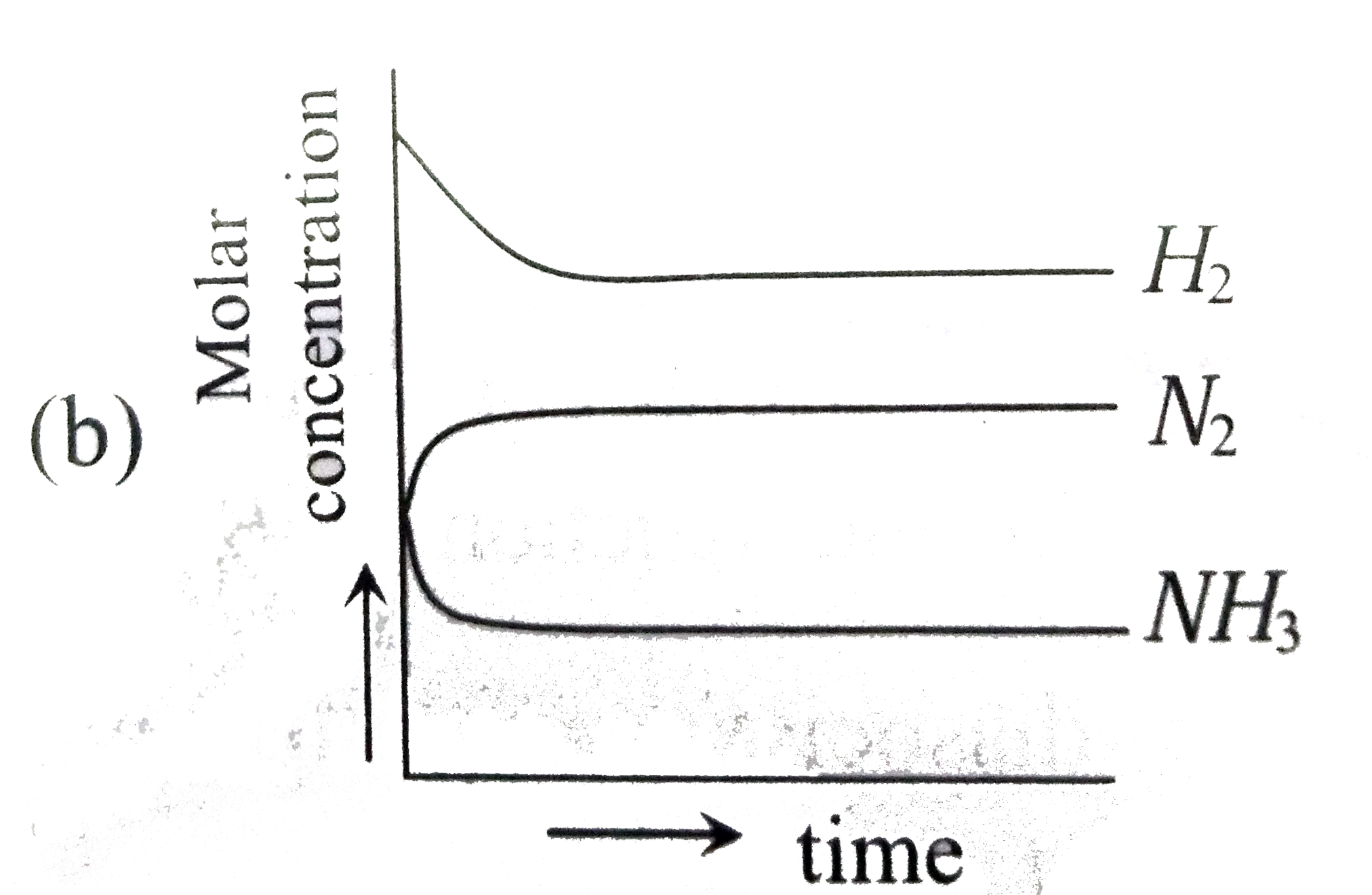
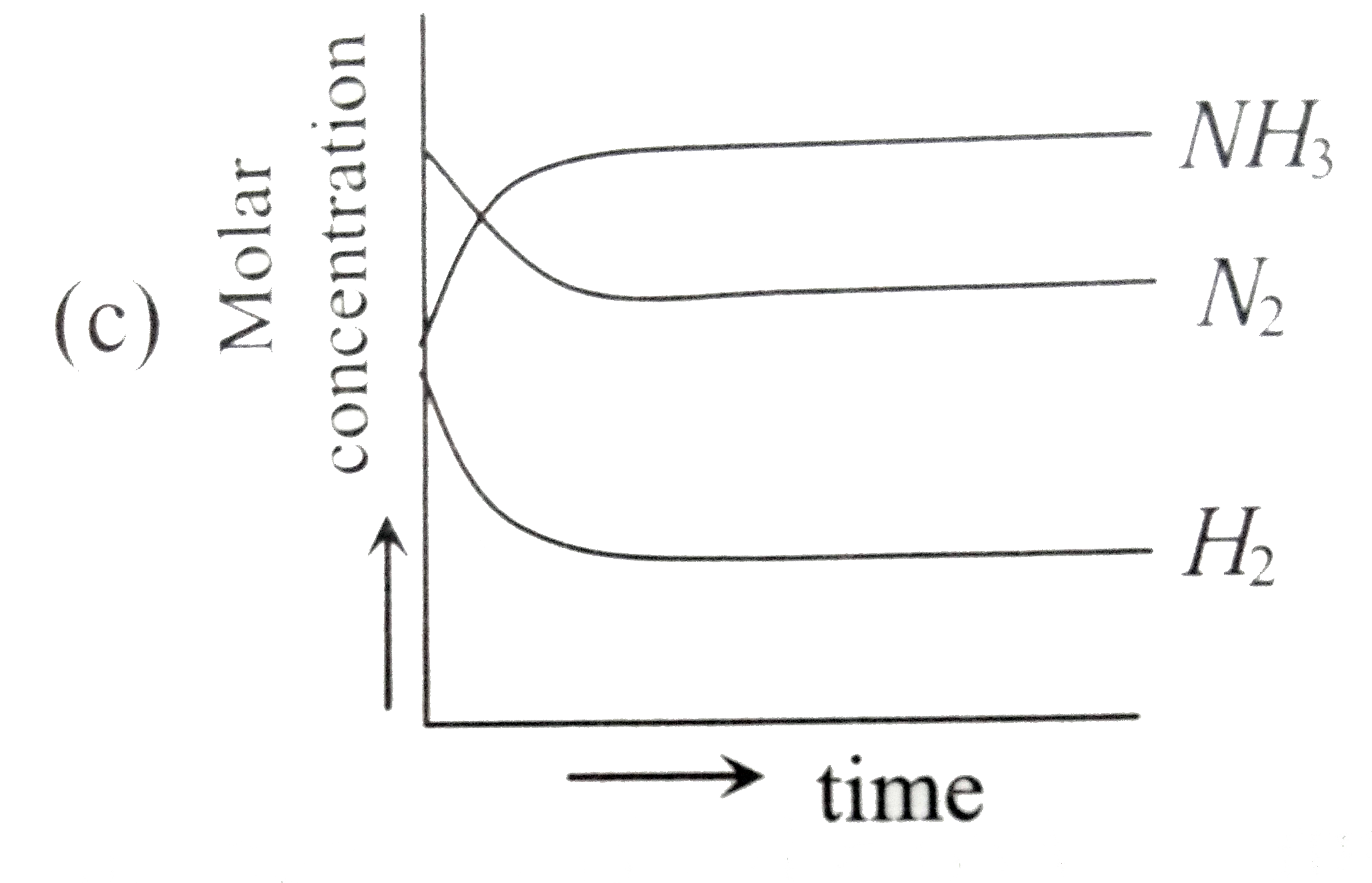
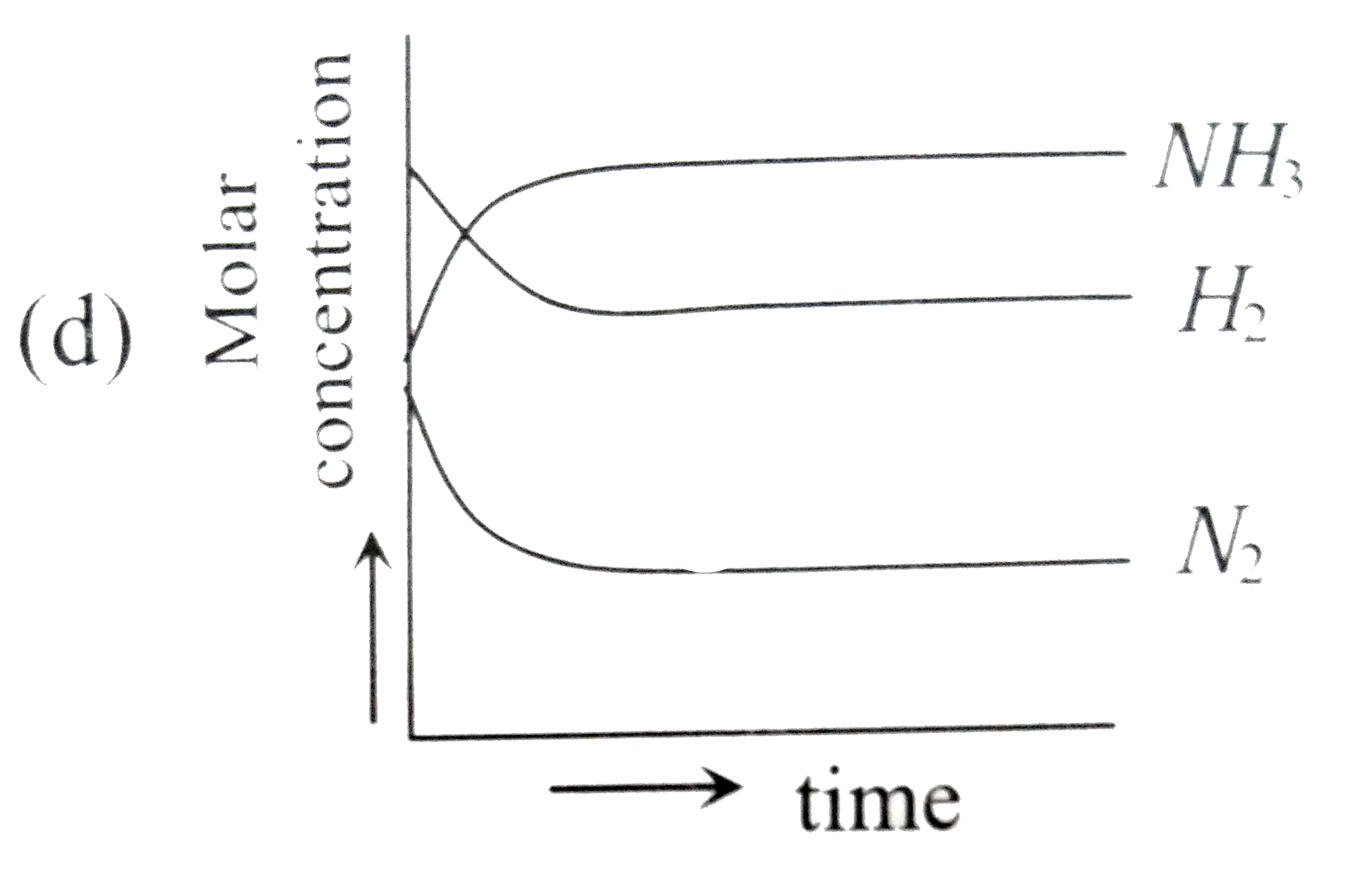
For the synthesis of ammonia by the reaction N_(2)+3H_(2)iff2NH_(3) in the Haber process, the attainment of equilibrium is correctly predicted by the curve |
|
Answer»
|
|
| 7. |
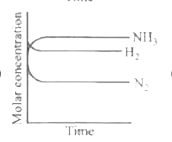
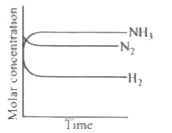
For the synthesis of ammonia by the reaction N_(2)+3H_(2)hArr hNH_(3) in the Haber process the attainment of equilibrium is correctly predicted by the curve |
|
Answer»
|
|
| 8. |
For the synthesis of ammonia at 300 K : N_2(g)+3H_2(g)to2NH_3(g) Calculate the value of DeltaG^@ in Kcal and give your answer in magnitude by using the following data : {:(( ),N_2,H_2,NH_3),(DeltaH_f(Kcal//"mole"),0,0,-10),(S^@(Cal//"K-mole"),40,30,45):} |
|
Answer» `DeltaS_R^@=2xxS_(NH_3)^@-3xxS_(H_2)^@-S_(N_2)^@=2xx45-3xx30-40=-40` Cal/K `DeltaG^@=DeltaH^@-TDELTAS^@= - 20 - (300xx(-40))/1000=-20+12=-8 Kcal` |
|
| 9. |
For the structure given below the sign marked as S is an: |
|
Answer» TETRAHEDRAL VOID |
|
| 10. |
For the strong electrolytes NaOH, NaCl and BaCl_2 the molar ionic conductivities at infinite dilution are 248.1xx10^(-4),126.5xx10^(-4) and 280.0xx10^(-4) mho cm^2 mol^(-1) respectively. Calculate tmolar conductivity of Ba(OH)_2 at infinite dilution. |
|
Answer» |
|
| 11. |
For the standard cell Cu(s)|Cu^(2+)(aq)||Ag^(+)(aq)|Ag(s). [E_((Cu^(2+))/(Cu))=0.3V and E_((Ag^(+))/(Ag))^(0)=0.80V] Write the reaction taking place at the electrodes. |
|
Answer» SOLUTION :At cathode `AG^(+)+E^(-) to Ag` At ANODE `Cu to Cu^(2+)+2e^(-)` |
|
| 12. |
For the standard cell Cu(s)|Cu^(2+)(aq)||Ag^(+)(aq)|Ag(s). [E_((Cu^(2+))/(Cu))=0.3V and E_((Ag^(+))/(Ag))^(0)=0.80V] Identify the cathode and the anode as the current is drawn from the cell. |
| Answer» SOLUTION :Cathode is `Ag^(+)//Ag and" ANODE is "CU^(2+)//Cu` | |
| 13. |
For the square coplanar complex [Pt(NH_(3))(NH_(2)OH)P_(Y)(Cl)]^(+), how many geometrical isomers are possible? Draw them. |
Answer» SOLUTION :Three isomers are possible. Any other possible CONFIGURATION WOULD MERELY be a ROTATION or reflection of one of these. 
|
|
| 14. |
For the sequential first order reaction: A overset(k_(1)) rarr B overset(k_(2)) rarrC t=0 [A_(0)] 00 Match the following lists: {:(,"List-I",,"List-II"),("(P)","Time for" (+(d[C])/dt)_(max)when k_(1)=k_(2)=k,,(1)1/k),("(Q)","Time for" (+(d[C])/dt)_(max)when k_(1)nek_(2),,(2)(l nk_(2)-l nk_(1))/(k_(2)-k_(1))),("(R)",[B]when k_(1)=k_(2)(d[B])/(dt)=0 and (d^(2)[B])/dt^(2)=-ve,,(3)[A_(0)]/e),("(S)",[B]when k_(1) ne k_(2)(d[B])/(dt)=0 and (d^(2)[B])/(dt^(2))=-ve,,[A_(0)](k_(2)/k_(1))^(k_(2)/(k_(1)-k_(2)))):} |
|
Answer» `{:("PQRS"),("1234"):}` |
|
| 15. |
For the simultaneous reactions:2A to B, -(d[A])/(dt) =(0.04min^(-1)).[A] 3A to 2C, -(d[A])/(dt) =(0.03min^(-1)).[A] Which of the following statement(s) is/are incorrect regarding the reactions? |
|
Answer» The overall rate constant for the disappearance of 'A' is `0.17min^(-1)`. |
|
| 16. |
For the solution of the gasesW, X, Yandzinwaterat298 K , theHenryslawconstants(K _ H )are 0.5, 2, 35 and40 kbar,respectively. Thecorrectplotfor the givendata is: |
|
Answer»
`P_("gas")=K_(H).(1-X_(H_(2)O))` `P_("gas")=K_(H)-K_(H).X_(H_(2)O)` `y=C+mx` For higher `K_(H)` SLOPE will be more negative |
|
| 17. |
For the sequential reaction: A.overset(k_(1)=0.2"min"^(-1))(to)Boverset(k_(2)=0.2"min"^(-1))(to)C t= 0 a M ""0""0 The time (in min) at which concentration of B becomes maximum is : |
|
Answer» |
|
| 18. |
Forthe sequential first order reactions: {:(,Aoverset(k_(1)=2xx10^(-4)s^(-1))to,Boverset(k_(2)=10s^(-1))to,C),(t=0,0.4M ,0,0):} the time after which the concentration of C cecomes 0.3 M is: |
|
Answer» `(In2)/(k_(1))` |
|
| 19. |
For the sequence of reactions, RC_6 H_5 NO_2 overset(HNO_3) underset(H_2 SO_4) to A overset((NH_4)_2 S) to B, the compound Bis |
|
Answer» ANILINE 
|
|
| 20. |
For the second order reaction , A + B toProducts When a moles of A reacts with b moles of B , the rate equation is given by k_(2) t= (1)/((a-b)) "ln" (b(a-x))/(a(b-x)) When a gt gt b , the rate expression becomes that of |
|
Answer» First ORDER ` GT gt b` means (a-x) = a and (a-b) =a i.e., `k_(2) t = (1)/(a)` ln `(ba)/(a(b-x)) implies k_(2) t = (1)/(a)` ln `(b)/((b-x))` (SINCE 'a' being very large , may be treated as constant after the change) . Thus , the reaction FOLLOWS first order kinetics . |
|
| 21. |
For the second order reaction t_((1)/(2))prop |
|
Answer» `(1)/(a^(2))` |
|
| 22. |
The rate constant for a second order reaction is k=(2.303)/(t(a-b))log""(b(a-x))/((b-x)) where a and b are initial concentrations of the two reactants A and B involved. If one of the reactants is present in excess, it becomes pseudo unimolecular. Explain how ? |
|
Answer» first order w.r.t. A |
|
| 23. |
For the same metal, stabilisation energies of tetrahedral and octahedral complexes are related as |
|
Answer» `Delta_t = Delta_0` |
|
| 24. |
For the same alkyl (or) aryl group, boiling point, is more for |
|
Answer» RI |
|
| 25. |
For the salt of weak acid and strong base, the hydrolysis constant is given by the expression : |
|
Answer» `K_(H)=(K_(W))/(K_(B))` |
|
| 26. |
For the reversible vapourisation of water at 100^(@)C and 1 atmospheric pressure. DeltaG is equal to? |
|
Answer» `DELTAH` |
|
| 27. |
For the reversible vaporisation of water at 373 K and 1 atmosphere pressure, Delta G is equal to |
|
Answer» `DELTA H` |
|
| 28. |
For the reversible reaction the initial concentrations of A and B are Am and bm,and the equillibrium concentrations are (a-x)M and (b+x) respectively. The value of x is: |
|
Answer» `(K_(1)a+K_(2)B)/(K_(1)+K_(2))` |
|
| 29. |
For the reversible vaporisation of water at 100^@C and 1 atmospheric pressure, triangleG is equal to: |
|
Answer» `TRIANGLEH` |
|
| 30. |
For the reversible reaction N_(2(g))+3H_(2(g))iff2NH_(3(g)) At 500^(@)C, the value of K_(p) is 1.44xx10^(-5) when partial pressure is measured in atmospheres. The corresponding value of K_(c) with concentration in mole "litre"^(-1), is |
|
Answer» <P>`1.44xx10^(-5)//(0.082xx500)^(-2)` `=1.44xx10^(-5)//(0.082xx773)^(-2)` |
|
| 31. |
For the reversible reaction N_2(g) + 3H_2(g) = 2NH_3(g) at 500^@C the value of K_p is 1.44 xx 10^-5 when partial pressure measured in atmosphere The corrosponding value of K_c with concentration is mole/lit. IS : |
|
Answer» `(1.44xx10^(-5))/ (0.082xx500)^(-2)` |
|
| 32. |
For the reversible reaction : A(s)+B(g)iffC(g)+D(g) : DeltaG^(@)=-350 kj.Which one of the following statements is true |
|
Answer» The ENTROPY CHANGE is NEGATIVE |
|
| 33. |
For the reversible reaction : Aounderset(K_(2))overset(K_(1))hArrB ,k_(1)=0.02"min"^(-1) and k_(2)=0.03"min^(-1) . The reaction is statedwith A only .If the half life of suchreaction is defined as the time in which halfof the equilibrium amount of B is formed , then , what is the half life of reaction ? |
|
Answer» 34.65 min |
|
| 34. |
For the reversible reaction. A(s)+B(g) Leftrightarrow C(g)+D(g), triangleG^(@)=-350kJ Which one of the following statement is true? |
|
Answer» The REACTION is thermodynamically non-feasible |
|
| 35. |
For the reversible reaciton, N_(2(g))+3H_(2(g))hArr2NH_(3(g)) at 500^(@)C, the value of K_(p) is 1.44xx10^(-5) when partial pressure is measured in atmospheres. The conrresponding value of K_(c) with concentration in mole "littre"^(-1), is |
|
Answer» `1.44xx10^(-5)//(0.082xx500)^(-2)` `Deltan=2-4=-2` `K_(p)=K_(c)[RT]^(Deltan),K_(p)=K_(c)[RT]^(-2)` `K_(c)=(K_(p))/([RT]^(-2))=(1.44xx10^(-5))/([0.082xx773]^(-2))` |
|
| 36. |
For the reversible reaction A =+ 2B harr C+ Heat the forward raction will proceed at |
|
Answer» LOW TEMPERATURE and low pressure |
|
| 37. |
For the reversible reaction : A_(s) + B_(g) hArr C_(g) + D_(g) : Delta G^(@) = - 350 kJ Which one of the following statements is true ? |
|
Answer» The ENTROPY CHANGE is negative |
|
| 38. |
For the reversible reaction 2H_2S_((g)) hArr 2H_(2(g))+S_(2(g)) The equilibrium concentrations, are [H_2S]=0.5 mole/litre [H_2]=0.4 mole/litre [S_2]=0.4 mole/litre The value of 'K' would be |
|
Answer» `0.004` mole/litre |
|
| 39. |
For the reduction of silver ions with copper metal, the standard cell potential was found to be +0.46V at 25^(@)C. Thevalue of standard Gibbs energy, DeltaG^(@) will be (F=96500Cmol^(-1)) |
|
Answer» `-98.0kJ` `n=2` `DeltaG=-nFE_(CELL)` `DeltaG=-2xx96500xx0.46` joul `DeltaG=-88.78kJ=-89kJ`. |
|
| 40. |
For the reduction of silver ions with copper metal, the standard cell potential was found to be +0.46V at 25^(@)C. The value of standard Gibbs energy, DeltaG^(@) will be (F=96500" C "mol^(-1)) |
|
Answer» `-98.0kJ` `DeltaG^(@)=-nFE_(cell)^(@)=-2xx96500xx0.46J=-88780J=-89kJ` |
|
| 41. |
For the relief of post operative pains, cardiac pains, suitable analgesic is________ |
|
Answer» Codeine |
|
| 42. |
For the reduction of NO_(3)^(-) ion in an aqueous solution, E^(@) is +0.96V. Values of E^(@) for some metal ions are given below V_((aq))^(2+)2e^(-)toV""E^(0)=-1.19V Fe_((aq))^(3+)+3e^(-)toFe""E^(@)=-0.04V Ag_((aq))^(3+)+3e^(-)toAu""E^(0)=+1.40V Hg_((aq))^(2+)+2e^(-)toHg""E^(o)=+0.86V The pair(s) of metals that is (areO oxidized by NO_(3)^(-) in aqueous solution is(are) |
|
Answer» V and HG These species are V, FE, Hg. |
|
| 43. |
For the reduction of NO_(3)^(-) ion in an aqueous solution , E^(0) is + 0.96 V , the values of E^(0) for some metal ions ar given below : i) V_((aq))^(+2) + 2e^(-) to V,E^(0) = 1.19V ii) Fe_((aq))^(+3) + 3e^(-) to Fe , E^(0) = -0.04 V iii) Au_((aq))^(+3) + 3e^(-) to Au , E^(0) = + 1.40 V iv) Hg_((aq))^(+2) + 2e^(-) to Hg , E^(0) = +0.86 V The pair(s) of metals that is/are oxidizd by NO_3^(-) in aqueous solution is /are |
|
Answer» FE and AU |
|
| 44. |
For the reduction of Feo at the temperature corresponding to point D, which of the following statements is correct? |
|
Answer» `DeltaG^(@)` value for the overall reduction reaction with carbon monoxide is ZERO. Thus overall value of `DeltaG^(@)` will be zero. |
|
| 45. |
For the reduction of FeO at the temperature corresponding to point D, which of the following statements is correct ? |
|
Answer» `DeltaG` value for the OVERALL reduction REACTION with carbon MONOXIDE is ZERO. |
|
| 46. |
Forthe redox reacton Cr_2 O_(7)^(2+)+H^(+) +NIto Cr^(3+) +NI^(2+)+H_2 O the correctcoefficientsof thereactantsfor thebalancedreaction areCr_2 O_(7)^(2-)NIH^+ |
|
Answer» 1314 |
|
| 47. |
For the redox reaction Zn_((s))+Cu^(2+)(0.1M)toZn^(2+)(1M)+Cu_((s)) taking place in a cell, E_(cell)^(o) is 1.10 volt, E_(cell) for the cell will be (2.303(RT)/(F)=0.0591) |
|
Answer» 2.14 VOLT `=1.10-0.0295log10=1.07` volt |
|
| 48. |
For the redox reaction Zn(s) + Cu^(2+) (0.1M) rarr Zn^(2+) (1M) + Cu(s) that takes place in a cell, E^(o)""_(cell) is 1.10 volt. E_(cell) for the cell will be: |
|
Answer» `2.14` VOLT |
|
| 49. |
For the redox reaction Zn+NO_(3)^(-)rarr Zn^(2+)+NH_(4)^(-) is basic medium, coefficients of Zn, NO_(3)^(-) and OH^(-) in the balanced equation respectively are : |
|
Answer» 4, 1, 7 |
|