

Saved Bookmarks
This section includes 7 InterviewSolutions, each offering curated multiple-choice questions to sharpen your Current Affairs knowledge and support exam preparation. Choose a topic below to get started.
| 1. |
For reaction : A+2Bunderset("yield")overset(40%)rarr4C If 10 moles of A and B each are taken calculate number of moles of 'C' formed are: |
|
Answer» 20 10 10 B is LR which is 40% react `0.4xxn_(B)=(n_(C)"formed")/(2)RARR n_(C)"formed"=0.4xx10xx2=8` Ans |
|
| 2. |
For reaction 2NOCl_((g))hArr2NO_((g))+Xl_(2(g)), K_(c)at 427^(@)Cis 3xx10^(-6)Lmol^(-1). The value of K_(p) is nearly |
|
Answer» <P>`7.50xx10^(-50)` `K_(p)+K_(c)(RT)^(DELTAN)` `K_(p)=3xx10^(-6)(0.0821xx700)=172.41xx10^(-6)=1.72xx10^(-4)` |
|
| 3. |
For reaction , 3A toproducts, it is found that the rate of reaction increases 4- fold when concentration of A is increased 16 times keeping the temperature constant. The order of reaction is |
| Answer» ANSWER :D | |
| 4. |
For reaction, 2A_((g))hArr3C_((g))+D_((s)), the value of K_(c) will be equal to |
|
Answer» `K_(p)(RT)` For this reaction, `Deltan_(g)=3-2=1` `THEREFORE K_(p)=K_(C)[RT]^(1)or (K_(p))/(K_(c))=RTor K_(c)=(K_(p))/(RT)` |
|
| 5. |
For reaction 2Cl(s)rarrCl_(2)(s), the signs of DeltaH and DeltaSrespectively are |
|
Answer» `+, -` |
|
| 6. |
For radioactive decay: |
|
Answer» `t_(3//4) = 2 t_(1//2)` |
|
| 7. |
For raction : mA+nB rarr pC+ qDthe rate law given by dx/dt = K[A]^x[B]^y The correct statement for this raction if |
|
Answer» the molecularityh of the raction is m+n Molecularity of the reaction = Total NUMBER of reactant molecules in the reactant molecules in the reaction = m+ n Order of the reaction = SUM of the powers of the conc. of reactants in the rate law = x+ y |
|
| 8. |
For Ra^(266 t_((t)/(2))) yrs is 1620 yrs from 0.001 g of Ra how many alpha particles relaease per min? |
| Answer» SOLUTION :`2.17xx10^(9) MIN ^(-1)` | |
| 9. |
For pure water on small increase in temperature: |
|
Answer» PH decreases |
|
| 11. |
For producing the effective collisions the colliding molecules must have |
|
Answer» a certain MINIMUM AMOUNT of energy |
|
| 12. |
For producing the effective collisions thecolliding molecules must have : |
|
Answer» A CERTAIN MINIMUM amount of energy |
|
| 13. |
For prevention of rusting of iron,which is used in paints |
|
Answer» PbO |
|
| 14. |
For preparing one litre N/10 solution of H_(2)SO_(4), we need H_(2)SO_(4) |
| Answer» Solution :`(1)/(10)=(Wxx1000)/(EQ." "wtxxvol.)=(Wxx1000)/(49xx1000)impliesW=4.9gm` | |
| 15. |
For prevention of rusting of iron, which is used in paints ? |
|
Answer» PBO |
|
| 16. |
For preparing monohalogen derivative of phenol, halogenation is carried out |
|
Answer» at HIGH temperature |
|
| 17. |
For preparing methyl acetylene, we take - |
|
Answer» `CH_(3)-UNDERSET(CHCOOK)underset(||)(C)-COOK` |
|
| 18. |
For preparing M/10 solution of H_2 SO_4 in one litre we need H_2 SO_4 |
|
Answer» 0.009 g |
|
| 19. |
For preparing H_(2)O_(2)in the laboratory |
|
Answer» `PbO_(2)`is added to ACIDIFIED solution of `KMnO_(4)` |
|
| 20. |
For preparing a salt bridge, gelatin or agar-agar is dissolved in a hot aqueous solution of |
|
Answer» `K_(2)CO_(3)` |
|
| 21. |
For preparing an alkane, a saturated solution of sodium or potassium salt of a carboxylic acid is subjected to |
|
Answer» Hydrolysis |
|
| 22. |
For preparing a buffer solution of pH 6 by mixing sodium acetate and acetic acid, the ratio of the concentration of salt and acid should be (K_(a) = 10^(-5)) |
|
Answer» `1:10` `pH = -LOG K_(a) + log .(["SALT"])/(["Acid"]), 6 = -log 10^(-5) + log .(["Salt"])/(["Acid"])` `6 = 5 log 10 + log .(["Salt"])/(["Acid"]), 6 = 5 + log .(["Salt"])/(["Acid"])` `log .(["Salt"])/(["Acid"]) = 6 =5 = 1, (["Salt"])/(["Acid"]) = (10)/(1)`. |
|
| 23. |
For preparing 0.1 N solution of a compound fromits impure sample of which the percentage purity is known, the weight of the substance required will be |
|
Answer» More than the theroretical WEIGHT |
|
| 24. |
For preparing a buffer solution of pH 6 BY mixing sodium acetate and acetic acid the ratio of concentration of salt and acid (K_a=10^(-5))Should be : |
|
Answer» 1:10 |
|
| 25. |
For preparing 0.1 N solution of a compound from its impure sample, of which the percentage purity is known, the weight of the substance required will be |
|
Answer» More than the THEORETICAL weight |
|
| 26. |
For precipitation reaction of Ag^(+) ions with NaCl, which of the following statements is correct |
|
Answer» `DELTAH` for the reaction is ZERO |
|
| 27. |
For precipitation of silver from the complex [Ag(CN)_(2) ]^(-), zinc is used but not copper. Why? |
|
Answer» Solution :copper is ALSO more electropositive than SILVER. Thuspractically copper can also precipitatesilver from`[Ag (CN)_(2)]^(-)`. ButZincis more electropositivewhencompared with copper and ZINC is cheaper than copper . Thus zincis USED commonly to precipitate silver from `[Ag(CN)_(2)]^(-)` |
|
| 28. |
For positive sol arrange the coagulation power of the following active ions in the decreasing order, Cl-, PO_(4)^(3-), [Fe(CN)_(6)]^(4-), SO_(4)^(2-) |
| Answer» SOLUTION :Decreasing ORDER : `[Fe(CN)_(6)]^(4-) gt PO_(4)^(3-) gt SO_(4)^(2-) gt Cl^(-)` | |
| 29. |
For per gram of reactant, the maximum quantity of N_(2) gas is produced in which of the following thermal decomposition reactions? (Given : Atomic wt. - Cr = 52u, Ba = 137u) |
|
Answer» `2NH_(4)NO_(3)(s) to 2N_(2)(g) + 4H_(2)O(g)+O_(2)(g)` |
|
| 30. |
For per gram of reactant, the maximum quantity of N_(2) gas is produce in which of the following thermal decomposition reactions ? (Given : Atomic wt : Cr = 52 u, Ba = 137 u) |
|
Answer» `(NH_(4))_(2) Cr_(2)O_(7) (s) rarr N_(2)(g) + 4H_(2) O (g) + Cr_(2)O_(3) (s)` |
|
| 31. |
For PCl_5 hArr PCl_3 + Cl_2, DeltaH = 22 kcal the dissociation of PCl_5 will be more on: |
|
Answer» INCREASING temperature |
|
| 32. |
for oxyacid HClO_(x), if x=y=z (x,y and are natural numbers), then calculate the value of |x+y+z|. Where x= Number of 'O' atoms y= Total number of Ione pair at central atom z= Total number of pi (pi) electrons in the oxyacid |
|
Answer» The COMPOUND is `HCIO_(3)` |
|
| 33. |
For oxidation of iron, 4Fe(s) + 3O2(g) to 2Fe2O3(s) entropy change is – 549.4 JK ^(–1 ) mol^(–1)at 298K. Deltar H^(@) for this reaction is – 1648 xx 10^( 3) J mol^(–1)Above reaction is :- |
|
Answer» Spontaneous |
|
| 34. |
For osazone formation, the effective structural unit necessary is |
|
Answer» `UNDERSET(|)underset(CO)underset(|)(""CH_2OCH_3)` |
|
| 35. |
For ......... ores froth floatation process is used. |
|
Answer» BAUXITE |
|
| 36. |
For one of the element various successive ionization enthalpy (in kJ "mol"^(-1) ) are given below: The element is |
|
Answer» Al |
|
| 37. |
For one of the element varioussuccessiveionizationethalpies ( in kj "mol"^(-1)) are givenbelow : The elementis |
|
Answer» A) P |
|
| 38. |
For one mole of NaCl(s) the lattice enthalpy is : Na(s) + (1)/(2)Cl_(2)(g) overset(+108.4 kJ//mol)rarr Na(g) + (1)/(2)Cl_(2)(g) overset(+495.6 kJ//mol)rarr Na^(+)(g) + (1)/(2)Cl_(2)(g) overset(121 kJ//mol)rarr Na^(+)(g) + Cl(g) overset(-348.6 kJ//mol)rarr Na^(+)(g) + Cl^(-)(g) overset(Delta H^(theta)" lattice")rarr NaCl("solid") underset(-411.2 kJ/mol)larr Na(s) + (1)/(2)Cl_(2)(g) |
|
Answer» `- 788 KJ//mol` `- 411.2 = 108.4 + 495.6 + 121 - 348.2 + Delta H_("LATTICE")^(@)` :. `Delta H_("lattice")^(@) = - 411.2 - 108.4 - 495.6 - 121 + 348.2` `= - 788 kJ mol^(-1)` |
|
| 39. |
For one of the element various successive ionization enthalpies (in kJ mol^(-1)) are given below : The element is |
|
Answer» `Mg` |
|
| 40. |
For one molecule reaction at higher pressure or higher concentration what is order of reactant? |
|
Answer» 0 |
|
| 41. |
For one mole of glycerol, how many mole of acetyl chloride are required for complete acetylation: |
|
Answer» One |
|
| 42. |
For one mole of an ideal gas the slope of V vs. T curve at constant pressure of 2 atm is X lit "mol"^(-1)K^(-1). The value of the ideal universal gas constant R in termsof X is |
|
Answer» X lit ATM `"mol"^(-1)K^(-)` `PV=RT` `impliesV/T=R/Pimplies` slope `=R/P=X` lit `"mol"^(-1)K^(-1)` `impliesR=PxxX` lit `"mol"^(-1)K^(-1)` `R=23` atm `xx X` lit `"mol"^(-1)K^(-)` ( `:. P=2` atm) `impliesR=2` X lit atm `"mol"(-1)K^(-1)` 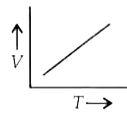
|
|
| 43. |
For one mole of electrolyte which of the following increases with dilution? |
|
Answer» Resistance |
|
| 44. |
For one mole of an ideal gas, increasing the temperature from 10^(@)C to 20^(@)C |
|
Answer» A) increases the average kinetic energy by TWO TIMES. Final temperature `=293K` `KE_(1)=(3RT_(1))/(2),KE_(2)=(3RT_(2))/(2)` `(KE_(1))/(KE_(2))=(T_(1))/(T_(2))=(283)/(293)=0.96` `KE_(2)=1.04KE_(1)` `v_(rms)=sqrt((3RT)/(M))` `(v_(1))/(v_(2))=sqrt((T_(1))/(T_(2)))rArrsqrt((283)/(293))` `v_(2)=v_(1)sqrt((293)/(283))=1.02v_(1)` Both average K.E. and rms velocity increase but not significantly. |
|
| 45. |
For one mole of an ideal gas ((delta P)/(delta T))_(V) ((delta V)/(delta T))_(P) ((delta V)/(delta P))_(T)= |
|
Answer» `-1` |
|
| 46. |
For one mole of a van der Waal's gas when b = 0 and T = 300K, the PV us 1//V plot is shown ahead. The value of the van der Waal's constant a(atm. "litre"^(2) mol^(-2)) is: |
|
Answer» `1.0` |
|
| 47. |
For one mole of a gas, the total kinetic energy is equal to : |
|
Answer» RT |
|
| 48. |
For one first order reaction 60 minutes are required to decrease the initial concentration from 0.8 M to 0.1 M,determine the half reaction time (t_((1)/(2))) |
|
Answer» 20 min |
|
| 49. |
For O_(2) gas at T_(1) and T_(2) following Maxwell speed distribution is observed [not to be scale] Ratio A_(1)//A_(2) is equal to |
|
Answer» |
|