

Saved Bookmarks
This section includes 7 InterviewSolutions, each offering curated multiple-choice questions to sharpen your Current Affairs knowledge and support exam preparation. Choose a topic below to get started.
| 1. |
Ethers should never be evaporated to dryness because |
|
Answer» they FORM EXPLOSIVES peroxide |
|
| 2. |
Ethersreact withthe formation of ethyl halide with halogen acidsin the orderof reactivity as : |
|
Answer» `HI GT HBR gt HCL ` |
|
| 3. |
Ethers on hydrolysis yield |
|
Answer» ketone |
|
| 4. |
Ethers like alcohols do not form strong.. . Bonding. Hence they are more volatile |
|
Answer» Covalent |
|
| 7. |
Ethers in the presence of atmospheric oxygen oxidises to give hydroperoxides and dialkyl peroxides Such a spontenous reaction by atmospheric oxygen is called__________. |
|
Answer» auto OXIDATION |
|
| 8. |
Ethers form co-ordination complexes with |
|
Answer» `BF_3` |
|
| 9. |
Ethers can be used as |
|
Answer» General ANAESTHETIC |
|
| 10. |
Ethers can be prepared byWilliamson synthesis in which an alkyl halide is reacted with sodium alkoxide. Di - tert butyl ether cannot be prepare by this method. Explain. |
|
Answer» Solution :With tertiary BUTYL halide, ELIMINATION is favoured over substitution. So formation of alkene takes place. `CH_(3)-overset(CH_(3))overset("|")underset(CH_(3))underset("|")"C "-Br+Na^(+)O^(-)-overset(CH_(3))overset("|")underset(CH_(3))underset("|")"C "-CH_(3)RARR CH_(3)-underset(CH_(3))underset("|")"C "=CH_(2)+NaBr +CH_(3)-overset(CH_(3))overset("|")underset(CH_(3))underset("|")"C "-OH` |
|
| 11. |
Ethers can be prepared by Williamson synthesis in which an alkyl halide is reacted with sodium alkoxide. Di-tertiary ether can't be prepared by this method. Explain. |
| Answer» Solution :`to` The Williamson.s reaction take place in presence of strong NUCLEOPHILE ALKOXIDE ion and alkyl halide. The alkoxide ion is ALSO a strong base APART from strong nucleophile. If the substrate is tertiary alkyl halide, the alkoxide ion will bring out the elimination reaction of tertiary alkyl halide that RESULTS in the formation of alkene as a major product. | |
| 12. |
Ethers can be prepared by Williamson synthesis which an alkyl halide is reacted with sodium alkoxide. Di-tert-butyl ether can't be prepared by this method. Explain. |
|
Answer» Solution :In order to prepare di-tert butyl ETHER, sodium tert-butoxide must be reacted with tert-butyl bromide. Alkoxides are not only NUCLEOPHILES but they are STRONG base as well. They react with `3^(@)` alkyl halides leading to the elimination reaction. When tert-butyl-bromide reacts with sodium tert-butoxide instead of SUBSTITUTION, elimination takes place. As a result of this elimination reaction, Iso BUTYLENE is formed instead of di-tert butyl ether. `{:(""CH_(2)-H""CH_(3)""CH_(2)""CH_(3)),("|""|""||""|"),(H_(3)C-C-Br+Na-O-C-CH_(3) overset("Elimination")rarr H_(3)C-C-CH_(3)+H_(3)C-C-OH+NaBr),("|""|" "Iso-butylene" "|"),(""CH_(3)""CH_(3)""CH_(3)),("Tert-butyl bromideSodium.tert butoxide2-methylpropan-2-ol"):}` `{:(""CH_(2)-H""CH_(3)),("|""|"),(H_(3)C-C-Br+Na-O-C-CH_(3) overset("Substitution")rarr "No reaction"),("|""|"),(""CH_(3)""CH_(3)),("Tert-butyl bromideSodium.tert butoxide"):}` |
|
| 13. |
Ethers can be prepared by Williamson synthesis in which an alkyl halidde is reacted with sodium alkoxide. Di-tert-butyl ether can't be prepared by this method. Explain. |
Answer» Solution :Williamson's synthesis occurs by `S_(N)2` mechanism in which SODIUM alkoxide REACTS with an alkyl halide. Now to prepare di-tert-butyl ether, sodium tert-butoxide must be REACTED with tert-butyl bromide. Since `3^(@)` alkyl halides prefer to undergo elimination rather than SUBSTITUTION, therefore, sodium tert-butoxide reacts with tert-butyl bromide and favours elimination to form ISOBUTYLENE rather than substitution to form di-tert-butyl ether.  
|
|
| 14. |
Ethers can be prepared by (1)heating alkyl halide with R-OH (2)boiling alkyl halide with alc.KOH (3)heating alkyl halide with sodium alkoxide (4)reacting alcohol with diazomethane |
|
Answer» 2,3,4 |
|
| 15. |
Ethers are very good solvent for which type of compound: |
|
Answer» LEWIS base |
|
| 16. |
Ethers are relatively inert. Justify. |
| Answer» Solution :Due to ABSENCE of any ACTIVE site in their molecules, divalent oxygen is linked to carbon ATOMS on both SIDES `(C - underset(ddot)overset(ddot)(O)- C)` | |
| 17. |
Ethers are reacted with cold HI gives |
|
Answer» ONE MOLE ALCOHOL and one mole of ALKYL iodide |
|
| 18. |
Ethers are quite stable towards : |
|
Answer» Oxidisingagents |
|
| 19. |
Ethers are not distilled to dryness for fear of explosion. This is due to formation of |
|
Answer» OXIDES |
|
| 20. |
Ethers are not distilled to dryness for fear of explosion. This is due to formation of : |
|
Answer» Oxides |
|
| 21. |
Ethers are mainly used as, |
|
Answer» solvent |
|
| 22. |
Ethers are made free from peroxide linkage on distilling impure sample with : |
|
Answer» CONC.`HNO_3` |
|
| 23. |
Ethers are isomeric with |
|
Answer» aldehydes |
|
| 24. |
Ethers are insoluble in water due to the |
|
Answer» ABSENCE of co-ordinate BOND |
|
| 25. |
Ethers are inactive because they do not contain |
|
Answer» ACTIVE atom |
|
| 26. |
Ethers are cleaved only by acids and not by bases. |
Answer» Solution :The C-O-C BOND in ethers like the C-OH bond in alcohols is quite STRONG. In order to weaken it, the OXYGE atom must be protonated. A subsequent nucleophilic attack by a strong nucleophile such as `BR^(-)` or `I^(-)` ion on the less hindered carbon atom of the protonated `C-underset(H)underset(|)overset(+)(O)-C` bond brings about the cleavage of ethers to form an alcohol and an alkyl halide. for example.  On the other hand, bases cannot weaken the C-O-C bond because ethers themselves being Lewis bases are not ATTACKED by strong bases such as `OH^(-)` or `H^(-)` (from `LiAlH_(4)`) ion. In other words, bases cannot cleave ethers. |
|
| 27. |
Ethers are functional isomers of _________ |
|
Answer» ACIDS |
|
| 28. |
Ethers are basic in nature owing to the presence of |
|
Answer» UNSHARED ELECTRON PAIRS on oxygen |
|
| 30. |
Ethers are __________. |
|
Answer» alkyl DERIVATIVES or anhydride of alcohols |
|
| 31. |
Etherial solution of an organic compound .A. when heated with magnesium gave .B.. .B. on treatment with ethanal followed by acid hydrolysis gave 2- propanol. Identify the compound .A.. What is .B. known as? |
|
Answer» Solution :COMPOUNDS .A. and .B. are identified as under : `underset(A) underset("Methyl BROMIDE")(CH_(3)Br)+Mg overset("Ether")RARR underet(B)underset("bromide")underset("Methyl magnesium")(CH_(3)MgBr)` `underset("Ethanal")(CH_(3)-overset(O)overset(||)C-H)+CH_(3)MgBr rarrCH_(3)-overset("OMgBr")overset("|")"CH"-CH_(3)overset(H_(2)O)rarr underset("2-Propanol")(CH_(3)-overset(OH)overset("|")"CH"-CH_(3))` |
|
| 32. |
Ethers and alcohols are |
|
Answer» metamers |
|
| 33. |
Ethers. |
|
Answer» Solution :(1) DIETHYL ether is used as industrial SOLVENT for oils, FATS gum, RESIN, etc. (2) It is used as solvent in the reaction of Grignared reagent. It is used as refrigerant. (4) Natalite, a mixture of diethyl ether and ETHYL alcohol is used as fuel. |
|
| 34. |
Etherial solution of an organic compound ‘X’ when heated with Mg gave ‘Y’. ‘Y’ on treatment with CH_(3)CHO followed by acid hydrolysis gave 2-propanol. Identify the compound ‘X’. What is ‘Y’ known as ? |
|
Answer» Solution :`UNDERSET(X)(CH_(3)Br) + Mg OVERSET("DRYETHER")(to) underset((y))(CH_(3)MgBr)` `CH_(3) - overset(O)overset(||)(C ) - H + CH_(3) Mg Br overset("Dryether")(to)` 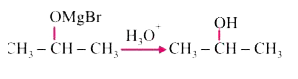 `CH_(3) overset(H_(3)O^(+))(to)CH_(3) - overset(OH)overset(|)(CH) - CH_(3)` `CH_(3) overset(H_(3)O^(+))(to)CH_(3) - overset(OH)overset(|)(CH) - CH_(3)`
|
|
| 35. |
Ether which is liquid at room temperature is |
|
Answer» `C_(2)H_(5)OCH_(3)` |
|
| 37. |
Ether which is liquid at room temperatureis ____________. |
|
Answer» `C_2H_5OCH_3` |
|
| 38. |
Ether underset(H_2O)overset(dil. H_2SO_4)totwo products . One of the product on oxidation give acetic acid , while the other on oxidation give acetone . The ether is |
|
Answer» ETHYL n-propyl ether |
|
| 39. |
Diethyl Ether reacts with chlorine in the dark to form- |
|
Answer» `CH_(2)Cl-CH_(2)-O-CH_(2)-CH_(3)` |
|
| 40. |
Ether oxygen is capable of forming ________ bonds with electron deficient species. |
|
Answer» COVALENT |
|
| 41. |
Ether is formed when ethyl alcohol is heated with conc. H_(2)SO_(4) . The conditions are |
|
Answer» Excess of `H_(2)SO_(4) and 170^(@)`C |
|
| 42. |
Ether is prepared by |
|
Answer» WILLIAMSON's synthesis |
|
| 43. |
Ether is formed when alkylhalide is treated with sodium alkoxide. This method is known as |
|
Answer» HOFFMANN REACTION. |
|
| 45. |
Ether in contact with air for a long time form peroxides. The presence of peroxide in ether can be tested by adding Fe^(2+) ion in it and then adding: |
|
Answer» KCNS |
|
| 46. |
Ethers in contact with air for a long time form peroxides. The presence of peroxide in ether can be tested b y adding Fe^(2+) ions followed by the addition of |
| Answer» ANSWER :A | |
| 47. |
Ether form peroxide in contact with air and light it may cause explosion, since the boiling point light it may cause explosion, since the boiling point of peroxide is : |
|
Answer» EQUAL to ETHER |
|
| 48. |
Ether does not react with, |
|
Answer» SODIUM metal |
|
| 49. |
Ether fire can be extinguished by : |
|
Answer» Sand |
|


