

Saved Bookmarks
This section includes 7 InterviewSolutions, each offering curated multiple-choice questions to sharpen your Current Affairs knowledge and support exam preparation. Choose a topic below to get started.
| 1. |
Equation for the half period in first order reaction is |
|
Answer» `t_(1//2)=(0.602)/K` |
|
| 2. |
Equation for the half life period in first order reaction is : |
|
Answer» `t_1/2=0.602/k` |
|
| 3. |
Equation ._(17)Cl^(37) + ._(1)H^(2) rarr ._(18)Ar^(38) + ._(0)n^(1) is |
|
Answer» NUCLEAR fission |
|
| 4. |
Equanil is an example of |
|
Answer» ARTIFICIAL SWEETENERS |
|
| 5. |
Equanil is _____ |
|
Answer» ARTIFICIAL sweetener |
|
| 6. |
Equanil is |
|
Answer» ARTIFICIAL sweetener |
|
| 7. |
Equanil is .. . |
|
Answer» Artificial sweetener |
|
| 8. |
Equanil is ……… |
|
Answer» ARTIFICIAL sweetener |
|
| 9. |
Equanil is a ............. . |
|
Answer» ARTIFICIAL sweetener |
|
| 10. |
Equanil is ………………. |
|
Answer» ARTIFICIAL sweetener |
|
| 11. |
Equanil is __________ |
|
Answer» artificial SWEETNER |
|
| 12. |
Equanil is : |
|
Answer» Antibiotic |
|
| 13. |
Equal weights of Zn metal and iodine are mixed together and the iodine is completelyconverted to ZnI_(2). What fraction by weightof the original zinc remains unreacted?(zn = 65 , I = 127 ) |
|
Answer» Solution :Let x g be the INITIAL WEIGHT of the Znmetaland iodine each. SINCE `I_(2)` is completelyconverted to `ZnL_(2)`, we have, initial no. of moles :`{:((x)/(65)""(x)/(254)""0),(Zn ""+ ""I_(2)""to ""ZnI_(2)):}` No.of moles at the end of the reaction. `((x)/(65)-(x)/(254))""0""(x)/(254)` `:.` fraction of Zn REMAINED unreacted = `(((x)/(65)-(x)/(254)))/((x)/(65))=0.74.` |
|
| 14. |
Equanil is "………." |
|
Answer» ARTIFICIAL sweetener 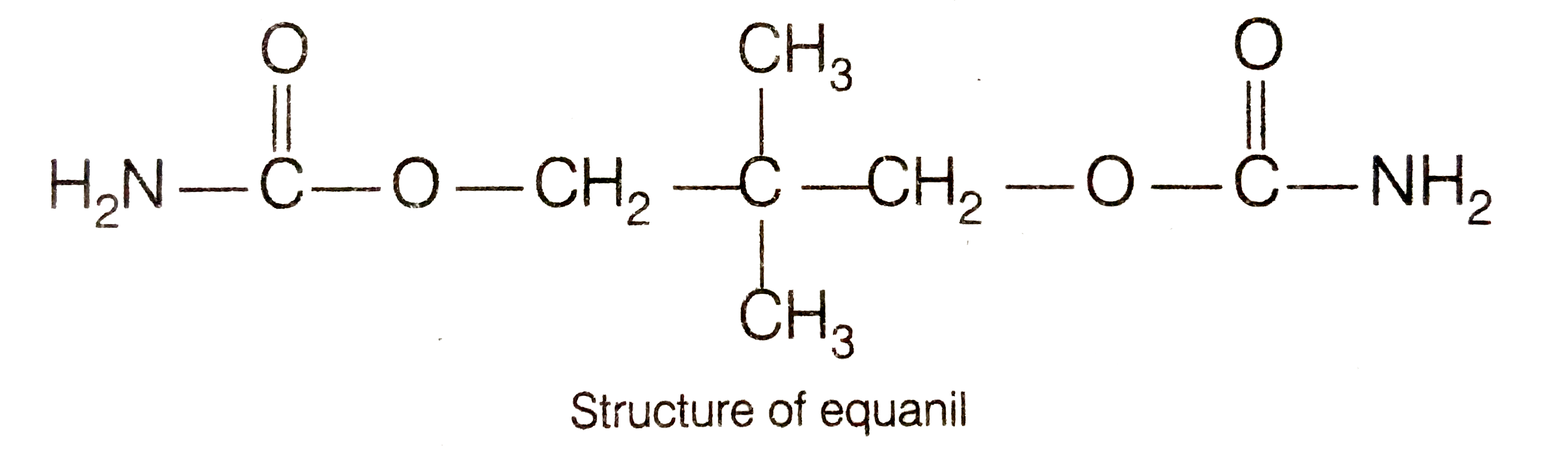
|
|
| 15. |
Equal weights of phosphorusand oxygenare heated in a closed vessel producing P_(2)O_(3) and P_(2)O_(5) in a 1 : 1mole ratio. Ifthe limitingcomponent is exhausted, findwhichcomponentand alsowhatfraction of it is left over. |
|
Answer» Solution :As1 mole each of `P_(2) O_(3) and P_(2) O_(5)` is formed, the mole ratio of thereacting P and O ATOMSIS 4 : 8 or 1 : 2 As the givenweights of phosphorus and oxygen are same, say w g,their MOLES of ATOMS are `(omega)/(31) and (omega)/(16)` respectively. `:.` 2 moles of O combine WITH1 mole of P. `:. (omega)/(16)` moles of O combine with `(omega)/( 32)`moles of P. Sophosphorous is left over and moles of Premaining `= (omega)/( 31) - (omega)/( 32)` `:.`fractionof P left over`=(((omega)/(31)-(omega)/(32)))/((omega)/(31))= (1)/(32)or 3 . 125 %` |
|
| 16. |
The pressure of a mixture of equal weight of two gases of mol wt. 4 and 40, is 1.1 atm. The partial pressure of the lighter gas in this mixture is |
|
Answer» |
|
| 17. |
Equal weights of two gases of molecular mass 4 and 40 are mixed. The pressure of the mixture is 1.1 atm. The partial pressure of the lighter gas in this mixture is |
|
Answer» 0.55 atm Moles of heavier gas `= ( W)/( 40)` Mole fraction of lighter gas `= ( W //4)/( W //4+ W// 40) = 10 //11` PARTIAL pressure of lighter gas = Mole fraction `xx` Total pressure `= ( 10)/( 11) xx 1.1 = 1.0 atm` |
|
| 18. |
Equal weights of SO_(2) and O_(2) are mixed in an empty container at 300 K . The total pressure exerted by the gaseous mixture is 1 atm . The partial pressure of SO_2 gas in the mixture is |
|
Answer» 0.33 ATM |
|
| 19. |
Equal weights of methane and hydrogen are mixeed in an empty container at 25^(@)C. The fraction of total pressure exerted by hydrogen is : |
|
Answer» `1//`8 `((1)/(2)) /((1)/(2) + ( 1)/( 16) ) = (( 1)/( 2))/((9)/( 16)) = ( 1)/(2) XX ( 16)/( 9) = ( 8)/( 9 )` |
|
| 20. |
Equal weights of methane and hydrogen are mixed in an empty container at 25^@ C. The farction of total pressure exerted by hydrogen is |
|
Answer» `1//2 ` |
|
| 21. |
Equal weights of ethane and hydrogen and mixed in an empty container at 25^(@)C. The fraction of total pressure exerted by hydrogen is |
|
Answer» <P>`1:2` Suppose w is the weight of each of `C_(2)H_(6)` and `H_(2)` taken. `:.n_(C_(2)H_(6))=w/30,n_(H_(2))=w/2` `:.p_(H_(2))=x_(H_(2))xxp=(n_(H_(2))/(n_H_(2))+n_(C_(2)H_(6)))xxp` `impliesp_(H_(2))=((w//2)/(w/2+w/30))p=((1//2)/(1/2+1/30))p` `impliesp_(H_(2))=15/16pimpliesp_(H_(2)):p=15:16` |
|
| 22. |
Equal weight of NaCl and KCl are dissolved separately in equal volumes of solutions, then the molarity |
|
Answer» Will be equal for the TWO solutions |
|
| 23. |
Equal volumes of two monoatomic gases, A and B, at same temperature and pressure are mixed. The ratio of specific heats (C_(p)//C_(v))of the mixture will be |
| Answer» Solution :`(C_(P))/(C_(V))=(5//2R)/(3//2R)=(5)/(3)=1.67`. | |
| 24. |
Equal volumes of two solutions of pH 4 and pH 11 are mixed. The pH of the resulting solution will be : |
|
Answer» `7.5` |
|
| 25. |
Equal volumes of two gases which do not react together are enclosed in separate vessels. Their pressure are 100mm and 400 mm respectively. If the two vessels are joined together, then what will be the pressure of the resulting mixture ( temperature remaining constant ) |
|
Answer» 125 mm `P=(P_(1)+P_(2))/(2)=(100+400)/(2)=250` mmHg |
|
| 26. |
Equal volumes of two gases A and B diffuse through a porous pot in 20 and 10 seconds respectively. If molar mass of A is 80 calculate the molar mass of B. |
|
Answer» SOLUTION :Suppose volume of each gas DIFFUSED = V mL Then by Graham.s Law `=(r_(A))/(r_(B))=(((V)/(20))/((V)/(10)))=sqrt((M_(B))/(M_(A))) rArr 1//2 =sqrt((M_(B))/(80))` `therefore M_(B) =20 GMOL^(-1)` |
|
| 27. |
Equal volumes of three and acid solutions of pH 1,2 and 3 are mixed in a vessel, What will be the H^+ ion concentration in the mixture? |
| Answer» Answer :A | |
| 28. |
Equal volumes of three acid solutions of pH 3, 4and 5 are mixed in a vessel. What will be the H^+ ion concentration in the mixture? |
|
Answer» `3.7xx10^(-3)` M `[H^+]=10^(- pH)` , `[H^+]` of SOLN. 1= `10^(-3)` `[H^+]` of soln. 2= `10^(-4)` , `[H^+]` of soln. 3= `10^(-5)` Total concentration of `[H^+] = 10^(-3) (1+1xx10^(-1) + 1xx10^(-2))` `10^(-3) (1/1+1/10 +1/100) rArr 10^(-3) ((100+10+1)/100)` `rArr 10^(-3) (111/100) = 1.11xx10^(-3)` M So, `H^+` ION concentration in MIXTURE of equal mixture of these acid solution `= (1.11xx10^(-3))/3 = 3.7xx10^(-4)` M |
|
| 29. |
Equal volumes of three acid solutions of pH 3, 4 and 5 are mixed in a vessel. What will be the H^(+) ion concentration in the mixture ? |
|
Answer» `1.11xx10^(-4)M` `[H_(3)O]^(+)=1xx10^(-3)` MOLES/litre `[therefore [H_(3)O]=10^(-pH)`] SIMILARLY for solution having pH=4, `[H_(3)O]^(+)=1xx10^(-4)` moles/litre and for pH=5 `[H_(3)O^(+)]=1xx10^(-5)` moles/litre Let the volume of each solution in mixture be 1L, then total volume of mixture solution L=(1+1+1)L=3L Total `[H_(3)O]^(+)` ion PRESENT in mixture solution `=(10^(-3)+10^(-4)+10^(-5)` moles Then `[H_(3)O]^(+)` ion concentration of mixture solution `=(10^(-3)+10^(-4)+10^(-5))/(3)M=(0.00111)/(3)M` `=0.00037 M=3.7xx10^(-4)M` |
|
| 30. |
Equal volumes of the following Ca^(2+) and F^(-) solutions are mixed. In which of the solutions will precipitations occur ? [K_(sp) of CaF_(2)=1.7 xx 10^(-10)] 1. 10^(-2) M Ca^(2+)+10^(-5)MF^(-) 2. 10^(-3) M Ca^(2)+10^(-3)MF^(-) 3. 10^(-4) MCa^(2)+10^(-2)MF^(-) 4. 10^(-2) MCa^(2)+10^(-3)MF^(-) Select the correct answer using the codes given below |
|
Answer» In 4 only `[Ca^(2+)]` in reaction mixture `=0.5 xx 10^(-2)M` `[F^(-)]` in reaction mixture `=0.5 xx 10^(-5)M` `:. ` Ionic product `=[Ca^(2+)][F^(-)]^(2)=(0.5 xx 10^(-2))xx (0.5 xx10^(-5))^(2)` `=125 xx 10^(-15)=1.25 xx 10^(-13)xx1.7 xx 10^(-10)` `:. `No. ppt is formed in this case In case 2 `[Ca^(2+)]` in reaction mixture `=0.5 xx 10^(-3)M` `[F^(-)]` in reaction mixture `=0.5 xx 10^(-3)M` `:. `Ionic product `=(0.5 xx 10^(-3))(0.5 xx 10^(-3))^(2)` `=125 xx 10^(-12)=1.25 xx 10^(-10)lt 1.7 xx 10^(-10)` No. ppt. is formed in this case In case 3 `[Ca^(2+)]` in reaction mixture `=0.5 xx 10^(-4)M` `[F^(-)]` in reaction mixture `=0.5 xx 10^(-2)M` `:. ` Ionic product `=[Ca^(2+)]xx[F^(-)]^(2)` `=[0.5 xx 10^(-4)] xx [0.5 xx 10^(-2)]^(2)` `=125 xx 10^(-11)` `=1.25 xx 10^(-9) gt 1.7 xx 10^(-10)` Thus a ppt. of `CaF_(2)` will be formed In case 4 `[Ca^(2+)]` in reaction mixture `=0.5 xx 10^(-2)M` `[F^(-)]`in reaction mixture `=0.5 xx 10^(-3)M` Ionic product `[Ca^(2+)][F^(-)]^(2)` `=[0.5 xx 10^(-2)][0.5 xx 10^(-3)]^(2)=125 xx 10^(-11)` `=1.25 xx 10^(-9) gt 1.7 xx 10^(-10)` Thus a ppt of `CaF_(2)` will be formed. |
|
| 31. |
Equal volumes of three acid solutions of PH 1,2 and 3 are mixed in a vessel. What will be the H^+ ion concentration in the mixture? |
|
Answer» `3.7 times 10^-2` `therefore[H^+]=10^(-ph)` LET the VOLUME be x mL `V_1M_1+V_2M_2+V_3M_VM` `thereforexmL of 10^-1 M+xmL of 10^-2 M+xL of 10^-3M` `=3xmL of [H^+]` `therefore[H^+]=(x[0.1+0.01+0.001])/3=(0.1+0.01+0.001)/3=0.111/3` `=0.037=3.7 times 10^-2` |
|
| 32. |
Equal volumes of three acid solution of pH 3,4 and 5 are mixed in a vessel. What will be the H^(+) ion concentration in the mixture |
|
Answer» `3.7 xx 10^(-3) M` `= (1)/(3)(10^(-3) + 10^(-4) + 10^(-5)) = 37 xx 10^(-5) = 3.7 xx 10^(-4)`. |
|
| 33. |
Equal volumes of molar hydrochloric acid and sulphuric acid are neutralised by dilute NaOH solution andx kcal and y kcal of heat are liberated respectively. Which of the following is true? |
|
Answer» x=y ` therefore ` Ratio of heat LIBERATED` = x/y = 1/2 RAR x = y/2` |
|
| 34. |
Equal volumes of methanoic acid and sodium hydroxide are mixed. If x is the heat of formation of water, then heat evolved on neutralisation is |
|
Answer» More than x |
|
| 35. |
Equal volumes of following solutions are mixed, in which case the pH of resulting solution will be average value of pH of two solutions. |
|
Answer» pH=2 HCl and pH=12 NaOH pH=12 NaOH so [NaOH]=`10^(-2)` HENCE pH of mixture =7 (neutral ) (D)pH=5 `CH_3COOH` and pH=9 `NH_3` (aq), both must be of equal concentrations as `pK_a=pK_b`.Hence pH=pOH only if concentration are equal so on mixing equal volume we will get `CH_3COONH_4` salt solution and its pH is given is given by `pH=1/2(pK_w+pK_a-pK_b)=7` |
|
| 36. |
Equal volumes of different gases at any definite tempearture and pressure have: |
|
Answer» EQUAL WEIGHTS |
|
| 37. |
Equal volumes of different gases at a fixed temperature and pressure : |
|
Answer» have EQUAL WEIGHTS |
|
| 38. |
Equal volumes of all gases under same conditions of temperature and pressure contains equal number of |
|
Answer» Moles |
|
| 39. |
Equal volumes of all gases under similar conditions of temperataure and pressure contain equal number of molecules. This statement is called………………….. . |
| Answer» SOLUTION :AVOGADRO's LAW | |
| 40. |
Equal volumes of 30% by mass of H_(2)SO_(4) (density 1.218g mL^(-1)) and of H_(2)SO_(4) (density 1.610 g mL^(-1)) are mixe. If the density of te mixture is 1.452 g mL^(-1) , calculate the molarity oand molality of the solution. |
|
Answer» Solution :Calculation of molarity of the solution Let V mL of each sample of `H_(2)SO_(4)` bemixed for 30% `H_(2)SO_(4)` Mass of `H_(2)SO_(4)`=30g ,Mass of solution=100 g `" Volume of solution"=("Mass of soulution")/("Density")= ((100g))/((1.218gmL^(-1)))=100/(1.218)=mL` `100/1.218` mL of sample contains `H_(2)SO_(4)=30 g` V mL of contains `H_(2)SO_(4)=((30g)xx(V mL))/((100//1.18mL))=(0.3654 V)g` For 70% `H_(2)SO_(4)` Mass of `H_(2)SO_(4)`=70g, Mass of solution=100 g `"Volume of solution"=("Mass of solution")/("Density")=((100g))/((1.610gmL^(-1)))=100/(1.610)mL` `100/(1.610)` mL of sample sontains `H_(2)SO_(4)=70g` V mL of sample contains `H_(2)SO_(4)=((70g)(VML))/((100//1.610mL))=(1.127V)g` On mixing the two sample os `H_(2)SO_(4)` Total mass of `H_(2)SO_(4)=0.3654V+1.127V=(1.127V)g` Total volume of solution=2VmL=(0.002V)L `"Molarity of solution(M)"= ("Total mass of" H_(2)SO_(4)//"Molar mass")/("Voluume of solution in litres") ` `=((1.4924 Vg)//(98gmol^(-1)))/((0.002V)L)=7.614 MOL L^(-1)=7.614 M` Calculation of malality of the solution. Total mass of solution= `d xx" volume "=(1.425 gmL^(-1)xx2VmL)=(2.85v)g` Total mass of ACID =(1.4924 V)g Mass of WATER = `(2.85 V-1.4924 V) g=(1.3576xx10^(-3)V) kg` `"Molality of solutin (m)"=("Mass of" H_(2)SO_(4)//"Molar mass")/("Mass of SOLVENT in kg")=((1.4924V)g//(98gmol^(-1)))/((1.3576xx10^(-3)V)kg)` =11.217 mol `kg ^(-1)`=11.217 m |
|
| 41. |
Equal volumes of 1.0M AgNO_(3) and 1.0M KCl are mixed . The depression of freezing point of the resulting solution will be (K_(f)(H_(2)O)=1.86 K kg "mol"^(-1), 1M=1m) |
|
Answer» `3.72K` |
|
| 42. |
Equal volumes of 1M HCl and 1M H_2SO_4 are neutralised by dilute NaOH solution and x kJ and y kJ of heat are libreated respectively . Which of the following is correct ? |
|
Answer» `x=y` |
|
| 43. |
Equal volumes of 1.0 M Na_2 CO_3and 1.0 M HCl are mixed. Calculate [CO_3^(2-)]at equilibrium. K_1and K_2 for H_2CO_3 are 4.5 xx 10^(-7) and 4.7 xx 10^(-11)respectively. |
|
Answer» Solution :Solution is 0.50 M `NaHCO_3`(plus 0.5 M NACL). `5 xx 10^(-3)M` |
|
| 44. |
Equal volumes of 10% solution (by wt) of the solute A and 15 % solution (by wt) of the solute B are mixed. The mass percent of A and B in the mixture would be respectively |
|
Answer» 5 and 7.5 |
|
| 45. |
Equal volumes of 1 M HCl and H_(2)SO_(4) are neutralised by dil NaOH solution and x kJ and y kJ of heat are librated respectively. Which of the following is true ? |
|
Answer» X = y |
|
| 46. |
Equal volumes of 0.1M AgNO_(3) and 0.2M NaCI are mixed. The concentration of NO_(3)^(-) ions in the mixture will be |
|
Answer» `0.1M` `0.1M AgNO_(3)` reacts with `0.1M NaCI` to produce `0.1M AgCI` and `0.1M NaNO_(3)` `:. NO_(3)^(-) = (0.1M)/(2) = 0.05M` `[ :'` When EQUAL volumes are mixed dilution occurs] |
|
| 47. |
Equal volume of all gases contain equal number of atoms at same temperature and pressure. This statement is |
|
Answer» In ACCORDANCE with Dalton's ATOMIC theory and is KNOWN as BERZELIUS Hypothesis |
|
| 48. |
Equal volume of 0.02 M NH_(3)OH is mixed with 0.02 M HCI. Calculate [NH_(4)OH] at equivalence point : K_(b)[NH_(4_OH)]=10^(-5) |
|
Answer» `1.414xx10^(-3.5)` |
|
| 49. |
Equal volume each of two sols of Agl, one obtained by adding AgNO_(3) to slightly excess of Kl and another obtained by adding Kl to slight excess of AgNO_(3), are mixed together . Then : |
|
Answer» the TWO sols will stablize each other |
|
| 50. |
Equal volume each of two sols of Agl one obtained by adding AgNO_3 to slight excess of KI and another obtained by adding KI to slight excess of AgNO_3 are mixed together then |
|
Answer» The sols will COAGULATE each other mutually |
|