

Saved Bookmarks
This section includes 7 InterviewSolutions, each offering curated multiple-choice questions to sharpen your Current Affairs knowledge and support exam preparation. Choose a topic below to get started.
| 2. |
Enthalpy of vaporization of benzene is +35.3 kJ mol^(-1) at its boiling point, 80^(@)C. The entopy change in the transition of the vapour to liquid at its boiling point [in JK^(-1)mol^(-1)] is…. |
|
Answer» `-441` At equilibrium, `DeltaG=0` And entropy decreases on going from VAPOUR to liquid, i.e., `DeltaH=TDeltaS` `DELTAS=-(DeltaH)/(T)=-(35300)/(80+273)=-100 JK^(-1)MOL^(-1)` |
|
| 3. |
Enthalpy of vaporization of benzene is + 35.3 kJ mol^(-1) at its boiling point, 80^(@)C. The entropy change in the transition of the vapour to liquid at its boilling point [in JK^(-1) mol^(-1)] is ………. |
|
Answer» `-441` `DeltaG=DeltaH-TDeltaS` At EUILIBRIUM, `DeltaG=0` And entropy decreases on going from vapour to liquid. i.e., `DeltaH=TDeltaS` `DeltaS=-(DeltaH)/(T)=-(35300)/(80+273)=-100"JK"^(-1)"MOL"^(-1)` |
|
| 4. |
Enthalpy of vaporisation for water is 186.5kJ mol^-1. The entropy change during vaporisation is____kJ K^-1mol^-1: |
|
Answer» 0.5 |
|
| 5. |
Enthalpy of solution of NaOH (solid) in water is -41.6 kJ mol^(-1). When NaOH is dissolved in water, the temperature of water |
|
Answer» INCREASES |
|
| 6. |
Enthalpy of physical adsorption is quite low: Give reason. |
| Answer» Solution :Because it INVOLVES WEAK VAN DER WAALS. forces. | |
| 7. |
Enthalpy of neutralization of acetic acid by NaOH is -50.6 kJ//"mol". And the heat of neutralisation of a strong acid with a strong base is -55.9 kJ/mol. What is the value of DeltaH for the ionisation of CH_(3)COOH |
|
Answer» `+5.3 kJ//mol` `DeltaH_("ioniz")=+5.3 kJ//mol`. |
|
| 8. |
Enthalpy of neutralization is defined as the enthalpy change when 1 mole of acid/base is completely neutralized by base/acid in dilute solution. For strong acid and strong base neutralization net chemical change is ""H^(+)(aq) + OH^(-)(aq) rarr H_(2)O(l), "" Delta_(r)H^(@) = -55.84 KJ//mol DeltaH_("ionization")^(@) of aqueous solution of strong acid and strong base is zero. When a dilute solution of a weak acid or base is neutalized, teh enthalpy of neutralization is some what less because of the absorption of heat in the ionization of the weak acid or base, for weak acid/base DeltaH_("neutrilization")^(2) = DeltaH_("ionization")^(@) + Delta_(r)H^(@) "" (H^(+) + OH^(-) rarr H_(2)O) Under the same condition how many mL of 0.1 M NaOHand 0.05 M H_(2)A (strong diprotic acid) solution should be mixed for a total volume of 100 mL produce the highest rise in temperature: |
|
Answer» `25:75` If we take equal VOLUME , all `H^(+) (5 m-"mole")` will react with all `OH^(-)(5 m-"mole").` |
|
| 9. |
Enthalpy of neutralisation of NaOH with H_(2)SO_(4) is -57.3kJ mol^(-1) and with ethanoic acid -55.2 kJ mol^(-1). Which of the following is the best explanation of this difference? |
|
Answer» Ethanoic ACID is WEAK acid and thus requires less `NaOH` for neutralisation |
|
| 10. |
Enthalpy of formation of two compounds x and y are - 84 kJ and - 156 kJ respectively. Which of the following statement is correct |
|
Answer» x is more stable than y |
|
| 11. |
Enthalpy of formation of HF and HCl are -161 kJ and -92 kJ respectively. Which of the following statements is incorrect? |
|
Answer» HCL is more STABLE than HF Or Higher the enthalpy (-ve value) of formation of a compound greater will be stability of the compound. HF is more stable than HCl. |
|
| 13. |
Enthalpy of combustion of C_(6) H_(6) (l) is - 3264. 64 kj/ mol . The heat produced by burning 3. 9 g of benzene is |
|
Answer» `-163.23 KJ` `=-3264.6 kJ` therefore, heat produced , by buring 3.9 g benzence `3.9/78xx(-3264.6)=-163.23 kJ` |
|
| 14. |
Enthalpy of atomisation is lowest in |
|
Answer» Sc |
|
| 15. |
Enthalpy of a compound is equal to its |
|
Answer» HEAT of combustion |
|
| 18. |
Enthalpy (H) is equal to |
|
Answer» Internal energy (E) |
|
| 19. |
Enthalpy for the reaction C+O_(2)rarrCO_(2) is |
|
Answer» Positive |
|
| 20. |
Enthalpy for the reaction C+O_2rarrCO_2 is: |
|
Answer» `=ve` |
|
| 21. |
Enthalpy change in the formation of an imaginary lattice Cl^(+)Cl^(-) from Cl_(2)(g) is represented as Delta_(t)H. Given that bond dissociation enthalpy DeltaH_(Ct-ct) =x_(1). Ionisation of chlorine is x_(2), electron gain enthalpy of chlorine is -x_(3) and lattice enthalpy of Cl^(+)Cl^(-) is -x_(4). The value of DeltaH is |
|
Answer» `x_(1) + x_(2) + x_(3)+x_(4)` |
|
| 22. |
Enthalpy change , when 1 g water is frozen at 0(@)C is (DeltaH_("fus")= 1.435 kcal mol ^(-1) ) |
|
Answer» 0.0797 KCAL `0.0797 kcal g^(-1)` |
|
| 23. |
Enthalpy change for the reaction, 4H(g)to2H_(2)(g) is -869.5 kJ. The dissociation energy of H-H bonds is |
|
Answer» `+217.4kJ` `=(869.6)/(2)=+434.8kJ` |
|
| 24. |
Enthalpy change for the reaction, 4H_((g))rarr2H_(2(g)) is - 869.6 kJ. The dissociation energy of H - H bond is |
|
Answer» `+ 217.4` KJ |
|
| 25. |
Enthalpy change in the following process is A+ e^(-) to A^(-) Delta H= - X kJ//"mole" Which of the following processes has enthalpy change=X kJ/mole ? |
|
Answer» `A^(-2) to A^(-)+1E^(-)` |
|
| 26. |
Enthalpy change for reaction, (1)/(2)H_(2)+(1)/(2)Cl_(2)rarrHCl, is called |
|
Answer» ENTHALPY of COMBINATION |
|
| 27. |
Enthalpy change for a reaction does not depend upon |
|
Answer» The physical states of REACTANTS and products |
|
| 28. |
Enthalpuy of solution of NaOH (s) in water is -41 .6 KJ mol ^(-1) .when NaOH is dissolved in water , the temperature of water |
|
Answer» increases |
|
| 29. |
Enthalpies of elements in their standard states are taken as zero. Hence the enthalpy of formation of a compound |
|
Answer» SHUOLD always be negative |
|
| 30. |
Enrichment of uranium is made by : |
|
Answer» distillation |
|
| 31. |
Enough moisture in food permits |
|
Answer» DECREASE the GROWTH of microbs |
|
| 32. |
Enol content is maximum in: |
|
Answer» ACETONE 
|
|
| 34. |
Enlist the various steps involved in extraction of metals. |
Answer» SOLUTION :
|
|
| 35. |
Enlist the total number of distinct naturally occurring amino acids obtained by complete acidic hydrolysis of the peptide shown below is : |
Answer» SOLUTION :The PRODUCTS of HYDROLYSIS are SHOWN : 
|
|
| 36. |
Enlist the main points of difference between S_(N)1 and S_(N)2 reactions. |
Answer» SOLUTION :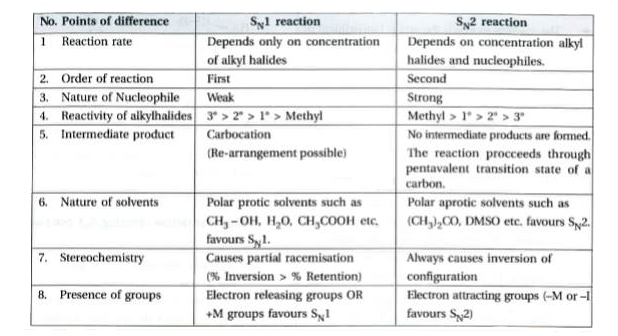
|
|
| 37. |
Enlist the condition which facour the formation of an idela solution. |
| Answer» SOLUTION :For ANSWER, CONSULT SECTION 6. | |
| 38. |
Enlist the points of difference between fibrous and globular proteins. |
Answer» SOLUTION :The POINTS of DIFFERENCES are : 
|
|
| 39. |
Enlist the main uses of nitrogen. |
|
Answer» Solution :In manufacturing of ammonia and industrial chemicals such as calcium cyanamide.In iron and steel industry to maintain inert atmosphere. As inert diluent for reactive chemicals. Liquid NITROGEN is used as refigerant to preserve BIOLOGICAL MATERIALS, FOOD items and in CRYOSURGERY. |
|
| 40. |
Enlist the physical properties of transition elements |
|
Answer» Solution :The physical properties of transition elements are: Metallic in nature They are malleable and ductile. All are SOLIDS EXCEPT MERCURY which is liquid. They have high tensile strength All the elements except Zn, Cd, Hg have high melting points and have low VOLATILITY. Boiling points are also high. They produce sound on striking and hence are sonorous. They have high thermal and electrical conductivity and have metallic lustre. At normal TEMPERATURES, all the elements except Zn, Cd, Hg and Mn have one or more typical metallic structures. |
|
| 41. |
Enlist the characteristics of unit cell. |
|
Answer» Solution : Its dimensions along three edges a, b, and c. These edges may or may not be MUTUALLY perpendicular. ANGLES between the edges `alpha`(between b and c),`beta`(between a and c) and ` gamma`(between a and b). THUS UNIT cell is characterised by six PARAMETERS `a, b, c, alpha, beta` and ` gamma` . 
|
|
| 42. |
Enlist some important vitamins with their sources and the disease caused due to their deficiency in body. |
Answer» SOLUTION :
|
|
| 43. |
Enlist the characteristic properties of solid state. |
|
Answer» SOLUTION : Solids have definite mass, volume and shape. Intermolecular distances are short. Intermolecular forces are strong. The constituent particles (atoms, MOLECULES or ions) in solids have fixed positions and can only oscillate about their MEAN positions. They are rigid and INCOMPRESSIBLE. |
|
| 44. |
Enlist the characteristics of crystal lattice. |
|
Answer» Solution : Each point in a LATTICE is CALLED lattice site or lattice point . Each point in a crystal lattice REPRESENTS one constituent particles which may be an atom, a molecule (group of atoms) or an ion. Lattice points are JOINED by straight LINES to bring out geometry of the lattice. |
|
| 45. |
E_(ni^(2+)//Ni)^(@)=-0.25 VE_(Au^(3+)//Au)^(@)=1.50 v The emf of the voltaic cell Ni//Ni^(2+)(1.0 M)||Au^(3+)(1.0 M)|Au is |
|
Answer» 1.25 V |
|
| 46. |
Energy requried to dissociate 4 g of gaseous hydrogen into free gaseous atoms is 208 kcal at 25^(@)C. The bond energy of H-H will be |
|
Answer» 104 kcal `MOL^(-1)` Given, `2H_(2)(g)to4H(g),DeltaH=104` kcal `mol^(-1)`. Hence, BOND energy of H-H bond is 104 kcal `mol^(-1)` |
|
| 47. |
Enery is stored in our body in the form of ………. . |
| Answer» ANSWER :A | |
| 48. |
Energy required to separate neutron and proton from the nucleus is called |
|
Answer» BOND energy |
|
| 49. |
Energy required to ionise 1 model of gaseousHe^+ion present in its ground state is |
|
Answer» `108.8 N_AeV` |
|


