

Saved Bookmarks
This section includes 7 InterviewSolutions, each offering curated multiple-choice questions to sharpen your Current Affairs knowledge and support exam preparation. Choose a topic below to get started.
| 1. |
E ^(@) of the cell, zn| Zn^(2+)(aq) ||Cu^(2+) (aq) |Cu is 1.10Vat 25^(@)C. The equilibrium constant for the cell reaction Zn + Cu^(2+) (aq) hArr Cu + Zn ^(2+) (aq) is of the order of |
|
Answer» `10^(-37)` `therefore K_(C) =1.9 xx10^(37)` |
|
| 2. |
E^(@) of some oxidants are given as : I_(2)+2e rarr 2I^(-) " "E^(@) = +0.54V MnO_(4)^(-)+8H^(+)+5e rarr Mn^(2+)+4H_(2)O "" E^(@) = +1.52V Fe^(3+)+e rarr Fe^(2+) " " E^(@) = +0.77V Sn^(4+)+2e rarr Sn^(2+) ""E^(@) = +0.1V (a) Select the strongest reductant and oxidant in these. (b) Select the weakest reductant and oxidant in these. (c) Select the spontaneous reaction from the changes given below : (i) Sn^(4+)+2Fe^(2+) rarr Sn^(2+)+2Fe^(3+) (ii) 2Fe^(2+)+I_(2) rarr 2Fe^(3+)+2I^(-) (iii) Sn^(4+)+2I^(-) rarr Sn^(2+)+I_(2) (iv) Sn^(2+)+I_(2) rarr Sn^(4+)+2I^(-) |
|
Answer» Solution :(a) More or `+ve` the `E_(OP)^(@)`, more is the tendency form oxidation or stronger is reductance. Therefore, since maximum `E_(OP)^(@)`, stands for : `Sn^(2+) rarr Sn^(4+)+2e, E_(OP)^(@) = -0.1V` `:.` STRONGEST reducant :` Sn^(2+)` and weakest OXIDANT : `Sn^(4+)` (b) More or `+ve` is `E_(RP)^(@)`, more is the tendency form reduction or stronger is oxidant. Therefore, since maximum `E_(RP)^(@)` stands for : `MnO_(4)^(-)+8H^(+)+5e rarr Mn^(2+)+4H_(2)O, E_(RP)^(@) = +1.52V` `:.` Strongest oxidant : `MnO_(4)^(-)` and weakest REDUCTANT : `Mn^(2+)` Note: Stronger is oxident, weaker is its conjugate reductant and vice-versa. (c) For (i) `E_(cell)^(@) = E_(OP_(Fe^(2+)//Fe^(3+)))^(@)+E_(RP_(Sn^(2+)//Sn^(3+)))^(@) = -0.77+0.1` `becauseFe^(2+)` oxidizes and `Sn^(4+)` reduces in change. `E_(cell)^(@) = -0.67V` `E_(Cell)^(@)` isnegative. `:.` (i) Is non-spontaneous change. For (ii), `E_(Cell)^(@) =E_(OP_(Fe^(2+)//Fe^(3+)))^(@)+E_(RP_(I_(2//I^(-))))` `= -0.770+0.54 = -0.23V` (ii) Is non-spontaneouos change. (iii) `E_(Cell)^(@) = E_(OP_(I^(-)//I_(2)))^(@)+E_(RP_(Sn^(4+)//Sn^(2+)))^(@)` `= -0.54 + 0.1 = -0.44 V` `:.` (iii) Is non-spontaneous change. For (IV), `E_(Cell)^(@) = E_(RP_(Sn^(2+)//Sn^(4+)))^(@)+E_(RP_(I_(2)//I^(-)))` `= -0.1+0.54 = +0.44V` |
|
| 3. |
E^@ of zinc electrode is -0.762V. Calculate the single electrode potential of Zn electrode in decimolar ZnSO_4 solution. |
|
Answer» Solution :SIMPLIFIED Nernst equation for single electrode POTENTIAL, `E=E^(@)+(0.059)/(2) log[ZN^(2+)]` SUBSTITUTING the values in the expression for the single electrode potential of Zn. `E = -0.762+0.0295log 10^(-1)` `= - 0.7915V`. |
|
| 4. |
E^(@) of three mctals A, B, C are +0.44 V, +1.37 V and -1.35 V. Arrange the metals in increasing order of their reducing power. |
|
Answer» SOLUTION :As `E^(@)` value decreases REDUCING power increases `THEREFORE B |
|
| 5. |
E^(@) values of Mg^(2+) //Mg is -2.37V, of Zn^(2+)//Zn is -0.76V and Fe^(2+) //Fe is -0.44V. Which of the following statement is correct ? |
|
Answer» Mg oxidises FE |
|
| 6. |
E^@ of Fe|Fe^(2+) is +0.44V , E^@ of Cu|Cu^(2+) is -0.32V. Then in the cell |
|
Answer» Cu OXIDISES `Fe^(2+)`ION |
|
| 7. |
E^(@) of Cu is +0.34V while that of Zn is -0.76V. Explain |
| Answer» Solution :In CASE of copper, the hydration enthalpy of `CU^(2+)` does not balance the summation of sublimation enthalpy and ionization ENTHALPIES and so it has positive `E^(@)` VALUES. However in case of ZN the second ionization enthalpy is low because electrons is to be removed from 4s-orbital to attain stable `3d^(10)` configuration. Hence Zn has negative `E^(@)` value | |
| 8. |
E^(@) of Cu is + 0.34 V while that of Zn is – 0.76 V. Explain. |
| Answer» Solution :High ionisation enthalpy to change Cu (s) to `Cu^(2+)` is not balanced by hydration enthalpy. Therefore, it EXHIBITS a positive `E^(@)` value. However, Zn exhibits a lower value of ionization enthalpy because a stable `3d^(10)` CONFIGURATION is attained after LOSING two electrons. The hydration energy for `Zn^(2+)` is COMPARABLE to that of `Cu^(2+)`. Therefore, `Eo^(@)` for Zn is negative. | |
| 9. |
E^(@) of a cell aA=bBtocC+dD is |
|
Answer» `-(RT)/(nF)"LOG"([C]^(C)[D]^(d))/([A]^(a)[B]^(b))` |
|
| 10. |
E^(0) for the reaction Fe +Zn^(2+) to Zn + Fe^(2+) is -0.35 V . The given cell reaction is |
|
Answer» FEASIBLE |
|
| 11. |
E^(@) for two reactions are given below : Cr^(+3) + 3e^(-) to Cr , E^(@) = - 0.74 V Ocl^(-) + H_2O + 2e^(-) to Cl^(-) + 2OH^(-) , 2OH , E^(@) = 0.94 V What will be the E^(@) for 3OCl^(-) + 2Cr + 3H_2O to 2Cr^(+3) + 3Cl^(-) + 6OH^(-) |
|
Answer» `-1.68 V ` |
|
| 12. |
E^(0) for the half cell Zn^(2+) // Znis - 0.76 V . Emfof the cell Zn// Zn^(2+)(1M) // //H^(+)(1M) // H_2 at 1 atm is |
|
Answer» `-0.76`V |
|
| 13. |
E^@ for the half cell reactions are as,Zn→Zn^(2+) +2e,E^@=+0.76VFe→Fe^(2+)+2e,E^@=+0.41VThe E^@ for the cell reaction.Fe^(2+) +ZnrarrZn^(2+)+Fe: |
|
Answer» `-035V` |
|
| 14. |
E^@ for Mg to 2e^(-) + Mg^(2+)is + 2.37 V and for Cu to 2e^(-) + Cu is -0.34V. What will be the standard potential of cell constructed with these electrodes ? Which electrode will be positive terminal to draw the current? |
|
Answer» |
|
| 15. |
E^(@) for Fe^(2+)+2e^(-) too Feis -0.4 volts and E^(@) for Zn^(2+)+2e^(-) to Znis -0.76 volts . Its means that |
|
Answer» FE is more electropositive |
|
| 16. |
E^(@) forFe^(2+) + 2e to Feis -0.44 V , E^(@) for Zn^(2+) + 2e to Znis - 0.76 V . Then |
|
Answer» ZN is more ELECTROPOSITIVE than FE |
|
| 17. |
E^@ for Fe^(2+) +2e rarrFe is -0.44 volt and E^@ for Zn^(2+) +2e rarrZn is -0.76 volt thus: |
|
Answer» ZN is more ELECTROPOSITIVE than Fe |
|
| 18. |
E^@ for F_2 +2erarr 2F^- is 2.8V,E^@ for 1//2F_2+erarr F^- is : |
|
Answer» `2.8V` |
|
| 19. |
E^(0) for F_2 + 2e^(-) to 2F^(-) is 2.8 V , E^(0) for1//2 F_2 + e^(-) to F^(-) is |
|
Answer» 2.8V |
|
| 20. |
(E) dissolves in aqueous solution of ammonia giving a colourless solution of (F). Identify (A) to (F) and give chemical equations for reactions involved insteps (i) to (v). |
|
Answer» Solution :`(A) -Ag_(2)S` (B) `-NaAg(CN)_(2)` (C) `-Na_(2)SO_(4)` (D) `AG` (E) `AgCl` (F) `-Ag(NH_(3))_(2)Cl` `underset((E))(AgCl)+underset((F))(2NH_(3) rarr)Ag(NH_(3))_(2)Cl` `4AgCl+2Na_(2)CO_(3) rarr 4Ag+4 NaCl+2 CO_(2)+O_(2)` |
|
| 21. |
E^(@) for a cell having, Fe to Fe^(2+) + 2e, E^(@) = 0.40 V Zn to Zn^(2+) +2e, E^(@) = 0.76 V |
| Answer» Answer :A | |
| 22. |
d_(z^(2))-orbital has: |
|
Answer» TWO LOBES ALONG z-axis |
|
| 23. |
Dyeting of fibre involves the process of |
|
Answer» adsorption |
|
| 24. |
Dyes are generally from the substances obtained from |
|
Answer» PETROLEUM products |
|
| 25. |
Dyeing of fibre involves the process of |
|
Answer» ADSORPTION |
|
| 26. |
Dyeing of fibre involves the process of : |
|
Answer» Adsorption |
|
| 27. |
Dye test is used to distinguish |
|
Answer» ETHANAMINE and METHANAMINE |
|
| 28. |
Dye test can be used to distinguish |
|
Answer» ETHYLAMINE and acetamide Aniline gives diazonium chloride with `HNO_(2)(NaNO_(2)//HCl)` at `0^(@)C` which form coloured dye with PHENOLS. This is dye-tesopt. Aliphatic amines form alcohol with evolution of `N_(2)` on treating with `HNO_(2)`. |
|
| 29. |
d_(xy) orbital has lobes between x- and y- axes. The wave function of two lobes are positive and those of other two are negative. The positive wave function signifies that : |
|
Answer» both `X` and `y` are positive |
|
| 30. |
Dye test can be used to distinguish between: |
|
Answer» ETHYLAMINE and acetamide |
|
| 31. |
Dyamite is a mixture of : |
|
Answer» Nitroglycerine `+` Saw DUST. |
|
| 32. |
Dust is an example of- |
|
Answer» SOLID SOLUTION |
|
| 33. |
Draw the structures of all eight structural isomers that have the molecular formula C_(5)H_(11)Br. Name each isomer according to IUPAC system and classify them as primary, secondary or tertiary bromide. |
Answer» SOLUTION :EIGHT ISOMERS are possible. Their structures and IUPAC NAMES are given below: 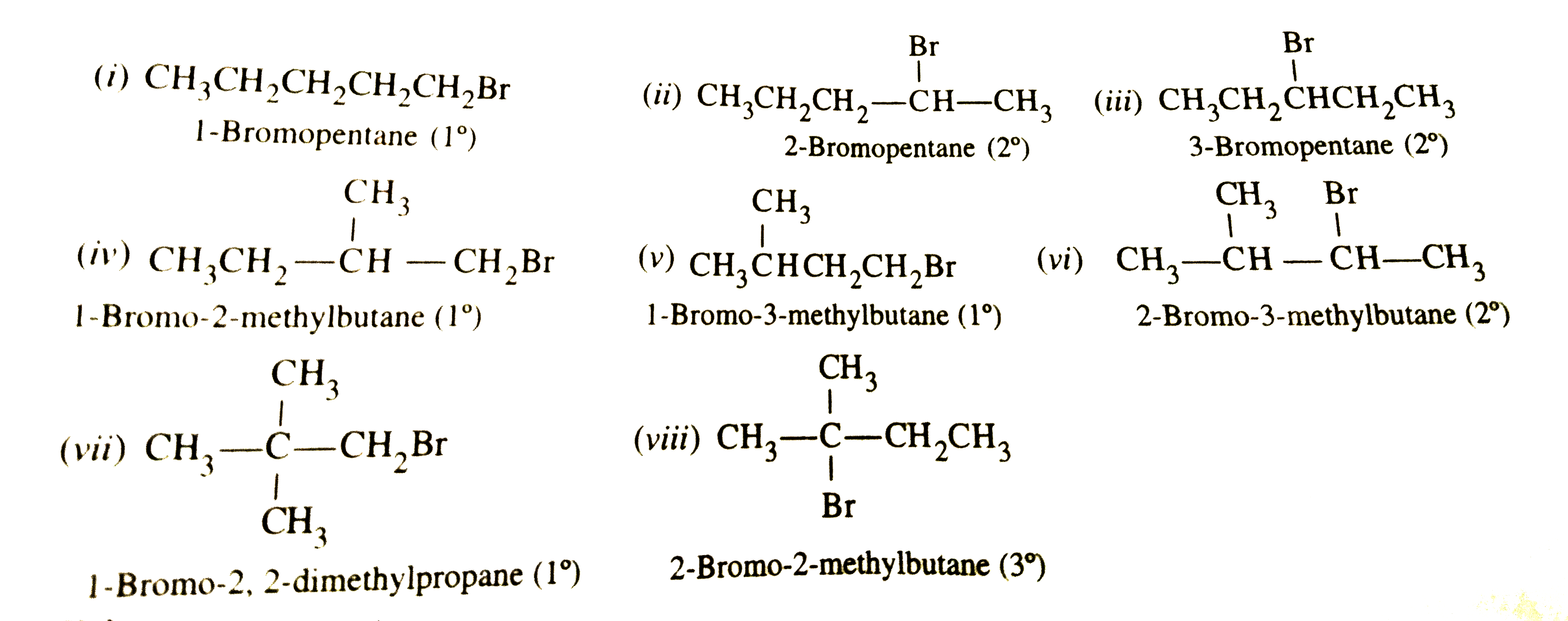
|
|
| 35. |
Draw the structures of (a) cis-dichloridotetracyanochromate (III) (b) Mer-triamminetrichloridocobalt (III) (c ) Fac-triaquatrinitro-N-cobalt (III) |
Answer» SOLUTION :
|
|
| 36. |
During winters , moisture condenses in the form of dew and can be seen on plant leaves and grass, The entropy of the system in such cases decreases as liquids process lesser disorder as compared to gases. With reference to the second law, which statement is correct , for the above process? |
|
Answer» The randomeness of the universe decreases |
|
| 37. |
Draw the structures, give names according to IUPAC and indicate primary, secondary and tertiary amines : (a) eight isomeric amines of formula C_(4)H_(11)N. (b) five isomeric amines of formula C_(7)H_(9)N that contain a benzene ring. |
|
Answer» SOLUTION :(a) Eight isomeric amines of formula `C_(4)H_(11)N` (i) `underset("BUTANAMINE"(1^(@)))(CH_(3)CH_(2)CH_(2)CH_(2)NH_(2))` (ii) `underset("Butan-2-amine(1^(@)))(CH_(3)CH_(2)underset(NH_(2))underset(|)(CHCH_(3)))` (iii) `underset("2-Methylpropanamine"(1^(@)))(CH_(3)underset(CH_(3))underset(|)(CHCH_(2))NH_(2))` (iv) `underset("2-Methylpropan-2-amine"(1^(@)))(CH_(3)-underset(CH_(3))underset(|)overset(CH_(3))overset(|)(C)-NH_(2))` (v) `underset("N-Methylpropanamine"(2^(@)))(CH_(3)CH_(2)CHNHCH_(2))` (vi) `underset("N-Methylpropan-2-amine"(2^(@)))(CH_(3)overset(CH_(3))overset(|)CHNHCH_(3))` (vii) `underset("N-Ethylethanamine"(2^(@)))(CH_(3)CH_(2)NHC_(2)H_(5))` (viii) `underset("N,N-Dimethylethanamine"(3^(@)))(CH_(3)CH_(2)N(CH_(3))_(2))` (b) Five isomeric amines of formula `C_(7)H_(9)N` containing a benzene ring  
|
|
| 38. |
During war, arsenic containing poisonous gas called Lewisite is sometimes used. The soldiers may get affected due to poisoning by arsenic or it may affect the people living in the nearby areas. Similarly, we use a number of articles containing lead. If somehow it enters into our body, e.g., along with water if lead pipes are used for transport of water, there may be lead poisoning. The person inflicted with arsenic or lead poisoning has to be given an antidote. Now, answer the following questions : (i) What values are expressed in the above paragraph? (ii) Whihc antidote is given for arsenic poisoning and which one for lead poisoning? |
|
Answer» SOLUTION :(i) (a) Lead pipes should not be used for transport of drinking water. (b) People LIVING in the areas close to war field should take the antidote if inflicted. (ii) BRITISH Anti-Lewisite (BAL) for ARSENIC poisoning and EDTA for lead poisoning. |
|
| 39. |
Draw the structures and write the lUPAC name of the following compounds. () Benzyl alcohol (i) Allyl alcohol (i) Cyclohexyl alcohol |
Answer» SOLUTION :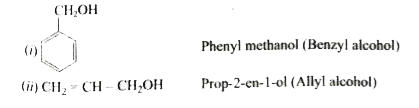 
|
|
| 40. |
During which of the following extraction of metal poling process is used :- |
| Answer» ANSWER :D | |
| 41. |
During war , accidents or street quarrels , sometime people get deep injuries which require stitching, of wounds. Earlier these wounds used to be stitched by nylon thread which was non - biodegradable. This thread used to be pulled out after healing of wounds. This process caused pain to the patients. But these days biodegradable polymer is used for stitching of wounds which gets degraded by itself , within a weak or so. Now answer the following questions : Write the name of the biodegradable polymer used for stitching of wounds after operation. (ii) What are the monomer units of this polymer ? (iii) What are the degradation products of this polymer and what happens to them in the body ? |
|
Answer» Solution :(i) Name of the biodegradable polymer in nylon -2-nylon -6. (ii) The monomer units of this polymer are : `underset("GLYCINE")(H_(2)N-CH_(2)-COOH)` `underset("6 -Aminohexanoic acid")(H_(2)N-(CH_2)_(5)-COOH` (iii) The degradation products of this polymer are the monomer molecules themselves. These are either oxidation in the BLOOD to `CO_2` and `H_2O` or glycine MAY be used in the synthesis of PROTEINS needed by the body. |
|
| 42. |
During thhe preparation of H_(2)S_(2)O_(8) (per disulphuric acid) O_(2) gas also releases at anode as byproduct. When 9.72 of H_(2) releases at cathode and 2.35L O_(2) at anode at STP, the weight of H_(2)S_(2)O_(8) produced in gram is |
|
Answer» 87.12 |
|
| 43. |
Draw the structure of xenon oxyfluoride which is isoelectronic with IF_5. |
Answer» SOLUTION :Xe ATOM in `XeOF_4` is `sp^3 d^2`hybridized and has square PYRAMIDAL STRUCTURE shown below:
|
|
| 44. |
During the working of the Daniel cell , which of the following happen ? |
|
Answer» the size of the Zn rod as well as the INTENSITY of the COLOUR of `CuSO_(4)` solution remain unchanged |
|
| 45. |
During the vulcanization of rubber, sulphur cross linking occurs at a) Double bonds b) Allylic - CH_(2) - groups c)Methyl groups The correct answer is |
|
Answer» only a |
|
| 46. |
Draw the structure of xenon fluoride molecule which is isoelectronic with IF_5. |
Answer» SOLUTION :` XeOF_4` is ISOELECTRONIC with `IF_5`. It has `sp^3d^(2)` hybridisation and exists in SQUARE PYRAMIDAL structure. 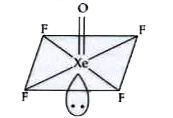
|
|
| 47. |
During the transformation of .^(b)X_(a) rarr .^(d)Y_(c) the number of beta-particles emitted is |
|
Answer» `((b -d))/(4)` `b = d + 4x + 0y " " a = c + 2X - y` or, `b =d+ 4x " " or, a = c + 2.(b-d)/(4) -y` or, `x = (b-d)/(4) "" or, a = c + (b -d)/(2) - y` or, `y = (c -a) + ((b -d))/(2)` |
|
| 48. |
Draw the structure of XeF_4 molecule. |
Answer» SOLUTION :
|
|
| 49. |
During the transformation of ""_(a)^(c)X to ""_(d)^(b)Y the number of beta-particles emitted are : |
|
Answer» `(a-b)/(4)` |
|
| 50. |
During the titration of sodium thiosulphate and iodien, the following reaction takesplace : 2Na_2 S_2O_3 + I_2 to Na_2 S_4 O_6 + 2NaI Which of the following statement is correct ? |
|
Answer» SODIUM thiosuphate gets oxidised because OXIDATION number of S in it INCREASES from+ 2 to + 4. |
|