

Saved Bookmarks
This section includes 7 InterviewSolutions, each offering curated multiple-choice questions to sharpen your Current Affairs knowledge and support exam preparation. Choose a topic below to get started.
| 1. |
Define the followingterms : (i) Glycosidic linkage . (ii) Invert sugar . (iii) Oligosaccharides. |
|
Answer» Solution :(i) GLYCOSIDIC linkage: TheTwo monosaccharides units are joined togetherthrough an oxidelinkagefromed byloss of a molecule of `H_(2)O` . (ii)Invert sugar : HYDROLYSIS of sucrosebrings abouta changein a sign of rotation fromdextro (+) to leavo (-) and theproducts is KNOWAS invert sugar . (III) See thepoint 3 (iii) in quick sugar . |
|
| 2. |
Define the following terms : (i) F-centre (ii) p-type semiconductor (iii) Ferrimagnetism. |
|
Answer» Solution :(i) ANIONIC positions occupied by electron are called F-centres. They IMPART colour to alkyl halides like NaCl, KCI, LiCl. (ii) When an element is doped with electron deficient impurity, p-type semiconductor is obtained. For example, when Si is doped with B, this semiconductor is obtained. Boron contains three valence electrons whereas four electrons are needed to form covalent bonds with silicon. So an electron vacancy or positive hole is created. On applying a POTENTIAL difference, positive holes move towards the negatively charged electrode. These positive holes increase the conductance of Si. (iii) For ferrimagnetism, SEE POINT Number 18 of "Chapter At A Glance". |
|
| 3. |
Define the following terms : (i) Elastomers (ii) Fibres (iii) Thermoplastics (iv) Thermosetting polymers |
|
Answer» Solution :The CLASSIFICATION of polymers on the basis of inter-molecular forces of atraction such as van der Waal.s forces and hydrogen bonding etc. can be done in the following way : (i) ELASTOMERS . Such of polymers have weakest inter-molecular forces between the polymer chains. As a RESULT of this stretching of chains can take place . However , there are a few cross-links also between the chains due to which the chains regain their original position when the stretching force is withdrawn. (ii) Fibres . Such of polymers have the strongest inter-molecular forces such as hydrogen bonds and dipole-dipole interactions. As a result of this, fibres have high tensile strength and elasticity. 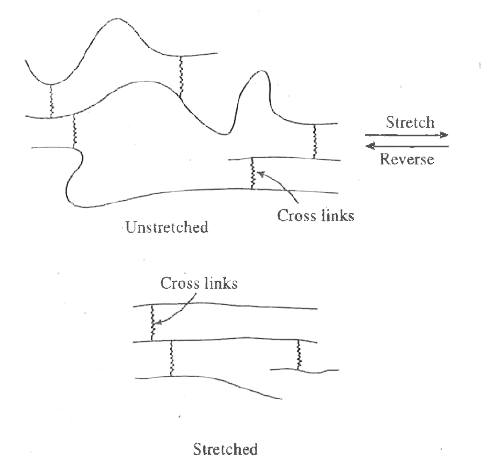 The molecules of fibres are long, thin and thread-like and can be woven into fabrics. Nylon-66 and terylene are examples the magnitude of inter-molecular forces is intermediate between those in elastomers and fibres. These are no cross links between the polymer chains. As a result , thermoplastics are not very rigit and can be moulded into different shapes. POLYTHENE , polypropylene and polystyrene are some examples of thermoplastics. (iv) Thermosetting polymers . Such polymers have RELATIVELY low molecular masses which get highly cross-linked on heating . This gives rise to a hard, infusible nad insoluble three dimensional network soild. Bakelite and melamine are examples of thermosetting polymers. |
|
| 4. |
Define the following terms : (i) Crystalline solids (ii) Frenkel defect (iii) n-type semiconductor. |
|
Answer» Solution :(i) A crystalline solid consists of a large number of crystals each of them having a definite characteristic geometric shape. There is a regular pattern of arrangement of particles which repeats itself over the entire CRYSTAL. Sodium chloride and QUARTZ are the EXAMPLES. (ii) Frenkel defect is shown by ionic solids. The cation is dislocated from its position to interstitial position. This defect is shown when there is a large difference in the SIZE of cation and anion. For example, ZnS, AgCl, AgBr and Agl. (iii) When an element is doped with electron rich impurity, n-type semiconductors are obtained. For example when Si is doped with P, this type of semiconductor is obtained. Phosphorus contains five electrons in the valence shell out of which four are used in bond formation with Si. The fifth electron is delocalised. These delocalised electrons increase the conductivity of Si. |
|
| 5. |
Define the following terms : (i) Colligative properties. (ii) Molality (m). |
|
Answer» Solution : (i) Colligative PROPERTIES - These are those properties of solutions that depend upon the concentration of the solution and not upon the NATURE of the solute. For example, osmotic PRESSURE, lowering of vapour pressure, ETC. (ii) Molality (m) – Molality of a solution is equal to the number of moles of the solute dissolved in one kilogram of the solvent. Molality (m) = No. of moles of the solute / No. of kilograms of the solvent |
|
| 6. |
Define the following terms? (i) Adsorption (ii) Peptization (iii)Sol |
|
Answer» SOLUTION :)(i) see Q 19 SET II(O.D)-2013 (ii) See Q 19 (ii) Set III (O.D)-2013 (iii) Sol: when DISPERSED phase is solid and DESPERSION medium isliquid |
|
| 7. |
Define the following terms: (i) Activation energy (ii) Rate constant |
Answer» Solution : (i) Activation ENERGY : Energy required to form the intermediate called activated complex during a reaction, is KNOWN as activation energy. This is explained with the help of the given figure. (ii) Rate CONSTANT : It is the rate of the reaction when the concentration of the species involved is unity. Rate `=K[A]^(x)[B]^(y)` When [A] = [B] = 1, we have Rate= k Hence the above definition. |
|
| 8. |
Define the following terms: Associated colloids. |
| Answer» Solution :Associated colloids : These are those substances which at LOW concentration behave as NORMAL strong ELECTROLYTES but at higher concentration exhibit colloidal BEHAVIOUR due to the formation of aggregates (micelles). Soaps and synthetic DETERGENTS belong to this class. | |
| 9. |
Define the following terms as related to proteins (i) Primary structure (ii) Secondary structure (iii) beta - strands |
|
Answer» Solution :(i) Primary structure of proteins : Proteins are polypeptide chains made up ofamino acids connected through peptide bonds. The relative arrangement of the amino acids in the polypeptide chain is called the primary structure of the protein. (ii) Secondary structure of proteins : The amino acids in the polypeptide chain forms highly regular shapes (SUB- structures) through the HYDROGEN bond between the carbonyl oxygen ( -C=O) and the neighbouring amine hydrogen ( - NH) of the main chain. `beta`-Strands are extended peptide chain RATHER than coiled. The hydrogen bonds occur between main chain carbonyl group one such strand and the amino group of the ADJACENT strand resulting in the formation of a sheet LIKE structure. This arrangefi?.ent is called `beta`-sheets. |
|
| 10. |
Define the following terms as related to proteins : (i)Peptide linkage (ii) Primary structure . (iii) Denaturation. |
|
Answer» Solution :(i) Peptide linkage : Proteins are polymers of amino acids and they are connected to each other by peptide linkage. Chemically peptide linkage is an amide formed between -COOH group and — `NH_(2)` group. (ii) PRIMARY structure : Each polypeptide in a protein has amino acids linked with each other in a specific sequence. It is this sequence of amino acids that is called as primary structure of proteins. (iil) DENATURATION : When a protein in its native form is subjected to physical change like temperature or CHEMICAL change in PH, the hydrogen bonds are disturbed. Due to this the globules unfold and helix get uncoiled and the protein loses its biological activity. This is called denaturation. |
|
| 11. |
Define the following terms: (a) Tranquilizers (b) Antiseptic |
|
Answer» Solution :(a) Tranquilizers : Tranquilizers are a class of chemical compounds used for the treatment of STRESS, and mild or even severe mental DISEASES. They relieve anxiety, stress, irritability or excitement by INTRODUCING a SENSE of well-being. (b) Antiseptic : Antiseptics are chemicals which either kill or prevent the growth of microorganisms. Antiseptics are applied to living TISSUES such as wound, cuts, ulcers and diseased skin surfaces. |
|
| 12. |
Define the following terms : (a) Tranquilizer (b) Limited spectrum antibiotics. (c) Disinfectant. |
|
Answer» Solution :(a) Tranquilizer : Neurologically active drugs or chemical COMPOUNDS used for TREATMENT of STRESS or anxiety and mild or even severe mental diseases are called tranquilizers. (b) Limited spectrum antibiotics : Antibiotics which are effective against a single organism or disease are called limited spectrum antibiotics. (c) Disinfectant : Chemicals that kill or prevent GROWTH of microbes and are applied on inanimate or non-living objects are called disinfectants. |
|
| 13. |
Define the following terms (a) Paraffins (b) Alkyl group (c) Carbocyclic compounds (d) Hetercyclic compounds (e) Unsaturated compounds (f) Saturated compounds. |
| Answer» | |
| 14. |
Define the following : (i) Elementary step in a reaction, (ii) Rate of the reaction. |
|
Answer» Solution :(i) Elementary step in a reaction : The SLOWEST step is called rate DETERMINING step in the proposed mechanism. E.g., The reaction occurs in two steps : `{:(NO_(2)+F_(2)rarr NO_(2)F+F " slow step"),(NO_(2)+F rarr BO_(2)F"FAST step"),(ulbar(2NO_(2)+F_(2)rarr 2NO_(2)F " Net reaction")):}` The rate is determined by the first step which is the slower of the two step. Each of the step is called elementary reaction. (ii) The rate of a chemical reaction at a given temperature may depend on the concentration of one or more REACTANTS and PRODUCTS. The representation of rate of reaction in terms of concentration of reactants is known as rate law. |
|
| 15. |
Define the following: (i) Boiling point (ii) Molal, depression constant. |
|
Answer» Solution :(i) BOILING point. It is the TEMPERATURE at which vapour pressure of a liquid or solution becomes equal to the atmospheric pressure. (ii) MOLAL depression constant. It is equal to the depression in FREEZING point of a solution when its molality is UNITY. |
|
| 16. |
Define the following : (i) Anionic detergents. (ii) Broad spectrum antibiotics. (iii) Antiseptic. |
|
Answer» Solution :(i) Anionic detergents : Anionic detergents are sodium salts of sulphonated LONG chain alcohols or hydrocarbons. In anionic detergents, the anionic PART of the molecule is involved in cleansing action. (ii) Broad spectrum antibiotics : Antibiotics which kill or inhibit a wide RANGE of Gram-positive or Gram-negative bacteria are said to be broad spectrum antibiotics. Ampicillin and Amoxycillin are broad spectrum antibiotics. (iii) Antiseptics Antiseptics are chemicals which either kill or prevent the growth of microorganisms. Antiseptics are applied to living tissues such as wounds, cuts and ulcers and diseased SKIN surfaces. |
|
| 17. |
Define the following by giving one example of each: (i) Antiseptics (ii) Antioxidants (iii) Narcotic analgesics |
|
Answer» Solution : (i) Antiseptics are the chemicals applied to the LIVING tissues either to kill or prevent the growth of micro organisms. Example : dettol. (ii) Antioxidants are the compounds which RETARDS the action of oxygen on food and reduces its rate of decomposition by OXIDATION. Example: BHA. (iii) Narcotic analgesics are the chemicals used for the relief of pst operative pain. Example: morphine. |
|
| 18. |
Define the following as related to proteins : (i) Peptide linkage (ii) Primary structure (iii) Denaturation |
Answer» SOLUTION :(i) PEPTIDE linkage : In proteins, the various amino acids are linked by an amide linkage `(-CONH-)` between two successive amino acids. Such amide linkages are known as peptide linkage.  (ii) Primary structure : Proteins may have one or more polypeptide chains. Each polypeptide in a PROTEIN has amino acids linked with each other in a specific sequence and it is this sequence of amino acids that is said to be the primary structure of protein. Any change in this primary structure creates the different proteins. (iii) Denaturation : The disruption of native structure and PROPERTIES of proteins by change in pH, temperature or by addition of some salt is called denaturation of protein. |
|
| 19. |
Define the following as related to proteins. (i) Peptide linkage. (ii) Primary structure (iii) Denaturation. |
Answer» Solution :(i) Peptide bond. Proteins are condensation polymers of `alpha`-amino acids in which the same or different `alpha`-amino acids are connected by peptide bonds. Chemically, a peptide bond is an amide LINKAGE formed between `-COOH` group of one `alpha`-amino acid and `-NH(2)` group of the other `alpha`-amino acid by loss of a molecule of water. For example, 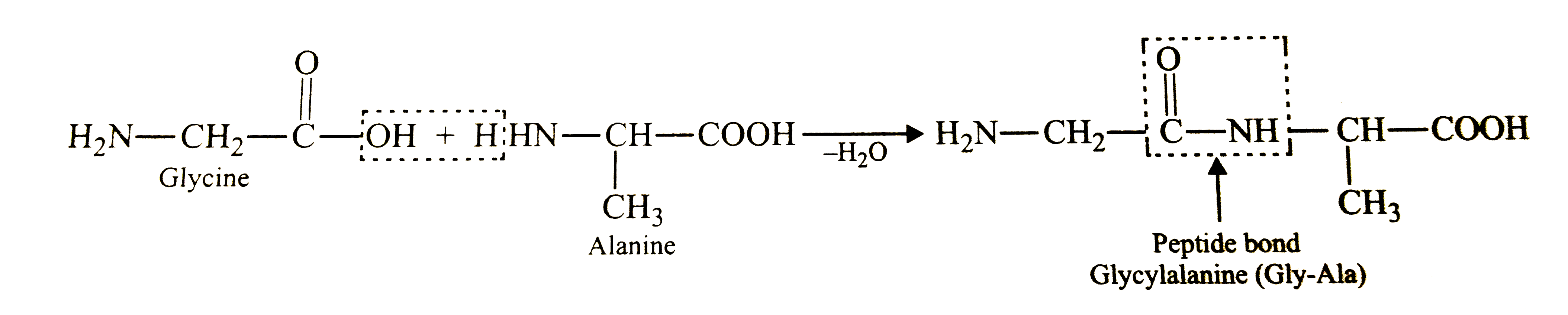 (ii) Primary strcuture : Proteins may contain oneor more polypeptide chains. Each polypeptide chain has a large number of `alpha` - amino acids which are linked to one another in a specific sequence. The specific sequencein which the various `alpha` -amino acids present in a protein are linked to one another is called is primary structure. Any change in the sequence of `alpha`-amino acids creates a different protein. The gerneral primary structure of a protein is given. (iii) Denaturation : Each proteins in the biological SYSTEM has a unique three - dimensional structure and has specific biological activity. This is called native form of a protein. When a protein in its native form is subjected to physical changes in temperature, p H etc .hydrogen bonds are broken. Due to cleavage of hydrogen bonds, unfolding of protein molecule occurs and the protein loses its biological activity. This loss of biological activity is called denaturation. As a result of denaturation, globular proteins (soluble in `H_2O`) are converted into FIBROUS proteins (insoluble in `H_2O`). In other words , denaturation leads to coagulation. That is why COAGULATED proteins are also called denatureated proteins. The most common example of denaturation of proteins is the coagulation of albumin present in the while of an egg. When the egg is boiled hard , the soluble globular protein present in it is denatured and is converted intoinsoluble fibrous protein. Another example is CURDING of milk which is caused due to formation of lactic acid by bacteria present in milk. |
|
| 20. |
Define the followingas relatedto proteins. . (i) Peptidelinkage(ii) Primary structure(iii) Denatuartion . |
|
Answer» Solution :(i) Peptide linakge: Amino acidsare bifunctionalmoleculeswith `NH_(2)` GROUP at its oneend andCOOH at the other . Therforethe COOH of onemolecules and`NH_(2)`of anothermolecule caninteract witheliminationof a `H_(2)O`molecule to from an amide like linkagecalledpeptidebondor peptidelinkage . (ii) Primarystrcuture: Thesequencein whichamino acids are linked togetherin a polypeptidechain froms theprimary STRUCTURE. (iii) DENATURATION: The process of by whichsecondaryand tertiarystructure of PROTEINS getdisturbed by CHANGEOF pH or temperature ,so that theyarenot ableto perform theirfucntions, is calleddenaturationof proteins. |
|
| 21. |
Define the following as related to proteins: (i) Peptide linkage (i) Primary structure (iii) Denaturation. |
Answer» Solution :(i) Peptide linkage : Proteins are condensation polymers of -amino acids in which the same or different ce-amino acids are connected by peptide bonds. Peptide bond is an amide linkage formed between -COOH GROUP of one c-amino acid and NH, group of the other O-amino acid by loss of a molecule of water. For example,  (II) Primary structure : Proteins may contain one or more polypeptide chains. Each polypeptide chain has a large number of c-amino acids which are linked to one another in a specific manner. The specific sequence in which the various CL-amino acids present in a protein are linked to one another is called its primary structure. Any change in the sequence of c-amino acids creates a different protein. The general primary structure of a protein is given below:  (iii) Denaturation : Each protein in the biological system has a unique three-dimensional structure and has specific biological activity. This is called native form of a protein. When a protein in its native form is subjected to physical changes such as change in temperature, pH, etc., hydrogen bonds are broken. Consequently, unfolding of protein molecule occurs and the protein loses its biological activity. This loss of biological activity is called denaturation During denaturation, `2^(@)` and `3^(@)` structures of proteins are destroyed but `1^(@)` structure remains intact. As a result of denaturation, globular proteins (soluble in H,0) are converted into fibrous proteins (insoluble in H,O). In other words, denaturation leads to coagulation An example of denaturation of proteins is the coagulation of albumin present in the white of an egg When the egg is BOILED HARD, the soluble globular protein present in it is DENATURED and is converted into insoluble fibrous protein. Curdling of milk, which is caused due to formation of lactic acid by the bacteria present in milk is another example of denaturation. |
|
| 22. |
Define the following and give one example : Tranquilizers. |
| Answer» Solution :DRUGS which REDUCE anxiety and PRODUCE feeling of well-being are called tranquilizers. For EXAMPLE, equanil and seconal. | |
| 23. |
Define the following and give one example: Tranquilizers. |
| Answer» Solution :It is a group of CHEMICAL SUBSTANCE which is used for the treatment of STRESS and SEVERE mental stress. For h EXAMPLE Valium. | |
| 24. |
Define the following and give one example of each : (i) Antipyretics, (ii) Antibiotics |
|
Answer» Solution :(i) Antipyretics : Drugs which REDUCE temperature of feveral body are CALLED antipyretics. For EXAMPLE, PARACETAMOL. (II) Antibiotics : Drugs which kill or prevent the growth of bacteria and other microorganisms are called antibiotics. For example, streptomycin and penicillin. |
|
| 25. |
Definethe followingand give one exampleof each: (a) Isoelectricpoint (b)Mutarotation (c) Enzymes . |
|
Answer» Solution :(a) Isoelectric point : Itis the pH at which+veand -vecharges on zwitter ion areequal. (b) Mutarotation: It is a spontaneous changeisoptical rotationwhenan optically ACTIVE substanceis dissolvedin WATER . Example`alpha`- glucose ,when dissolvedin water , then itsoptical rotationchanages from `111^(@)`to ` 52.5^(@)` . (c) ENZYMES: Enzymes are biocatalysts whichspeedsup thereactions in biosystem . Theyarehighly specificand selectivein their ACTION . Chemically all enzymes are proteins. |
|
| 26. |
Define the following: (a) Leaching (b) Methallurgy (c ) Anisotropy The boiling point of benzene is 353*23K. When 1.80 gram of non-volatile solute was dissolved in 90 gram of benzene, the boiling point is raised to 354.11 K. Calculate the moler mass of solute. [K_(b)for benzene =2.53K mol^(-1)] |
|
Answer» Solution :(a) Leaching : It is a chemical method for the concentration of the ore. In this procfess the powdered ore is dissolved selectively in certain acids, BASES or other suitable reagents. The impurities remains undissolved as Sludge. The solution of ore is filtered and ore is recovered by precipitation or crystallisation. It is a process in which the ore is concentrated by chemical reaction with a suitable reagent which dissolves out the ore but not the impurities. For example, bauxite is leached with hot and concentrated solution of NaOH which `Al_(2)O_(3)` goes into solution forming solid sodium meta aluminate. `Al_(2)O_(3).2H_(2)O+2NaOHto underset("Soluble")(2NaAlO_(2))+3H_(2)O` The solution is then filtered to remove insoluble impurities like silca and otheroxides. The filtrate is diluted with WATER and seeded with small AMOUNT of freshly precipitated aluminium hydroxide as a result of which a white ppt. is formed. `NaAlO_(2)+2H_(2)Oto darrunderset("White ppt.")(Al(OH)_(3))+3H_(2)O` The ppt. is then separted, washed and ignited to get aluminium oxide in pure state. `2Al(OH)_(3)underset(Delta)tounderset("Pure alumina")(Al_(2)O_(3))+3H_(2)O` The process of leaching can also be applied in case of argentite and for certain ores containing gold. (b) Metallurgy : The entire scientific and technological process used for isolation of the metal from its ores is known as methllurgy. Types of metallurigical processes 1. Pyrometallurgy : In this process, extraction of metals takes place at very high temperature. Cu, Fe, Zn, Sn, etc., are extracted by this method. 2. Hydrometallurigical process : In this method, metals are extracted by this method. 3. Electro-metallurigical process : Electricity is used in this method for exteraction. ` Na, K, Li, Ca, etc.,` are exteracted from their MOLTEN salt solution through electrolytic method. The extraction and isolation of metals from ores involve the following major steps : Concentration of the ore, Converting ore into ore, Reduction Refining (Purification of the metal) (c ) Expression for maximum work : Consider an ideal gas confined in a cylinder with a frictionless piston. Suppose it expands reversibly from volume `V_(1)` to `V_(2)` at a constant temperature, the pressure of the gas is succssfully reduced from `p_(1)` to `P_(2).` 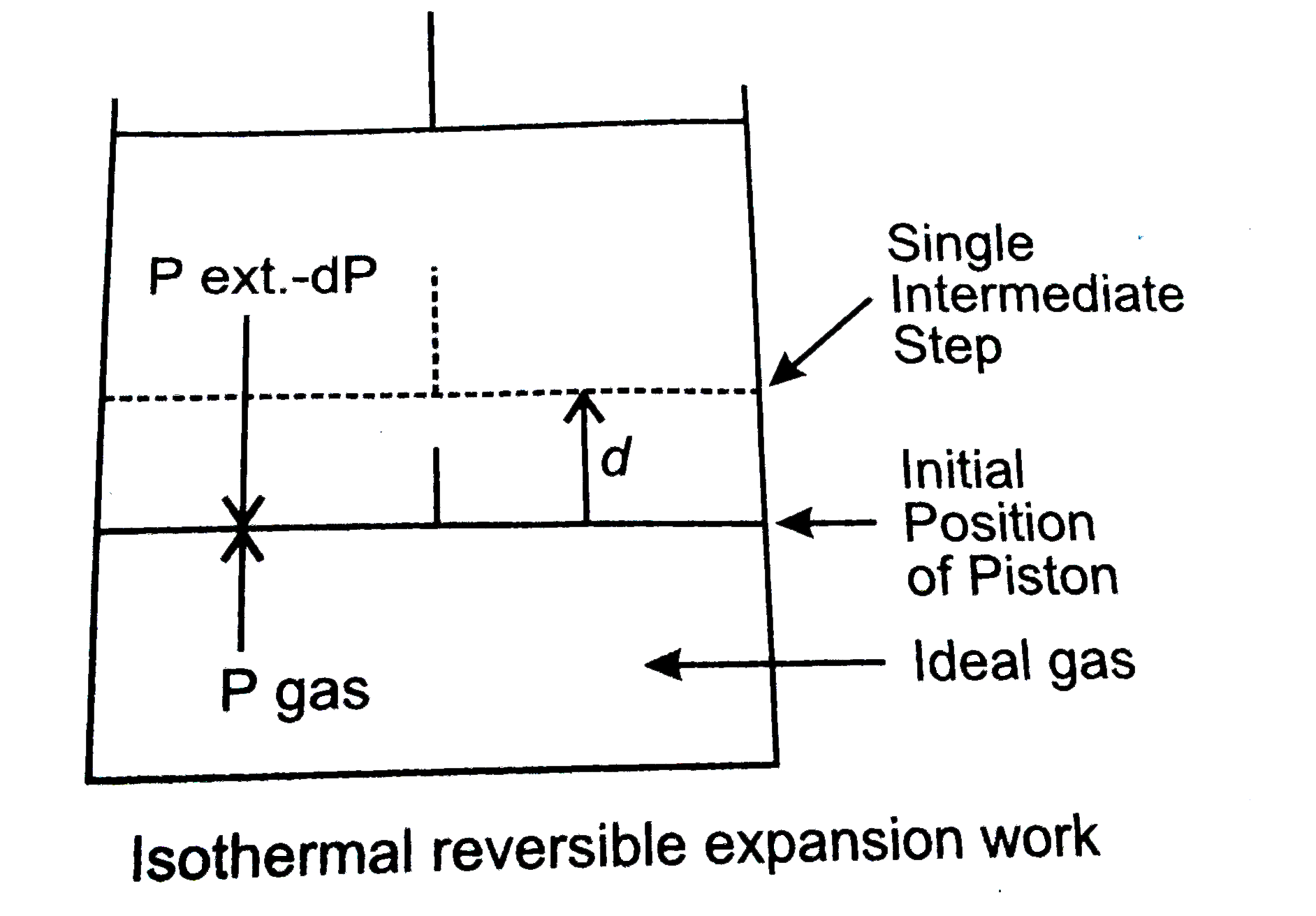 The work done by gas in one infinitesimal setp (dW), can be expressed as : `dW=PxxAdl` (A = cross-section area of piston)`PxxdV`where dV is the increase in volume. The total amount of work dony by the ideal gas from `V_(1)` to `V_(2)`is, therefore, `W=underset(V_(1))overset(V_(2))intP*dV` By the ideal gas equation, `P=(nRT)/(V)` `W=underset(V_(1))overset(V_(2))int(nRT)/(V)dV` `nRTunderset(V_(1))overset(V_(2))int(dV)/(V)` or `W_(max) =-2.303n RT log V_(2)//V_(1)` Weight of solute `=1.80` g Weight of solvent `=90`g `K_(b)` for benzene `=2.53K mol^(-1)` The elevation in the BOILING point `=354.11K-353.23K =0.88` K Substituting these values in expression we get `T_(b)=K_(b)M` `M=(1.80xx1000)/(x xx90)` `or 0.88=(2*53xx1*80xx1000)/(x xx90)` `x=(2*53xx1*80xx100)/(0.88xx90)` `x=57*5g mol^(-1)` Therefore, molar mass of the solute, `M_(2)=57*5g mol ^(-1).` |
|
| 27. |
Define the following: (a) Anionic detergents (b) Narrow spectrum antibiotics (c) Antacids. |
|
Answer» Solution :(a) ANIONIC detergents (b) Narrow spectrum antibiotics: 9C) ANTACIDS: Substnaces which NEUTRALIZE the excess ACID and raise the pH to an appropriate level in stomach are called antacids. Ex. Ranitidine, cimetidine. |
|
| 28. |
Define the following: (a) Anionic detergents (b) Limited spectrum antibiotics (c) Antiseptics |
|
Answer» Solution :(a) Anionic detergents: These are so CALLED because a large part of their molecules are anions. these are of two types: (a) Sodium alkyl sulphates: for example, sodium lauryl sulphate `C_(17)H_(23)CH_(2)OSO_(3)Na` (b) Sodium alkyl benzene sulphonates:  (b) Limited spectrum antiobiotics: Antibiotics which are are specific for certain desease only. Ex: pencillin. Streptomycin for tuberculosis etc. (c) Antiseptics: They are the chemical SUBSTANCES which prevent the growth of micro-organism and may even kill them. they are safe to be APPLIED to living tissues. For example, Dettol, Savlon, Iodine, Boric aciid etc. |
|
| 29. |
Define TFM value. |
|
Answer» SOLUTION :(i) The quality of a SOAP is described in terms of total fatty matter(TFM value). It is defined as thetotal amount of fatty matter that can be SEPARATED from a sample after spliting with mineral ACIDS. Higher the TFM value in the soap, better is its quality. (ii) As per BIS standards, Grade I soaps should have 76% minimum TFM value. |
|
| 30. |
Defineterms with a suitable example : Artificial sweeteners |
| Answer» Solution :Chemicals which are sweet in TASTE and with low CALORIES, eg-Saccharin | |
| 31. |
Defineterms with a suitable example : Antibiotics |
| Answer» Solution :An antibiotic refers to a substance produced wholly or PARTLY by chemical synthesis, which in LOW concentrations inhibits the growth or destroys microorganisms by INTERVENING in their METABOLIC processes. Penicillin | |
| 32. |
Defineterms with a suitable example : Analgesics |
| Answer» Solution :ANALGESICS reduce or abolish pain without CAUSING IMPAIRMENT of consciousness, mental confusion, INCOORDINATION or PARALYSIS or some other disturbances of nervous system. Aspirin (or any other correct example) | |
| 33. |
Define Tautomerism. Give example. Whky tertiary nitro alkanes do not exhibit tautomerism? |
Answer» Solution :(i) Tautomerism is an isomerism in which the isomers change into one ANOTHER with great ease of SHIFTING of proton so that they exist together in EQUILIBRIUM.  (ii) Tertiary NITRO alkanes do not exhibit tautomerism due to absence of `ALPHA`- H atom. |
|
| 34. |
Define Tautomerism. Give example. Why tertiary nitro alkanes do not exhibit tautomerism? |
Answer» Solution :(i) Tautomerism is an isomerism in which the ISOMERS change into one another with great ease of shifting of proton so that they exist together in equilibrium. 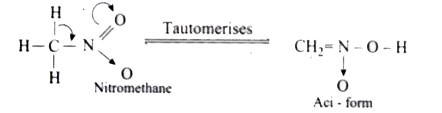 (ii) Tertiary NITRO alkanes do not EXHIBIT tautomerism DUE to absence of `alpha-H` atom. |
|
| 35. |
Define temperature coefficient of a reaction. What is general value of it ? |
|
Answer» Solution :It is the ratio of rate constants of reaction at two DIFFERENT temperatures DIFFERING by `10^(@)C`. Temperature coefficient ` = (k_(T) + 10)/(k_(T)) = 2` Temperature coefficeient of most of the reactions is 2. |
|
| 36. |
Define tautomerism. |
Answer» SOLUTION :Primary and secondary nitroalkanes, having `alpha-H`, ALSO SHOW an EQUILIBRIUM MIXTURE of two tautomers namely nitro-and aci - form. 
|
|
| 37. |
Define stereo isomerism in coordination compound . Given its type. |
|
Answer» Solution :The phenonmenon in which the coordination COMPOUND have the same CHEMICAL formula and connectivity between the central metal atom and the ligands is known as STEREO isomerism. But they differ in the spatial arrangement of ligands in THREE dimensional space. They can be further classified as (a) Geometrical isomerism (B) Optical isomerism |
|
| 38. |
Define standard reduction potential. |
|
Answer» |
|
| 39. |
Define standard electrode potential. If standard oxidation potential of an electrode is 0.80 V, what will be its standard reduction potential ? |
| Answer» Solution :STANDARD electrode potential is the electrode potential of a METAL in contact with its IONS when the concentration of ions is 1 molar. It may be standard reduction potential or standard oxidation potential. The TWO have the same magnitude but OPPOSITE sign. The standard reduction potential is - 0.80 V. | |
| 40. |
Define - Standard electrode potential. |
| Answer» SOLUTION :Standard electrode POTENTIAL is the value of the standard emf of a cell in which MOLECULAR hydrogen under standard pressure (latm) and temperature (273K) is oxidised to SOLVATED PROTONS at the electrode, | |
| 41. |
Define standard emf of a cell. |
|
Answer» Solution :When the emf of a cell is DETERMINED under standard conditions, it is called the standard emf. It is DEFINED as the emf of a cell with 1 M solutions of reactants and products in solution measured at `25^(@)C`. It is REPRESENTED by the SYMBOL `E^(@)`. |
|
| 42. |
Definestandardelectrodepotential. |
| Answer» Solution :STANDARDELECTRODEPOTENTIALIS the VALUE OFTHE standardemfof a cellin whichmolecularhydrogenunderstandardpressure(1 atm)and temperature(273 k) isoxidised to solvatedprotonsat the electrode. | |
| 43. |
Define specific surface area. |
| Answer» Solution :It is the surface area in SQUARE METERS per gram of the solid ADSORBENT which may be in the form of POWDER or porous mass. | |
| 44. |
Define specificreaction rate or rate constant. |
| Answer» SOLUTION :Specific reaction rate is the rate of reaction when the MOLAR concentration of each of the reactants is UNITY. | |
| 45. |
Define specific conductance . Give its SI unit. |
|
Answer»
`k = C.l/A` The SI unit of specific conductance is `Sm^(-1)` |
|
| 46. |
Define specific conductance. |
| Answer» Solution :The SPECIFIC conductance is DEFINED as the conductance of a CUBE of an electrolytic solution of UNIT DIMENSIONS. | |
| 47. |
Define space lattice. |
| Answer» Solution :A space lattice is a PATTERN of POINTS that describes the arrangement of constituent units (atoms, ions or MOLECULES) in a crystal. | |
| 48. |
Define solubility product. |
|
Answer» Solution :SOLUBILITY product: It is DEFINED as the product of the molar CONCENTRATION of the constituent ions, each RAISED to the power of its stoichiometric co-effcient in a balanced equilibrium equation. `X_mY_(n(s))leftrightarrow^(H_2O)mX^(n+)(aq)+nY^(m-) (aq)` `K_(sp)leftrightarrow[X^(n+)]^m[Y^(m-)]^n` |
|
| 49. |
(i)Define solubility product. (ii) What is the pH of an aqueous solution obtained by mixing 6 gram of acetic acid and 8.2 gram of sodium acetate and making the volume equal to 500 ml. (Given: K_(a)for acetic acid is 1.8xx10^(-5)) |
| Answer» Solution :The solubility product of a compound is defined as the product of the molarconcentration of the consistuent ions, each raised to the POWER of its stoichiometric CO - efficient in a balanced EQUILIBRIUM EQUATION. | |
| 50. |
Define solubility. How is it expressed ? |
| Answer» SOLUTION :UNITS of SOLUBILITY = G/100 g of the solvetnt. | |