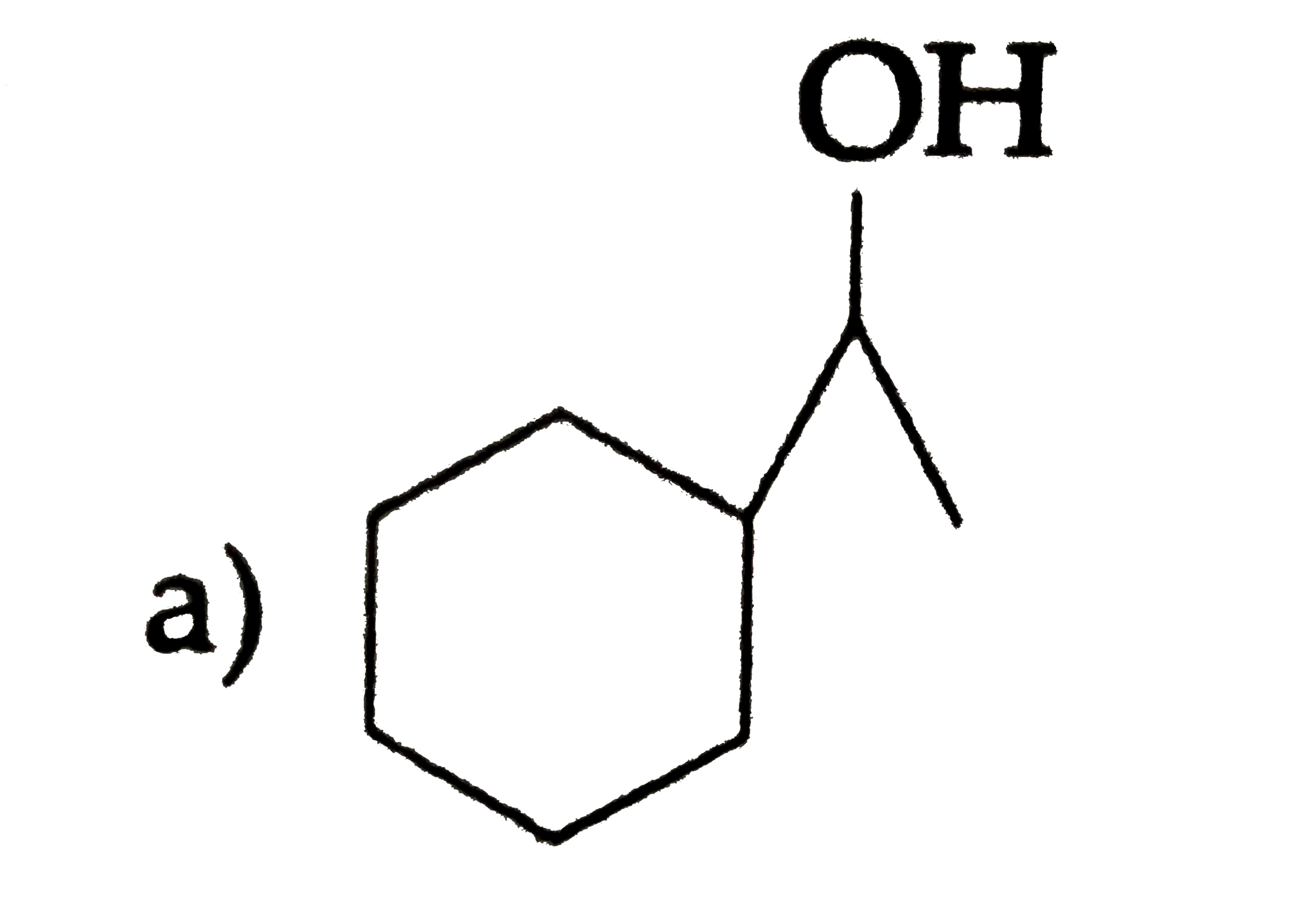
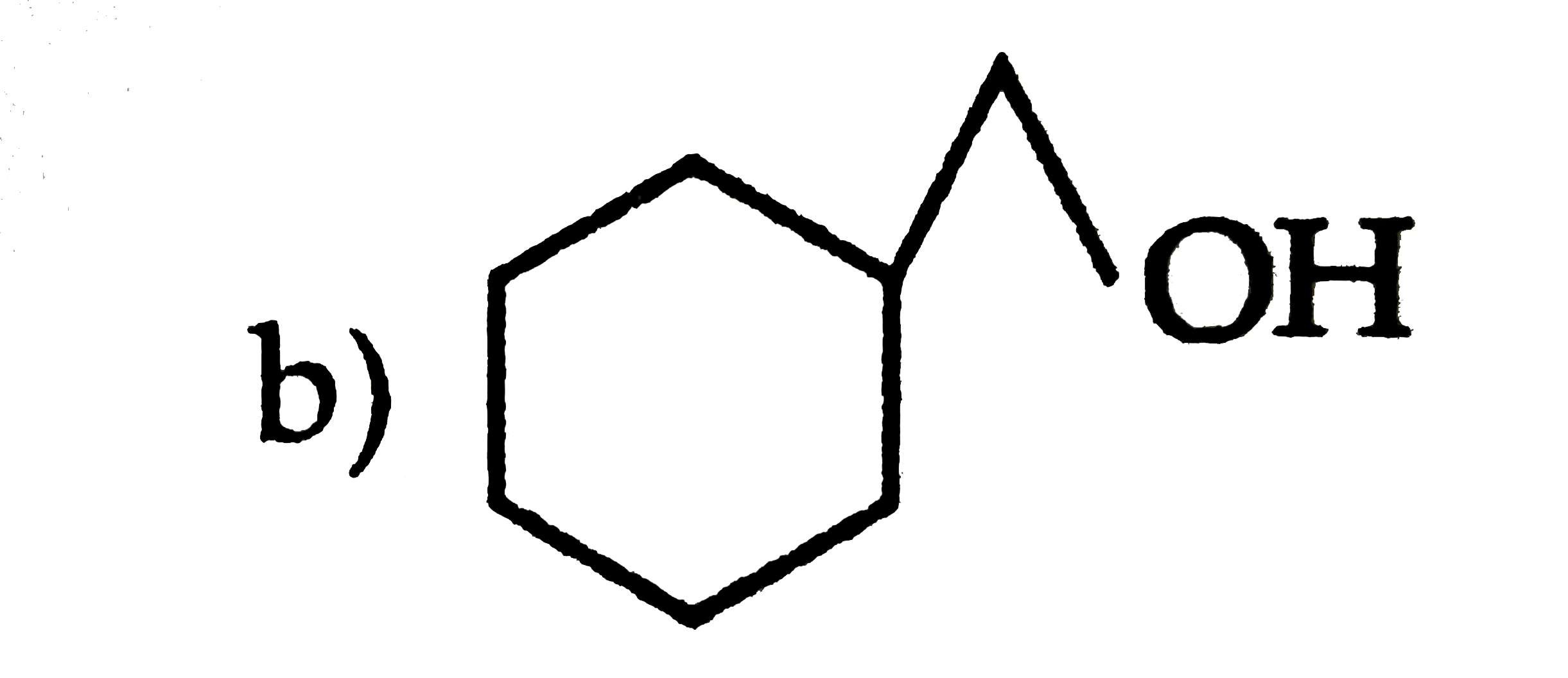
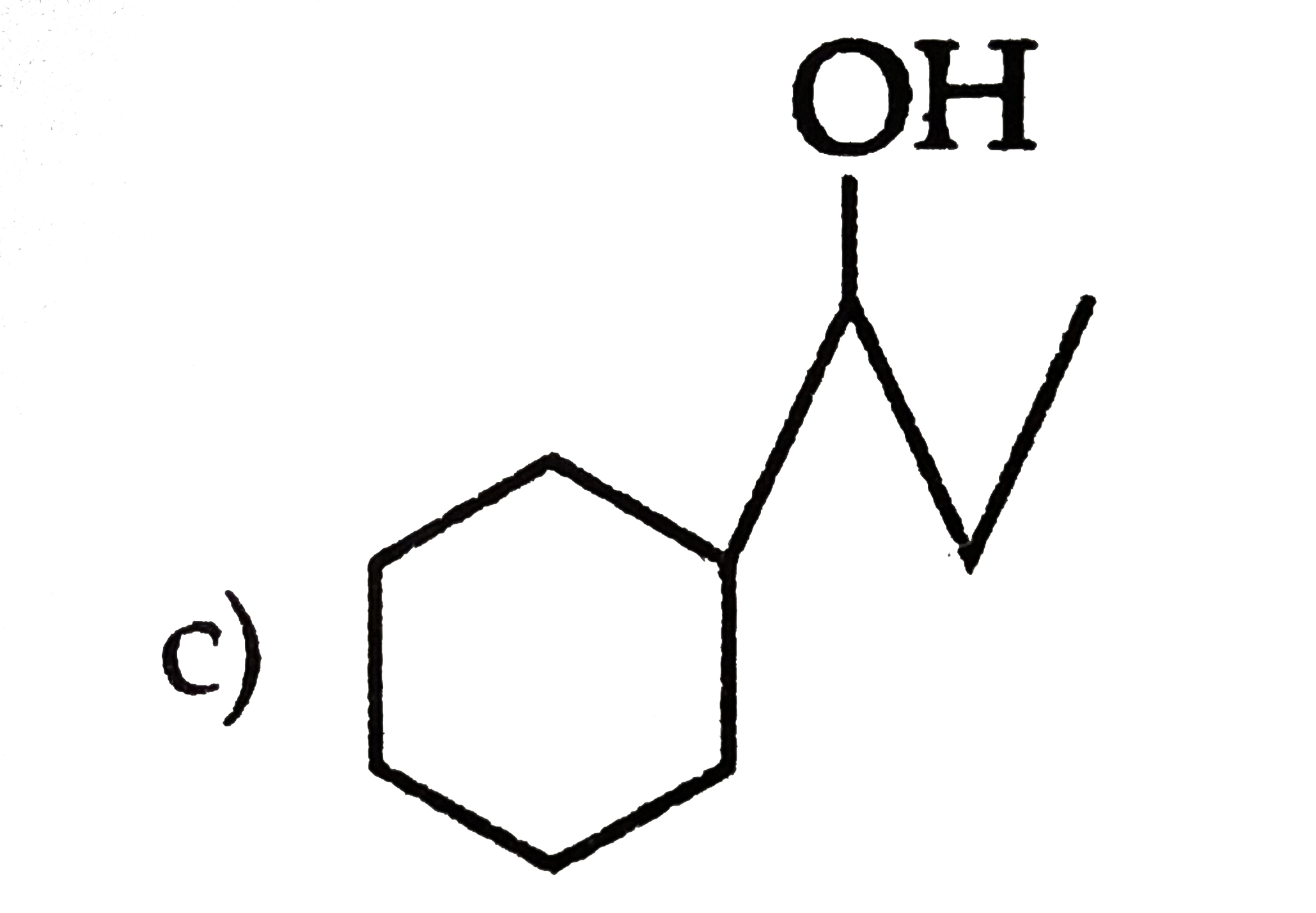
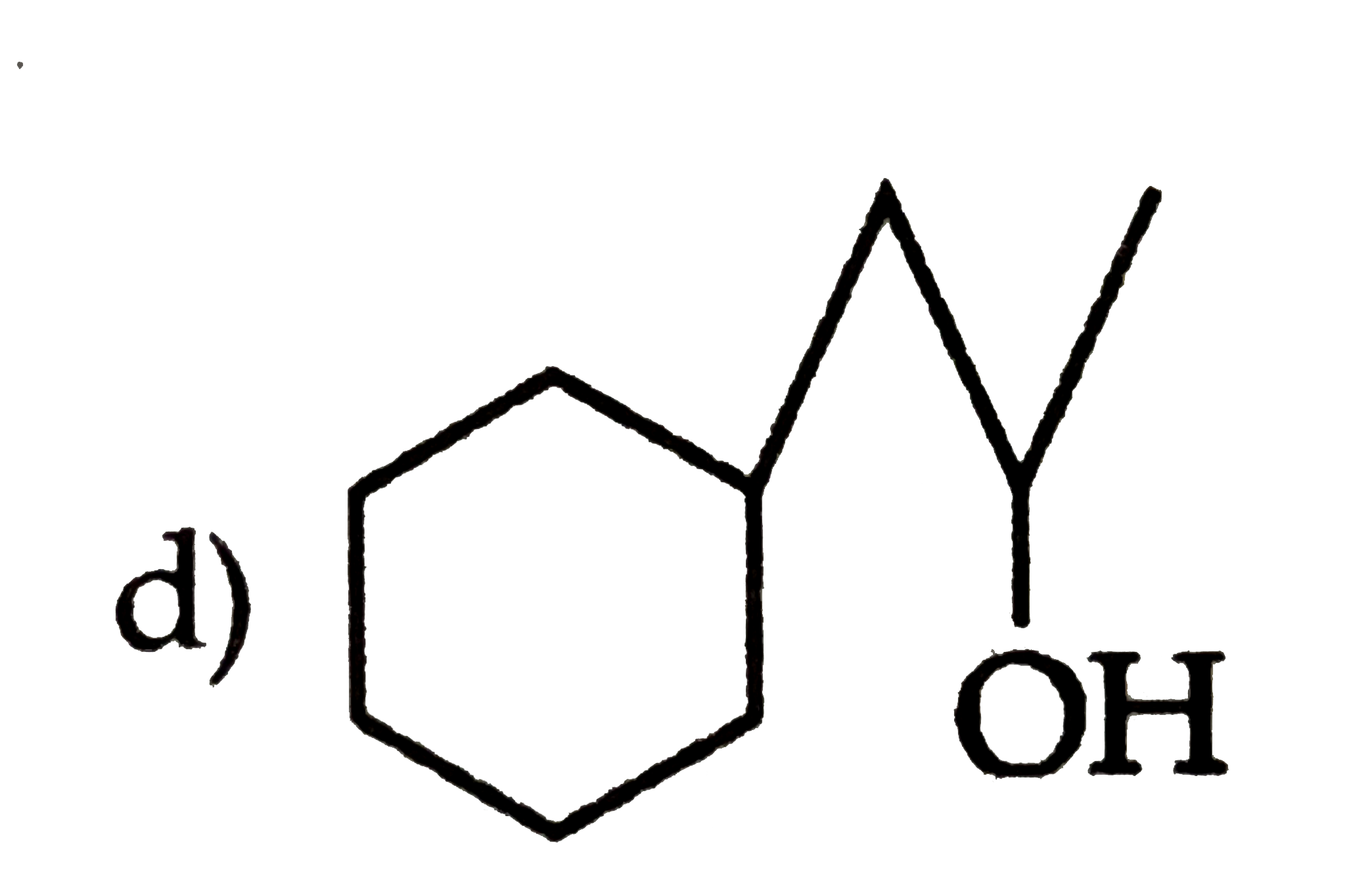
Saved Bookmarks
This section includes 7 InterviewSolutions, each offering curated multiple-choice questions to sharpen your Current Affairs knowledge and support exam preparation. Choose a topic below to get started.
| 2. |
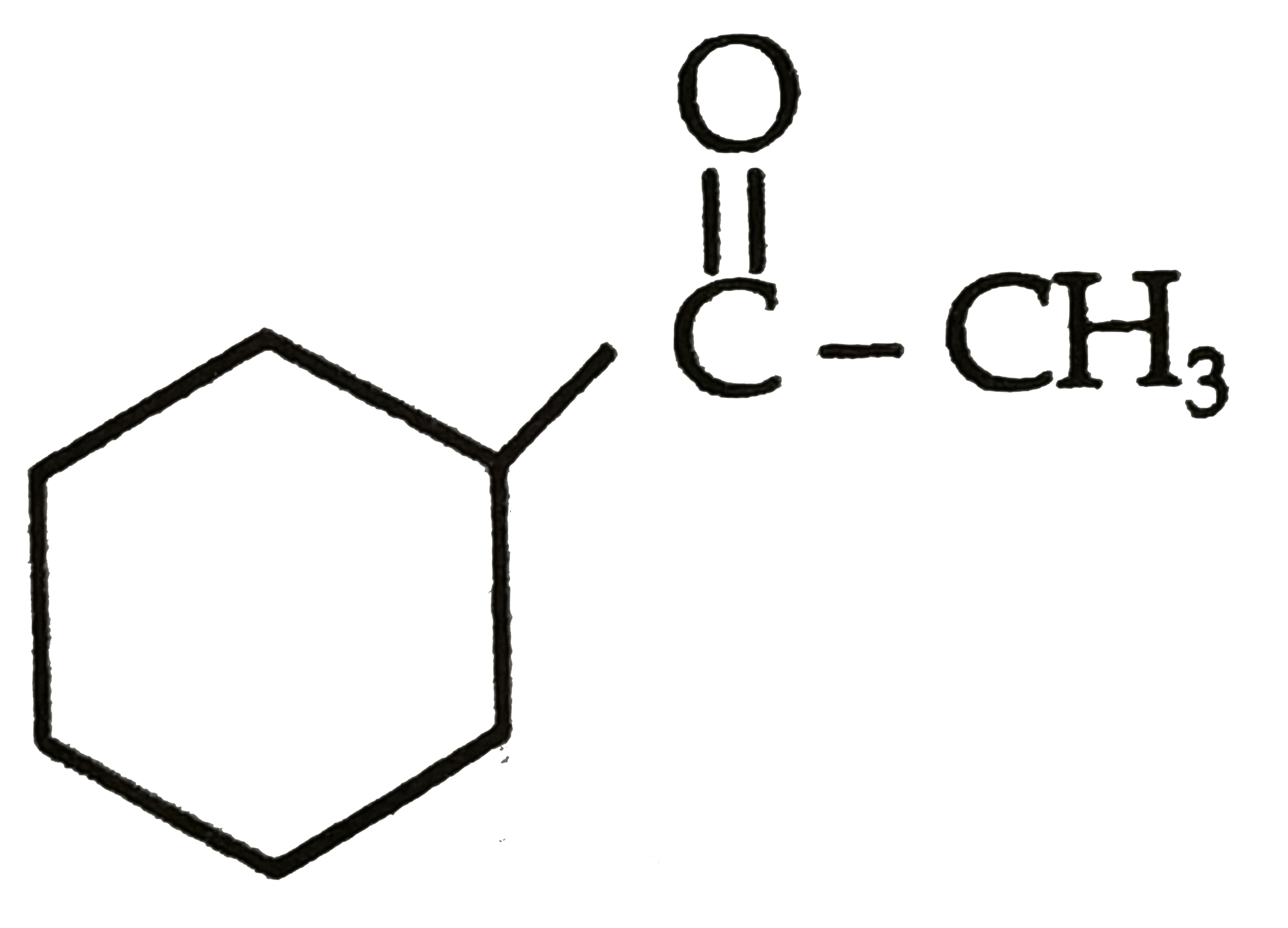
Cyclohexanone is subjected to reduction by NaBH_4 The product formed is : |
|
Answer» CYCLOHEXANE |
|
| 3. |
Cyclohexanol is reacted with Lucas reagent gives |
|
Answer» 1-cyclohexyl CHLOROMETHANE |
|
| 4. |
Cyclohexanol overset(HNO_3)underset([O])toXoverset(HNO_3)underset([O])toY The product Y here is |
|
Answer» Cyclohexanoic ACID 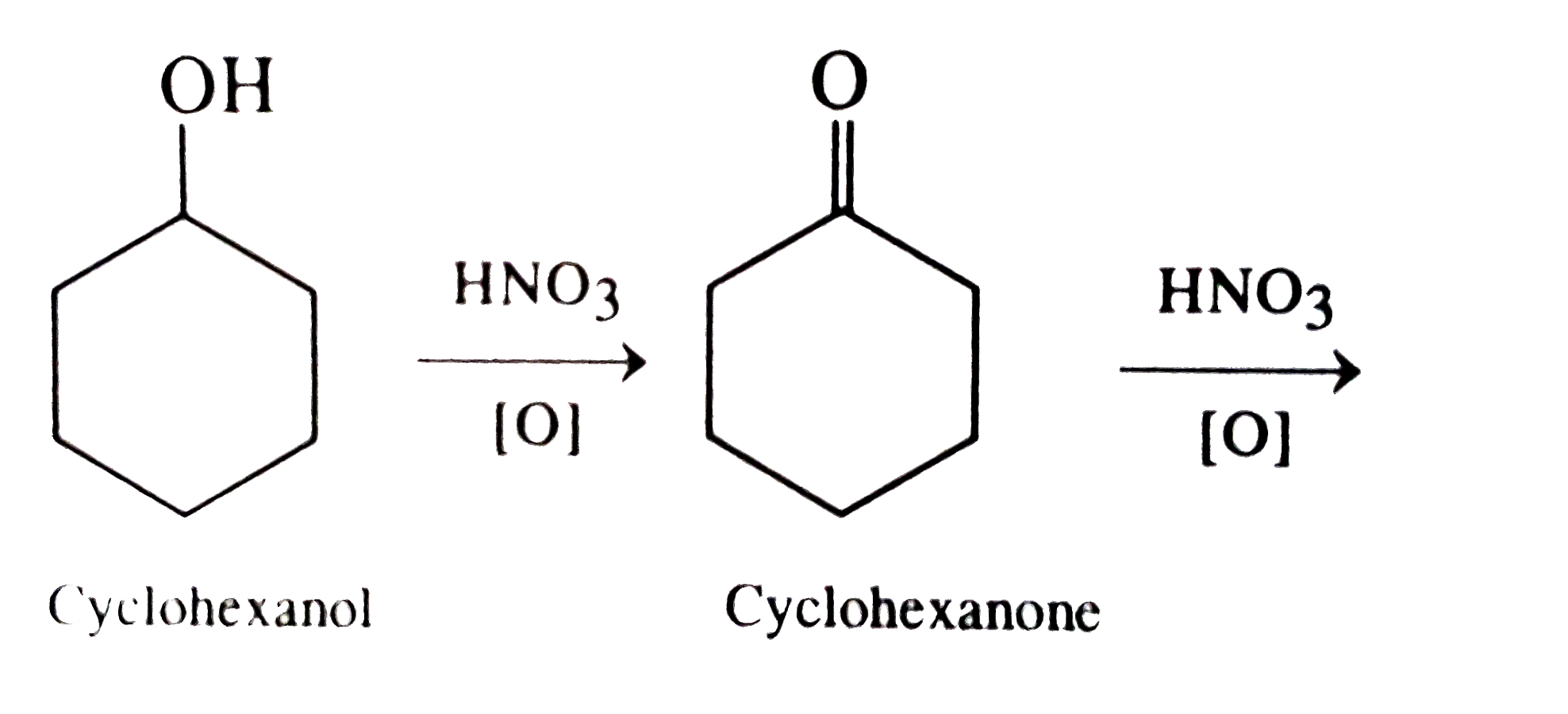
|
|
| 5. |
Cyclohexanol to cyclohexyl chloride |
Answer» SOLUTION :CYCLOHEXANOL to CYCLOHEXYL CHLORIDE : 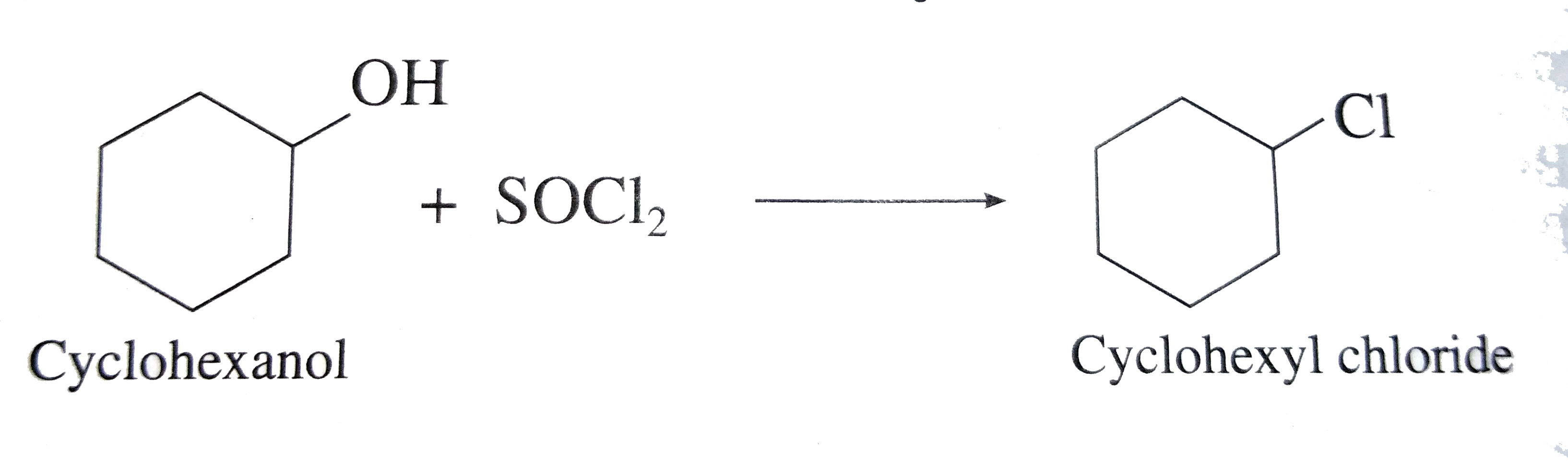
|
|
| 6. |
Cyclohexanol is dehydrated to cyclohexene on heating with conc. H_(2)SO_(4). If the yeild of this reaction is 75% ,how much cyclohexene will be obtained from 100 g of cyclohexanol ? C_(6)H_(12)O overset("conc." H_(2)SO_(4))to C_(2)H_(10) |
|
Answer» |
|
| 7. |
Cyclohexanol is a |
|
Answer» PRIMARY alcohol 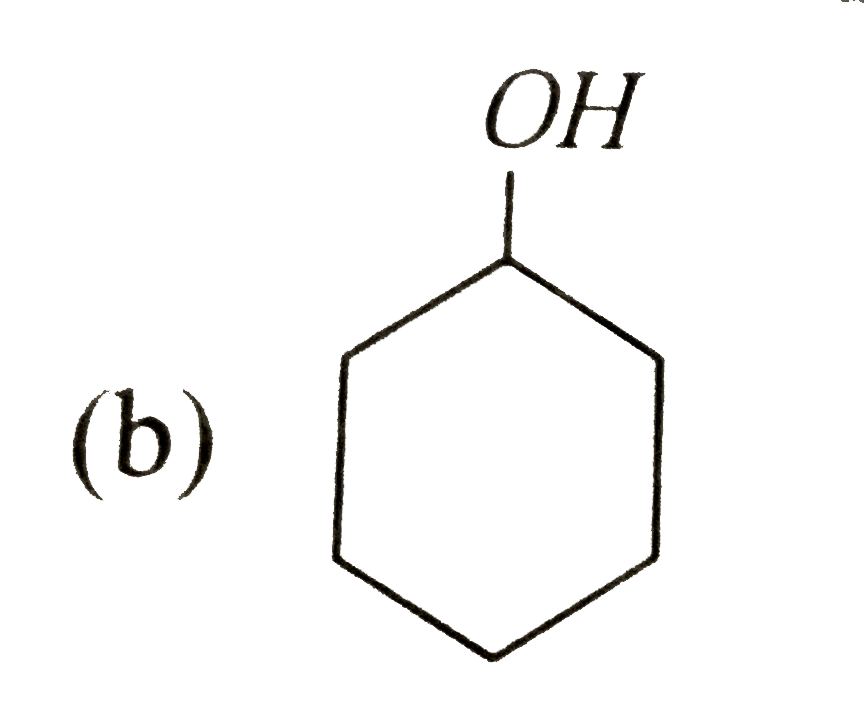 CYCLOHEXANOL is a secondary alcohol because -OH group is LINKED to `2^(@)` carbon. |
|
| 8. |
Cyclohexanol is a : |
|
Answer» Phenol |
|
| 9. |
Cyclohexanol (I), acetic acid (II), 2,4,6-trinitrophenola(III) and phenol(IV) are given. In these the order of decreasing acidic character will be. |
|
Answer» `IIIgtIIgtIVgtI`  Explanation: presence of three `-NO_(2)` groups in o-, p- positions to pheonolic groups (in II) makes phenol strongly acidic because its correspoding CONJUGATE base is HIGHLY stabilised due to RESONANCE. ltbr. Conjugate base of `CH_(2)COOH, II i.e.,CH_(3)COO^(-)` is resonance hybrid of two equivalent structures. The conjugate base of phenol, IV is stabilised due to resonance (note that there all resonancing structures are not equivalent). The conjugate base of cyclohexanol, I does not exhibit resonance, hence not FORMED. |
|
| 10. |
Write chemical reactions of affect the Cyclohexene to hexane-1, 6-dioic acid transformations. |
Answer» SOLUTION :
|
|
| 11. |
Cyclohexane on ozonolysis followed by reaction with zinc dust and water gives compound E, on further treatment with aqueous KOHfollowed by heating yields compound F. The compound F is |
|
Answer»
|
|
| 12. |
Cyclohexane carboxylic acid is treated with Cl_(2) in phosphorus where alpha-halogenation takes place. How many different monochloro derivatives would be formed? |
|
Answer» |
|
| 13. |
Cyclohexane carbaldehyde is reacted with ethyl magnesium halide in the presence of dry ether and product on acid hydrolysis gives |
|
Answer»
|
|
| 15. |
Cyclohexane and ethanol at a particular temperature have vapour presure of 280 mm and 168 mm respectively. If these two solutions having mole fraction value of cyclohexane equal to 0.32 are mixed and the mixture has a total vapour pressure of 376 mm, will the mixture be an ideal solution ? |
|
Answer» SOLUTION :Mole fraction of cyclohexane `=0.32` `:.` mole fraction of ethanol `=1-0.32=0.68` Thus, ,br> `p=280xx0.32+168xx0.68`…………(Eqn.3) `=203.84mm` For the solution to be an ideal ONE, the VAPOUR pressure should be `203.84` but as the given value of vapour pressure is `376mm`, the solution is not ideal |
|
| 16. |
Cyclobutylbromide on treatment with magnesium in dry ether forms organometallic compound (A). The organometallic compound reacts with ethanol give an alcohol (B) after mild acidification. Prolonged treatment of alcohol (B) with equivalent amount of HBr gives 1-bromo-1-methylcyclopentane ( C ). Write structures of (A), (B) and explain how C is obtained by (B). |
Answer» SOLUTION :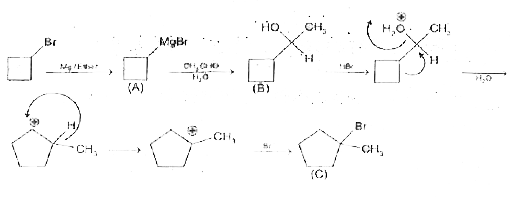
|
|
| 17. |
Cyclobutyl amine is treated with sodiumnitrite and aqueous HCl. The products formed are |
|
Answer»
|
|
| 18. |
Cycloalkane has the formula |
|
Answer» `C_(N)H_(2n+1)` |
|
| 19. |
Cyclic trimer strucutre of SO_(3) contains ________no. of "S = O" bonds |
Answer» 
|
|
| 20. |
Cyclic structure of D-glucose resembles with |
|
Answer» furan |
|
| 21. |
Cyclic Product, At what value of 'n' the formation of six membered ring take place. |
Answer» 
|
|
| 22. |
Cyclic hydrocarbon molecule 'A' has all the carbon and hydrogen in a single plane. All the carbon-carbon bonds are of same length less than 1.54Å, but more than 1.34Å. The C-C bond angle will be |
|
Answer» `109^(@)28'` |
|
| 23. |
Cyclic structure of fructose resembles with |
|
Answer» pyran |
|
| 24. |
Cyclic hydrocarbon molecule A has all the carbon and hydrogen in a simple plane. All the carbon-carbon bonds are of same length and less than 1.54 Å but more than 1.34 Å . C-C-C bond angle will be |
|
Answer» `120^@` |
|
| 25. |
Cyanohydrine of the following compound on hydrolysis give optically active compound. |
|
Answer» `CH_(3) - COCH_(3)` lactic ACID ( optically active acid) |
|
| 26. |
Cyanohydrin of which of the following forms lactic acid? |
|
Answer» HCHO |
|
| 27. |
Cyanohydrin of which compound on hydrolysis will give lactic acid? |
| Answer» Answer :C | |
| 28. |
Cyanogen is 46.2% C and 53.8% N by mass. At a temperature of 25^(@)C and a pressure of 750 mm Hg, 1.0 g of cyanogen gas occupies 0.476 L. Find the formula of cyanogen. |
| Answer» SOLUTION :`C_(2)N_(2)` | |
| 29. |
Cyanohydrin of which compound gives lactic acid on hydrolysis: |
|
Answer» ACETONE |
|
| 30. |
Cyanoform is ………… acid in nature than chloroform. The missing word is |
|
Answer» STRONGER |
|
| 33. |
Cyanides and isocyanides are isomers of the type : |
|
Answer» POSITION isomerism |
|
| 34. |
Cyanide process is used for obtaining |
|
Answer» Cr |
|
| 37. |
Cyanide ion is |
|
Answer» NUCLEOPHILIC |
|
| 38. |
Cyanide ion acts as an ambident nucleophile. From which end it acts as a stronger nucleophile in aqueous medium ? Give reason for your answer. |
| Answer» Solution :It ACTS as a stronger NUCLEOPHILE from the carbon end because it will LEAD to the FORMATION of C- C bond which is more stable (bond between TWO similar atoms) than C-N bond. | |
| 39. |
Cyanide ion acts an ambident nucleophile. From which end it acts as a stronger nucleophile in aqueous medium ? Give reason for you answer. |
Answer» Solution :`:C-=N`: is an ambident nucleophile since it can react either through C or through N. since C-C BOND is stronger than C-N bond, therefore, CYANIDE ION will preferentially attack through carbon to form alkyl cyanides. 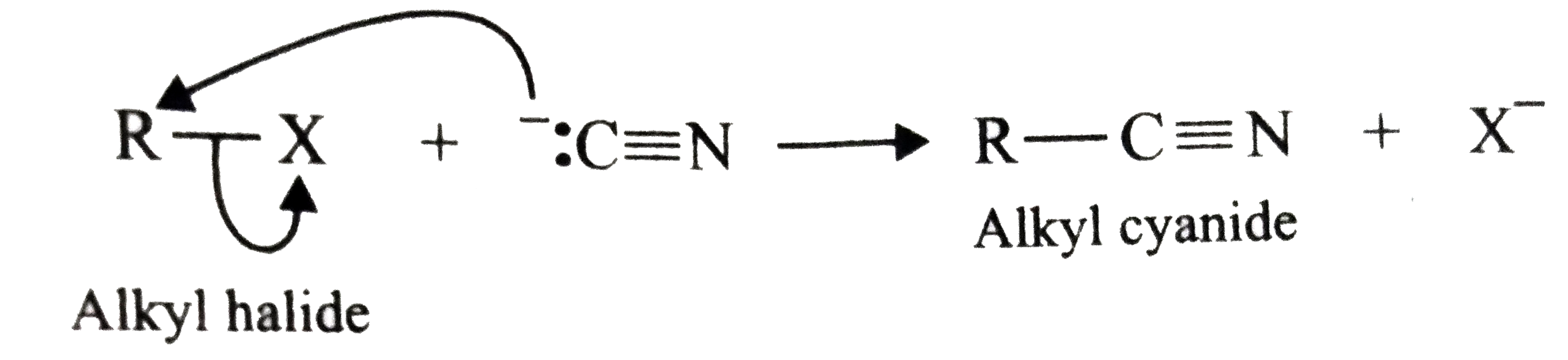
|
|
| 40. |
C_(v) value of He is always 3R/2 but C_(v) value of H_(2)is 3R/2at low temperature and 5R/2 at moderate temperature and more than 5R/2 at higher temperature. Explain in two or three lines. |
| Answer» | |
| 41. |
Cuyolite and fluorspar are mixed with Al_(2)O_(3) during electrolysis for extraction of aluminium to |
|
Answer» increase the MASS of the reaction mixture |
|
| 44. |
CuSO_(4)(aq)overset(H_(2)Suarr)rarrMdarroverset("Excess of KCN")rarrN+O Then final product N and O are respectively. |
|
Answer» `[CU(CN)_(4)]^(3-), (CN)_(2)` |
|
| 45. |
CuSO_(4)(aq) overset(H_(2)S(uarr))(to)M(darr)overset("Excess")underset(KCn)(to)N+O Then final products N and O are respectively. |
|
Answer» `[Cu(CN)_(4)]^(3-), (CN)_(2)` |
|
| 46. |
CuSO_(4).5H_(2)O is blue in colour while CuSO_(4) is colourless. Why ? |
| Answer» Solution :In `CuSO_(4).5 H_(2)O, 4 H_(2)O` molecules are present as ligand. CRYSTAL FIELD splitting occurs and hence d-d transition occurs which gives it BLUE colour. In `CuSO_(4)`, there are no `H_(2)O` molecules present as ligand. No crystal field splitting occurs and hence it has no colour. | |
| 47. |
CuSO_(4).5H_(2)O is blue in colour while CuSO_(4) is colourless, why ? |
| Answer» Solution :In `CuSO_(4).5H_(2)O`, WATER acts as ligand as a result it causes crystal field SPLITTING. Hence d-d TRANSITION is possible in `CuSO_(4).5H_(2)O` and shows colour. In the anhydrous `CuSO_(4)` DUE to the ABSENCE of water (ligand), crystal field splitting is not possible and hence no colour. | |
| 48. |
CuSO_(4) when reacts with KCN forms CuCN which is insoluble in water. It is soluble in excess of KCN due to the formation of the complex. |
|
Answer» `K_(3)[CU(CN)_(4)]` `CuSO_(4) + 2KCN to K_(2)SO_(4) + Cu(CN)_(2)` `2Cu(CN)_(2) to 2CuCN + CN - CN` `CuCN + 3KCN to K_(3)[Cu(CN)_(4)]` |
|
| 49. |
CuSO_4 , solution with excess of KCN gives __________. |
|
Answer» `Cu(CN)_2` |
|