

Saved Bookmarks
This section includes 7 InterviewSolutions, each offering curated multiple-choice questions to sharpen your Current Affairs knowledge and support exam preparation. Choose a topic below to get started.
| 1. |
Consider the following alkyl halides ( 1) (CH_3)_3CBr , (2)CH_3Br , (3)C_2H_5Br , (4)CH_3CHBr CH_3 Arrange these alkyl halides in decreasing order of reactivity in Williamson reaction. |
|
Answer» 1 gt 4 gt 3 gt 2 |
|
| 2. |
Consider the following abbreviations for hydrated alkali ions X=[Li(H_(2)O)_(n)]^(+), Y=[K(H_(2)O)_(n)]^(+), Z=[Cs(H_(2)O)_(n)]^(+) Which is the correct order of size of these hydrated alkali ions |
|
Answer» XgtYgtZ |
|
| 3. |
Consider the followign statements 1. Isotonic solutions have the same molar concentration at a given temperature 2. The molal elevation constant K_b is a characteristic of a solvent, and is independent of the solute added 3. The freezing point of a 0.1 M aqueous AlCl_3 solution. Which of these statements is correct |
|
Answer» 1 and 2 |
|
| 4. |
Consider the floowing reaction: Which of the following is correct combination of major products, correspondingly ? |
|
Answer» `I - a, II - p` |
|
| 5. |
Consider the follow redox reaction and select the correct option (s).2SO_2 O_3 ^(2-)+I_2toS_4O_(6) ^(2-) + 2I^(-) |
|
Answer» `S_2 O_(3)^(2-)`gets reducedto`S_4O_(6)^(2-)` |
|
| 6. |
Consider the first ionization energies of the elements whose electronic configurations correspond to the following. I. [He]2s^(2) 2p^3 II. [He]2s^(2) 2p^4 III. [Ne]3s^(2)3p^(1)[Ar]3d^(10)4p^1 Which of the above have almost the same first ionization energies? |
|
Answer» I and II |
|
| 7. |
Consider the figure given alongside and answer the questions (i) to (vi) given below (i) Give the direction of electron flow. (ii) Is silver plate the anode or cathode ? (iii) What will happen if salt bridge is removed ? (iv) When will the cell stop functioning ? Zinc plate ,, (v) How will concentration of Zn^(2+) ions and Ag^(+) ions be affected when the cell functions ? (vi) How will the concentration of Zn^(2+) ions and Ag^(+) ions be affected after the cell becomes 'dead' ? |
|
Answer» Solution : (i) Electrons move from Zn to Ag. (ii) Ag is the cathode. (iii) CELL will stop functioning. (iv) When `E_("cell")=0` (v) Concentration of `Zn^(2+)` ions will increase and concentration of `Ag^(+)` ions will DECREASE. (vi) When `E_("cell")=0` equilibrium is reached and concentration of `Zn^(2+)` ions and `Ag^(+)` ions will not change. |
|
| 8. |
Consider the figure below and answer the following questions : (i) Cell 'A' has E_("cell") = 2V and Cell 'B' has E_("cell") = 1.1 V which of the two cells 'A' or 'B' will act as an electrolytic cell. Which electrode reaction will occur in this cell? (ii) If cell 'A' has E_("cell") = 0.5 V and cell 'B' has E_("cell") =1.1 V then what will be the reaction at anode and cathode? |
|
Answer» Solution :(i) Cell .B. will act as electrolytic cell as it has lower emf. The electrode reactions will be : `ZN^(2+) + 2e^(-) to Zn` at cathode `Cu to Cu^(2+) + 2e^(-)` at ANODE. (ii) Now cell .B. acts as GALVANIC cell as it has higher emf and will push electrons into cell .A.. The electrode reaction will be : `{:("At anode", Zn to Zn^(2+) + 2e^(-)),("At cathode", Cu^(2+) + 2e^(-) to Cu):}` |
|
| 9. |
Consider the figure below and answer the following questions : (i) Cell 'A' has E_(cell)=2" V " and Cell B has E_(cell) =1.1" V " which of the two cells 'A' or 'B' will act as an electrolytic cell. Which electrode reactions will occur in this cell ? (ii) If cell 'A' has E_(cell)=0.5" V " and cell 'B' has E_(cell) =1.1" V " then what will be the reactions at anode and cathode ? |
|
Answer» Solution :(i) SINCE the cell (B) has low e.m.f. , it will act as electrolytic cell. In the cell, the ELECTRODE reaction that takes PLACE is : `Zn^(2+)(AQ)+2e^(-) to Zn(s)""("At cathode")` `Cuoverset((aq)) rarr Cu^(2+)(aq)+2e^(-)` (ii) The data shows that the cell 'B' will act as electrochemical cell since its `E_(cell)`. (1.1V) is mre than that of cell 'A' (0.5V).The electrode reactions which TAKE place are : `Zn(s) to Zn^(2+)(aq)+2e^(-)"" ("At anode")` `Cu^(2+)(aq)+2e^(-) to Cu(s)"" ("At cathode")` |
|
| 10. |
Consider the figure and mark the correct option. |
|
Answer» Water will move from SIDE (A) to side (B) id a PRESSURE lower osmitic pressure is applied on piston(B) Thus in this case, water will move form side (B) to side (A) it a pressure greater than osmotic pressure is applied on piston (B). |
|
| 11. |
Consider the Figure and mark the correct option. |
|
Answer» WATER will move from side (A) to side (B) if a presure LOWER than OSMOTIC pressure is APPLIED on piston (B). |
|
| 12. |
Consider the figure and answer the questions (i) to (vi) gives below. (i) Redraw the diagram to show the direction of electron flow. (ii) Is silver plate the anode or cathode ? (iii) What will happen if salt bridge is removed ? (iv) When will the cell stop functioning ? (v) How will concentration of Zn^(2+) ions and Ag^(+) ion be affected when the cell functions ? (vi) How will the concentration of Zn^(2+) ions and Ag^(+) ions be affected after the cell becomes 'dead' ? |
Answer» Solution :(i) Electrons move from ZN to Ag.  (II) It acts as cathode. (ii) Cell will stop functioning. (iv) When equilibrium is attained i.E., `E_(cell)=0`. (v) CONCENTRATION of `Zn^(2+)` will increase and `Ag^(+)` ions will decrease. (vi) When `E_(cell)=0` (equilibrium is REACHED), concentration of `Zn^(2+)` ions and `Ag^(+)` ions will not change. |
|
| 13. |
Considerthe figure and answer the questions (i) to (vi) given below : (i) Redraw the diagram to show the direction of electron flow. (ii) Is silver plate the anode or cathode ? (iii) What will happen if salt bridge is removed ? (iv) When will the cell stop functioning ? (v) How will concentration of Zn^(2+) ions and Ag^(+) ions be affected when the cell functions ? How will the concentration of Zn^(2+) ions and Ag^(+) ions be affected after the cell becomes 'dead' ? |
|
Answer» Solution :(i) The flow of eectrons takes place from zinc plate towards COPPERPLATE in the outer circuit. (ii) Silver plate acts as cathode. (iii) Cell will stop working because the inner circuit does not exist any more. (iv) When `E_(cell)`=0 (v) Concentration of `Zn^(2+)`(AQ) ions will gradually decrease while that of `Ag^(+)`(`mu`aq) ions will increase. (vi) When the cell becomes dead (`E_(cell)`=0), the concentration of `Zn^(2+)` (aq) and `Ag^(+)` (aq) ions will not change any more. 
|
|
| 14. |
Considerthefigureandmark the correctoption . |
|
Answer» water will move from SIDE (A) to side (B) if a PRESSURE lower than OSMOTIC pressure is applied on piston (B) |
|
| 15. |
Consider the figure and answer the following questions. (i) Cell 'A' has E_(cell)2V and cell 'B' has E_(cell)=1.1V which of the two cells 'A' or 'B' will act as an electrolytic cell. Which electrode reactions will occur in this cell ? (ii) If cell 'A' has E_(cell)=0.5Vand cell 'B' has E_(cell)=1.1V then what will be the reaction at anode and cathode ? |
|
Answer» Solution :(i) Cell .B. will act as electrolytic cell as it has lower EMF `therefore` The electrode reactions will be: Reduction at cathode : `Zn^(2+)+2E^(-) to Zn` Oxidation at anode : `CU to Cu^(2+) +2e^(-)` (ii) Now cell .B. ACTS as galvanic cell as it has higher emf and will push ELECTRONS into cell .A.. The electrode reaction will be : At anode : `Zn to Zn^(2+) + 2e^(-)` At cahotde : `CutoCu^(2+)+2e^(-)` |
|
| 16. |
Consider the figure and answer the following question. (i) Cell 'A' h as E_("cell")=2V and Cell 'B' has E_("cell")=1.1V which of the two cell 'A' or 'B' will act as an electrolytic cell. Which electrode reactions will occur in this cell? (ii) If cell 'A' has E_("cell")= 0.5V and cell 'B' has E_("cell")=1.1V then what will be the reactions at anode and cathode? |
|
Answer» SOLUTION : (i) Cell 'B' act as electrolytic cell due to its lesser value of EMF. Theelectrode REACTIONS will be Atcathode `Zn^(2+)+2e^(-)rarrZn` At anode `CurarrCu^(2+)+2e^(-)` (ii) If cell 'B' are higher emf, it acts as galvanic cell. Now it will push electrons into cell 'A' In this CASE, the reactions will be `ZnrarrZn^(2+)+2e^(-)` (At anode) `Cu^(2+)+2e^(-)rarrCu`(At cathode) |
|
| 17. |
Consider the expression Delta G= - RT " In " K_(p)+RT " In " Q_(p) and select the correct statement at equilibrium where Q_(p) and K_(p) term refer to reaction quotient and eq uilibrium constant at constant pressure respectively. |
|
Answer» `Delta G= 0, Q_(p) GT K_(p)`the EQUILIBRIUM reaction will SHIFT from left to right Then `Delta G^(@)= - RT " In " Q_(p)= - RT " In" K_(p)` |
|
| 18. |
Consider the Fig. and mark the correct option. |
|
Answer» WATER will move from SIDE (A) to side (B) if a pressure lower than OSMOTIC pressure is applied on PISTON (B). |
|
| 19. |
Consider the figure and mark the correct option. |
|
Answer» Water will move form side (A) to side (B) if a PRESSURE lower than OSMOTIC pressure is APPLIED on poston (B). |
|
| 20. |
Consider the equilibrium SO_(3) (g) hArr SO_(2) (g) + (1)/(2) O_(2) (g) ""K_(C ) = 1 What should be the initial concentration so that at equilibrium [SO_(3)] =[O_(2)] |
|
Answer» `(4)/(3) M` GIVEN `[SO_(3)] = (O_(2)]` `C_(0) - x = (x)/(2)` `(3x)/(2) = C_(0) RARR x = (2C_(0))/(3)` at equilibrium `[O_(2)] = (x)/(2) = (C_(0))/(3), [SO_(2)] = x = (2C_(0))/(3), [SO_(3)] = C_(0) - x` `[SO_(3)] = C_(0) - (2C_(0))/(3)` `[SO_(3)] = (C_(0))/(3)` `K_(C) = 1 = ([SO_(2)] [O_(2)]^(1//2))/([SO_(3)]) = ((2C_(0))/(3) xx ((C_(0))/(3))^(1//2))/((C_(0))/(3))` `1 = 4 (C_(0))/(3)` `C_(0) = (3)/(4) M` |
|
| 21. |
Consider the equilibrium HgO(s)+4I^(-)(aq)+H_(2)O(l)hArrHg I_(4)^(2-)(aq)+2OH^(-) (aq), which changes will decrease the equilibrium concentration of HgI_(4)^(2-) |
|
Answer» Addition of 0.1 M HI (aq) |
|
| 22. |
Consider the electronic configuration: 1s^(2)2s^(2)2p_(x)^(2) It violates |
|
Answer» Aufbalu principle |
|
| 23. |
Consider the diamagnetic complex [M(en)_(3)](ClO_(4))_(30, Where M is a first row transition metal except Sc. Find the value of x+y of M in above complex. If x=oxidation state y= number of d electrons present |
|
Answer» |
|
| 24. |
Consider the DeltaG_(f)^(@) (kJ/mol) for the following oxides. Which oxide can be most easily decomposed to form the metal and oxygen gas? |
|
Answer» `ZNO (DELTAG^(@)=-318.4 , DELTAH^(@)=-348.3)` |
|
| 25. |
Consider the decomposition reaction : 2H_2O_2 overset(OH^(-)//I^-)to 2H_2O + O_2 This reaction takes place in two steps as given below : Step 1. H_2O_2 + I^(-) to H_2O + IO^(-) (slow) Step 2. H_2O_2 +IO^(-) to H_2O + I^(-) + O_2 (fast) Determine rate law expression. |
| Answer» SOLUTION :Rate = `K[H_2O_2][I^(-)]` because SECOND step is rate determining step. | |
| 26. |
Consider the decomposition reaction : 2H_2O_2 overset(OH^(-)//I^-)to 2H_2O + O_2 This reaction takes place in two steps as given below : Step 1. H_2O_2 + I^(-) to H_2O + IO^(-) (slow) Step 2. H_2O_2 +IO^(-) to H_2O + I^(-) + O_2 (fast) Determine the order of reaction. |
| Answer» SOLUTION :ORDER = 1 + 1 = 2 | |
| 27. |
Consider the decomposition of N_(2)O_(5) as N_(2)O_(5) to 2" NO"_(2)+(1)/(2)O_(2) The rate of reaction is given by -(d[N_(2)O_(5)])/(DT)=(1)/(2)(d[NO_(2)])/(dt)=2(d[O_(2)])/(dt)=k_(1)[N_(2)O_(5)] Therefore, -(d[N_(2)O_(5)])/(dt)=k_(1)[N_(2)O_(5)] +(d[NO_(2)])/(dt)=2k_(1)[N_(2)O_(5)]=k_(1)'[N_(2)O_(5)] +(d[O_(2)])/(dt)=(1)/(2)k_(1)[N_(2)O_(5)]=k_(1)''[N_(2)O_(5)] Choose the correct option |
|
Answer» `k_(1)=k_(1)'=k_(1)''` `k_(1)[N_(2)O_(5)] = (1)/(2) k_(1)'[N_(2)O_(5)] = 2k_(1)''[N_(2)O_(5)]` or `k_(1) = (1)/(2)k_(1)' = 2k_(1)'' or 2k_(1) = k_(1)' = 4k_(1)''` |
|
| 28. |
Consider the decomposition of N_2O_(5(g)) to form NO_(2(g)) and O_(2(g)) . At a particular instant N_2O_5 disappears at a rate of 2.5xx10^(-2) "mol dm"^(-3)s^(-1) . At what rates are NO_2 and O_2 formed ? What is the rate of the reaction ? |
|
Answer» Solution :`2N_2O_5(g)rarr4NO_(2(g))+O_2(g))` from the stoichiometry of the REACTION of the reaction. `-1/2(d[N_2O_5])/(dt)=1/4(d[NO_2])/(dt)=-(d[NO_2])/(dt)=2(-d[N_2O_5])/(dt)` RATE of disappearance of `N_2O_(5(g))` is `2.5xx10^(-2) "mol dm"^(-3)s^(-1)` `:.` The rate of formation of `NO_2` at this TEMPERATURE is `2xx2.5xx10^(-2)=5xx10^(-2)"mol dm"^(3)s^(-1)` . `-1/2(d[N_2O_5])/(dt)=-(d[O_2])/(dt)` `:. (d[O_2])/(dt) = 1/2xx2.5xx10^(-2) "mol dm "^(-3)s^(-1)=1.25xx10^(-2)" mol dm "^(-3)s^(-1)` |
|
| 29. |
Consider the decomposition of hydrogen peroxide in the alkaline medium which is catalysed by iodide ions. This reaction takes place in two steps as given below step-1 H_(2)O_(2) + I^(-1) to H_(2)O + IO^(-)(Slow) Step II H_(2)O_(2) + IO^(-) to H_(2)O + I^(-) +O_(2) (fast) a) Write the rate law expression and determine the order of reactan w.r.t H_(2)O_(2) b) What is the molecularity of each individual step? |
|
Answer» SOLUTION :a) Rate law expression: Rate = `k[H_(2)O_(2)][I^(-)]` Order of REACTION w.r.t `H_(2)O_(2)=1` B) Molecularities of both step-I and step-II are two. |
|
| 30. |
Consider the decomposition of hydrogen peroxide in alkaline medium which is catalysed by iodide ions. 2H_(2)O_(2) overset(OH^(-)) to 2H_(2)O+O_(2) The This reaction takes place in two steps as given below: Step I H_(2)O_(2)+I^(-) to H_(2)O+IO^(-) (slow) Step IIH_(2)O_(2) +IO^(-) to H_(2)O +I^(-) +O_(2) (fast) (a) Writethe rate expression and determine the order of reaction wrt H_(2)O_(2). (b) What is the molecularity of each individual step? |
|
Answer» Solution :(a)Rate `=k[H_(2)O][IO^(-)]` As, there is one molecule of `H_(2)O_(2)` involved in the SLOW step, ORDER of the reaction WRT `H_(2)O_(2)`is 1. (B) Molecularity of step `I=2`. Molecularity of step `II =2.` |
|
| 31. |
Consider the decomposition of hydrogen peroxide in alkaline medium which is catalysed by iodide ions : 2" H"_(2)"O"_(2)overset("OH"^(-))to2" H"_(2)"O"+"O"_(2) This reaction takes place in two steps as given below : Step-I. "H"_(2)"O"_(2)+I^(-)to"H"_(2)"O"+" IO"^(-)("slow") Step-II."H"_(2)"O"_(2)+"IO"^(-)to"H"_(2)"O"+I^(-)+"O"_(2)("fast") (a) Write the rate law expression and determine the order of reaction w.r.t. "H"_(2)"O"_(2). (b) What is the molecularity of each individual step ? |
|
Answer» |
|
| 32. |
Consider the decomposition of hydrogen peroxide in alkaline medium which is catalysed by iodide ions. 2H_2O_2 overset(OH^(-))to 2H_2O + O_2 This reaction takes place in two steps as given below : Step I H_2O_2 + I^(-) to H_2O + IO^(-)(slow ) Step II H_2O_2 + IO^(-) to H_2O + I^(-) + O_2 ( fast ) (a) Write the rate law expression and determine the order of reaction w.r.t. H_2O_2. (b)What is the molecularity of each individualstep ? |
|
Answer» Solution :(a) Rate `=K[H_2O][IO^(-)]` As , there is ONE moleculeof `H_2O_2` involved in the slow step, order of the reaction w.r.t. `H_2O_2` is 1 . (B) Molecularityof step I = 2 . Molecularity of step II =2 . |
|
| 33. |
Consider the data given below (AAK_MCP_16_NEET_CHE_E16_019_Q01.png" width="80%"> On the basis of the given data, arrange the gases in their increasing |
|
Answer» AltBltCltD |
|
| 34. |
Consider the coordination compound [Cr(NH_3)_5CO_3]Cl.Write the ionisation isomer of the above compound. |
| Answer» SOLUTION :The IONISATION ISOMER is `[CR(NH_3)_5Cl]CO_3` | |
| 35. |
Consider the coordination compound [Cr(NH_3)_5CO_3]Cl.Write the IUPAC name of the above coordination compound. |
| Answer» SOLUTION :Pentammine CARBONATO CHROMIUM(III) CHLORIDE | |
| 36. |
Consider the coordination compound [Cr(NH_3)_5CO_3]Cl.whether the ligands present in the above compound are ambidentate ligands?Why? |
| Answer» Solution :No both AMMONIA and carbonate IONS are not ambidentate because they have only one DONOR SITE | |
| 37. |
Consider the coordination compound [Cr(NH_3)_5CO_3]Cl.Name the ligands present in the above compound. |
| Answer» SOLUTION :AMMONIA CARBONATE ION | |
| 38. |
Consider the coordination compound [Cr(NH_3)_5CO_3]Cl.Name the central metal ion of the above compound. |
| Answer» SOLUTION :CHROMIUM(Cr^+3) | |
| 39. |
Consider the coordination compound [Co(NH_3)_5SO_4]Br.Which type of structural isomerisms is exhibited by the above coordination compound? |
| Answer» SOLUTION :IONISATION ISOMERISM | |
| 40. |
Consider the coordination compound [Co(NH_3)_5SO_4]Br.Write the IUPAC name of the above coordination compound. |
| Answer» SOLUTION :Pentaamminesulphatocobalt(III0 BROMIDE | |
| 41. |
Consider the coordination compound [Co(NH_3)_5SO_4]Br.What is the primary valance and secondary valance of the central metal cobalt in the above coordination compound? |
| Answer» Solution :Primary VALENCE of CO^(+3)(i.e,OXIDATION state) secondary valence of Co=6(i.e.coordination NUMBER) | |
| 42. |
Consider the coordination compound, [Co(NH_(3))_(5)SO_(4)]Br (i) Write IUPAC name of the above coordinationcompound (ii) What is the primary valence and secondary valence of the central metal, cobalt, in the above coordination compound? (iii) Which type of structural isomerism is exhibited by theabove coordination compound ? |
| Answer» Solution :(i) pentaamminesulphatocobalt (III) BROMIDE (ii) Primary valence = +3, SECONDARY valence =6 (iii) Ionization isomerism] | |
| 43. |
Consider the coordination compound [Co(NH_3)_5Cl]Cl_2 write the name of the isomerism exhibited by the complex [Pt(NH_3)_2Cl_2] represent the possible isomers |
| Answer» SOLUTION :GEOMETRICAL ISOMERISM | |
| 44. |
Consider the compounds Pick up the correct statement/s |
|
Answer» II is more BASIC than I and III |
|
| 45. |
Consider the coordination compound [Co(NH_3)_5Cl]Cl_2 write the IUPAC name of the coordination compound. |
| Answer» SOLUTION :Pentaamminechloridocobalt(III) CHLORIDE | |
| 46. |
Consider the coordination compound [Co(NH_3)_5Cl]Cl_2 what is the primary valence and secondary valence of the central metal ion in the above co ordination compound. |
| Answer» SOLUTION :PRIMARY VALENCY:+3,SECONDARY valency:6 | |
| 47. |
Consider the compounds given below: (P) BiCl_(3) (Q) SbCl_(3) (R ) VCl_(5) (S) AlCl_(3) Which would form oxo ion of MO^(+) type when subjected to hydrolysis? |
|
Answer» <P>P,Q,R only |
|
| 48. |
Consider the compound on left column and match with reactions from right column by which they can be prepared: |
|
Answer» |
|
| 49. |
Consider the complexes (P) [Fe(Cl)(F)(CN)(H_(2)O)(en)] (Q) [MoCl_(2)F_(2)(gly)]^(2-) these are having number for optically active isomers a and b respectively then a-b is : |
|
Answer» |
|
| 50. |
Consider the complex [Pt(S_(5))_(3)]^(2-). If x, y and z are the number of chelates, number of optically active isomers and number of geometrical iosmers respectively, find the value of (x+y+z): |
Answer» 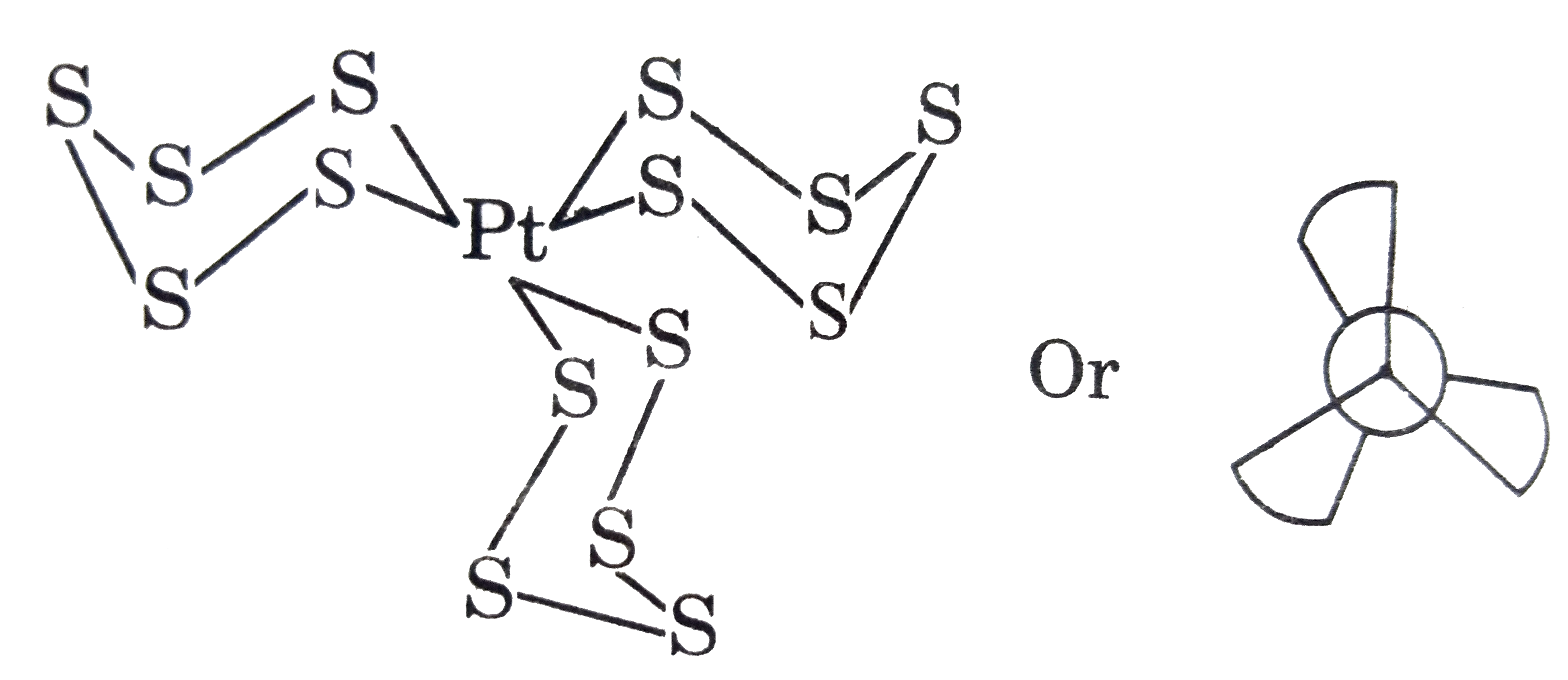 NUMBER of chelates =3 Number of OPTICALLY active =2(Fnantiomers) Number of geometrical isomers=0 3+2+0=5 |
|

