

Saved Bookmarks
This section includes 7 InterviewSolutions, each offering curated multiple-choice questions to sharpen your Current Affairs knowledge and support exam preparation. Choose a topic below to get started.
| 1. |
Compared to meta and para isomers, o-nitrophenol has |
|
Answer» lower solubility in water |
|
| 2. |
Compared to mass of lightest nucleus the mass of an electron is only: |
|
Answer» `1/80` |
|
| 3. |
Compare the structural shapes of the following species : SF_4 and SF_6 . |
Answer» SOLUTION :STRUCTURAL SHAPES of `SF_4 and SF_6` are GIVEN below : 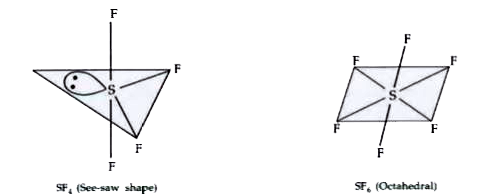
|
|
| 4. |
Compare the strength of mono, di, trichloro acetic acid. |
|
Answer» SOLUTION :`C Cl_(3)COOHgtCHCl_(2)COOHgtCH_(2)ClCOOHgtCH_(3)COOH` CHLORINE is the ELECTRON withdrawing group, it increases the acidic strength by -I effect. |
|
| 5. |
Compare the stability of Ni^(4+)and Pt^(4+)from their ionisation enthalpy values. {:(IE,Ni,Pt),(I,737,864),(II,1753,1791),(III,3395,2800),(IV,5297,4150):} |
|
Answer» Solution :(i) `Ni^(4+)I.E.=737+1753+3395+5297=11182"kJ mol"^(-1)` (ii) `PT^(4+)I.E. =864+1791+2800+4150=9605 "kJ mol"^(-1)` `Pt^(4+)`compounds are stable than `Ni^(4+)` compounds because the ENERGY needed to remove 4 electrons in Pt is LESS than that of Ni. |
|
| 6. |
Compare the stability of Ni^(4+) and Pr^(4+) from their ionisation enthalpy values. |
| Answer» SOLUTION :`PT^(4+)` compounds are stable than `Ni^(4+)` compounds because the energy needed to REMOVE 4 electrons in Pt is less than that of Ni | |
| 7. |
Compare the stability of (+2) oxidation state for the elements of the first transition series. |
|
Answer» Solution :The most common oxidation state of elments in FIRST transition series is (+2). The (+2) oxidation state arises due to participation of 4s ELECTRONS. From Sc to MN, the tendency to SHOW the higher oxidation state increases and then decreases as d-electrons START pairing. Thus in a series, TI(II) is less stable than Ti(IV). Sc(II), however does not exist, while zinc exists only as Zn(II) |
|
| 8. |
Compare the stability of +2 oxidation state for the elements of the first transition series. |
| Answer» Solution :The DECREASING negative electrode potentials of `M^(2+)//M` in the first transition series (See "CHAPTER At A GLANCE" Point 12) shows that in general, the stability of +2 oxidation state decreases from left to right (the exceptions being MN and Zn). The decrease in the negative electrode potentials is due to increase in the sum `IE_(1)+IE_(2)`. The GREATER stability of +2 state for Mn is due to half-filled d-subshell `(d^(5))` in `Mn^(2+)` and that of Zn is due to completely filled of subshell `(d^(10))` in `Zn^(2+)`. | |
| 9. |
Compare the reduction potentials of Mn^(3+) // Mn^(2+) and Fe^(3+) // Fe^(2+). |
|
Answer» SOLUTION :`Mn^(3+)+ e^(-) to Mn^(2+)E^(0)= +1.51V` `Fe^(3+)+ e^(-)E^(0)= +0.77V` (ii) The high reduction potential of `Mn^(3+) // Mn^(2+)` INDICATES `Mn^(2+)` is more stable than `Mn^(3+)` For `Fe^(3+) // Fe^(2+)`the reduction potential is 0.77V, this low VALUE indicates that both `Fe^(3+)` and `Fe^(2+)`can exist under normal conditions, (iii) The drop from Mn to Fe is due to the electronic structure of the ions concerned. `Mn^(3+)` has `3d^(5)` CONFIGURATION while that of `Mn^(2+)` is `3d^(5)`. The extra stability associated with a half filled d sub-shell MAKES the reduction of `Mn^(3+)` very feasible. |
|
| 10. |
Compare the relative stability of +2 oxidation states in aqueous solutions for the metals having in their atoms the outer electron configurations, 3d^(3) 4s^(2), 3d^(6) 4s^(2) and 3d^(5) 4s^(2). |
|
Answer» SOLUTION :The relative stability of +2 OXIDATION states for the metals is given below: `Mn^(2+)(3d^(5))gt V^(2+)(3d^(3))gt Fe^(2+)(3d^(6))` `3d^(5)4s^(2)gt 3d^(3)4s^(2)gt 3d^(6)4s^(2)` It is because `Mn^(2+)` has half-filled d-orbitals, therefore it is more STABLE. `Fe^(2+)` does not have half-filled d-orbitals. `V^(2+)` is more stable than `Fe^(2+)` because it has `t_(2G)` orbitals which is half-filled and thus more stable. |
|
| 11. |
Arrange the following compounds in increasing order of their reactivity in nucleophilic addition reactions. Benzaldehyde , p-Toualdehyde, p-Nitrobenzaldehyde , Acetophenone. |
| Answer» Solution :Order of reactivity: acetophenone `lt` p-tolualdehyde `lt` benzaldehyde `lt` p-nitrobenzaldehyde. Due to hyperconjugation, methyl GROUP in p-tolualdehyde is ELECTRON releasing because of which the positive charge on carbonyl carbon decreases. Due to resonance effect (electron withdrawing effect of nitro group) in p-nitrobenzaldehyde, the positive charge on carbonyl carbon increases. GREATER the positive charge on carbonyl carbon, more is the reactivity.Further, it may be noted that ketones are less reactive than ALDEHYDES. | |
| 12. |
Compare the reactivity order of benzaldehyde, p -tolualdehyde and p - nitrobenzaldehyde. |
| Answer» Solution :Order of reactivity p - tolualdehyde `LT` benzaldehyde `lt` p - NITROBENZALDEHYDE. DUE to hyperconjugation, methyl group in - tolualdchyde is electron releasing because of which the positive charge on carbonyl CARBON decreases. Due to resonance EFFECT (electron withdrawing effect of nitro group ) in p - nitrobenzaldehyde, the positive charge on carbonyl carbon increases . Greater the positive charge on carbonyl carbon. more is the reactivity. | |
| 13. |
Compare the reactivity of benzaldehyde and ethanal towards nucleophilicaddition reacions. Write cross aldol condensation product between benzaldehyde and ethanal. |
Answer» Solution :the carbon atom of the CARBONYL group of benzaldehude is less eletrophilic than carbon atom of the carbonyl group PRESENT in ETHANAL . Thepolarity of the CARBONY group is reduces in benzaldehyde due to resonance HENCE less reactive than ethanal . 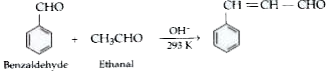
|
|
| 14. |
Compare the rate of reaction:- |
| Answer» Answer :A | |
| 15. |
Compare the pysical properties (mu,b.p, m.p., & stability) in the geometrical isomers of CH_2-CH=CH-CN.Choose from the following options: |
|
Answer» `{:(mu,b.p,m.p.,"STABILITY"),(cisgttrans,cisgttrans,transgt cis,transgtcis):}` 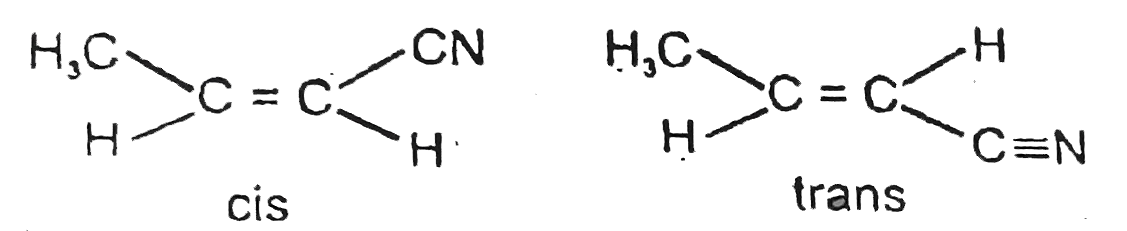 In TRANS isomersthere islinear addition of BOND dipoles hence `mu` is GREATER and its B.P. will be more .Packing is trans is better hence m.p. is more. 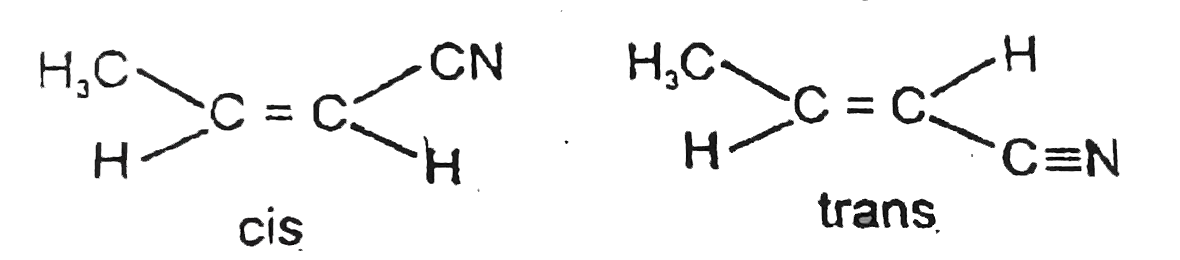
|
|
| 16. |
Compare the properties of two isomeric products x and y formed in the following reaction. |
|
Answer» `{:("Acid Strength",H_(2)O " Solubility","VOLATILITY","MALTING POINT",),(y gt x,y gt x,x gt y,y gt x,):}` |
|
| 17. |
Compare the properties of two isomeric products x and y formed in the following reaction . Match the following : {:("Column-I","Column-II"),((A)"Dipole moment" , (p)XgtY),((B)H_2O"solubility",(q)Y=X),(( C)"Boiling point",(r)YgtX),((D)"Melting point",(s)"Can't say"):} |
|
Answer» |
|
| 18. |
Compare the potential energy of the following compounds (above compounds) |
|
Answer» Solution :If COMPOUND after being in free Radical form is very stable (i.e., less energy) it mean it WOULD have POSSESSED more energy initially i.e. it POTENTIAL energy will be most `a lt b lt c lt d` `**`Potential energy `propto` STABILITY of free Radical |
|
| 19. |
Compare the oxidizing powers of F_(2) and Cl_(2) on the basis of bond dissociation enthalpy, electron gain enthalpy of halogens and hydration enthalpy of halide ions. |
| Answer» Solution :It is DUE to low ENTHALPY of DISSOCIATION of F – F bond and high hydration enthalpy of `F^(−)`. | |
| 20. |
Compare the osmotic pressures of the following two solution at the same temperature : 1 M Glucose solution 1M barium chloride solution . |
| Answer» SOLUTION :Osmotic PRESSUREOF 1M Glucose solution is equal to the osmotic PRESSURE of 1M UREA solution , because both glucose and urea are non-electrolytic non-ionisable solutes. | |
| 21. |
Compare the ionization enthalpies of first series of the transition elements. |
|
Answer» SOLUTION :Ionization enthalpies of first transition series: (i) Ionization energy of transition element is intermediate between those of s and p block elements. (ii) As we move from LEFT to right in a transition metal series, the ionization ENTHALPY increases as expected. This is due to INCREASE in nuclear charge corresponding to the filling of d electrons. (iii) The increase in first ionisation enthalpy with increase in atomic number along a particular series is not regular. The added electron enters (n-1)d orbital and the inner electrons act as a shield and decrease the effect of nuclear charge on valence ns. electrons. Therefore, it leads to VARIATION in the ionization energy values. |
|
| 22. |
Compare the ionizationenthalpies of firstseriesof the transitionelements. |
|
Answer» Solution :(I ) Ionizationenergyof transitionelementis intermediatebetweenthoseof aandp blockelements.Aswe movefromleftto rightin atransitionicreasesas EXPECTED . Thisis due to increase in nuclearchargecorrespondingto the fillingof d electrons.Thefollowingfigureshow thetrendsinionisationenthalpyof transtionelements . (ii) The firstionisation energyof 5dseriesofelementare muchhigherthat those of3dand 4dseriesof elements . (III)The added electronenters(n-1)orbitaland theinnerelectronsact asshieldand decreasethe effectof nuclearchargeon VALENCE nselectrons. (IV)therefore it leads tovariation in theionization energyvalues. 
|
|
| 23. |
Compare the general characteristics of the first transition series of transition metals with those of the second and third transition series metals in the respective vertical columns. Give special emphasis on the following point : (i) electronic configuration (ii) oxidation states (iii) inonisation enthalpies (iv) atomic sizes. |
|
Answer» Solution :(i) Electronif configuration. There are some exceptions in the electronic configurations.In all the three series. (ii) Oxidation state. The ELEMENTS belonging to the different series but present in the same group have similar electronic configuration and therefore, exhibit almost same VARIABLE oxidation state. In general, these are maximum in the middle of the series while minimum towards the END. (III) Ionisation enthalpies. In general, the ionisation enthalpies in all the three transitionseries increase from left to the right.However, the gaps in the two successive elements in a particular series are small and are also notregular. The first three ionisation enthalpies of the elements present in thefirst transition series are given in the text part. The `Delta_(i)H^(1)` values of the elements belonging to 5d series an HIGHER as compared to those belonging to 3d to 4d series in the same group because of poor shelding by intervening 4f electrons present. (iv) Atomic size. In all the three transition series, the atomic as well as ionic radii of the elements increase from left to the right. The values for 3d series are given in the text part. However, the increasein their values are not as much asexpected since the shielding by (n-1)d electrons in not as much as expected. In a particular group, the atomic radius of the elements belonging to 4d series is more than the element in the 3d series. However, the gaps in the elements belonging to 4d and 5d series are negligible on account of lanthanoid contraction which the elements of 5d experience. |
|
| 24. |
Compare the general characteristics of the firstseries of transition metals with those of the second and third series metals in the respective vertical column. Give special emphasis on the following points : (i) electronic configuration (ii) oxidatio states (iii) ionisation enthalpies and (v) atomic sizes. |
|
Answer» Solution :(i) Electronic configuration . In the firsttransition series, 3d orbitals are progressively filled while in the seond and third transition series, 4d and 5d orbitals . Further , the elements in the same vertial column generally have similar electronic configurations. HOWEVER, the first series shows only TWO exceptions, i.e., `Cr= 3d^(5) 4s^(1)` and `Cu =3d^(10), 4s^(1)` but second series shows more exceptions, e.g., `Mo ( 42) = 4d^(5) 5s^(1), Tc ( 43) = 4d^(6) 5s^(1) , Ru ( 43) = 4d^(7) 5s^(1), Rh (44) = 4d^(7) 5s^(1) , Pd ( 46) = 4d^(10) 5s^(0), Ag( 47) = 4d^(10) 5s^(1)` . Similarly , in the third series, `W( 74) = 5d^(4) 6s^(2) , Pt ( 78) =5d^(9) 6 s^(1) ` and `Au ( 79 ) = 5d^(10) 6 s^(1)` . Thus, in the same vertical column, in anumber of cases, the electronic configuration of the three series are not similar. (ii) Oxidation states. The number of oxidation states shown by the elementsin the middle of each series is maximum and minimum at the extreme ends. However , the first row elements differ from the second and thrid row elements in the fact that for all the first row elements ,`+2` and `+3` states are important , i.e., ions `M^(2+)` and `M^(3+)` are common but these are less important for second and thrid row elements. For example, first low elements form a large number of extremely stable complexes in `+ II` or `+ III` states , e.g.,`[overset(III) (Cr)Cl_(6)]^(3-) ` and `[overset(III) (Co)(NH_(3))_(6)]^(3+)`. No EQUIVALENT complexes of Mo or W or Rh or Ir, are known . For second and third row elements , higheroxidation states are more important than those of the first row elements. For example, some compounds of second and third row elements exist in higher oxidation states which have no counter parts inthe first row , e.g.,`WCl_(6) , ReF_(7) , RuO_(4) , OsO_(4) ` and `PtF_(6)` (iii) Ionization enthalpies. The firstionization enthalpies in each series generally increase gradually as we move from left to right though some exceptions are observed in each seres. The first ionization enthalpies of some elements in the second (4d) series are higher while some of them have LOWER value than the elements of 3d series in the same vertical column. However, the first ionization enthalpiesof third ( 5d) series are hgiher than those of 3d and 4d series. This is because of weak shielding of nucleus by 4f electrons in the 5d series. (iv) Atomic sizes. In general , ions ofthe same charge or atoms in a given series SHOW progressively decrease in radius with increasing with atomic number through the decrease in quite small. But the size of the atoms of the 4d seris is larger than the correspondingelement of the 3d series whereas those of correspongind elements of the 5d series are nearly as those of 4d seriesbecause of lanthanoid contraction. |
|
| 25. |
Compare the general characteristics of the first series of transition metals with those of the second and third series metals in the respective vertical columns. Give special emphasis on the following points : (i) electronic configurations, (ii) oxidation states, (iii) ionisation enthalpies and (iv) atomic sizes. |
|
Answer» Solution :(i) Electronic configurations : In the first transition series, 3d ORBITALS are progressively filled while in the second and third transition series, 4d and 5d orbitals are progressively filled. Elements in the same vertical column generally have similar electronic configurations. However, the first series shows only two exceptions, i.e., `Cr=3d^(5)4s^(1)` and `Cu=3d^(10)4s^(1)` but second series shows more exceptions, e.g., Mo `(42)=4d^(5)5s^(1),Tc(43)=4d^(6)5s^(1),Ru(43)=4d^(7)5s^(1),Rh(44)=4d^(8)5s^(1),PD(46)=4d^(10)5s^(0),Ag(47)=4d^(10)5s^(1)`. Similarly, in the third series the exceptions are : W `(74)=5d^(4)6s^(2),Pt(78)=5d^(9),6s^(1)`. Thus, in the same vertical column, in a number of cases, the electronic configuration of the three series are not similar. However, it has been observed that for all the first row elements, +2 and +3 states i.e, ions `M^(2+)` and `M^(3+)` are more common. For example, first row elements FRORM a large number of extremely stable complexes in +II or +III states, e.g., `overset(III)([CrCl_(6)]^(3-))` and `overset(III)([Co(NH_(3))_(6)]^(3+))`. No equivalent complexes of Mo, W, Rh, Ir, are known. In second and third row elements, higher oxidation states are more common. For example, some compounds of second and third row elements exist in higher oxidation states which have no counterparts in the first row, e.g., `WCl_(6),ReF_(7),RuO_(4),OsO_(4)` and `PtF_(6)`. (iii) Ionisation enthalpies : The first ionisation enthalpies in each series generally increase gradually as we move from left to right though some exceptions are observed in each series. The first ionisation enthalpies of some elements in the second (4d)series are higher while some of them have lower value than the elements of 3d series in the same vertical column. However, the first ionisation enthalpies of third (5d) series are higher than those of 3d and 4d series. This is because of weak shielding of nucleus by 4f electrons in the 5d series. (iv) Atomic sizes : It is observed that, ions of the same clarge or aloms in a given series show progressive decrease in radius with increasing atomic number though the decrease is quite small. But the size of the atoms of the 4d series is larger than the corresponding elements of the 3d series whereas those of corresponding elements of the 5d series are nearly the same as those of 4d series because of lanthanoid CONTRACTION. |
|
| 26. |
Compare the general characteristics of the first series of the transition metals with those of the second and third series metals in the respective vertical columns. Give special emphasis on the following points: (i) electronc configurations (ii) oxidation states (iii) ionisation enthalpies (iv) atomic sizes. |
|
Answer» Solution :(i) Electronic configuration: The 3D, 4D and 5d orbitals are successively filled in `1^(st) and 2^(nd) and 3^(rd)` transition series respectively. (II) Oxidation states: The elements present in the same group, show similar oxidation states. The highest oxidation state is equal to total number of ELECTRONS in d-orbitals and s-orbital. The elements present in the middle of the series show maximum oxidation states. Ex Mn(VII), Os(VIII) etc. The stability of elements in their highest oxidation state increases down the group Ex: W(VI) is move stable than Cr(VI). In first transition series, (+2) and (+3) oxidation states are common. (iii) Ionization enthalpies: Ionization enthalpies in each series increases moving left to right. However, ionization enthalpies of 5d series are nearly same as 4d series due to lanthanoid contraction. (iv) Atomic sizes: The atomic sizes of 4d and 5d series are nearly same due to lanthanoid contraction. The atomic radii increases from 3d to 4d and remains nearly same from 4d to 5d. |
|
| 27. |
Compare the general characteristics of the first series of the transition metals with those of the seconds and third series metals in the respective vertical columns. Give special emphasis on the following points. (i). Electronic configuration and (ii). Oxidation states. (iii) ionisation enthalpies and (iv) Atomic. |
|
Answer» Solution :(i). Electronic configuration: The elements in the same vertical column generally have SIMILAR electronic configuration However the first series shows only two exceptions, `i.e.,Cr=3d^(5)ds^(1)` and `Cu=3d^(10)4s^(1)` but second series shows more exceptions e.g., `Mo(42)=4d^(5)5s^(1),Tc(43)=4d^(6)5s^(1),Ru(43)=4d^(7)5s^(1),Rh(44)=4d^(9)5s^(1),Pd(46)=4d^(10)5s^(0),Ag(47)=4d^(10)5s^(1)`. Similarly in the third series, `W(74)=4d^(4)6s^(2),Pt(78)=5D^(9),6s^(1)` and `Au(79)=5d^(10)6s^(1)`. Thus in the same vertical column in a number of cases, the electronic configuration of the three series are not similar. (ii). Oxidation states: The elementws in the same vertical column generally show similar oxidation states. The number of oxidation states shown by the elements in the middle of each series is maximum and minimum at the extreme ends. (iii). Ionisation enthalpies: `IE_1` in each series generally increase gradually along the series though some exception are observed in each series. `IE_1` of some elements in the second `(4d)` series are higher while some of them have lower value than the element of `3d` series in the same vertical column. However, the `IE_1` of third `(5d)` series are higher than those of `3d` and `4d` series. This is because of poor shielding of nucleus by `4f` electrons in the `5d` series. (iv). Atomic sizes: In general ions of the same charge or atoms in a given series hwo progeressively decrease in radius with increasing atomic number though the decrease is quite small. But the size of the of the atoms of the atoms of `4d` series is LARGER than the corresponding elements of the `3d` series whereas those of corresponding elements of the `5d` series nearly the same as those of `4d` series because of lanthanoid contraction. (v). Enthalpies of atomisation: The metals of the second and third series have greater enthalpies of atomisation than the corresponding elements of the first series. This is due to much more FREQUENT metal-metal BONDING in compounds of heavy transition metals. |
|
| 28. |
Compare the following complexes with respect to structural shapes of units, magnetic behaviour and hybrid orbitals involved in units : [Co(NH_(3))_(6)]^(3+),[Cr(NH_(3))_(6)]^(3+),Ni(CO)_(4) |
|
Answer» Solution :(i) `[Co(NH_(3))_(6)]^(3+)` Oxidation STATE of Co= +3 Config. of `Co^(3+)` :`3d^(6)4s^(0)` Shape: Octahedral Magnetic BEHAVIOUR: DIAMAGNETIC Hybrid orbitals involved :`d^(2)sp^(3)` (ii) `[Cr(NH_(3))_(6)]^(3+)` Oxidation state of Cr = +3 Configuration of `Cr^(3+)` : `3d^(3)4s^(0)` Shape: Octahedral Magnetic behaviour: PARAMAGNETIC Hybrid orbitals involved: `d^(2)sp^(3)` (iii) `Ni(CO)_(4)` Oxidation state of Ni = 0 Shape : Tetrahedral Magnetic behaviour : Diamagnetic Hybrid orbitals involved: `sp^(3)` |
|
| 29. |
Compare the dipole moments of water and ammonia. |
Answer» Solution :UNSHARED pairs of electrons make LARGE CONTRIBUTIONS to the dipole moments of water and ammonia. Because an unshared pair has no other atom attached to it to partially neutralize its NEGATIVE charge, an unshared electron pair CONTRIBUTES a large moment directed away from the central atom. (The O-H and N-H moments are also appreciable.) 
|
|
| 30. |
Compare the coagulating power of FeCl_3 with that of NaCl. Given that their coagulation values are 0.090 and 50 respectively. |
| Answer» SOLUTION :`(Coagu lati ng POWER of FeCl_3)/(Coagu lati ng power of NaCl)=(Coagu lati ng VALUE of NaCl)/(COA gu lati ng value of FeCl_3)implies50/0.090` | |
| 31. |
Compare the chemistry with that of the lanthanoids with special reference to (i) electronic configuration (ii) atomic and ionic sizes (iii) oxidation state (iv) chemical reactivity . |
Answer» SOLUTION :COMPARISON between CHEMISTRY of ACTINOIDS and LANTHANOIDS : 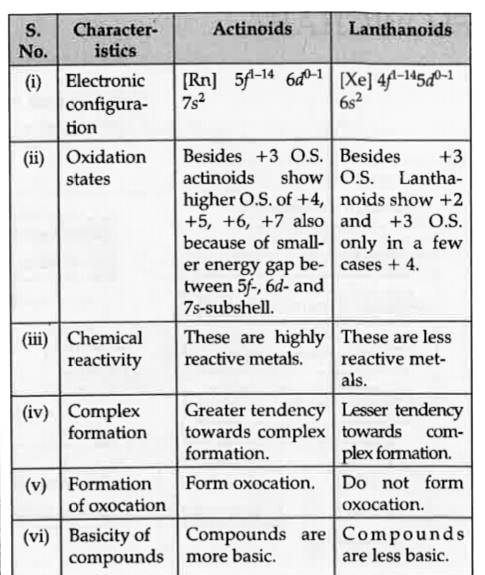
|
|
| 32. |
Compare the chemistry of actinoids with that of the lanthanoids with special reference to: (i) Electronic configuration (ii) Atomic and ionic sizes (iii) Oxidation state (iv) Chemical reactivity |
|
Answer» Solution :(i) Electronic configuration: Lanthanoids have general electronic configuration `[Xe] 4f^(1-14) 5d^(0-1) 7s^(2)` and actionoids have general electronic configuration of `[RN] 5f^(1-14) 6f^(0-1) 7s^(2)`. (ii) Atomic and ionic sizes: From, lanthanum to leutetium, atomic size DECREASES though decrease is not regular. However, decrease in size of `M^(3+)` ions is very sharp. In case of actinoids, the decrease in size is more pronounced from elements to element because of poor sheilding effect of 5f electrons. (iii) OXIDATION states: The most common oxidation state in lanthanoid is (+3). However, (+2) and (+4) oxidation states are also shown by lanthanoids. The actinoid shows variable oxidation states ranging from (+3) to (+7). This is because of comparable energies of 5f, 6d and 7s levels. (iv) Chemical REACTIVITY: As compared to lanthanoids, actinoids are more reactive. At moderate temperatures, actionoids REACT with non-metals while at lanthanoid reacts at high temperature. Actinoids are not attacked by `HNO_(3)` because of formation of protective layer of oxides on its surfae and also they are not attacked by alkali. However, actinoids react with HCl. Lanthanoids liberates `H_(2(g))` from dilute acids and produces trihalides when reacted with halogens. |
|
| 33. |
Compare the chemistry of actinoids with that of the lanthanoids with special referene to : (i). Electronic configuration. (iii). Oxidation state (ii). Atomic and ionic sizes and (iv). Chemical reactivity. |
|
Answer» Solution :(i). Electronic configuration: The general ELECTRON configuration of lanthanoids is `4f^(1-14)4d^(0-1)` `6s^2` whereas that of actinoids is `5F^(1-14)6d^(0-1)6s^2` whereas that of actinoids is `5f^(1-14)6d^(0-1)7s^2`. Thus lanthanoids belong to 4f-series whereas actinoids belong to 5f-series. (ii). OXIDATION states: Lanthanoids show limited oxidation states `(+2,+3,+4)` out of which `+3` is most common. This is because of large energy gap between 4f,5d and 6s subshells. On the other hand, actinoids show a large number of oxidation states because of small energy gap between 5f, 6d and 7s subshells. (iii). Atomic and ionic sizes: Both show decrease in size of their atoms or IONS in `+3` oxidation state. In lanthanoids, the decrease is called lanthanoid contraction whereas in actinoids, it is called actinoid contraction. However, the contraction is greater from element to element in actinoids due to imperfect shieldintg by 5f electrons. (iv). Chemical Reactivity: REFER to section 6.12. |
|
| 34. |
Compare the chemistry of actinoids with that of the langthanoids with special reference to : (a) electronic configuration (ii) oxidation state (iii) atomic and ionic sizes, and (d) chemical reactivity. |
|
Answer» Solution :(a) Electronic configuration : The general electronic configuration of langthnoids is `[Xe]4f^(1-14)5d^(0-1)6s^(2)` whereas that of actinoids is `[Rn]5f^(1-14)6d^(0-1)7s^(2)`. Thus, lanthanoids belong to 4f-series whereas actinoids belong to 5f-series. (b) Oxidation STATE : Lanthanoids show limited oxidation STATES `(+2,+3,+4)` out of which +3 is most common. This is because of large energy gap between 4f, 5d and 6s subshells. On the other hand, actinoids show a large NUMBER of oxidation states because of small energy gap between 5f, 6d and 7s subshells. (c) Atomic and ionic sizes : Both lanthanoids and actinoids show decrease in size of their atoms or ions in 3 oxidation state. In lanthanoids, the decrease is called lanthanoid contraction whereas in actinoids, it is called actinoid contraction. However, the contraction is greater from element to element in actinoids due to poorer shielding by 5f electrons. (d) Chemical reactivity : Important reactions of lanthanoids and actinoids are given below : Lanthanoids : (i) They combine with `H_(2)` on gentle heating with carbon, then form carbides. When burnt in presence of halogen, they form halides. (ii) They react with dilute acids to liberate hydrogen gas. (iii) They form oxides and HYDROXIDES of the type `M_(2)O_(3)` and `M(OH)_(3)` which are basic in character. Actinoids : (i) They combine with most of the non-metals at moderate temperature with carbon, they form carbide, with sulphur, sulphides are formed and with halogens, halides are formed. (ii) These metals are attacked by hydrochloric acid, but the effect of nitric acid is small due to the formation of boilling WATER to give a mixture of oxides and hydroxides. (iv) Alkalis have no action on them. |
|
| 35. |
Compare the chemistry of actinoids with that of lanthanoidswith special reference to (i) electronic configuration (ii) oxidation state (iii) atomci andionic sizes (iv) chemical reactivity. |
|
Answer» Solution :(i) Electronic configuration. The general electronicconfiguration of LANGTHANOIDS is `[Xe]^(54) 4f^(1-14) 5d^(0-1) 6s^(2)`WHEREAS that of actinoids is `[Rn]^(86) 5f^(1-14) 6 s^(0-1) 7s^(2)` . Thus, langthanoids belong to 4f- series whereas actinoids belong to 5f - series. (ii) Oxidation staes. Lnathanoids show limited oxidation states`( + 2, +3, +4)` out of which `+3` is most common. This is becasue of LARGE energy gap between 4 fand 5d subshells. On the other hand, actinoids show a large number of oxidation staes becasue of small energy gap between 5f , 6d and 7s subshell. (iii) Atomic and ionic sizes. Both show decrease in size of their atoms or ions in `+3` oxidation state. In langthanoids, the decrease is called langthanoid contraction whereas in actinoids, it is called actinoid contraction . However , the contraction is greater from element to element in actinoids due to poorer shielding by 5f electrons thanthat by 4f electrons in langthanoids. (iv) CHEMICAL REACTIVITY. Refer to page. |
|
| 36. |
Compare the chemistry of actinoids with that of lanthanoids with special reference to : (i) Atomic sizes (ii) Chemical reactivity. |
|
Answer» Solution :(i) Atomic Sizes. ACTINOIDS show greater CONTRACTION in sizes as we the from left to right due to poorer shielding by 5f electrons than 4f electrons. (II) Chentical REACTIVITY. They are more REACTIVE than lanthanoids. |
|
| 38. |
Compare the boiling points of 1^(@),2^(@) and 3^(@) amines. |
|
Answer» Solution :(i) The boiling point of various amines FOLOWS the order. `CH_(3)UNDERSET(1^(@))(-)overset(..)(N)H_(2)underset(gt)(gt)underset(2^(@))((CH_(3))_2)overset(..)(N)Hunderset(gt)(gt)underset(3^(@))((CH_(3))_(3)overset(..)(N)` (ii) Due to the polar nature of primary and secondary amines, can form intermolecular hydrogen bonds using their lone pair of electron on nitrogen atom. However, tertiary amins do not form intermolecular hydrogen bond and they have lower boiling point than `1^(@)` and `2^(@)` amines. |
|
| 39. |
Compare the bond energies of C – H bond (at a, b, c, d, e and f position) |
Answer» Solution : `b gt e gt a gt f gt C = d ?` Stability order of free Radical that might be formed after REMOVAL of H (Homolytically) from the given carbon. `rArre lt b lt a lt f lt c = d` (`C - H`BOND energies) `*`In the above compound while comparing `2^(@)` BENZYLIC allylic stability at two given position  while drawing the resonating structure of the  (Here inspite of Resonace THREE`alpha (C - H)` bond are available for no bond Resonance. `rArr ` Therefore extre stable than  which have which haveonly two `alpha (C - H)`bond for Hyper conjugation. Therefore `2^(@)` benzylic allylic corresponding to structure (a) is more stable than that of structure (b) |
|
| 40. |
Compare the basic characters of methyl amine and dimethyl amine. |
|
Answer» SOLUTION :BASICITY of amines is controlled by the availability of lone pair of electron of protonation. The order of basicity is `(CH_3)_2NH`LT`CH_3NH_2` |
|
| 41. |
Compare the acidity of four hydrogen atoms x, y, z and w ? |
|
Answer» x is more acidic than z |
|
| 42. |
Compare the acidity of 1^@, 2^@ and 3^@ alcohols. |
|
Answer» Solution :(i) The acidic nature of the alcohol is due to the polar nature of O-H bond. When an electron withdrawing -I groups such as -Cl, - F etc... is attached to the carbon bearing the OH group, it withdraws the electron DENSITY towards itself and thereby facilitating the proton donation. (ii) In contrast, the electron releasing group Such as alkyl group increases the electron density on oxygen and decreases the polar nature of O- H bond, Hence it results in the decrease in acidity. (iii) On moving from primary to SECONDARY and tertiary alcohols, the number of alkyl groups which attached to the carbon bearing -OH group increases, which results in the FOLLOWING order of acidity. `1^@" alcohol" gt 2^@ " alcohol" gt 3^@ "alcohol"` For example 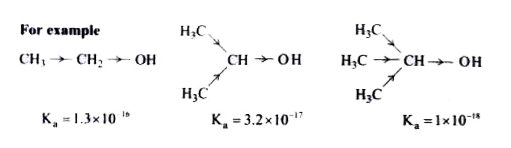
|
|
| 43. |
Compare the acidic nature : (a) H_(2)O and H_(2)O, and (b) CO and CO_(2). |
|
Answer» Solution :(a) `H_(2)O` is neutral. `H_(2)O_(2)` is weakly acidic. `H_(2)O_(2)` forms salts upon neutralisation with alkali. `H_(2)O_(2)+ NaOH_(2)+H_(2)O,H_(2)O_(2)+2NaOHrarr Na_(2)O_(2)+2H_(2)O` (b) `CO` is neutral. `CO_(2)` is weakly acidic. Carbondioxide forms carbonic acid with WATER and salt with alkali. `CO_(2)+H_(2)OrarrH_(2)CO_(3),CO_(2)+2NaOHrarrNa_(2)CO_(3)+H_(2)O` |
|
| 44. |
Compare the acid strength of the following compounds (i) Nitro methane (ii) Nitro ehane (iii) 2- nitro propane. |
|
Answer» Solution :(i) The `alpha` -H atom of `1^(@)` and `2^(@)` NITROALKANES show acidic character because of the electron withdrawing effect of `NO_(2)` group. (ii) Nitroalkanes dissolver in NaOH solution to form a salt. (iii) When the number of alkyl group ATTACHED to `alpha` carbon increases, acidity decreses, due to+I effect of alkyl GROUPS. `CH_(3)-NO_(2)gtCH_(3)-CH_(2)-NO_(2)gt ` 
|
|
| 45. |
Compare the acid strength in 1^(@), 2^(@) and 3^(@) alcohol giving reason. |
|
Answer» Solution :(i) Alcohols are water acid than water because of +1 effect of ALKYL group. HENCE, alcohols react only with electropositive metals evolving hydrogen. `2C_(2)H_(5)OH + 2Na to underset("sodium ethoxide") (2C_(2)H_(5)O"Na" + H_(2))` (ii) The acid strength DECREASES in the order `1^(@) gt 2^(@) gt 3^(@)` because of the electrons releasing effect of the alkyl groups. |
|
| 46. |
Compare th relative acidic strengths of hydroxyl amine and am oxime. |
Answer» Solution :Both contain 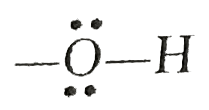 group in their molecules and are expectedto be WEAKLY acidic. However, oxime is actually more acidic. Infact, hydroxyl amine after losing a PROTON forms a CONJUGATE base in which NEGATIVE charge is localised only on the oxygen atom. group in their molecules and are expectedto be WEAKLY acidic. However, oxime is actually more acidic. Infact, hydroxyl amine after losing a PROTON forms a CONJUGATE base in which NEGATIVE charge is localised only on the oxygen atom. 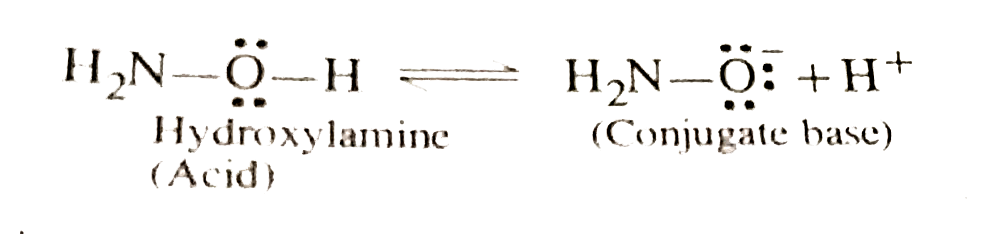 However, in case of oxime, the negative charge gets delocalished by extending `pi` electron BONDING. 
|
|
| 47. |
Compare reactivity between benzaldehyde & propanal. |
| Answer» SOLUTION :BENZALDEHYDE LT PROPANAL | |
| 48. |
Compare mass of pure NaOH in each of the aqueous solution 50 g of 40% (w/w) NaOH 50 ml of 50% (w/v) NaOH [d_(soln)=1.2 g/(mL)] |
|
Answer» `(II)GT(i)` |
|
| 49. |
Compare Li and Mg in the following properties (a) hydration of chlorides. (b) tendency to form nitrides. |
| Answer» Solution :(a) both hydrated(b) both form nitrides `(Li_(3)N,Mg_(3)N_(2))` | |
| 50. |
Compare lanthanides and actinides. |
Answer» SOLUTION :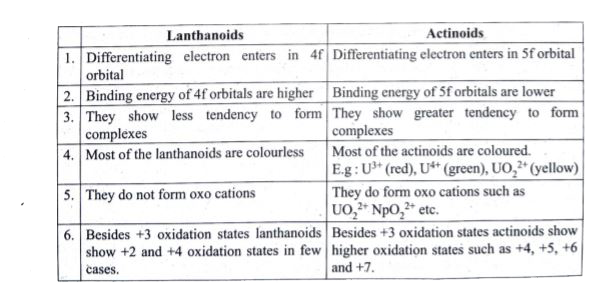
|
|