

Saved Bookmarks
This section includes 7 InterviewSolutions, each offering curated multiple-choice questions to sharpen your Current Affairs knowledge and support exam preparation. Choose a topic below to get started.
| 1. |
co-ordination compounds have great importance in biological systems. In these context, which statement is incorrect? |
|
Answer» Carbooxypeptidase-A is an enzyme and contains zinc. |
|
| 2. |
Co-ordination number for copper (Ca) is |
|
Answer» 1 |
|
| 3. |
Colligativeproperties are observed when …….. |
|
Answer» A nonvolatile SOLID is dissolved in a VOLATILE LIQUID. |
|
| 4. |
Colligative properties depend on ___ |
|
Answer» the nature of the SOLUTE PARTICLES dissolved in solution. |
|
| 5. |
Co-ordination isomerism is possible in : |
|
Answer» `[AG(NH_(3))_(2)][Ag(CN)_(2)]` |
|
| 6. |
Collin,s reagent causes the conversion: |
|
Answer» `-COrarrCHOH` |
|
| 7. |
Co-ordination complexes can show stereoisomerism square planar complexes of Ma_(2)b_(2) type can show geometrical isomerism but not optical & octahedral complexes of Ma_(2)b_(2)C_(2), Ma_(3)b_(3) Mabcdef etc show stereoisomerism, for e.g. Mabcdef have 15 geometrical isomers & all are optically active so it has 15 pairs of enantiomers thus in totaly it has 30 stereoisomers. (a,b,c,d etc. are monodentate lignads while AB is bidenatate ligand) How many pair of enantiomers exits for Ma_(2)b_(2)c_(2)? |
|
Answer» 0  So STR. (5) & its enantiomer is OPTICALLY active |
|
| 8. |
Co-ordination compounds have great importance in biological system in this content which of the following statemt is correct. |
|
Answer» Carboxypeptidese A, is an enzyme and contains zinc |
|
| 9. |
Colligative property measurement is one of the techniques used in the measurement of chemical quantities with reasonable accuracy. If a 40.65 gm sample of K_2SO_4 and BaSO_4 is dissolved in 900 gm of pure water to form a solution 'A' at 57^@C.Its vapours pressure is found to be 39.6 torr while vapour pressure of pure water at 57^@C is 40 torr. Density of solution A is 1.24g/ml. In a different experiment when small amount of pure BaSO_4 is mixed with water at 57^@C it gives the osomotic rise at 4.05xx10^(-5) atm. (R=0.082 Lt.-atm//"mol"-K,K=39,Ba=137,S=32,O=16) Elevation in boiling point of solution A is (K_b "water"=0.54 K-kg//mol): |
|
Answer» 0.3 K |
|
| 10. |
Co-ordiantion compounds show structural isomerism and it is different from the nature of the isomerism which we generally come across in organic compounds. The co-ordination and linkage isomers depending upon their upon the number of ions which they furnish upon dissociation in aqueous solution . The isomers belonging to a particular type can also be distinguished from each structural isomerism, the co-ordination compounds are also involved in geometrical and optical isomerism. Whereas optical octahedral and square planar complexes can exhibit geometrical isomerism. One mole of the complex compoundgives 3 mole of ions on dissolution in water. One mole of the same complex reacts with two moles ofto yield two moles of . The structure of the complex is : |
|
Answer» `[CO(NH_(3))_(3)Cl_(3)].2NH_(3)` |
|
| 11. |
Co-ordiantion compounds show structural isomerism and it is different from the nature of the isomerism which we generally come across in organic compounds. The co-ordination and linkage isomers depending upon their upon the number of ions which they furnish upon dissociation in aqueous solution . The isomers belonging to a particular type can also be distinguished from each structural isomerism, the co-ordination compounds are also involved in geometrical and optical isomerism. Whereas optical octahedral and square planar complexes can exhibit geometrical isomerism. Which of the following will not show geometrical isomerism ? |
|
Answer» `[Cr(NH_(3))_(4)Cl_(2)]Cl` |
|
| 12. |
Colligative property of dilute solutions depends on : |
|
Answer» the NATURE of solute |
|
| 13. |
Colligative property measurement is one of the techniques used in the measurement of chemical quantities with reasonable accuracy. If a 40.65 gm sample of K_2SO_4 and BaSO_4 is dissolved in 900 gm of pure water to form a solution 'A' at 57^@C.Its vapours pressure is found to be 39.6 torr while vapour pressure of pure water at 57^@C is 40 torr. Density of solution A is 1.24g/ml. In a different experiment when small amount of pure BaSO_4 is mixed with water at 57^@C it gives the osomotic rise at 4.05xx10^(-5) atm. (R=0.082 Lt.-atm//"mol"-K,K=39,Ba=137,S=32,O=16) Concentration of Ba^(2+) ions in solution 'A' is : |
|
Answer» `3.5xx10^(-18) M` `:. [BA^(2+)]=(5.6xx10^(-13))/0.224=2.5xx10^(-12) M` |
|
| 14. |
CO on passing over heated nickel gives: |
|
Answer» `NiCO_3` |
|
| 15. |
Colligative property measurement is one of the techniques used in the measurement of chemical quantities with reasonable accuracy. If a 40.65 gm sample of K_2SO_4 and BaSO_4 is dissolved in 900 gm of pure water to form a solution 'A' at 57^@C.Its vapours pressure is found to be 39.6 torr while vapour pressure of pure water at 57^@C is 40 torr. Density of solution A is 1.24g/ml. In a different experiment when small amount of pure BaSO_4 is mixed with water at 57^@C it gives the osomotic rise at 4.05xx10^(-5) atm. (R=0.082 Lt.-atm//"mol"-K,K=39,Ba=137,S=32,O=16) Solubility product of BaSO_4 in water at 57^@C is : |
|
Answer» `5xx10^(-19)` `C=7.483xx10^(-7)` `therefore K_(SP)=5.6xx10^(-13)` |
|
| 16. |
CO+NaOHto |
| Answer» Solution :`CO+NaOH overset(Delta)toHCOONa` | |
| 17. |
Colligative property measurement is one of the techniques used in the measurement of chemical quantities with reasonable accuracy. If a 40.65 gm sample of K_2SO_4 and BaSO_4 is dissolved in 900 gm of pure water to form a solution 'A' at 57^@C.Its vapours pressure is found to be 39.6 torr while vapour pressure of pure water at 57^@C is 40 torr. Density of solution A is 1.24g/ml. In a different experiment when small amount of pure BaSO_4 is mixed with water at 57^@C it gives the osomotic rise at 4.05xx10^(-5) atm. (R=0.082 Lt.-atm//"mol"-K,K=39,Ba=137,S=32,O=16) Percentage of K_2SO_4 in the sample is : |
|
Answer» `65.75%` x=29.29 G `%=29.29/40.65xx100=72%` |
|
| 18. |
Colligative property depends only on - in a solution. |
|
Answer» Number of solute PARTICLES |
|
| 20. |
CO is used in metallurgy of .. |
|
Answer» CU |
|
| 21. |
CO is _________ toxic than CO_2 and SO_2. |
| Answer» | |
| 22. |
CO is more toxic than CO_2 because |
|
Answer» It AFFECTS the nervous system |
|
| 23. |
Colligative properties of a solution depend upon the number of moles of a solute dissolved and do not depend upon the nature of the solute. However, they are applicable only to dilute solutions in which the solutes do not undergo any association or dissociation. For solutes undergoing such changes, van't Hoff introduced a factor, called van't Hoff factor (i). This has helped not only to explain the abnormal molecular masses of such solutes in the solution but has also helped to calculate the degree of association or dissociation. Which one of the following aqueous solutions will have the lowest freezing point ? |
|
Answer» 0.1 molal solution of urea |
|
| 24. |
CO is more stable at higher temprature .Why? |
| Answer» Solution :In the ELLINGHAM diagram ,the formation of carbon MONOXIDE is a straight line with NEGATIVE slope.In this case `DeltaS` is POSITIVE as 2 moles of CO gas is formed by the consumption of one MOLE of oxygen .Hence,CO is more stable at higher temprature | |
| 25. |
CO is a stronger ligand than NH_(3) for many metals. Explain. |
| Answer» Solution :CO is a stronger field LIGAND than `NH_(3)` because back of bonding leading to SYNERGIC effect. As a RESULT, the bond between the ligand (CO) and metal (M) becomes stronger as COMPOUND to bond between `NH_(3)` and metal which is simply a co-oridinate bond. | |
| 26. |
Colligative properties have been used to determine the_____of the solutes. |
| Answer» SOLUTION :MOLAR MASS | |
| 27. |
Colligative properties of a solution depend upon the number of moles of a solute dissolved and do not depend upon the nature of the solute. However, they are applicable only to dilute solutions in which the solutes do not undergo any association or dissociation. For solutes undergoing such changes, van't Hoff introduced a factor, called van't Hoff factor (i). This has helped not only to explain the abnormal molecular masses of such solutes in the solution but has also helped to calculate the degree of association or dissociation. The van't Hoff factor for 0.1 M Ba(NO_(3))_(2) solution is 2.74. The degree of dissociation is |
|
Answer» `91.3%` Total `=1+2alpha therefore i=1+2alpha` `or alpha=(i-1)/(2)=(2.72-1)/(2)=0.87=87%.` |
|
| 28. |
CO is a stronger ligand than Cl^- because |
|
Answer» Co is a NEUTRAL MOLECULE |
|
| 29. |
Colligative properties of a solution depend upon : |
|
Answer» MOLARITY |
|
| 30. |
CO is a reducing agent. Justify with an example. |
|
Answer» Solution :Both THERMODYNAMIC and KINETIC factors make carbon MONOXIDE (CO) a better reducing agent. When CO is used to reduce a metal oxide, it gets OXIDIZED to `CO_(2)`. Thermodynamically `CO_(2)` is much more stable than CO For EXAMPLE. `CO+Fe_(2)O_(3)to2Fe+3CO_(2)` |
|
| 31. |
Colligative properties depend on …………. |
|
Answer» the nature of the SOLUTE PARTICLES dissolved in solution |
|
| 32. |
CO (g) and H2(g) react to give different products in the presence of different catalysts. Which ability of the catalyst is shown by these reactions? |
| Answer» SOLUTION :SELECTIVITY of a CATALYST | |
| 33. |
Colligative properties depend on ……. |
|
Answer» The NATURE of the solute particles DISSOLVED in solution. |
|
| 34. |
CO (g) and H_2(g) react to give different products in the presence of different catalysts. Which ability of the catalyst is shown by these reactions ? |
| Answer» SOLUTION :This is KNOWN as SELECTIVITY of the CATALYST. | |
| 35. |
Elevation of boiling point is a colligative property. What is colligative properties ? |
| Answer» SOLUTION :PROPERTIES of dilute solutions that depend only on the number of solute PARTICLES are CALLED COLLIGATIVE properties. | |
| 36. |
CO forms a volatile compound with : |
|
Answer» Nickel |
|
| 37. |
Colligative properties can beused to determine the molecular mass of solutes in solutions. For determining the molecular mass of polymers, osmotic pressure is preffered to other properties. Why ? |
| Answer» Solution :Osmoticpressure MEASUREMENTS can be DONE at the room temperature. For small amount of SOLUTE, large value of OSMOTIC PRESSURE will be obtain. | |
| 38. |
CO- factors (non- protein prosthetic groups) used to bond conjugated proteins are : |
|
Answer» Carbohydrates |
|
| 39. |
CO convertsa sulphuricacid solutionof 2 - methyl -2- butene, t - pentyl alcohol , neopentyl acohol into 2, 2-dimethylbutanoicacid. Suggesta mechansim for this conversion . |
Answer» SOLUTION :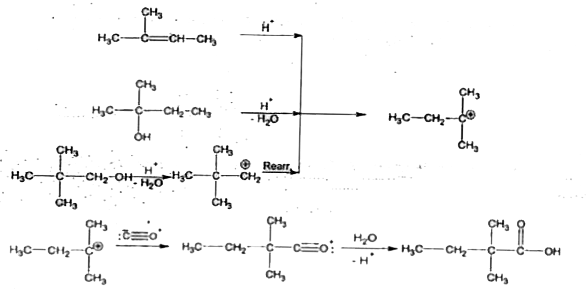
|
|
| 40. |
Colligative properties depend on ______ |
|
Answer» the NATURE of the solute PARTICLES dissolved in solution. |
|
| 41. |
CO cannot be used for the reduction of ZnO- why? |
| Answer» Solution :`Delta_(f)G^(@)` of `CO_(2)` from `CO` always remains less negative than the `Delta_(f)G^(@)` of `ZnO`. Therefore, CO cannot be USED for the REDUCTION of `ZnO.` | |
| 42. |
For intravenous injections, only solutions with freezing point depression equal to that of 0.9% NaCl solution is used Why ? |
| Answer» Solution :Due to same OSMOTIC pressure, i.e., BLOOD is ISOTONIC with this solution. | |
| 44. |
Colligative properties are properties of solutions which depend on the number of solute particles irrespective of their nature. Name the four important colligative properties |
|
Answer» Solution :(i) RELATIVE lowering of vapour PRESSURE (ii) ELEVATION in boiling point (III) DEPRESSION in freezing point Osmotic pressure |
|
| 45. |
C_(n)H_(2n) is the general formula of : |
|
Answer» Only ALKENES |
|
| 46. |
Colligative properties are properties of solutions which depend on the number of solute particles irrespective of their nature. What happens to the colligative properties when ethanoic acid is treated with benzene ? |
| Answer» Solution :Magnitude of colligative properties decreases due to the decreases in the NUMBER of particles . This is due to association of ethanoic acid in benzene to form DIMERS. | |
| 47. |
C_(n)H_(2n) O is general formula for |
|
Answer» ALDEHYDES |
|
| 48. |
Colligative properties are properties of solution which depends on the number of solute particles in the solution. The value of van't Hoff factor, 'i', for aqueous KCl solution is close to 2, while the value of 'I' for ethanoic acid in benzene is nearly 0.5. Give reasons |
|
Answer» Solution :KCl in AQUEOUS solution undergoes dissociation as KCl`toK^++Cl^-` Thus, the NUMBER of PARTICLES in solution becomes double and hence van.t Hoff factor .I. for aqueous KCl solution is close to 2. ETHANOIC acid in benzene undergoes, association (dimerisation). `therefore` i is nearly |
|
| 49. |
CN^(-) solution is used in the extraction of which metal ? |
|
Answer» AG |
|