

Saved Bookmarks
This section includes 7 InterviewSolutions, each offering curated multiple-choice questions to sharpen your Current Affairs knowledge and support exam preparation. Choose a topic below to get started.
| 1. |
CO_((g))+H_(2(g))overset([X])rarrHCHO_((g)) In above reaction, what is [X] ? (A) |
|
Answer» `NI//CrO_(3)` |
|
| 2. |
Clemmensen reduction of a ketone is carried out in presence of - |
|
Answer» `H_2` with PD as catalyst |
|
| 3. |
Cleasing action of cationic detergent is due to |
|
Answer» HYDROPHOBIC PART of cation |
|
| 4. |
CO(g)+H_(2)(g)overset(Cu)toX CO(g)+H_(2)(g)overset(Cu//ZnO-Cr_(2)O_(3))toY CO(g)+H_(2)(g)overset(Ni)toZ X,Y and Z respectively are |
|
Answer» `CH_(3) OH, HCHO, CH_(4)` |
|
| 5. |
Clay is an example of |
|
Answer» THREE DIMENSIONAL SILICATES |
|
| 6. |
CO_((g))+2H_(2(g))overset(?)rarrCH_(3)OH_((g)) |
|
Answer» `NI` |
|
| 7. |
Claus obtained ........... by subjecting ............ to high frequency ultrasonic vibrations. |
| Answer» SOLUTION :MERCURY SOL , mercury | |
| 8. |
Claude process is used in the manufacture of: |
|
Answer» `N_2` |
|
| 9. |
[CoF_(6)]^(3-) is |
|
Answer» paramagnetic and under `SP^(3)d^(2)` hybridisation `[CoF_(6)]^(3-):CO^(3+)(3D^(6))` 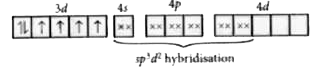
|
|
| 10. |
Classify the following species into Lewis acids and Lewis bases and show how these can act a Lewis acid/ Lewis base? OH^- ions (ii)F^- (iii)H^+ (iv) BCl_3 |
|
Answer» Solution :`OH^-` IONS can DONATE an electron pair and act as Lewis base. (II) `F^-` ions can donate an electron pair and act as Lewis base. (iii) `H^+` ions can accept an electron pair and act as Lewis base. (iv) `BCl_3` can accept in electron pair since Boron atom is electron DEFICIENT. It is a lewis acid. |
|
| 11. |
[CoF_(6)]^(3-) forms outer orbital complexes while (Co(CN)_(6)]^(3-)forms inner orbital complexes. Why |
| Answer» Solution :In`[CoF_(6)^(3-)` FIONS provide a weak LIGAND field and therefore unpaired electrons of cobalt do not get PAIRED. As a result, the orbitals of outer shell are used in hybridization `(sp^(3)d^(2)`. On the contrary, in `[CO(CN)_(6)]^(3+)` the strong ligand field of `CN^(-)` forces the PAIRING of electrons, in inner shell VACATING the inner d-orbitals for hybridization `(d^(2)sp^(3))` | |
| 12. |
Classify the following solids on the basis of bonding considerations : CO_(2), MgO, Al, H_(2), Si, Gd, Pb, AgCl. |
|
Answer» Solution :The SOLIDS are arranged against the type of bonding as under : `{:("Molecular solids", - ,CO_(2) H_(2)),("Iconic solids ",- , MgO AgCI),("Covalent solids ",-,Si),("Metalliac solids",- ,"Gd Al Pb."):}` |
|
| 13. |
COF_2gas passed over a catalyst at 1000^@Ccomes to equilibrium:2 COF_2(g)iffCO_2(g) + CF_4(g)Analysis of the equilibrium mixture (after quick cooling to freeze the equilibrium) shows that 500 mL of equilibrium mixture (NTP) contains 300 mL (NTP) of COF_2 and CO_2 . Taking the total pressure to be 10 atm, calculate K_p . |
|
Answer» SOLUTION :At eqb:`UNDERSET(100ML)(2COF_2) IFF underset(200ML)(CO_2) + underset(200mL)(CF_4)` 4.0 |
|
| 14. |
[Co(en)_(3)]^(3+) ion is expected to show : |
|
Answer» TWO optically ACTIVE isomers : d and l forms |
|
| 15. |
Classify the following solids into different types (a) Ammonium phosphate (b) Brass (c) S_(8) molecule (d) Diamond |
Answer» SOLUTION :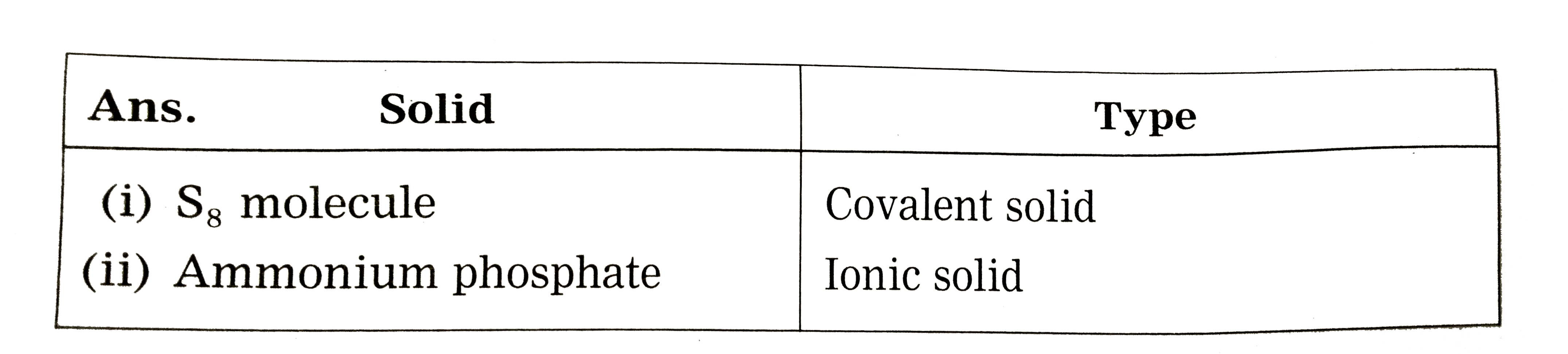
|
|
| 16. |
Classify the following solids into isotropic and anisotropic. Polyvinylchloride, Rubber, Glucose, Glass |
|
Answer» SOLUTION :ANISOTROPIC - GLUCOSE Istropic-Glass,RUBBER,POLYVINYLCHLORIDE |
|
| 17. |
Classify the following solids in different categories based on the nature of intermolecular forces operating in them : Potassium sulphate, tin, benzene, urea, ammonia, water, zinc sulphide, graphite, rubidium, argon, silicon carbide. |
|
Answer» SOLUTION : METALLIC solids : TIN, Rubidium Ionic solids : Potassium sulphate, Zinc sulphide. Covalent solids : Graphite, Silicon carbide Molecular solids : BENZENE, Urea, Ammonia, Water, Argon. |
|
| 18. |
[Co(en)_2(NH_3)_2]Cl_3 can exhibit (A) ionisation isomerism (B) geometrical isomerism (C) optical isomerism |
| Answer» Answer :B | |
| 19. |
Classify the following solids in different categories based on the nature of intermolecular forces operating in them : Potassium sulphate, tin, benzene, urea, ammonia, water, zinc sulphide, graphite, rubidium, argon, silicon carbide. Solid Category Potassium sulphate Ionic |
| Answer» Solution :`{:("Solid","Category"),("Potassium sulphate","Ionic"),("Tin","Metallic"),("Benzene","MOLECULAR"),("Urea","Molecular"),("Ammonia","Molecular with H-bonds"),("Water","Molecular with H-bonds"):}{:("Solid","Category"),("ZINC sulphide","Ionic"),("Graphite","Covalent"),("Rubidium","Metallic"),("ARGON","Molecular"),("Silicon carbide","Covalent"):}` | |
| 20. |
[Co(en)_(2)Cl_(2)]Br react with silver nitrate to form.............coloured precipitate. |
|
Answer» |
|
| 21. |
Classify the following solids in different categories based on the nature of intermolecular forces operating in them : Potassium sulphate, tin, benzene, urea, ammonia, water, zinc sulphide, graphite, rubidium, argon, silicon carbide. |
| Answer» Solution :`{:("Potassium sulphate","Ionic"),("Tin","Metallic"),("Benzene","Molecular (non polar)"),("Urea","Molecular (polar)"),("Ammonia","Molecular (hydrogen bonded)"),("WATER","Molecular (hydrogen bonded)"),("Zinc sulphide","Ionic"),("Graphite","Covalent or NETWORK"),("RUBIDIUM","Metallic"),("ARGON","Molecular (non polar)"),("SILICON carbide","Covalent or Network"):}` | |
| 22. |
Coductivity of an electrolytic solution depends on____ |
|
Answer» NATURE of electrolyte |
|
| 23. |
Classify the following solids based on the nature of intermolecular forces operating in them: potassiumsulphate, tin, benzene, urea, ammonia, water, zinc sulphide, graphite, rubidium, argon, silicon carbide. |
|
Answer» Solution :Molecular SOLIDS: BENZENE, urea, AMMONIA, water, argon ionic solids : potassium sulphate, zinc suphide metallic solids : tin, RUBIDIUM covalent solids : graphite, silicon carbide |
|
| 24. |
Classify the following solids (a) P_(4) (b) Brass (c ) Diamond (d) NaCl (e ) Iodine |
|
Answer» Solution :(a) `P_(4)` - Molecular solid (B) Brass - Metallic solid (C ) Diamond - Covalent solid (d) NACL - IONIC solid (e ) Iodine - Molecular solid |
|
| 25. |
[Co(e n)_(3)]^(3+) ion is expected to show :- |
|
Answer» Two OPTICALLY active isomers |
|
| 26. |
Codon is present in |
|
Answer» t- RNA |
|
| 27. |
Classify the following solids (a) P_(4), (b) Brass (c) Diamond (d) NaCI (e) lodine |
| Answer» SOLUTION :`{:("(a) P4 - MOLECULAR SOLID"),("(b) Brass - Metallic solid"),("(C) Diamond - Covalent solid"),("(d) NaCl - Ionic solid"),("(E) Iodine - Molecular solid"):}` | |
| 28. |
COD stands for |
|
Answer» ChemicalOxygendemand . |
|
| 29. |
Classify the following reactions as homegeneous and heterogeneous catalysis : (a) Vegetable oil (l)+H_(2)(g)overset (Ni(s))rarrVegetable ghee (s) (b) C_(12)H_(22)O_(11)(aq)+H_(2)O(l) overset (H_(2)SO_(4)(aq))rarr C_(6) H_(12)O_(6)(aq)+C_(6)H_(12)O_(6)(aq) |
|
Answer» SOLUTION :(a) : HETEROGENEOUS CATALYSIS (B): HOMOGENEOUS catalysis |
|
| 30. |
Cod liver oil is- |
|
Answer» FAT DISPERSED in water |
|
| 31. |
Classify the following reaction in one of the reacation type studied in this unit. (1) CH_(3)CH_(2)Br+HS^(-)rarrCH_(3)CH_(2)SH+Br^(-) (2) (CH_(3))_(2)C=CH_(2)+HCIrarr(CH_(3))_(2)C CI-CH_(3) (3) CH_(3)CH_(2)Br+HO^(-)rarrCH_(2)=CH_(2)+H_(2)O+Br^(-) (4) (CH_(3))_(3)C-CH_(2)OH+HBrrarr(CH_(3))_(2)CBrCH_(2)CH_(2)CH_(3)+H_(2)O |
|
Answer» Solution :(1) Nucleophilic substitution (2) ELECTROPHILIC ADDITION (3) `BETA` - ELIMINATION (4) Nucleophilic substitution & rearrangement |
|
| 32. |
Classify the following ligand based on the number of donor atoms. (a) NH_(3) (b) en (c )"ox"^(2-) (d) triaminotriethylamine (e) pyridine |
|
Answer» Solution :`(a) NH_(3)`- Monodentate LIGANDS (`N`-Donor ATOM) `(B) en`- Bidentate ligand (`2N`-Donor atom) `(c ) OX^(2-)`- Bidentate ligand (`2O`- Donor atom ) `(d)` triaminotriethylamine- Tridentate ligand (`3N`-Donor atom) `(e )` pyridine- Monodentate ligand (`N`- Donor atom) |
|
| 33. |
Classify the following ligands into monodentate and polydentate : (a) Ammonia (b ) Carbon monoxide(c ) Ethylene diamine (d ) Ethylene diamine tetra 0 acetate ion |
|
Answer» Solution :Monodentate LIGANDS are : AMMONIA Carbon MONOXIDE Polydenatate ligands are : ETHYLENE diamine Ethylene diamine tetra - acetate ION. |
|
| 34. |
Fats on alkaline hydrolysis, give |
|
Answer» Glycol It is a SAPONIFICATION REACTION. |
|
| 35. |
Classifythe following intomonosacharides ,oligosaccharides and polysaccharides . (i)Strach(ii) fructose(iii) surcose (iv) lactose(v) maltose . |
|
Answer» Solution :(i) Starch -Polysaccharides . (II) FURCTOSE- Mono saccharides . (iii) SURCOSE- Oligo saccharides . (iv)LACTOSE - Oilgosacchardie (v) MALTOSE - Oligosaccharide . Surcose , Lactose and Maltoseare typicaldisaccharides . |
|
| 36. |
Coconut charcoal at 93K in used to separate |
| Answer» Answer :D | |
| 37. |
Coconut charcoal at-180^0C is used to separate a mixture of: |
|
Answer» AR and Kr |
|
| 38. |
Classify the following into monosaccharides and disaccharides. Ribose, 2-deoxyribose, maltose, galactose, fructose and lactose. |
|
Answer» Solution :MONOSACCHARIDES : Ribose, 2-deoxyribose, galactose and FRUCTOSE. Disaccharides : MALTOSE and Lactose |
|
| 39. |
Coconut charcoal at -100^@C adsorbs a mixture of |
|
Answer» He and KR |
|
| 40. |
Classify the following into monosaccharides, , oligosaccharides and polysaccharides i) Starch ii) fructose iii) sucrose iv) lactose v) maltose |
|
Answer» Solution :(i) Starch -Polysaccharide (ii) FRUCTOSE - monosaccharide (iii) SUCROSE- oligosaccharides (IV) lactose- oligosaccharides (v) MALTOSE - oligosaccharide |
|
| 41. |
Coconut charcoal at-100^0C absorbs in a mixture of: |
|
Answer» He and KR |
|
| 42. |
Classify the following into monosaccharides and disaccharides : Ribose, 2-deoxyribose, maltose, galactose, fructose and lactose. |
|
Answer» Solution :MONOSACCHARIDES : RIBOSE, 2-deoxyribose, galactose and FRUCTOSE. DISACCHARIDES : Maltose and lactose. |
|
| 43. |
COCO_(3((s))hArrCaO_((s))+SO_(2(g)) with of the following expression is correct or For the equlibrium CaCO_(3(s))hArrCaO_((s))+CO_(2(s)) the equlibrium constant is perpesented by the following from |
|
Answer» `K_(p)=(P_(CaO+P_(CO_(2)))//P_(CaCo_(3)))` Solid molecule does not have PARTIAL pressure so in calculation of `K_(p)` only `P_(CO_(2))` is applicable. |
|
| 44. |
Classify the following into monosaccharides and disaccharides. Ribose, 2-deoxyribose , maltose, galactose, fructose and lactose. |
|
Answer» SOLUTION :Monosaccharides : RIBOSE , 2-deoxyribose , GALACTOSE and FRUCTOSE. Disaccharides : Maltose and LACTOSE. |
|
| 45. |
[Co(CN)_(6)]^(3-) and [CoF_(6)]^(3-) both are octahedral complexes. Then what is the difference between the two ? |
| Answer» Solution :`[CO(CN)_(6)]^(3-)` is an inner ORBITAL or low spin complex INVOLVING the hybridisation `d^(2)sp^(3)` while `[CoF_(6)]^(3-)` is an outer orbital or high spin complex involving `sp^(3)d^(2)` hybridisation. | |
| 46. |
Classify the following into homopolymer or copolymer Nylon 6, HDPE |
| Answer» Solution :Nylon 6 and HDPE 9 or HDP) are HOMOPOLYMERS | |
| 47. |
Classify the following into electrophilic and nucleophilic reagents: (a)H^(+)"(b) " Cl^(-)" (d) "NH_(3)"(d)"NO_(2)^(+)"(e)"Cbar(N)"(f)"H_(2)O "(g)"Br^(+)"(h)"ROH"(i)"BF_(3)"(j)"RNH_(2)"(k)"AlCl_(3) "(l)"ROR"(m) Carbocations(n)Carbanions(o) "SO_(3)H "(p)"BeCl_(2)"(q) "I^(-)"(r) "SnCl_(4)"(s)":"CCl"_(2)"(t) ":P(CH_(3))_(3) (u) H_(2)C=CH_(2) (B) Classify the following as Lewis acids and Lewis bases : (a)CH_(3)NH_(2)"(b)"CN^(-)"(c)"AlCl_(3)"(d)"Fe^(3+)"(e) "CO_(2)^(-) |
|
Answer» <P> SOLUTION :Electrophilic reagents: (a), (d), (g), (i), (k), (m), (o), (p), (r), (s)Nucleophilic reagents: (b), (c), (e), (f), (h), (j), (l), (N), (q), (t), (U). 1(B) Lewis ACIDS : (c), (d) Lewis bases : (a), (b), (c) |
|
| 48. |
[CoCl(NH_(3))_(4)(H_(2)O)]Br_(2) and [Co(NH_(3))_(4)Br_(2)]Cl.H_(2)O are …. Isomers as well as …… . |
| Answer» SOLUTION :IONIZATION, HYDRATE | |