Saved Bookmarks
This section includes 7 InterviewSolutions, each offering curated multiple-choice questions to sharpen your Current Affairs knowledge and support exam preparation. Choose a topic below to get started.
| 1. |
Give one example each of solutions showing positive and negative deviation from Raoult,s law, with reason. |
|
Answer» Lower |
|
| 2. |
Bile juice aids in the digestion and absorption of fats because it contains: |
|
Answer» BILE pigment |
|
| 4. |
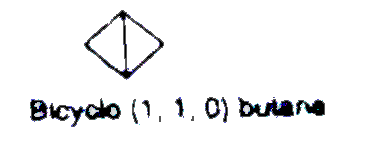
Bicyclo (1, 1, 0) butane is |
|
Answer»
|
|
| 5. |
BiCl_3 on hydrolysis form a white ppt of |
|
Answer» Bismuth acid |
|
| 6. |
BiCl_(3) is more stable than BiCl_(5). Why ? |
|
Answer» |
|
| 7. |
BHT, BHA, SO_2 , Vitamin E, sorbitol. |
| Answer» SOLUTION : Sorbitol. It is a SUGAR SUBSTITUENT where as OTHERS are antioxidants. | |
| 8. |
BHT as antioxidant. |
| Answer» Solution :BHT REDUCES rancidity of oil. (2) It is USED to preserve colour, odour and taste of foodstuff. (3) It is used in chewing GUM, cereals and OILS. | |
| 9. |
B.H.C. is used as a pesticide in agriculture under the trade name : |
|
Answer» GAMMEXANE |
|
| 10. |
Bhopal gas tragedy was caused by |
|
Answer» Methylamine |
|
| 11. |
Bharath went to his grandfather’s house in winter this year. As usual he went for fishing. His grandmother told him there will be no fishes in the lake. He noticed that it was more difficult to find fishes in winter. The fishes were deep inside the river. Whereas in summer they were on the surface and hence he was able to catch fishes. (a) Why are fishes on the surface in water than in the depth in summer?Srisha wanted to keep ice creams without melting. So he had to keep it on ice taken in a container. His grandmother advised him to pour salt on the ice.(a)Why?(b) What value can be derived from this? |
|
Answer» Solution :According to Henry’s law at low temperature gases are more soluble and hence as more oxygengets dissolved in WATER fishes survive better even in DEPTH of the river. In summer as the oxygenis less in water the fishes come to the surface. (B)The value that I DERIVE from this is WISDOM is superior to knowledge |
|
| 12. |
BHA as antioxidant. |
| Answer» Solution :BHA is used to preserve COLOUR, and taste of FOODSTUFF. (2) It is used in consmetics, pharmaceutical, animal feed and in BUTTER to increases its STORAGE life from months to years. | |
| 13. |
BHAis |
|
Answer» buthlated p-hydroxy anisole |
|
| 14. |
BHA and BHT are most familiar example of |
|
Answer» HYPNOTICS |
|
| 15. |
BF_4 acts as acid according to : |
|
Answer» Arrhenius |
|
| 16. |
BF_3 is used as a catalyst in various organic reactions because |
|
Answer» it is a STRONG reducing agent |
|
| 17. |
BF_(3) is used as a catalyst in several industrial processes due to its |
|
Answer» Strong reducing agent |
|
| 18. |
BF_3 is termed as an acid though it does not contain H^+ ions. Explain . |
| Answer» Solution :According to Lewis CONCEPT of ACID and BASES, any SPECIES capable of accepting an electron PAIR is an acid. `BF_3` is electron deficient so accepts a pair of electron , Hence, termed as acid. | |
| 19. |
BF_3 is an acid according to : |
|
Answer» ARRHENIUS concept |
|
| 20. |
BF_3 is an example of Lewis acid because it behaves as : |
|
Answer» Electrophile |
|
| 21. |
Beznyl iodide is obtained from benzyl brimide by sing |
| Answer» Answer :D | |
| 22. |
Between two isotherms we have a cycle as shown. Find the work done by the gas during the cycle in (J). [Take: T_(1) = 127^(@)C, T_(2) = 16^(@)C, n = 1 mole] |
|
Answer» |
|
| 23. |
Between sodiumhydrogencarbonate and magnesium hydroxide which is a better antacid and why ? |
| Answer» SOLUTION :Magnesium hydroxide `[Mg(OH)_(2)]` is a batter antacid because beinginsoluble it does not allow the pH to increase neturaility. On the other han, sodium hydrogen carbonate being soluable and its excess amount can make the stomach ALKALINE and trigger the PRODUCTION of even more acid. | |
| 24. |
Between sodium hydrogencarbonate and magnesium hydroxide which is a better antacid and why? |
| Answer» Solution :MAGNESIUM HYDROXIDE `[Mg(OH)_(2)]` is a better antacid because being insoluble it does not allow the pH to increase above NEUTRALITY. On the other hand, SODIUM hydrogen carbonate being soluble and its excess amount can make the stomach alkaline and TRIGGER the production of even more acid. | |
| 25. |
Between sodium hydrogen carbonate and magnesium hydroxide which is a better antacid and why? |
| Answer» Solution :Magnesium HYDROXIDE is a BETTER antacid because being insoluble it does not allow the pH to INCREASE above neutrality. On the other hand, sodium HYDROGEN carbonate being soluble, its EXCESS can make the stomach alkaline and trigger the production of even more acid | |
| 26. |
Between sea water and pure water, which boils at a higher temperature ? |
| Answer» SOLUTION :SEA WATER | |
| 27. |
Between sea water and drinking water which will freeze at lower temperature? |
| Answer» SOLUTION :SEA WATER | |
| 28. |
Between phenol and alcohol which is more acidic ? Why ? |
| Answer» Solution :Phenol is more acidic than ALCOHOL. Reason: PHENOXIDE ion is resonancestablised whereas alkoxide is not RESONANCE stablished. | |
| 29. |
Between NH_3 and PH_3 which one is more basic ? |
| Answer» SOLUTION :`NH_3` is more basic than `PH_3`, DUE to greater ELECTRON DENSITY on SMALLER N-atom of `NH_3`. | |
| 30. |
Between N and O, which one has higher ionisation potential ? |
| Answer» Solution :N-atom `(N^7 = 1s^2 2s^2 2p_x ^1 2p_y ^1 2p_z ^1)` has HIGHER ionisation potential DUE to its half-filled stable ELECTRONIC configuration as compared to O-atom. | |
| 31. |
Between N_2O_3 and N_2O_5, which oxide is more acidic ? |
| Answer» SOLUTION :`N_2O_5` is more ACIDIC, DUE to higher oxidation number (+5) of N-atom in `N_2O_5` as compared to +3 O.N. in `N_2O_3` | |
| 32. |
Between ionic and covalent bonds, there are large majority of bonds, in which the bonding electrons are shared unequally between two atoms but are not completely transferred.Such bonds are said to be polar covalent bonds and the bond polarity is due to difference in electronegativity, the ability of an atom in a molecule to attract the shared electrons in a covalent bond. The measure of net polarity is a quantity called the dipole moment, mu , which is defined as the magnitude of the charge Q at either end of the molecular dipole times the distancer between the charges : mu=Qxxr.Molecular polarities give rise to some of the forces that occur between molecules and these forces are of several different types including dipole-dipole forces, London dispersion forces, and hydrogen bonds. All these intermolecular forces are electrical in origin and result from the mutual attraction of unlike charges or the mutual repulsion of like charges. In which of the following mixtures, the London dispersion force acts as a major intermolecular force of attraction ? |
|
Answer» SODIUM chloride and water |
|
| 33. |
Between ionic and covalent bonds, there are large majority of bonds, in which the bonding electrons are shared unequally between two atoms but are not completely transferred.Such bonds are said to be polar covalent bonds and the bond polarity is due to difference in electronegativity, the ability of an atom in a molecule to attract the shared electrons in a covalent bond. The measure of net polarity is a quantity called the dipole moment, mu , which is defined as the magnitude of the charge Q at either end of the molecular dipole times the distancer between the charges : mu=Qxxr.Molecular polarities give rise to some of the forces that occur between molecules and these forces are of several different types including dipole-dipole forces, London dispersion forces, and hydrogen bonds. All these intermolecular forces are electrical in origin and result from the mutual attraction of unlike charges or the mutual repulsion of like charges. Which of the following statement is true ? |
|
Answer» The dipole MOMENT of `NF_3` is more than `NH_3` 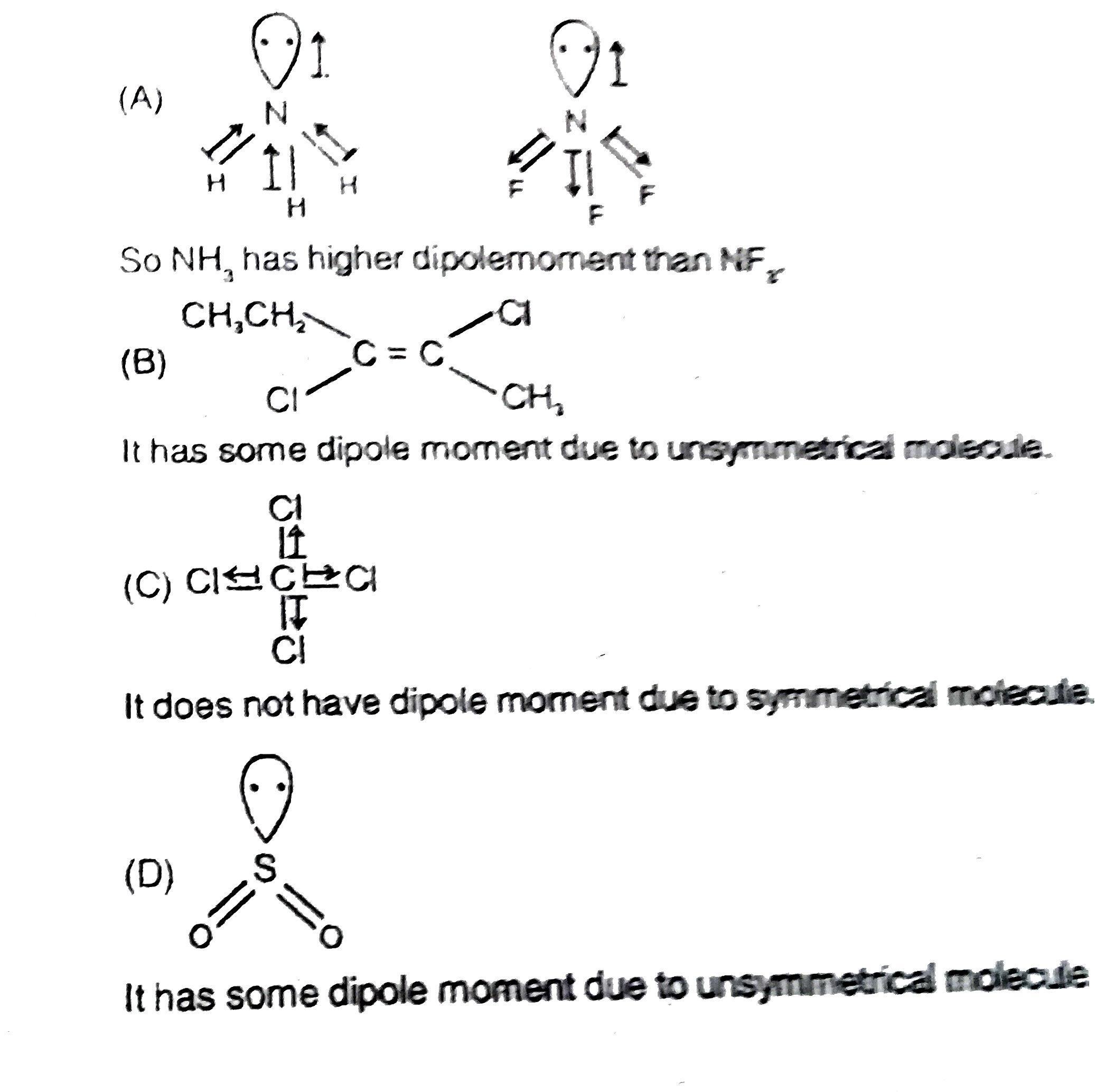
|
|
| 34. |
Between ionic and covalent bonds, there are large majority of bonds, in which the bonding electrons are shared unequally between two atoms but are not completely transferred.Such bonds are said to be polar covalent bonds and the bond polarity is due to difference in electronegativity, the ability of an atom in a molecule to attract the shared electrons in a covalent bond. The measure of net polarity is a quantity called the dipole moment, mu , which is defined as the magnitude of the charge Q at either end of the molecular dipole times the distancer between the charges : mu=Qxxr.Molecular polarities give rise to some of the forces that occur between molecules and these forces are of several different types including dipole-dipole forces, London dispersion forces, and hydrogen bonds. All these intermolecular forces are electrical in origin and result from the mutual attraction of unlike charges or the mutual repulsion of like charges. Which of the following statements is incorrect ? |
|
Answer» Out of trimethylamine and trimethylphsophine , trimethylamine has higher dipole moment 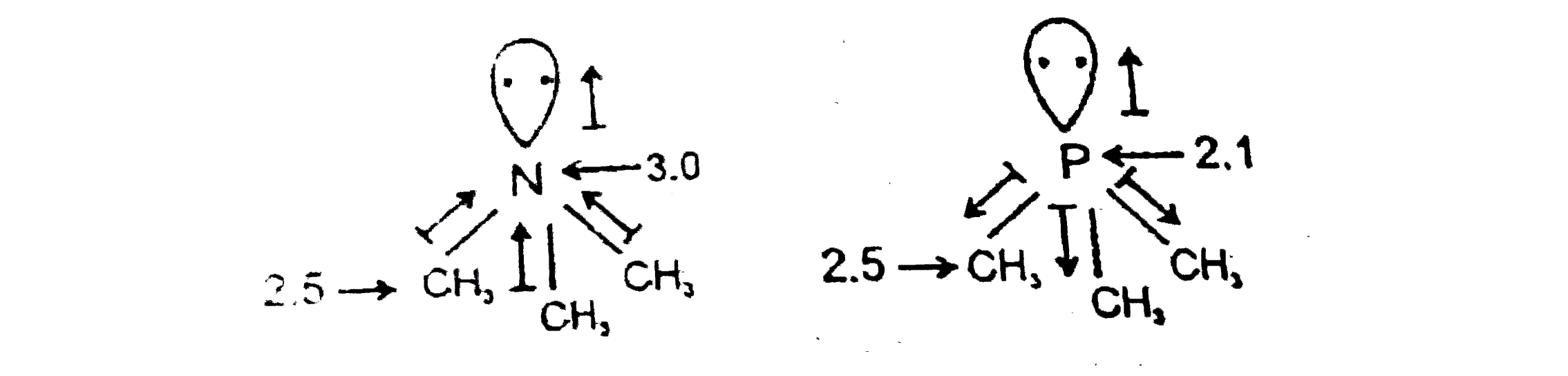 So,dipole moment of trimethylamine is greater than trimethy phosphine. (B)  In trisilyl ether the lone pair of electron on oxygen ATOM is less easily available for donation because of `ppi-dpi` delocalisation due to presence of the vacant d-orbital with Si.This however is not possible with carbon in `CH_3-O-CH_3` due to the absence of d-orbital making it more basic. ( C)The critical temperature DEPENDS on the magnitude (of strength) of intermolecular force of attraction between the molecules.If a molecules has dipole moment it means there is dipole attraction between the molecules and thus it will effect the critical temperature. (D)Hydrogen bond acts as a bridge between atoms which holds one atom by covalent bond and the order by hydrogen bond and this increase in the attraction between molecules. |
|
| 35. |
Between Eu and Ce which one exhibits +2 oxidation state ? |
| Answer» SOLUTION :Eu or MANGANESE DIOXIDE (`MnO_(2)`) | |
| 36. |
Between HF, HCl,has the highest ionic character because |
|
Answer» F has the highest ELECTRON affinity |
|
| 38. |
Between chlorobenzene and chloroethane, which is more reactive towards nucleophilic substitution reaction? |
| Answer» SOLUTION :Chloroethane, is more REACTIVE towards nucleophilic SUBSTITUTION REACTION. | |
| 39. |
Between CH_(3) COOH " and " H - COOH, the HCOOH will be |
|
Answer» LESS ACIDIC |
|
| 40. |
Between CH_3COOH and HCOOH, HCOOH will be |
|
Answer» LESS ACIDIC |
|
| 41. |
Between Caso_4 and Ca_3 (PO_4)_2 which one is require in maximum Concentration to Coagulate positive sol. |
| Answer» SOLUTION :`CaSO_4` | |
| 43. |
Among alcohols and phenols which one is more acidic? |
|
Answer» SOLUTION :PHENOL The phenoxide ION formed by the DISSOCIATION of phenol is stabilized by resonance. |
|
| 44. |
Between acids K_(a) is more for |
|
Answer»
|
|
| 45. |
Between 2M glucose solution and 1M glucose solution which one has a lower freezing point ? |
| Answer» SOLUTION :2M GLUCOSE. | |
| 46. |
Between 2 M glucose solution and 1 M glucose, which one has a lower freezing point? |
| Answer» Solution :HIGHER the concentration, greater is the depression and HENCE LOWER is the freezing point. Thus, 2 M glucose solution will have lower freezing point. | |
| 47. |
Between 0.1 M KCl and 0.1 M NaCl, 0.1 M KCl is least conductor, because. . . . |
|
Answer» SIZE of `NA^(+)` is smaller than `K^(+)`. |
|
| 48. |
between 0 and 1 in all cases |
|
Answer» between 2 and 4 in all cases |
|
| 49. |
Bethe and Van vleck proposed a coordination theory named as ………….. |
|
Answer» WERNER's theory |
|