

Saved Bookmarks
This section includes 7 InterviewSolutions, each offering curated multiple-choice questions to sharpen your Current Affairs knowledge and support exam preparation. Choose a topic below to get started.
| 1. |
An example of a sigma bonded organometallic compound is: |
|
Answer» GRIGNARD's reagent |
|
| 2. |
An example of a sigma bonded organometallic compound is - |
|
Answer» Ruthenocene |
|
| 3. |
An example of a sigma bonded organometallic compounds is |
|
Answer» Cobaltocene |
|
| 4. |
An example of a salt that will not hydrolyze is |
|
Answer» `CH_(3)COONH_(4)` `{:(KClhArrK^(+)+Cl^(-)),(underline(H_(2)OhArrH^(+)+OH^(-))),(KCl+H_(2)OhArr(K^(+)+Cl^(-))+H_(2)O):}` Thus concentrations of `H^(+) and OH^(-)` IONS remain equal. i.e. such salts form neutral solutions and do not hydrolyse. |
|
| 5. |
An example of a sigma bonded organometallic compound is |
|
Answer» ruthenocene |
|
| 6. |
An example of a reversible reaction is |
|
Answer» `Pb(NO_(3))_(2)(aq)+2NA(aq)=PnI_(2)(s)+2NaNO_(3)(aq)` |
|
| 7. |
An example of a psychedelic agent is |
|
Answer» DNA |
|
| 8. |
An example of a protein which acts as structural material is : |
|
Answer» haemoglobin |
|
| 9. |
An example of a non-stoichiometric oxide when heated is |
| Answer» Solution :At high temperature, metal excess non-stoichiometric DEFECT is SHOWN by ZnO, because it loses OXYGEN on heating. | |
| 11. |
An example of a non-stoichiometric compound is : |
|
Answer» `Al_2O_3` |
|
| 12. |
An example of a molecule which is chiral but does not contain chiral carbon atom is : |
|
Answer» `CH_(3)CH(OH)COOH` |
|
| 13. |
An example of a molecule having two lone pairs and three bond pairs is : |
|
Answer» 1. `XeF_(2)` |
|
| 14. |
An example of a major air pollutant is : |
|
Answer» Oxygen |
|
| 15. |
An example of a lipid is |
|
Answer» Lard |
|
| 16. |
An example of a Lewis acid is |
|
Answer» Aluminium chloride |
|
| 17. |
An example of a ferromagnetic oxide is : |
|
Answer» `CrO_(2)` |
|
| 18. |
An example of a fatty acid obtained from a .cooking oil is |
|
Answer» acetic ACID |
|
| 19. |
An example of a disaccharide made up of two units of the same monosaccharides is |
|
Answer» sucrose |
|
| 20. |
An example of a disaccharide made up of two units of the same monosaccharides is : |
|
Answer» SUCROSE |
|
| 21. |
An example of a covalent crystalline solid is |
|
Answer» Si |
|
| 22. |
An example of a condensation polymer is |
|
Answer» PVC |
|
| 23. |
An example of a condensationhomopolymer is |
|
Answer» BAKELITE |
|
| 24. |
An example of a compound with the functional group '-O-' is |
|
Answer» ACETIC acid |
|
| 25. |
An example of a compound with the functional group -O- is |
|
Answer» ACETIC acid |
|
| 26. |
An example of a compound with functional group- O-is : |
|
Answer» ACETIC acid |
|
| 27. |
An example of a bent molecule having bond angle greater than tetrahedral angle is : |
|
Answer» `H_(2)O` |
|
| 28. |
An example of a body centred cube is : |
|
Answer» Sodium |
|
| 29. |
An example of a antiaromatic species is |
|
Answer»
|
|
| 30. |
An example for second order reaction is |
|
Answer» `NO+1/2O_(2)toNO_(2)` |
|
| 31. |
An example for metallic conductor and semiconductor is |
| Answer» Answer :C | |
| 32. |
An example for indigestible (in humans) linear polysaccharide is ? |
|
Answer» CELLULOSE |
|
| 34. |
An example for autocatalysis is |
|
Answer» oxidation of NO to `NO_(2)` The pink colour of `KMnO_(4)` disappears slowly on TREATING it with oxalic acid, but therate of disappearance of colour factens after SOMETIME due to the formation of `Mn^(2+)` ions which acts as autocatalyst for the REACTION. |
|
| 35. |
An example for amino acid hormone is ? |
|
Answer» INSULIN |
|
| 36. |
An example for a strong electrolyte is |
|
Answer» Urea `H_(2)O hArr H^(+) + OH^(-)` `CH_(3)COOH + NaOH`. |
|
| 37. |
An example for a saturated fatty acid , present in nature is |
|
Answer» Oleic acid |
|
| 38. |
An example for a saturated fatty acid, present in nature is |
|
Answer» OLEIC acid Saturated monocarboxylic ACIDS form a homologous series which has a general formula `C_(n)H_(2n+1)COOH`or `C_(n)H_(2n)O_(2)`. Only palmitic acid follows this |
|
| 39. |
An example for a double salt is |
|
Answer» potassium ferricyanide `FeSO_(4)*(NH_(4))_(2)SO_(4)*6H_(2)OtoFe^(2+)` (AQUEOUS)`+2NH_(4)^(+)(aq)+2SO_(4)^(--)(aq)+6H_(2)O` |
|
| 40. |
An example for a neutral buffer is : |
|
Answer» 1. ammonium hydroxide and ammonium chloride |
|
| 41. |
An example for 1:1 electrolyte is |
|
Answer» `H_(2)SO_(4)` |
|
| 42. |
An ethereal solution of an alkyl halide preferably the bromide of iodide, is treated with sodium 2R-X+2Na overset("Ether")toR-R+2NaX 2CH_(3)-Br+2Na overset("Ether")toCH_(3)-CH_(3)+2NaBr CH_(3)CH_(2)Br+2Na+CH_(3)Br overset("Ether")toCH_(3)CH_(2)-CH_(3)+2NaBr In this reaction, the producthas new (C-C) bond with the same type of alkyl halide, the product has symmetery and this helps in deciding the nature of reacting halide. Intermediates are free radicals CH_(3)CH_(2)CH_(2)CH_(3) underset("hv controlled")overset(Cl_(2))to overset("Na//ether")to Major product of the above reaction is |
|
Answer» `CH_(3)(CH_(2))_(6)CH_(3)` |
|
| 43. |
An evacuated glass vessel weighs 50g when empty, 148.0 g when filled with a liquid of density0.98gml^(-1) and 50.5g when filled with an ideal gas at 760mm Hg at 300K . The molar mass of the ideal gas is ( Given R = 0.0821 L atm K^(-1) mol^(-1) ) |
|
Answer» 61.575 Density of liquid `= 0.47 g mL ^(-1)` Volume of glass vessel `= ( " Mass")/( " Density")` `= ( 94)/( 0.47) = 200ML` Pressure of gas, p = 760 mm Hg = 1 ATM Temperature, T = 300K Mass of gas in vessel = 50.5 - 50.0 = 0.5 g pV = nRT or pV = `( m )/( M ) RT ` or `M = ( m RT)/( pV) = ( 0.5 XX 0.082 xx 300)/( 1 xx 0.2)` `= 61.575g mol^(-1)` |
|
| 44. |
An ethereal solution of an alkyl halide preferably the bromide of iodide, is treated with sodium 2R-X+2Na overset("Ether")toR-R+2NaX 2CH_(3)-Br+2Na overset("Ether")toCH_(3)-CH_(3)+2NaBr CH_(3)CH_(2)Br+2Na+CH_(3)Br overset("Ether")toCH_(3)CH_(2)-CH_(3)+2NaBr In this reaction, the producthas new (C-C) bond with the same type of alkyl halide, the product has symmetery and this helps in deciding the nature of reacting halide. Intermediates are free radicals CH_(3)CH_(2)Br undergoes Wurtz reactions. We may expect some of the following products as |
|
Answer» only a 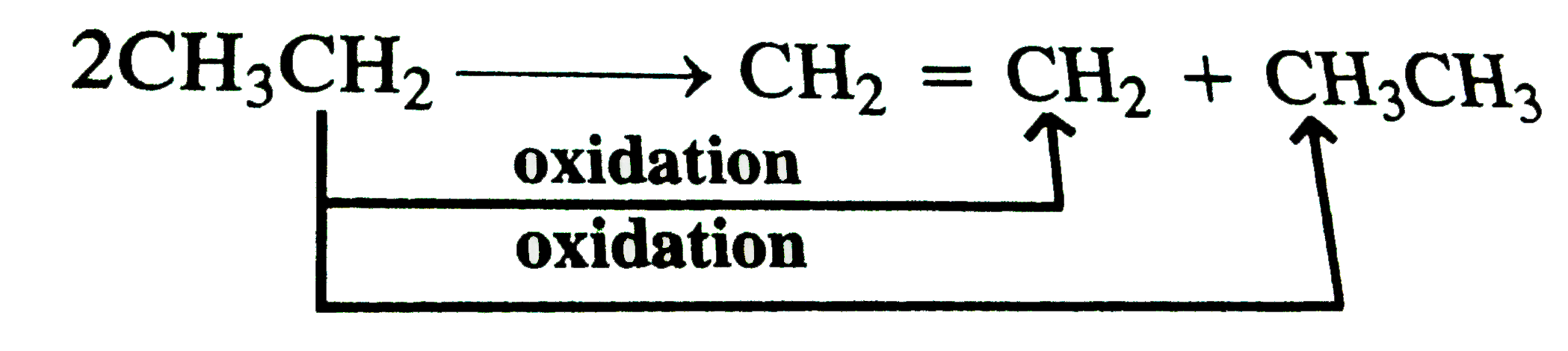
|
|
| 45. |
An ether solution of PhCH_(3) (I), PhNH_(2) (II) and PhOH (III) is extracted with squeous NAOH. The ether layer will contain which compound(s) after the extraction ? |
|
Answer» only III |
|
| 46. |
An etheris obtained when phenol reacts with ___________. |
|
Answer» `(CH_3)_3C Cl//HF` |
|
| 47. |
An ether is not cleaved by HI even at 525K. The compound is |
|
Answer» `C_6H_5OCH_3` |
|
| 48. |
An ether is more volatile than an alcohol having the same molecular formula. This is due to ……………………. . |
|
Answer» dipolar character of ETHERS |
|
| 49. |
An ether is more volatile than alcohol having the same molecular formula. This is due to |
|
Answer» INTERMOLECULAR HYDROGEN BONDING in alcohols |
|
| 50. |
An ether is |
|
Answer» R-O-R' |
|


