

Saved Bookmarks
This section includes 7 InterviewSolutions, each offering curated multiple-choice questions to sharpen your Current Affairs knowledge and support exam preparation. Choose a topic below to get started.
| 1. |
Although chlorine is an electron withdrawing group, yet it is ortho-para directing in electrophilic aromatic substitution reactions, why ? |
|
Answer» SOLUTION :THISIS explainedon thebasisof resonance Dueto resonanceelectrondensityis moreat -o- andp-positionsthereforeelectrophilicsubsitutionoccursat o- and -p-positions |
|
| 2. |
Although chlorine is an electron withdrawing group, yet it is ortho-, para- directing in electrophilic aromatic substitution reactions. Why? |
Answer» Solution :Chlorine WITHDRAWS electrons through inductive effect and releases electrons through resonance. Through inductive effect, chlorine destabilises the intermediate carbocation formed during the ELECTROPHILIC substitution. 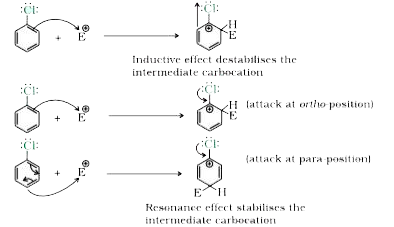 Through resonance, halogen tends to stabilise the carbocation and the effect is more pronounced at ortho- and para- positions. The inductive effect is STRONGER than resonance and causes net electron withdrawal and thus causes net deactivation. The resonance effect tends to oppose the inductive effect for the attack at ortho- and PARAPOSITIONS and hence makes the deactivation less for ortho- and paraattack. Reactivity is thus CONTROLLED by the stronger inductive effect and orientation is controlled by resonance effect. |
|
| 3. |
Although carbon and hydrogen are better reducing agents, by they are not used to reduce metallic oxides at high temperature.Why? |
| Answer» Solution :This is because CARBON and HYDROGEN REACT with METALS to form carbides and HYDRIDES respectively at high temperature. | |
| 4. |
Although carbon and hydrogen are better reducing agents but they are not used to reduce metallic oxides at high temperatures. Why? |
|
Answer» Solution :This is due to formation of metal carbides and metal HYDRIDES at high temperatures. `CaO + 3C OVERSET(2273K)(rarr) + CaC_2 + CO` `Ca + H_2 to CaH_2` |
|
| 5. |
Althoughcarbonand hydrogenare betterreducingagentsbuttheyare notused toreducemetallicoxidesat high temperatures.Why ? |
|
Answer» SOLUTION :Thereasonbeingthat ahightemperatures,metalsreactwith carbonandhydrogento formtheircarbidesandhydridesrespectively. Forexample, ` CaO(s)+3 C (s) overset ( 2273 K) toCa C _2(s)+CO(g) ` `CA(s)+H_2(g) overset (" Heat")toCaH _2(s) ` |
|
| 6. |
Although both polymers are prepared by free radical processes, poly (vinyl chloride) is amorphous and poly (vinylidene chloride) (saran) is highly crystalline. How do you account for the different? (vinylidene chloride is 1,1-dichloroethene). |
Answer» Solution : As poly (vinyl chloride) is ABLE to show stereoisomerism and further it is formed by a free radical PROCESS, it is atactic (chlorine atoms DISTRIBUTED randomly), the molecules fit together poorly. Poly (vinylidene chloride) has two identical substituents on each and the chains fit together well. |
|
| 7. |
Although both allyl alccohol and 1-propanol are primary alcohols, they can still be distinguished by Lucas reagent. Explain how? |
Answer» Solution :The ally carbocation is resonannce stabilzied and hence is as stable as a `3^(@)` carbocation.  Therefore, on TREATEMENT with Lucas reagent, allyl alcohol gives white turbidity in LESS than 1 min. 1-Propanol, on the other hand, does not react with Lucas reagent. `underset("Allyl alcohol")(CH_(2)=CH-CH_(2)OH) underset(("Lucas reagent"))overset(HCl+ZnCl_(2))to underset("Turbidity in " lt " 1min".)(CH_(2)=CH-CH_(2)CL)underset("1-Propanol")(CH_(3)CH_(2)CH_(2)OH) underset(("Lucas reagent"))overset(HCl+ZnCl_(2))to`No action. |
|
| 8. |
Although amino group is o- and p-directing in aromatic electrophilic substitution reactions, aniline on nitration gives a substantial amount of mnitroaniline. Give reason. |
| Answer» Solution :Thisis because in thestronglyacidicconditionsof NITRATION, MOSTOF theanilineof converted intoanilniumion and `""^(+)NH_3` WHICHIS m - DIRECTING | |
| 9. |
Although amino group is o-and p-directing in aromatic electrophilic substitution reactions, aniline on nitration gives a substantial amount of m-nitroaniline . Give reason. |
Answer» Solution :This is because in the STRONGLY ACIDIC conditions of NITRATION, most of the aniline is converted into ANILINIUM ion and `""^(+)NH_3` which is m-directing. 
|
|
| 10. |
Although Aluminium is above hydrogen in the electrochemical series, it is stable in air and water. Explain. |
| Answer» Solution :DUE to the FORMATION of PROTECTIVE OXIDE layer on its surface `(Al_(2)O_(3))`. | |
| 11. |
Although aldehydes are easily oxidisable to the corresponding carboxylic acids yet propanal can conveniently be prepared by the oxidation of propanol by acid potassium dichromate. |
|
Answer» Solution :Aldehydes can be obtained in quantitative YIELD by the oxidation of primary alcohols provided these are REMOVED from the reaction mixture as soon as they are formed to prevent their further oxidation to carboxylic acids. Since alehydes having boilng points less than 373K (b.p. of `H_(2)O`)can be easily removed by distillation, THEREFORE, propanal (b.p. 323K) can be easily prepared from propanonl-1 by distilling it from the alcohol-acid dichromate solution. |
|
| 12. |
Although AgCl is insoluble in water, it readily dissolves upon the addition of ammoniaAgCl(s) + 2NH_3(aq) iff Ag(NH_3)_2^(-) (aq)+ Cl^(-)(aq)(a) What is the equilibrium constant for this dissolving process?(b) Ammonia is added to a solution containing excess AgCl (s). The final volume is 1 litre and the resulting equilibriuin concentration of NH, is 0.80 M. Calculate the number of moles of AgCl dissolved, the molar concentration of Ag(NH_3)_2and the number of moles of NH, added to the original solution. K_(sp) (AgCl) = 1.8 xx 10^(-10) and K_f [Ag(NH_3)_2^+]= 1.7 xx 10^7 . |
| Answer» Solution :`(a) 3.1 XX 10^(-3) ` (b) 0.045 mole, 0.045 mole, 0.89 mole | |
| 13. |
Although aldehydes are easily oxidisable, propanal can conveniently be prepared by oxidation of propanol by acidified potassium dichromate. Why ? |
| Answer» SOLUTION :The aldehydes can beconveniently oxidised to their RESPECTIVE acids only if they are not removed from the reaction MIXTURE during preparation . As the boiling point of propanal is low (323K) , it is conveniently distilled out during the reation . This AVOIDS its further oxidation. | |
| 14. |
Although (+3) oxidation states is the characteristic oxidation state of lanthanoids but cerium shows (+4) oxidation state also. Why? |
| Answer» Solution :In (+4) OXIDATION state, a noble gas configuration `[Xe] 4f^(0) 5d^(0) 6S^(0)` is attained | |
| 15. |
Although +3 oxidation state is the characteristic oxidation state of lanthanoids but cerium shows+4 oxidation state also. Why ? |
| Answer» Solution :`._(58) Ce= [Xe]^(54) 4f^(2) 5d^(0) 6s^(2) . Ce^(3+) = [Xe]^(54) 4f^(1) `. Further lossof ONE electron GIVES stable `4f^(0)` configuration. Hence, it SHOWS `+4` oxidation state ALSO. | |
| 16. |
Although +3 oxidation state is the characteristic oxidation state of lanthanoids but cerium shows +4 oxidation state also. Why? |
| Answer» SOLUTION :The electronic CONFIGURATION of Ce is `-4f^(1)5d^(1)6s^(2)`. Usually `5d^(1)` and `6s^(2)` electrons are lost by the lanthanoids in their REACTIONS i.e., they exhibit +3 oxidation STATES. But Ce exhibit +4 oxidation state also because it gains extra stability by losing `4f^(1)` electron because it will give rise to completely filled ORBITALS. | |
| 17. |
Alternating copolymers are commonest copolymers. Comment |
|
Answer» Solution :Alternating copolymers are usually produced when TWO monomers which differ in their reactive groups undergo CONDENSATION. A dicarboxylic acid reacts with a diol and the CHAIN is propagated to give a polyester like polyethylene terephthalate (PET). PET also called dacron or terylene is an alternating copolymer. Nylon 6,6 is ANOTHER FAMILIAR condensation alternating copolymer. Buna type rubbers, on the other hand, are addition alternating copolymers. |
|
| 18. |
Although +3 is the characteristic oxidation state for langthanoids but certain also shows +4 oxidation state because "…...................." |
|
Answer» |
|
| 19. |
Although (+3) is the characteristic oxidation state for lanthanoids but cerium also shows (+4) oxidation state because… |
|
Answer» It has variable ionisation enthalpy |
|
| 20. |
Name of the protein which is responsible for gout is |
|
Answer» RIBOSE unit |
|
| 21. |
Also explain the behaviour of these ions in magnetic field. |
| Answer» Solution :`Ti^(+4)` and `Ag^(+)` are DIAMAGNETIC in NATURE. So they will be REPELLED by the magnetic field. `Co^(2+)` being PARAMAGNETIC in nature is attracted by the magnetic field. | |
| 22. |
alpha-particles can be detected using |
|
Answer» THIN aluminum |
|
| 23. |
Alpha particles are... Times heavier (approximately) than neutrons |
|
Answer» 2 |
|
| 24. |
Alpha rays consist of a stream of |
|
Answer» `H^(+)` |
|
| 25. |
alpha - particles can be detected using |
|
Answer» Thin ALUMINUM SHEET |
|
| 26. |
alpha -nitroalkene is converted into nitroalkane by |
|
Answer» OXIDATION |
|
| 27. |
Alpha particle is….times heavier than neutron: |
|
Answer» 2 |
|
| 28. |
alpha-maltose can be hydrolysed to glucose according to the following reaction: a - C_(12)H_(22)O_(11)(aq) + H_(2)O(l)to 2C_(6)H_(12)O_(6)(aq). Given standard enthalpy of formation of H_(2)O(l), C_(6)H_(12)O_(6)(aq) C_(12)H_(12)O_(11) are-285, -1263 and - 2238 kJ/mol respectively. Which of the following statements is true? |
|
Answer» The hydrolysis reaction is endothemic |
|
| 29. |
alpha-maltose consists of |
|
Answer» ONE `alpha`-D-GLUCOPYRANOSE unit and one |
|
| 30. |
alpha-hydroxypropanoic acid can be prepared from ethanal by following the steps given in the sequence. |
|
Answer» Treat withHCN followed by acidic hydrolysis. 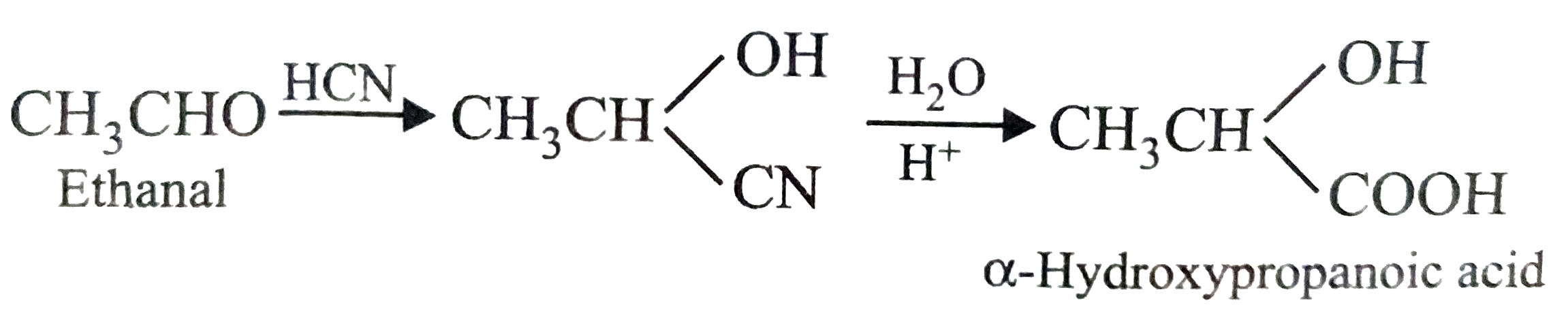
|
|
| 31. |
alpha-hydroxy acetic acid is also known as : |
| Answer» Answer :C | |
| 33. |
alpha-helix is a secondary structure of proteins formed by twisting of polypeptide chain into right handed screw like structures. Which type of interactions are responsible for making the alpha-helix structure stable ? |
| Answer» SOLUTION :Hydrogen BOND between `-NH-` group and `gt C=O` group of the peptide bond stabilises `alpha`-helix STRUCTURE of PROTEINS. | |
| 34. |
alpha-Helix is a secondary structure of proteins formed by twisting of polypeptide chain into right handed screw like structures. Which type of interactions are responsible for making the alpha- helix structure stabel ? |
| Answer» Solution :The `alpha`-helix STRUCTURE of polypeptide chain is stabilized by intramolecular H-bonding in which `gt C=O` of one AMINO acid residue in one TURN FORMS a H-bond with `-NH-` group of the fourth amino acid in the adjacent turn. | |
| 35. |
alpha - Helix is a secondary structure of protein formed by twistingof polypeptidechain into righthanded screw likestructure . Whichtype of interactions areresponsiblefor makingthe alpha - helix structurestable ? |
Answer» Solution :In a `ALPHA -` helix , a polypeptidechain is stabilised by the formationof hydrogenbondsbetween `- NH`-GROUP of amino acids in oneturn with the  groups of amino acidsbelongingto adjacent turn. groups of amino acidsbelongingto adjacent turn.
|
|
| 36. |
alpha-helix and beta- pleated structures of proteins are classified as : |
|
Answer» PRIMARY structure |
|
| 37. |
alpha-halogenation of carboxylic acid is called |
|
Answer» GATTERMANN reaction |
|
| 39. |
alpha-glucose and beta-glucose are |
|
Answer» Isomers |
|
| 40. |
alpha and beta -glucose differ in theorientation of OH goup around |
|
Answer» NUMBER of OH groups |
|
| 41. |
alpha-D- Glucose and beta - D glucose differ from each other due to difference in one carbon with respect to its? |
|
Answer» Size of hemiacetal RING |
|
| 42. |
alpha-D-Glucose and beta-D-Glucose are: |
|
Answer» Epimers |
|
| 43. |
alpha-D(+)-glucose and beta-D(+)- glucose are |
|
Answer» ENANTIOMERS |
|
| 44. |
alpha -D(+) glucose and beta-D(+) glucose are : |
|
Answer» enantiomers |
|
| 45. |
alpha-D glucose and beta-D glucose are : |
|
Answer» ANOMERS |
|
| 46. |
alpha-D-Glucopyranose and beta-D-Glucopyranose are |
|
Answer» Anomers |
|
| 48. |
alpha-D-glucopyranose and beta-D-glucopyranose are : |
|
Answer» stereosiomers |
|
| 49. |
alpha-D-galactose and beta-D-galactose are |
|
Answer» epimers |
|
| 50. |
alpha-(D)-(-)fructose and beta-(D)-(-) fructose are |
|
Answer» anomers |
|