

Saved Bookmarks
This section includes 7 InterviewSolutions, each offering curated multiple-choice questions to sharpen your Current Affairs knowledge and support exam preparation. Choose a topic below to get started.
| 1. |
Alkyl chloride on dehydrochlorination produces 2 alkenes (C_6H_(12) which on ozonolysis form four compounds (i)CH_3CHO,(ii)CH_3CH_2CHO,(iii) CH_3COCH_3 & (iv) (CH_3)_2CHCHO. The alkenes are- |
|
Answer» 4-methypent-2-ene and 2-methylpent-2-ene |
|
| 2. |
Alkyl bromide on treatment with silver fluoride gives alkyfluoride. What is this reaction known as ? |
| Answer» SOLUTION :SWARTS REACTION | |
| 3. |
Alkyl bromide is |
|
Answer» ` CH_2 =CH -CH_2 BR ` |
|
| 4. |
Alkyl benzene sulphonates can be used as detergents in hard water, unlike soaps, as |
|
Answer» They are highly soluble in WATER |
|
| 5. |
Alkyl benzene on oxidation by alkaline KmnO_(4) gives |
|
Answer» ALDEHYDE |
|
| 6. |
Alkyl benzene is converted in to carboxylic acid by using |
|
Answer» NaOX |
|
| 7. |
Alkyl amines are strong base than ammonia. Justify this statement. |
|
Answer» SOLUTION :When a+I GROUP like and ALKYL group is attached to the nitrogen increase the electron density on nitrogen which makes the electron pair readily availble for protonation. Hence alkyl amines are STRONGER than amonia. `underset("Alky amine") (RNH_(2)) underset("more basic")(gt)underset("Ammonia")(NH_(3))` |
|
| 8. |
Alkyl amines are stronger bases than aryl amines. Explain. |
| Answer» Solution :Because alkyl groups are electron releasing (+I) effect. Therefore they are STRONGER bases than aryl amines because aryl group is electron withdrawing (-I) effect. So, electron density is less on N. It is also due to +ve charge on NITROGEN on 3 out of 5 resonating STRUCTURES. | |
| 10. |
Alkyl resins, made of glycerol are used : |
|
Answer» As SUBSTITUTE for WHITE chalk |
|
| 11. |
Alkoxy group attached to benzene ring is ortho and para directing. Justify. |
| Answer» Solution :Alkoxy (R-O) GROUP with +M -effect ACTIVATES the ortho and PARA positions in the ring towards ELECTROPHILIC substitution | |
| 12. |
Alkenes usually undergo : |
|
Answer» ADDITION reactions |
|
| 13. |
Alkenes react rapidly with bromine in non-nucleophilic solvents to form vicinal dibromides.This reaction can be best described as |
|
Answer» ELECTROPHILIC addition |
|
| 14. |
Alkenes convert into alcohols by |
|
Answer» HYDROLYSIS by dill. `H_2SO_4` |
|
| 15. |
Alkenes can be oxidized in presence of different reagents to give different products. Alkenes on oxidation in presence of silver at high temperature give cyclic ethers, which also can be synthesized by using per acids. Alkenes on reductive ozonolysis give carbonyl compounds in presence of zinc and peroxide. On reaction with acidic KMnO4, it also produces corresponding carbonyl compound. Alkynes can also be oxidized in presence of such reagents but the products are different. A hydrocarbon (C_8H_16) on oxidation with a hot acidified solution of KMnO_4 forms 2-buanone and isobutyric acid. The hydrocarbon is |
|
Answer» `(CH_3)_3=C(CH_2CH_3)_2` |
|
| 16. |
Alkenes can be oxidized in presence of different reagents to give different products. Alkenes on oxidation in presence of silver at high temperature give cyclic ethers, which also can be synthesized by using per acids. Alkenes on reductive ozonolysis give carbonyl compounds in presence of zinc and peroxide. On reaction with acidic KMnO4, it also produces corresponding carbonyl compound. Alkynes can also be oxidized in presence of such reagents but the products are different. A hydrocarbon (C_8H_8) absorbs two moles of hydrogen in the presence of a platinum caralyst. The reduction product is inert to bromine and KMnO_4 solution. The hydrocarbon on ozonolysisproduces malonic acid only. The structure of hydrocarbon is |
|
Answer» `CH_2=CH-CH=CH-CH=CH_2` |
|
| 17. |
Alkenes can be oxidized in presence of different reagents to give different products. Alkenes on oxidation in presence of silver at high temperature give cyclic ethers, which also can be synthesized by using per acids. Alkenes on reductive ozonolysis give carbonyl compounds in presence of zinc and peroxide. On reaction with acidic KMnO4, it also produces corresponding carbonyl compound. Alkynes can also be oxidized in presence of such reagents but the products are different. An open chain hydrocarbon (C_7H_12), on ozonolysis produces, methanol and 2-oxopropanal. The hydrocarbon could be |
|
Answer»
|
|
| 18. |
Alkenes can be oxidized in presence of different reagents to give different products. Alkenes on oxidation in presence of silver at high temperature give cyclic ethers, which also can be synthesized by using per acids. Alkenes on reductive ozonolysis give carbonyl compounds in presence of zinc and peroxide. On reaction with acidic KMnO4, it also produces corresponding carbonyl compound. Alkynes can also be oxidized in presence of such reagents but the products are different. Ethane on reaction with MCPBA in CH_2Cl_2 forms a compound (A), which on reaction with CH_2-Mgl and subsequent hydrolysis gives a compound (B). (A) and (B) are, respectively |
|
Answer»
|
|
| 19. |
Alkenes can be oxidized in presence of different reagents to give different products. Alkenes on oxidation in presence of silver at high temperature give cyclic ethers, which also can be synthesized by using per acids. Alkenes on reductive ozonolysis give carbonyl compounds in presence of zinc and peroxide. On reaction with acidic KMnO4, it also produces corresponding carbonyl compound. Alkynes can also be oxidized in presence of such reagents but the products are different. Cyclohexene is allowed to react with ozone and subsequently with H_2O_2 and water. The product formed is |
|
Answer» OXALIC acid |
|
| 20. |
Alkenes are obtained from alcohols by |
|
Answer» OXIDATION |
|
| 21. |
Alkenes and carbonyl compounds both contain a pi bond but alkenes show electrophilic addition reaction whereas carbonyl compounds show nucleophilic addition reactions. Explains. |
|
Answer» Solution :In alkenes, the double bond is formed between two carbon atoms. There is no polarity in the bond. Butit polarises molecules like `Cl_(2), HCl, H_(2)O` ETC., resulting it in the attachment of ELECTROPHILE to one of the carbon atoms. In carbonyl compounds, the double bond is between C and O. Oxygen being electronegative than carbon, the latter attains a SLIGHT POSITIVE charge. This positive carbon attracts the nucleophile giving rise to nucleophilic addition reactions. |
|
| 22. |
Alkenes (A) and (B) yield the same alcohol (C) on hydration. On vigorous oxidation with KMnO_4, (A) gives a carbonyl compound (D) and an acid (E) each containing four carbon atoms. On the other hand, (B) gives an acid (E) and a carbonyl compound (G). In (G) no two identical groups are attached to the same carbon atom. Give the structures of (A) to (G). |
Answer» SOLUTION :(i)SINCE alkene (A) on oxidation gives a carbonyl compound (D) and an acid (E)of four carbon atoms each.  (ii) Alkene (A) and (B) give same alcohol on hydration and THUS compound (B) can only be  (iii) Hydration of (A) and (B) give the same alcohol: 
|
|
| 23. |
Alkene R-CH=CH_2 reacts readily with B_2H_6 and the product on oxidation with alkaline hydrogen peroxides produces |
|
Answer» `R-CH_2-CHO` 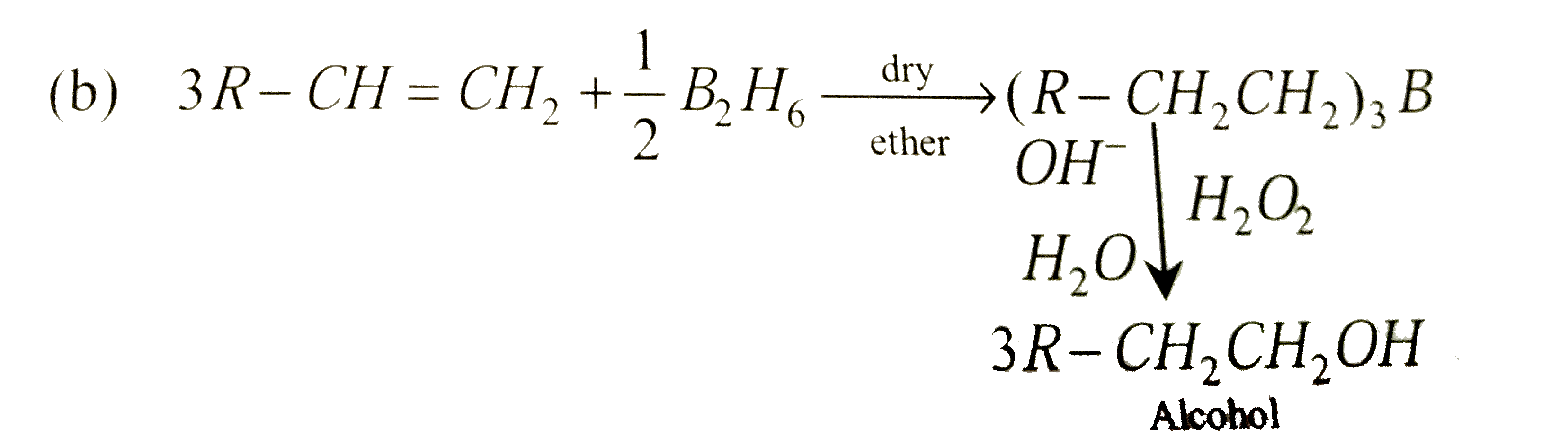
|
|
| 24. |
Alkene can be prepared from alkyl halide by the following reagent R-X+Nu^(-) toAlkene + NuH |
| Answer» Answer :A | |
| 25. |
Alkene-1 on hydroboration followed with action of H_2O_2 gives: |
|
Answer» Alkanol-2 |
|
| 26. |
Alkanes mainly show reactions involving : |
|
Answer» Carbonium |
|
| 27. |
Alkanes are inert is nature, why ? |
|
Answer» Solution :Alkanes are quite inert substances with highly stable nature. Their inactiveness has been explained as: (i) Alkanes have all the `C-C` and `C-H` bons being stronger a bonds and are not INFLUENCED by acid, oxidants under ordinary CONDITIONS. (II) The `C-C` bond is completely non polaar and `C-H` is weak polar. Thus polar species i.e. electrophiles or NUCLEOPHILES are unable to attack these bonds under ordinary conditions. |
|
| 28. |
Alkene R - CH = CH_2 reacts readily with B_2H_6 and the product on oxidation with alkaline hydrogen peroxide produces |
|
Answer» `R - COCH_3` |
|
| 29. |
Alkane mainly shows free radical substitution reaction. Free radical is electrically neutral species having one unpaired electron. All the reaction of alkane involves homolytic fission in presence of light energy. The reaction is exothermic. The reactivity of the halogen is F_(2) gt Cl_(2) gt Br_(2) gt I_(2). More the reactivity of halogen less the selectivity for reaction with free radical. the stability of free radical depends on hyperconjugation. the order is ter>sec>prim>CH_(3)^(**). Breaking a tertiary C-H bond requires the least energy and breaking of primary C-H bond require the most. Q. The smallest chloro alkane which on halogenation produces disteromers is |
|
Answer» 3-methyl ,3-chloro hexane |
|
| 30. |
Alkane mainly shows free radical substitution reaction. Free radical is electrically neutral species having one unpaired electron. All the reaction of alkane involves homolytic fission in presence of light energy. The reaction is exothermic. The reactivity of the halogen is F_(2) gt Cl_(2) gt Br_(2) gt I_(2). More the reactivity of halogen less the selectivity for reaction with free radical. the stability of free radical depends on hyperconjugation. the order is ter>sec>prim>CH_(3)^(**). Breaking a tertiary C-H bond requires the least energy and breaking of primary C-H bond require the most. Q. 2-chlorophenothane on halogenation with chlorine give products gives 2,3, dichloropentane. what will the structure of free radical form in reaction ? |
|
Answer» Planner |
|
| 31. |
Alkane mainly shows free radical substitution reaction. Free radical is electrically neutral species having one unpaired electron. All the reaction of alkane involves homolytic fission in presence of light energy. The reaction is exothermic. The reactivity of the halogen is F_(2) gt Cl_(2) gt Br_(2) gt I_(2). More the reactivity of halogen less the selectivity for reaction with free radical. the stability of free radical depends on hyperconjugation. the order is ter>sec>prim>CH_(3)^(**). Breaking a tertiary C-H bond requires the least energy and breaking of primary C-H bond require the most. Q. What will be major product formed when 2 methyl butene undergoes bromination in presence of light ? |
|
Answer» 1-bromo-2-methyl butene |
|
| 32. |
Alkanamide, which on Hofmann's reaction gives 1- phenylethylamine, is : |
|
Answer» 2- phenylpropanamide |
|
| 33. |
Alkaloids are poisonous and habit forming yet many of them are used as potent medicines, can you name the alkaloid used for the treatment of (i) hypertension, (ii)malaria fever and (iii) severe pain ? |
| Answer» Solution :(i)HYPERTENSION : RESERPINE , (II) Malaria FEVER : QUININE and (iii) Severe pain : Morphine. | |
| 34. |
Alkaline solutionof NH_(4)Cl givesppt with K_(2)HgI_(4) |
|
Answer» `3NaOH +NH_(3) + 2K_(2)HgI_(4) rarr 4KJ + 3NaI + 2H_(2)O` 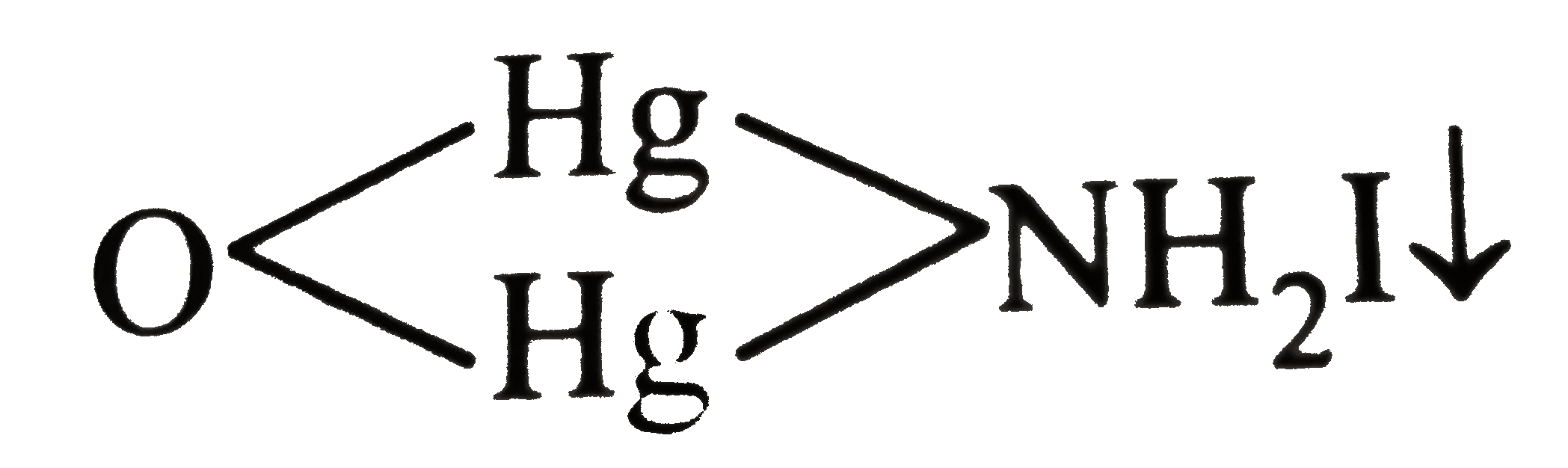
|
|
| 35. |
Alkaline solution of copper sulphate containing sodium potassium tartrate is called as _____. |
| Answer» SOLUTION :ROCHELLE SALT | |
| 36. |
Alkaline sodium nitroprusside is used to confirmthe presence of |
|
Answer» ALDEHYDE |
|
| 37. |
Alkaline Noverset(o+)(H)_(4) salt give brown ppt with K_(2)HgI_(4) brown ppt Is called ______(a)_____. |
|
Answer» |
|
| 38. |
Alkaline medium |
|
Answer» Solution :In alkaline medium : It depends upon the change in oxidation STATE. (i) When the oxidation state of Mn changes from +7 to +6, `therefore E_(KMnO_(4))=(158)/(1)=158` (II) When the oxidation state of Mn changes from +7 to +2. `therefore E_(KMnO_(4))=(158)/(3)=52.67` |
|
| 39. |
Alkaline KMnO_(4) used for the detection of unsaturation in organic compounds is called................. |
| Answer» SOLUTION :Baeyer.s REAGENT. | |
| 40. |
AlkalineKMnO_(4) coverts ethyleneinto : |
|
Answer» ETHANE |
|
| 41. |
Alkaline hydrolysis of which among the following compounds leads to the formation of a racemate ? |
|
Answer» 1-Bromo-1-phenylethane |
|
| 42. |
Alkaline hydrolysis of esters is……. than acid hydrolysis. |
|
Answer» FASTER |
|
| 43. |
Alkaline hydrolysis of R_2C.Cl_2 forms: |
|
Answer» Propanone |
|
| 44. |
Alkaline hydrolysis of esters is known as |
|
Answer» Saponification |
|
| 45. |
Alkaline hydrolysis of cooking oil gives |
| Answer» Solution :both (a) and (b) | |
| 46. |
Alkaline hydrolysis of ester is an example of |
|
Answer» 1ST ORDER reaction |
|
| 47. |
Alkaline hydrolysis of an ester is called |
|
Answer» NEUTRALISATION |
|
| 48. |
Alkaline hydrolysis if 1,1-dichloroalkane yields: |
|
Answer» Alkanal |
|
| 49. |
Alkaline earth metals belong to the |
|
Answer» s-block in PERIODIC table |
|


