

Saved Bookmarks
This section includes 7 InterviewSolutions, each offering curated multiple-choice questions to sharpen your Current Affairs knowledge and support exam preparation. Choose a topic below to get started.
| 1. |
Acetic acid and CH_(3)COCl can bedistinguished by |
|
Answer» `NaHCO_(3)` test (B) Aceticacid will give hydrogengas withsodium metal whereas acetyl chlorides does not. (C ) Both will form ester. (d) Both do not react with `Br_(2) (aq)`. |
|
| 2. |
Acetic acid and CH_(3)COCl can be distinguished by |
|
Answer» `NaHCO_(3)`test |
|
| 3. |
Acetate rayon is a ________. |
|
Answer» NATURAL POLYMER |
|
| 4. |
Acetate rayon is prepared from: |
|
Answer» ACETIC acid |
|
| 5. |
Acetanilide is prepared by the reaction of acetyl chloride on : |
|
Answer» ACETAMIDE |
|
| 6. |
Acetanilide is subjected to nitration and the product formed is subjected to hydrolysis. The resulting final product is mainly |
|
Answer»
|
|
| 7. |
Acetanilide is prepared by the reaction of acetyl chloride on |
|
Answer» acetamide |
|
| 8. |
Acetanilide can be prepared from aniline and which of the following |
|
Answer» Ethanol 
|
|
| 9. |
Acetanilde on nitration followed by hydrolysis yields ----as main product. |
|
Answer» 4-NITRO ANILINE |
|
| 10. |
Acetamide reacts with maximum ease with : |
|
Answer» `C_2H_5OH` |
|
| 11. |
Acetamino phenol, ibuprofen, aspirin, morphine. |
| Answer» SOLUTION :Morphine . It is an opioids (narcotic analgesic) WHEREAS OTHERS are NON narcotic analgesics. | |
| 13. |
Acetamide on reduction with Na//C_(2)H_(5)OH gives: |
|
Answer» ethylarnine |
|
| 14. |
Acetamide is treated with the following reagents separately. Which one of these would yield methylamine? |
|
Answer» `PCl_(5)` |
|
| 15. |
Acetamide is treated separately with the following reagents. Which would give methyl amine. |
|
Answer» `PCl_(5)` |
|
| 16. |
Acetamide is treated separtely with the following reagents. Which one of these gives methylamine |
|
Answer» `NaOH+Br_(2)` |
|
| 17. |
Acetamideis treatedseparately withthe followingreagents. Which one of thesewould givemethylamine ? |
|
Answer» `PCl_(5)` |
|
| 18. |
Acetamide is treated separately with the following reagents. Which one of those gives methylamine : |
|
Answer» NaOBr |
|
| 19. |
Acetamide is treated separately with the following reagents. Which of these would give methyl amine? |
|
Answer» `PCl_(5)` |
|
| 20. |
Acetamide is treated separately with the following reagents. Which one of these would give methylamine ? |
|
Answer» `PCl_(5)`<BR>`NaOH + Br_(2)` |
|
| 21. |
Acetamide is treated separately with the following reagent. Which one of those would give methylamine? |
|
Answer» Soda time<BR>`NaOH+Br_(2)` |
|
| 22. |
Acetamide is : |
|
Answer» NEUTRAL |
|
| 23. |
Acetamide and ethyl amine can be distinguished by reacting with : |
|
Answer» AQUEOUS HCL and heat |
|
| 24. |
Acetals are: |
|
Answer» Aldehyde |
|
| 25. |
Acetals are |
|
Answer» aldehyde |
|
| 26. |
Acetaldoxime reacts with P_(2)O_(5) to give |
|
Answer» METHYL cyanide |
|
| 27. |
Acetaldoxime reacts with P_(2)O_(5) to give : |
|
Answer» Methyl CYANIDE |
|
| 28. |
Acetaldoxime reacts with P_2O_5 to give : |
|
Answer» `CH_3CN` |
|
| 29. |
Acetaldoximeon reductionwith Na//C_(2)H_(5) OH gives |
|
Answer» 2-propanol |
|
| 30. |
Acetaldol is:............ |
|
Answer» 3-Hydroxybutanol |
|
| 31. |
Acetaldehyde, when treated with which among the following reagents does 'not' undergo addition reaction? |
|
Answer» AMMONIA |
|
| 32. |
Acetaldehyde , when treated with which among the following reagents does 'not' undergo addition reaction ? |
|
Answer» AMMONIA |
|
| 33. |
Acetaldehyde undergoes the aldol condensation with dil. NaOH. This is because of the presence of |
|
Answer» `-CHO` GROUP |
|
| 34. |
Acetaldehyde when treated with dilute NaOH gives |
|
Answer» `CH_(3) CH_(2)`OH |
|
| 35. |
Acetaldehyde undergoes self condensation in presence of aluminium ethoxide to give ethyl acetate.This reaction is called: |
|
Answer» PERKIN reaction |
|
| 36. |
Ethanal to propan-2-ol |
Answer» SOLUTION :ACETALDEHYDE to propan-2-ol : 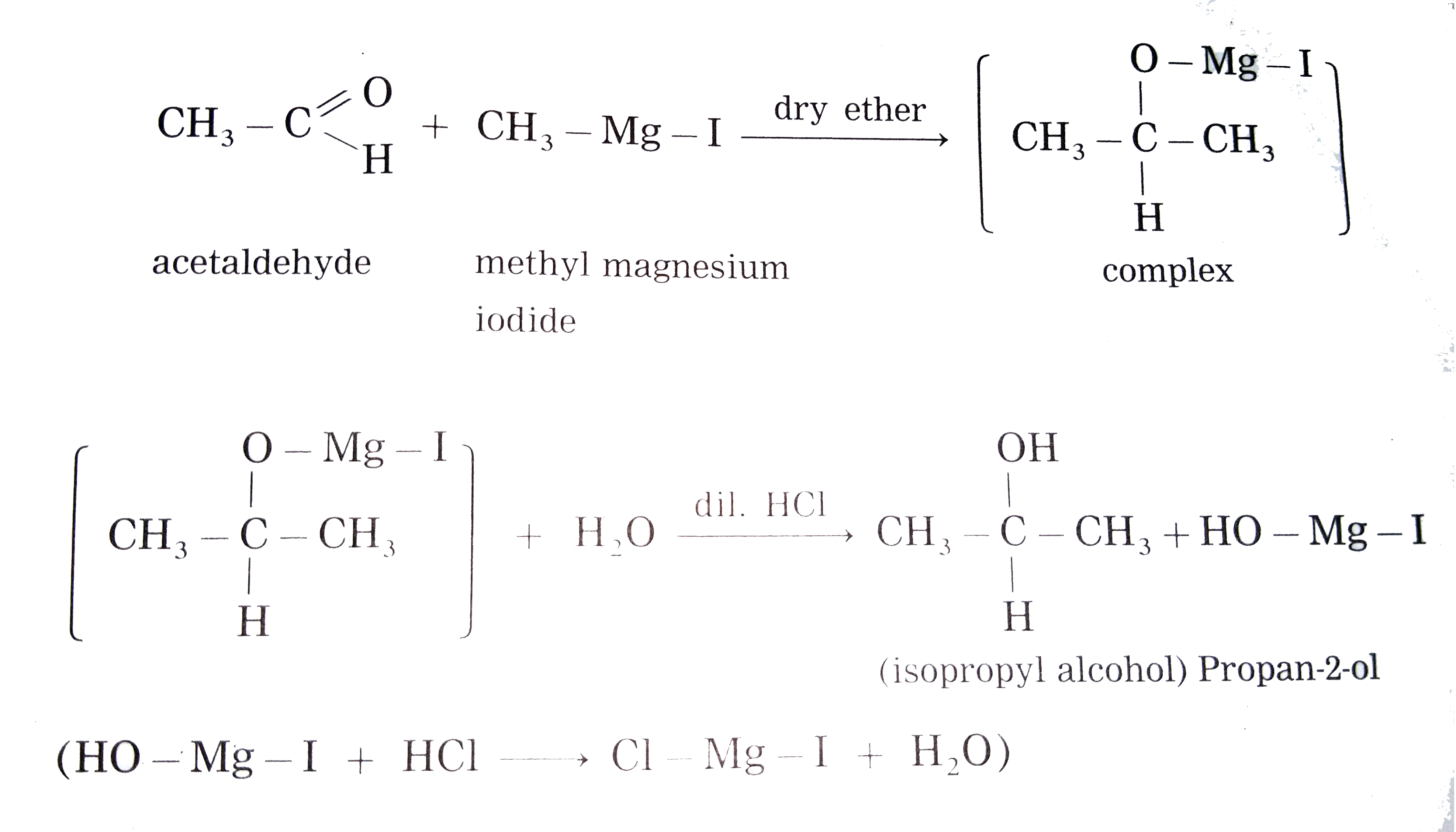
|
|
| 37. |
Acetaldehyde undergoes reaction in the presence of dil. NaOH to give |
| Answer» Answer :D | |
| 38. |
Acetaldehyde to but-2-enoic acid |
Answer» SOLUTION :
|
|
| 39. |
Acetaldehyde reacts with nitromethane in the presence of dil. NaOH to give |
|
Answer» 1-Nitropropan-2-ol 
|
|
| 40. |
Acetaldehyde reacts with PCl_5 , to give : |
|
Answer» ETHYL CHLORIDE |
|
| 41. |
Acetaldehyde reacts with NH_(2)OH to give |
|
Answer» ACETAL AMINE |
|
| 42. |
Acetaldehyde reacts with chlorine to give |
|
Answer» `C CI_(4)` `CH_(3)CHO + 3CI_(2) overset("chlorimation")RARR C CI_(3)CHO + 3HCI` |
|
| 43. |
acetaldehyde reacts with a mixture of KCN and NH_(4)Cl to give a product X which upon hydrolysis yields alanine. The products X is |
|
Answer» an aminonitrile |
|
| 44. |
Acetaldehyde reacts with HCN followed by hydrolysis forms a compound which shows : |
|
Answer» OPTICAL isomerism |
|
| 45. |
Acetaldehyde reacts with: |
|
Answer» Only NUCLEOPHILES |
|
| 46. |
Anatoldehydeunderset("room termerature ")overset("conc"H_2 CO_4)to(A)'A'is |
|
Answer» ACETALDEHYDE |
|
| 47. |
Acetaldehyde reacts with |
|
Answer» Electrophiles only |
|
| 48. |
Acetaldehyde on treatment with HCN form a cyanohydrin. What will be the product if, this cyanohydrin is furter hydrolysed: |
|
Answer» |
|
| 49. |
Acetaldehyde on reaction with grignard reagent and subsequent hydrolysis gives |
|
Answer» TERTIARY ALCOHOL |
|


