

Saved Bookmarks
This section includes 7 InterviewSolutions, each offering curated multiple-choice questions to sharpen your Current Affairs knowledge and support exam preparation. Choose a topic below to get started.
| 1. |
Which of the following electrolytes will be most effective in the coagulation of gold sol : |
|
Answer» `NaNO_(3)` |
|
| 2. |
Transition elements are ul"more electropositive" than group 1 elements |
| Answer» SOLUTION :LESS ELECTROPOSITIVE | |
| 3. |
The type of hybridisation of nitrogen in aliphatic amines is |
| Answer» Solution :`sp^(3)` | |
| 4. |
Which of the following statements is wrong about galvanic cells |
|
Answer» cathode is the positive ELECTRODE |
|
| 5. |
What is difference between sol, gel and emulsion? |
Answer» SOLUTION :
|
|
| 6. |
What is the effect of temperature on the rate of a reaction ? |
| Answer» SOLUTION :As temperature INCREASES rate of reaction increases. For every `10^(@)C` or 10 K increases in temperature rate of reaction gets DOUBLED. | |
| 7. |
Two elements X and Y combine to form two compounds XY_(2) and X_(3)Y_(2),0.1 mol of XY_(2) weighs 10 g and 0.05 mol of X_(3)Y_(2) weighs 9 g. Calculate the atomic masses of X and Y. |
|
Answer» Solution :Suppose ATOMIC MASSES of X and Y are x and y respectively. Molar mass of `XY_(2)=x+2y` But 0.1 mol of `XY_(2)` weighs = 10 g `therefore"Molar mass of"XY_(2)=100""therefore""x+2y=100"…(i)"` But 0.05 mol of `X_(3)Y_(2)`weigh = 9 g `therefore"Molar mass of "X_(3)Y_(2)=(9)/(0.05)=180""therefore""3x+2y=180"...(ii)"` Subtracting eqn. (i) from eqn. (ii), we get `{:(,2x=80,or,x=40,,),("Substituting in eq. (i),",40+2y=100,or,2y=60,or,y=30):}` |
|
| 8. |
Which has minimum solubility |
|
Answer» `Br_(2)S_(3)`<BR>`Ag_(2)S` |
|
| 9. |
Which of the following sets of elements are called aerogens ? |
|
Answer» He, NE, Ar |
|
| 10. |
Why are the atomic masses of most of the elements factional? |
| Answer» Solution :This is because atomic masses are the RELATIVE masses of atoms as COMPARED with an atom of `C-12` isotope TAKEN as 12. | |
| 11. |
Which of the following does not reduce Benedict's solution |
|
Answer» SUCROSE |
|
| 12. |
Which catalyst is used in preparation of orlon ? |
|
Answer» Peroxide |
|
| 13. |
Which of the following represents a synthetic detergent ? |
|
Answer» `C_(15)H_(31)COOK` |
|
| 14. |
When a mixture of calcium benzoate and calcium acetate is dry distilled, the resulting compound is |
|
Answer» acetophenone |
|
| 15. |
The regent who can't be used to detect the presence of both CO_(3)^(2-) and HCO_(3)^(-) in a mixture is - |
|
Answer» `CaCl_(2)` |
|
| 16. |
What would happen if the protective tin coating over an iron bucket is broken in some places? |
| Answer» Solution :In such a CASE, IRON corrodes faster than it does in the absence of TIN as OXIDATION potential of Fe is greater that that of Sn. | |
| 17. |
What happens when (i) n-butyl chloride is treated with alcoholic KOH. (ii) bromobenzene is treated with Mg in the presence of dry ether. (iii) chlorobenzene is subjected to hydrolysis. ((iv) ethyl chloride is treated with aqueous KOH. (v) methyl bromie is treated with sodium in presence of dry ether. (vi) methyl chloride is treated with KCN? |
Answer» SOLUTION :
|
|
| 18. |
Which of the following fibres are made of polyamides ? |
| Answer» Solution :Rayon is CHEMICALLY TREATED chellulose. | |
| 19. |
Which of the following represents number average molecular mass ? |
|
Answer» `M=(sumN_iM_i^2)/(sumN_i)` |
|
| 20. |
Which of the following molecule(s)/ion(s) can show optical isomerism ? |
|
Answer» `[Pt(bn)_(2)]^(2+)` |
|
| 21. |
When freshly precipitated Fe(OH)_3 is boiled with water in the presence of few drops of dil HCl, a hydrated ferric oxide sol is obtained. This method is termed |
|
Answer» Dialysis The process of converting a ppt into COLLOIDAL sol by shaking it with D.M in the presence of SMALL amount of electrolyte is called peptisation. |
|
| 22. |
Which of the following is tertiary alcohol |
|
Answer» `{:(CH_(2)-OH),(|),(CH-OH),(|),(CH_(2)-OH):}` |
|
| 23. |
Write the structure and IUPAC name of the following compounds?(i) Malonic acid (ii) Succinic acid (iii) Glutaric acid (iv) Adipic acid |
Answer» SOLUTION :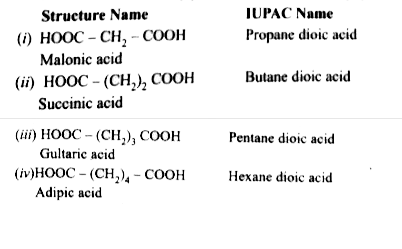
|
|
| 24. |
Which of the following elements does not form oxy acids? |
|
Answer» P |
|
| 25. |
Which of the following reactions represent major products ? |
|
Answer»
 `OVERSET(Br_(2))underset(NAOH)to` no reaction |
|
| 26. |
Whichof the followingare correctfor reaction (##AKS_TRG_AO_CHE_XII_V02_B_C03_E02_120_Q01.png" width="80%"> |
|
Answer»

|
|
| 27. |
Which of the following element involves th gradual filling of 5f level ? |
|
Answer» PM |
|
| 28. |
Which one of the following statements about zeolite is true |
|
Answer» They are used as cation exchangers |
|
| 29. |
Why are some medicines more effective in the colloidal form ? |
| Answer» Solution :MEDICINES are more effective in the COLLOIDAL FORM because they have a large SURFACE area and are EASILY assimilated in this form. | |
| 30. |
Which of the following is an analgesic drug ? |
|
Answer» ASPIRIN |
|
| 32. |
Which of the following statements are not correctlyassociated with S_N1 reaction? I. Rearrangement is possible. II. Rate is affected by solvent polarity. III. The strength of the nucleophile is important inrate determining step. IV. The reactivity order is : tertiary gtsecondarygt primary V. Proceeds with complete inversion of configuration. |
|
Answer» III, V only |
|
| 33. |
Write the monomers which are used for the synthesis of following polymer : Bakelite Indicate the type of polymerisation for each which forms polymer. |
| Answer» SOLUTION :`{:("Monomers","TYPE of polymerisation"),("PHENOL + FORMALDEHYDE","Condensation"):}` | |
| 34. |
The unit of rate constant for the reaction obeying rate expression, r=K[A]^1[B]^(2//3) IS: |
|
Answer» `MOL^(-2//3)LITRE^(2//3)time^-1` |
|
| 35. |
Which is not an ore of nickel? |
|
Answer» Pentlandite |
|
| 36. |
Which among the following square planar complex will exhibet geometrical isomerism? |
|
Answer» ` [Ma_2B_2]^(NT) ` |
|
| 37. |
Which of the following bases is not present in DNA ? |
|
Answer» ADENINE |
|
| 38. |
The stuctural formula of an amino acid isoleucine is____________. |
| Answer» | |
| 39. |
Which of the following is a 3^(@) amine? |
|
Answer» 1-methylcyclohexylamine 
|
|
| 40. |
What is the order of photochemical reactions? |
| Answer» SOLUTION :PHOTOCHEMICAL REACTIONS are generally of ZERO ORDER. | |
| 41. |
What is the rate determining step in Cannizzaro's reaction? |
Answer» Solution :`H- overset(overset(O)(||))(C )-H+ OH^(-) rarr H-UNDERSET(underset(H)(|))overset(overset(O)(|))(C )-OH`  and `H-overset(overset(O)(||))(C )- OH + CH_(3)O^(-) rarr HCOO^(-) + CH_(2)OH` Transfer of hydride ion on to the carbonyl carbon is the RATE determining step in the Cannizzaro.s reaction |
|
| 42. |
Which one of the equation is currect ? |
|
Answer» `delta G=delta G^0+ nRT LOG Q` |
|
| 43. |
Which of the following isnot characteristic of alcohols |
|
Answer» they are lighter than water |
|
| 44. |
Which of following compounds will give 1^(@) alkyl halide and 3^(@) alkyl halide on monohalogation? |
|
Answer» pentane It has `1^(@) H and 3^(@)H` on halogenation, gives, `1^(@)R-X and 3^(@)R-X` |
|
| 45. |
What happens when methyl chloride is treated with KCN ? |
|
Answer» Solution :The reactions are explained as under : `underset("Methyl chloride") (CH_(3) - Cl + KCN) overset(ETOH - H_(2) O , Delta ) to underset (Methyl cyanide") (CH_(3) - C -= N ) + KCL ` |
|
| 46. |
Write the equations for the reactions involved in the leaching of alumina from bauxite ore. |
|
Answer» Solution :`Al_(2)O_(3)(S) + 2NaOH(aq) + 3H_(2)O rarr 2NA[Al(OH)_(4)](aq)` `2Na[Al(OH)_(4)](aq) + 2CO_(2)(g) rarr Al_(2)O_(3).xH_(2)O(S) + 2NaHCO_(3)(aq)` `Al_(2)O_(3)x.H_(2)O(S) rarr Al_(2)O_(3)(S) + xH_(2)O(g)` |
|
| 47. |
Ultra violet rays are not allowed to pass through : |
|
Answer» FLINT glass |
|
| 48. |
Which of the following compounds gives fastest reaction with HBr and why? (i) (CH_(3))_(3)(ii) CH_(3) CH_(2) CH_(2) OH (iii) CH_(3) overset(OH)overset(|)(CH) CH_(3)(iv) CH_(3) overset(CH_(3))overset(|)(CH) CH_(2) OH |
|
Answer» SOLUTION :(i) `(CH_(3))_(3) C - OH` DUE to formation of EDG and formation of cation |
|
| 49. |
When the E_(a) of a reaction zero then the rate constant of the reaction is equal to ___________ |
|
Answer» `2.303 K` |
|
| 50. |
Which of the follwing is narrwo spectium bactericidal antibiotic? |
|
Answer» Erythnomycin |
|


