Explore topic-wise InterviewSolutions in Current Affairs.

This section includes 7 InterviewSolutions, each offering curated multiple-choice questions to sharpen your Current Affairs knowledge and support exam preparation. Choose a topic below to get started.

1.

The correct order of reactivity towards the electrophilic substitution of the compounds aniline (I) benzene (II) and nitrobenzene (III) is:

Answer»

`IgtIIgtIII`
`IIIgtIIgtI`
`IIgtIIIgtI`
`IltIIgtIII`

ANSWER :A
2.

The correct order of reactivity towards electrophilic substitution of the compounds : aniline (I), benzene (II) and nitro benzene (III) is :

Answer»

`III GT II gt I`
`II gt III gt I`
`I LT II lt III`
`I gt II gt III`

ANSWER :D
3.

The correct order of reactivity of the following compounds towards aqueous NaCN will be III. CH_(2) = CH - CH_(2)- Cl III. CH_(3) - overset(Cl)overset(|)(CH) - CH_(3)"" IV. CH_(2) = CH -CH_(2) - Br

Answer»

I `GT` II `gt` III `gt` IV
I `gt` IV `gt` II `gt` III
`IV gt` II `gt` I `gt` III
`IV gt` II `gt` III `gt` I

Answer :D
4.

The correct order of reactivity of PhMgBr with underset((I))(Ph-overset(O)overset(||)(C)-Ph), underset((II))(CH_(3)-overset(O)overset(||)(C)-H) and underset((III))(CH_(3)-overset(O)overset(||)(C)-CH_(3))

Answer»

`I gt II gt III`
`III gt II gt I`
`II gt III gt I`
`I gt III gt I`

SOLUTION :This is explained on the basis of electronic and STERIC factors. As a result the nucleophile ATTACK can take place most readily in (II) while it is most difficult in (I).
5.

The correct order of reactivity of the following compounds towards S_N1 reaction is I) CH_3CHX ""II) C_6H_5CH_2X III) (CH_3)_3CX ""IV) (CH_3)_2CHX

Answer»

I GT IV gt III gt II 
II gt III gt IV gt I 
I gt IV gt II gt III 
IV gt III gt I gt II

Answer :B
6.

The correctorder of reactivity of hydrogen halides with ethyl alcohol is

Answer»

`HF gt HCI gt HBR gt HI`
`HCI gt HBr gt HF gt HI`
`HBr gt HCI gt HI gt HF`
`HI gt HBr gt HCI gt HF`

Answer :D
7.

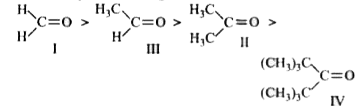
The correct order of reactivity of >C=O group in given compound is :

Answer»


ANSWER :A
8.

The correct order of reactivity of following compounds in nucleophilic substitution reaction is (i) CH_(3)Br(ii)CH_(3)Cl

Answer»

`(i) GT (ii) gt (III) gt (IV)`
`(iv) gt (iii) gt (ii) gt (i)`
`(iv) gt (i) gt (ii) gt (iii)`
`(iii) gt (iv) gt (ii) gt (i)`

Answer :C
9.

The correct order of reactivity of alkyl halides: CH_3CH_2Cl, CH_3CHClCH and (CH_3)_3 C Cl towards dehydrohalogenation ?

Answer»

` CH_ 3 CH_2 CL gt CH_3 CHCICH_3 gt (CH_3) _3 CCL`
` CH_3 CHCl CH_3 gt (CH_3)_3 C Cl gt CH_3 CH_2 Cl `
` (CH_3)_3 C Cl gt CH_3 CH_ 2 Cl gt CH_3 CHCl CH_3`
` (CH_3) _3 C Cl gt CH_3 CH Cl CH_3 gt CH_3 CH_2 Cl `

Answer :D
10.

The correct order of reactivity of aldehydes and ketones towards hydrogen cyanide is

Answer»

`CH_(3)COCH_(3) GT CH_(3)CHO gt HCHO`
`CH_(3)COCH_(3) gt HCHO gt CH_(3)CHO`
`CH_(3)COCH_(3) gt CH_(3)COCH_(3)gt HCHO`
`HCHO gt CH_(3)CHO gt CH_(3)COCH_(3)`

Solution :Hydrogen cyanide (HCN) undergoes nucleophilic addition reaction TOWARDS aldehydes and KETONES aldehydes and ketones CONTAINING more electrophilic carbonyare more reactivetowards nucleophilicaddittion reaction amongthe given compunds reactivity order is
`HCHO gt CH_(3)CHOgt CH_(3)COCH_(3)`
11.

The correct order of reactivity of alcohols with haloacids is …….

Answer»

`1^(@)gt 2^(@)gt 3^(@)`
`1^(@)gt 3^(@)gt 2^(@)`
`3^(@)gt 2^(@)gt 1^(@)`
`2^(@)gt 3^(@)gt 1^(@)`

Answer :C
12.

The correct order of reactivity in S_(N^(1)) reaction for the following compounds is (i). CH_(3)-underset(Cl)underset(|)(C)H-CH_(2)-CH_(3) (ii). Ph-underset(Cl)underset(|)(C)H-CH_(2)-CH_(3) (iii). CH_(3)-underset(OC H_(3))underset(|)overset(Cl)overset(|)(C)-CH_(3) (iv). CH_(3)-CH_(2)-CH_(2)-Cl

Answer»

`(i)GT(II)gt(iii)gt(iv)`
`(ii)gt(i)gt(iii)gt(iv)`
`(iii)gt(ii)gt(i)gt(iv)`
`(iv)gt(iii)gt(ii)gt(i)`

Solution :This order of reactivity in `S_(N^(1))` reactions is DIRECTLY proportional to the relative STABILITIES of carbocations in the SLOW step. `therefore` the correct order of reactivity is:
IIIgtIIgtIgtIV
13.

The correct order of reactivity in S_(N)1 reaction for the following compounds is- underset((I))underset(Cl)underset(|)(CH_(3)-CH-CH_(2)-CH_(3)), underset((II))(Ph-underset(Cl)underset(|)(C)H-CH_(2)-CH_(3)) underset((III))(CH_(3)-underset(OCH_3)underset(|)overset(Cl)overset(|)(C)-CH_(3)) , CH_(3)-CH_(2)-CH_(2)-Cl

Answer»

I GT II gt III gtIV
II gt I gt III gt IV
III gt II gt I gt IV
IV gt III gt II gt I

Solution :`S_(N)1` reaction proceeds via formation of carbocation INTERMEDIATE. Thus more stable the carbocation, more reactive is the parent alkyl HALIDE towards `S_(N)1` reaction. Compound (III) gives `2^(@)` carbocation which is stabilised by +M effect of -OME group. Thus it is the most stable carbocation. Compound (II) gives benzylic carbocation which is resonance stabilised. We know `2^(@)` carbocation is more stable than `1^(@)` carbocation. Therefore, the correct order of recactivity of `S_(N)1` reaction is III > II > I > IV.
14.

The correct order of reactivity of alcohol during dehydration is

Answer»

primary `gt` SECONDARY `gt` TERTIARY
primary `lt` secondary `lt` tertiary
tertiary `lt` secondary `lt` primary
secondary `lt` tertiary `lt` primary

Answer :B
15.

The correct order of reactivity is :

Answer»

`CH_(3)COClgtCH_(3)COOC_(2)H_(5)gtCH_(3)CONH_(2)`
`CH_(3)COOC_(2)H_(5)gtCH_(3)COClgtCH_(3)CONH_(2)`
`CH_(3)CONH_(2)gtCH_(3)COClgtCH_(3)COOC_(2)H_(5)`
`CH_(3)COClgtCH_(3)CONH_(2)gtCH_(3)COOC_(2)H_(5)`.

ANSWER :A
16.

The correct order of reactivity for the addition reaction of the following carbonyl compounds with ethyl magnesium iodide is

Answer»

`I gt III gt II gt IV`
`IV gt III gt II gt I`
`I gt II gt IV gt III`
`III gt II gt I gt IV`

Solution :If the CARBONYL carbon is sterically crowded then it will be reluctant to undergo addition reaction. Moreover, attachment of bulkier alkyl groups with the carbonyl carbon LESSENS its positive charge resulting into the minimisation of attack by `overset(ddot)(BARR)` from RMgBr. So, the ORDER is :
17.

The correct order of radiii is/are:

Answer»

`Pb gt Pb^(2+) gt Pb^(4+)`
`In^(+) gt Sn^(2+) gt Sb^(3+) gt Te^(4+)`
`CO gt Ni gt Cu gt ZN`
`K^(+) gt Li^(+) gt Mg^(2+) gt Al^(3+)`

Solution :The correct ORDER of radii: `Co ~~ Ni lt Cu lt Zn`
18.

The correct order of pseudohalide, polyhalide and interhalogen are

Answer»

`BrI_(2)^(-),OCN^(-),IF_(5)`
`IF_(5),BrI_(2)^(-),OCN^(-)`
`OCN^(-),IF_(5),BrI_(2)^(-)`
`OCN^(-),BrI_(2)^(-),IF_(5)`

Solution :Some complex ions of nitrogen show similarities with HALIDE ions. These are called pseudohalide ions e.g.. `NCO^(-),CN^(-)` etc. Halogen, among themselves, form complex ions which are called polyhalide ions e.g. `I_(3)^(-), IBrI_(2)^(-)` etc. SIMILARLY, interhalogenare the COMPOUND of halogen in which one halogen is anion. e.g., `IF_(7),ICl_(5),BrF_(3),IF_(5)` etc.
19.

The correct order of pi-acid nature is :

Answer»

`PF_(3)gtCOgtPCl_(3)gtPPh_(3)`
`COgtPF_(3)gtPCl_(3)gtPPh_(3)`
`PF_(3)gtCOgtPPh_(3)gtPCl_(3)`
\

ANSWER :A
20.

The correct order of Paramagnetic moment is…

Answer»

`Cr^(3+)ltMn^(3+)ltFe^(3+)`
`CU^(2+)gtZn^(2+)ltCo^(2+)`
`TI^(2+)ltV^(2+)ltCo^(2+)`
`Cr^(2+)LTCR^(3+)ltCr^(4+)`

ANSWER :A
21.

The correct order of oxidizing power is ..........

Answer»

`CrO_(4)^(2-) GT MnO_(4)^(2-) gt FeO_(4)^(2-)`
`VO_(4)^(3-) gt CrO_(4)^(2-) gt MnO_(4)^(-)`
`BrO_(4)^(-) gt IO_(4)^(-) gt ClO_(4)^(-)`
`BrO_(4)^(-) lt TeO_(4)^(-) lt ReO_(4)^(-)`

ANSWER :C
22.

The correct order of pK_b value of …......

Answer»

`overlineFgtOoverlineHgtNoverlineH_2gtCoverlineH_3`
`overlineCH_3gtoverlineNH_2gtOoverlineHgtoverlineF`
`OoverlineHgtNoverlineH_2gtCoverlineH_3gtoverlineF`
`NoverlineH_2gtOoverlineHgtCoverlineH_3gtoverlineF`

ANSWER :B
23.

The correct order of oxidizing nature of Ocl^(-),Obr^(-) and Ol^(-)ions are............

Answer»

`Ocl^(-) GT Obr^(-) gt OL^(-)`
`Ol^(-) gt Ocl^(-) gt Obr^(-)`
`Ol^(-) gt Obr^(-) gt Ocl^(-)`
`Obr^(-) gt Ocl^(-) gt Ol^(-)`

Solution :This can be explained on the basis of STANDARD electrode POTENTIALS. The standard electrode potentials of `Ocl^(-), Obr^(-)` and `Ol^(-)`are 1.61 V, 1.60 V and 1.44 V respectively.
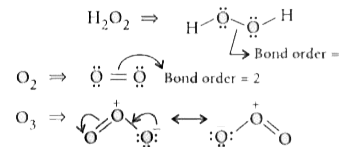
24.

The correct order of O-O bond length in O_(2),H_(2)O_(2) and O_(3) is

Answer»

`O_(2)gtO_(3)gtH_(2)O`
`H_(2)O_(2)gtO_(3)gtO_(2)`
`O_(3)gtO_(2)gtH_(2)O_(2)`
`O_(3)gtH_(2)O_(2)gtO_(2)`

SOLUTION :
BOND ORDER = 1.5
`:.` Order is `O_(2)gtO_(3)gtH_(2)O_(2)`
Bond length is `H_(2)O_(2)gtO_(3)gtO_(2)`
25.

The correct order of oxidising property of Ln ^(4+) ion is

Answer»

`DY gt Tb gt Nd gt PR gt Ce `
`Dy gt Nd gt Pr gt Tb gt Ce `
`Dy gt N d gt Tbgt Ce gt Pr`
`Nd gt Dy gt Tb gt Pr gt Ce `

Solution :Oxidising PROPERTY of `Tb ^(4+)` is less due to stable `4f^(7)` CONFIGURATION
26.

The correct order of nucleophilic strength is …….

Answer»

`""^(Θ)OH gt CH_(3)COO^(Θ)gt CH_(3)O^(Θ)gt C_(6)H_(5)O^(Θ)`
`""^(Θ)OH gt CH_(3)O^(Θ)gt C_(6)H_(5)O^(Θ)gt CH_(3)COO^(Θ)`
`""^(Θ)OH gt CH_(3)O^(Θ)gt CH_(3)COO^(Θ)gt C_(6)H_(5)O^(Θ)`
`CH_(3)O^(Θ)gt ""^(Θ)OH gt C_(6)H_(5)O^(Θ)gt CH_(3)COO^(Θ)`

ANSWER :D
27.

The correct order of negative electron gain enthalpy of the elements of oxygen family in the periodic table is :

Answer»

`OgtSgtSe`
`SgtSegtO`
`SgtOgtSe`
`SegtOgtS`

ANSWER :B
28.

The correct order of N-O bond lengths in NO, NO_2^- , NO_3^- and N_2O_4 is

Answer»

`N_2O_4 gt NO_2^(-) gt NO_3^(-) gt NO`
`NO gt NO_3^(-) gt N_2O_4 gt NO_2^-`
`NO_3^(-) gt NO_2^(-)gt N_2O_4 gt NO`
`NO gt N_2O_4 gt NO_2^(-) gt NO_3^(-)`

Solution :As the bond order INCREASES, bond LENGTH DECREASES and bond order is HIGHEST for NO, i.e. 2.5 and least for `NO_3^-` , i.e. 1.33. So, the order of bond length is
`underset"1.33"(NO_3^-) gt underset"1.5"(NO_2^-)gt underset"1.5"(N_2O_4)gt underset"2.5"(NO)`
29.

The correct order of the mobility of alkali metal ions in aqueous solution is :

Answer»

`Na^(+)GTK^(+)gtRb^(+)GTLI^(+)`
`K^(+)gtRb^(+)gtNa^(+)gtLi^(+)`
`Rb^(+)gtK^(+)gtNa^(+)gtLi^(+)`
`Li^(+)gtK^(+)gtNa^(+)gtRb^(+)`

Answer :C
30.

The correct order of melting points of group-15 trifluorides is ...........

Answer»

`PF_(3) ltAsF_(3) lt SbF_(3) lt BiF_(3)`
`BiF_(3) lt SbF_(3) lt PF_(3) lt AsF_(3)`
`PF_(3) gt SbF_(3) gt AsF_(3) gt BiF_(3)`
`BiF_(3) lt AsF_(3) lt SbF_(3) lt PF_(3)`

SOLUTION :`BiF_3` is an ionic HALIDE. Down the group, the melting point INCREASES.
31.

The correct order of melting and boiling points of primary (1^(@)), secondary and tertiary (3^(@)) alkyl halides is :

Answer»

`1^(@)GT2^(@)gt3^(@)`
`3^(@)gt2^(@)gt1^(@)`
`2^(@)gt3^(@)gt1^(@)`
`3^(@)gt1^(@)gt2^(@)`

ANSWER :A
32.

The correct order of melting and boiling points of the primary (1^@C) secondary (2^@C) and tertiary (3^@C) alkyl halides:

Answer»

<P>`P GT S gt T`
`T gt S gt P`
`S gt T gt P`
`T gt P gt S`

ANSWER :A
33.

The correct order of melting and boiling points of the primary (1^@)C, secondary (2^@)C and tertiary (3^@)C alkyl halides is :

Answer»

<P>`P GT S gt T`
`T gt S gt P`
`S gt T gt P`
`T gt P gt S`

ANSWER :A
34.

The correct order of magnetic moments (spin values in BM) among is:

Answer»

`[Fe(CN)_(6)]^(4-) gt [ClCl_(4)]^(2-) gt [MnCl_(4)]^(2-)`
`[MnCl_(4)]^(2-) gt [Fr(CN)_(6)]^(4-) gt [CoCl_(4)]^(2-)`
`[Fe(CN)_(6)]^(4-) gt [MnCl_(4)]^(2-) gt {CoCl_(4)]^(2-)`
`[MnCl_(4)]^(2-) gt [CoCl_(4)]^(2-) gt [Fe(CN)_(6)]^(4-)`

ANSWER :D
35.

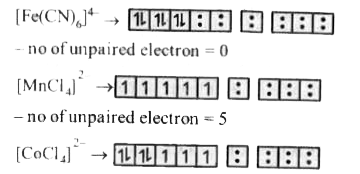
The correct order of magentic moments (spin only values is B.M ) among is

Answer»

`[Fe(CN)_(6)]^(4-) gt [MnCl_4]^(2-) gt [CoCl_(4)]^(2-)`
`[MnCl_(4)]^(2-) gt [Fe(CN)_6]^(4-) gt [CoCl_(4)]^(2-)`
`[MnCl_(4)]^(2-) gt [CoCl_(4)]^(2-) gt [Fe (CN)_(6)]^(4-)`
`[Fe(CN)_(6)]^(4-) gt [CoCl_(4)]^(2) gt [MnCl_(4)]^(2-)`

Solution :
no fo UNPAIRED ELECTRON =3
The greater the number of unpaired electrons, greater the magnitude of magnetic moment. Hence the CORRECT order will be
`[MnCl_(4)]^(2-) gt [CoCl_4]^(2-) gt [Fe (CN)_6]^(4-)`
36.

The correct order of magnetic moments (only spin value in BM) among is :

Answer»

`[Fe(CN)_(6)]^(4-) gt [CoCl_(4)]^(2-) gt [MnCl_(4)]^(2-)`
`[MnCl_(4)]^(2-)gt[Fe(CN)_(6)]^(4-)gt[CoCl_(4)]^(2-)`
`[Fe(CN)_(6)]^(4-)gt[MnCl_(4)]^(2-)gt[CoCl_(4)]^(2-)`
`[MnCl_(4)]^(2-)gt[CoCl_(4)]^(2-)gt[Fe(CN)_(6)]^(4-)`

SOLUTION :`mu=0" for "[Fe(CN)_(6)]^(4-)`
37.

The correct order of leaving group tendency is ……

Answer»

`I^(-)gt Br^(-)gt CL^(-)gt F^(-)`
`F^(-)gt Cl^(-)gt Br^(-)gt I^(-)`
`Cl^(-)gt F^(-)gt Br^(-)gt I^(-)`
`I^(-)gt Cl^(-)gt Br^(-)gt F^(-)`

Solution :WEAK bases are good LEAVING groups.
38.

The correct order of leaving group ability in a nucleophilic substitution reaction is

Answer»

`Br^(-) gt CL^(-)gt CH_3CO_2^(-) gt H^(-)`
`H^(-)gt CH_3CO_(2)^(-) gt Cl^(-) Br^(-)`
`Br^(-) gt CH_3CO_(2)^(-) gt Cl^(-) gt H^(-)`
`CH_3CO_2^(-) gt Br^(-) gt Cl^(-) gt H^(+)`

ANSWER :A
39.

The correct order of I^(st) ionisation potential among following elements Be, B, C, N, O is

Answer»

B lt Be lt C lt O lt N
B lt Be lt C lt N lt O
Be lt B ltC lt N lt O
Be lt B lt C lt O lt N

Solution :Because of extra STABILITY of exactly half-filled electronic configuration of N, its `IE_1` is higher than that of O. Further because of higher nuclear charge, `IE_1` of C is higher than that of Be and B. Amongest Be and B, the `IE_1` of Be is higher than that of B becuase in CASE of Be a 2s-ELECTRON is to removed while in case of B a 2p - electron is to be removed. Thus, the overall ORDER is `B < Be< C < O< N.
40.

The correct order of ionisation energy is :

Answer»

CU GT AG gt AU
Cu gt Au gt Ag
Au gt Cu gt Ag
Ag gt Au gt Cu

Answer :B
41.

The correct order of ionic size of N^(3-), Na^(+) , F^(-) ,Mg^(2+) and O^(-) is:

Answer»

`Mg^(2+) GT Na^(+) gt F^(-) gt O^(2-) gt N^(3-)`
`N^(3-) LT F^(-) gt O^(2-) gt Na^(+) gt Mg^(2+)`
`Mg^(2+) lt Na^(+) lt F^(-) lt O^(2-) lt N^(3-)`
`N^(3-) gt O^(2-) gt F^(-) gt Na^(+) lt Mg^(2+)`

Answer :C
42.

The correct order of ionisation enthalpy of C, N, O, F is

Answer»

`FltNltCltO`
`CltNltOltF`
`CltOltNltF`
`FltOltNltC`

Solution :In a period, on moving from left to right, the ionisation enthalpy INCREASES which can be explained on the basis of INCREASED nuclear charge and decrease in atomic radii. Both the factors increase the force of attraction of the elecron towards the nucleus and consequently, more ENERGY is needed to remove the valence electrons and thus the ionisation enthalpies increase. Thus, the order should be:
`CltNlt OltF`
However, N has stable `2P^(3)` electronic conficutation, as a result of which, its ionisation energy is greater than that of oxygen and thus, the correct order is
`CltOltNltF`.
43.

The correct order of ionic radius of Yb ^(3+), La ^(3+) , Eu ^(3+), Lu ^(3+) is

Answer»

`Yb lt LU lt EU lt LA`
`La lt Eu lt Lu lt Yb `
`Lu lt Eu lt La lt Yb `
`Yb lt La lt Eu lt Lu `

ANSWER :A
44.

The correct order of ionic radii of Y^(3+) ,La^(3+), Eu^(3+)and Lu^(3+) is

Answer»

`Y^(3+) LT LA^(3+) lt EU^(3+) ltLu^(3+)`
`Lu^(3+) lt Y^(3+) lt Eu^(3+) lt La^(3+)`
`Lu^(3+) ltEu^(3+) lt La^(3+) lt Y^(3+)`
`La^(3+) lt Eu^(3+) lt La^(3+) lt Y^(3+)`

Solution :
Thus, `Lu^(3+) lt Y^(3+) lt Eu^(3+) LTLA^(3+)`
45.

The correct order of ionic radii of Y^(3+), La^(3+), Eu^(3+) and Lu^(3+) is (Atomic nos. Y=39 , La = 57, Eu = 63, Lu = 71)

Answer»

`Y^(3+) LT LA^(3+) lt Eu^(3+) lt LU^(3+)`
`Y^(3+) lt Lu^(3+) lt Eu^(3+) lt La^(3+)`
`Lu^(3+) lt Eu^(3+) lt La^(3+) lt Y^(3+)`
`La^(3+) lt Eu^(3+) lt Lu^(3+) lt Y^(3+)`

Answer :B
46.

The correct order of ionic radii of Y^(3+), La^(3+),Eu^(3+) and Lu^(3+) is

Answer»

`Y^(3+) LT La^(3+) lt EU^(3+)ltLu^(3+)`
`Y^(3+) lt LU^(3+) lt Eu^(3+)ltLa^(3+)`
`Lu^(3+) lt Eu^(3+) ltLa^(3+) lt Y^(3+)`
`La^(3+) lt Eu^(3+) lt Lu^(3+) ltY^(3+)`

Answer :C
47.

The correct order of ionic radii of Y^(3+), La^(3+), Eu^(3+) and Lu^(3+) is :

Answer»

`Y^(3+) lt La^(3+) lt Eu^(3+) lt LU^(3+)`
`Y^(3+) lt Lu^(3+) lt Eu^(3+) lt La^(3+)`
`Lu^(3+) lt Eu^(3+) lt La^(3+) lt Y^(3+)`
`La^(3+) lt Eu^(3+) lt Lu^(3+) lt Y^(3+)`

Solution :Y is the first MEMBER of 4d-transition series. Its size is less than the size of the lanthanoids. In case of lanthanoids, the size decreases from `La^(3+) to Lu^(3+)`. Therefore, the correct ORDER of ionic RADII is
`Y^(3+) lt Lu^(3+) lt Eu^(3+) lt La^(3+)`
48.

The correct order of ionic radii of Y^(3+), La ^(3+), Eu ^(3+) and Lu ^(3+) is

Answer»

`Y^(3+)lt Lu ^(3+) lt EU ^(3+) lt La ^(3+)`
`La ^(3+) lt Eu ^(3+) lt Lu ^(3+) lt Y^(3+)`
`Lu ^(3+), lt Eu ^(3+) lt La ^(3+) lt Y ^(3+)`
`Y ^(3+) lt La ^(3+)lt Lu ^(3+) lt Eu^(3+)`

Answer :A
49.

The correct order of ionic radii of the ion is

Answer»

`LA^(3+) lt EU^(3+)lt Lu^(3+) lt Yb ^(3+)`
`Yb ^(3+)lt La ^(3+) lt Eu ^(3+) lt Lu ^(3+)`
`Lu_(3+) lt Eu ^(3+) lt Yb ^(3+) lt La ^(3+)`
`Lu ^(3+) lt Yb ^(3+) lt Eu ^(3+) lt La ^(3+)`

ANSWER :D
50.

The correct order of ionic radii of the following species is

Answer»

`Se^(2-) GT I^(-) gt BR^(-) gt O^(2-) gt F^(-)`
`I^(-) gt Se^(2-) gtO^(2-) gt F^(-)`
Se^(2-) gt I^(-) gt Br^(-) gt F^(-) gt O^(2-)
`I^(-) gt Se^(2-) gt Br^(-) gt O^(2-) gt F^(-)`

ANSWER :D