

Saved Bookmarks
This section includes 7 InterviewSolutions, each offering curated multiple-choice questions to sharpen your Current Affairs knowledge and support exam preparation. Choose a topic below to get started.
| 1. |
The catalyst used in the manufacture of H_2 by Bosche's process is |
|
Answer» `Cr_2O_3` |
|
| 3. |
The catalyst used in the manufacture of ammonia by Haber's process is |
| Answer» ANSWER :2 | |
| 4. |
The catalyst used in the industrial production of methanol is |
| Answer» Solution :`ZnO- Cr_(2)O_(3)` | |
| 5. |
The catalyst used in the manufacture of acetic acid from acetaldehyde by the atmosphere oxygen is |
|
Answer» `(CH_(3) COO)_(2) MN` |
|
| 6. |
The catalyst used in the hydrogenation of oils to obtain vanaspathi is ......... |
|
Answer» Iron |
|
| 7. |
The catalyst used in the hydrogenation of oils into fats is: |
|
Answer» `V_2O_5` |
|
| 8. |
The catalyst used in the hydrogenation of oils |
|
Answer» `V_(2) O _(5)` |
|
| 9. |
The catalyst used in the dehydration of ethylalcohol to ethene is |
| Answer» Answer :A | |
| 11. |
in the alpha - halogenation of aliphatic acids the catalyst used is : |
|
Answer» `Pd+BaSO_(4)` |
|
| 12. |
The catalyst used in getting aniline from chlorobenzene is |
| Answer» Solution :`Cu_(2)O` (Dow's process). | |
| 13. |
The catalyst used in Kjeldahl's method for the estimation of nitrogen is: |
|
Answer» COPPER |
|
| 17. |
Thecatalystused inGattermannreactionis |
|
Answer» `CUCI` |
|
| 19. |
The catalyst used in Bosch process for manufacture of H_(2) O is : |
| Answer» Answer :D | |
| 21. |
The catalyst used in Bosch process of manufacture of H_2 is: |
|
Answer» FINELY DIVIDED NI |
|
| 22. |
The catalyst used in a reaction can change |
|
Answer» ACTIVATION ENERGY of a reactio |
|
| 23. |
The catalyst used for the manufacture of H_2SO_4, in contact process for the oxidation of SO_2" to "SO_3 is |
|
Answer» FINELY DIVIDED iron |
|
| 24. |
The catalyst used for the polymerisation of olefins is |
|
Answer» ZIEGLER NATTA CATALYST |
|
| 25. |
The catalyst used for the oxidation of HCl by air is ......... |
| Answer» SOLUTION :`CuCl_2` | |
| 26. |
which catalyst used for the hydrogenation of vegetable oils for making margarine? |
|
Answer» |
|
| 27. |
The catalyst used for olefin polymerization is |
|
Answer» Ziegler-Natta catalyst |
|
| 28. |
The catalyst used for olefin polymerization is. |
|
Answer» Ziegler- NATTA CATALYST |
|
| 29. |
The catalyst used for preparingtoluene with a mixture of C_(6)H_(6) and CH_(3)Cl is |
| Answer» Answer :A | |
| 30. |
The catalyst used for converting methane tomethanol in presence of air at 100 atm and 523 K is |
|
Answer» `Mo_2O_3` |
|
| 31. |
The catalyst uned in the manufacture of H_(2)SO_(4) by contact process is |
|
Answer» `Al_(2) O_(3)` |
|
| 32. |
The catalyst used in the contact process of sulphuric acid is : |
|
Answer» COPPER |
|
| 33. |
The catalyst TiCl_(4)+R_(3)Al used in the polymerisation of ethylene is known as ……….catalyst. |
| Answer» SOLUTION :Zeigler-Natta | |
| 34. |
The catalyst poison in contact process of manufacture of SO_(2)is ....... |
|
Answer» `As_2O_3` |
|
| 35. |
The catalyst and promoter used in Haber's process are respectively ............. |
|
Answer» MO, FE |
|
| 36. |
The catalyst iron, employed in the Haber's process, contains molybdenum, the function of which is: |
|
Answer» To increases the rate of combination of gases |
|
| 37. |
The catalyst in Wacker's process is |
|
Answer» `CuCl_2` |
|
| 39. |
The catalysed decomposition of H_(2)O_(2) in aqueous solution is followed by removing equal volume samples at various time intervals and titrating them with "KMnO"_(4) to determine the undecomposed H_(2)O_(2). The results thus obtained are : {:("Time (seconds)",,,:,,,0,,,600,,,1200),("cm"^(2)" of KMnO",,,:,,,22.8,,,13.8,,,8.2):} Show that the reaction is mono-molecular. What is the value of the specific reaction rate ? |
|
Answer» |
|
| 40. |
The catalyst |
|
Answer» INCREASE the ACTIVATION energy |
|
| 41. |
The ease of hydrolysis of trichlorides of group - 15 elements decrease in the order |
|
Answer» `NCl_(3) GT PCl_(3) gt AsCl_(3) gt SbCl_(3) gt BiCl_(3)` |
|
| 42. |
The carboxylic acid which reduces Tollen's reagent is |
|
Answer» HCOOH `UNDERSET("Tollen's reagent")(2AG(NH_(3))_(2)^(+))+underset("formic acid")(HCOOH)to underset("Silver")(2Ag)+CO_(2)+2NH_(4)^(+)+2NH_(3)` Because it behave both as an acid and as an aldehyde. 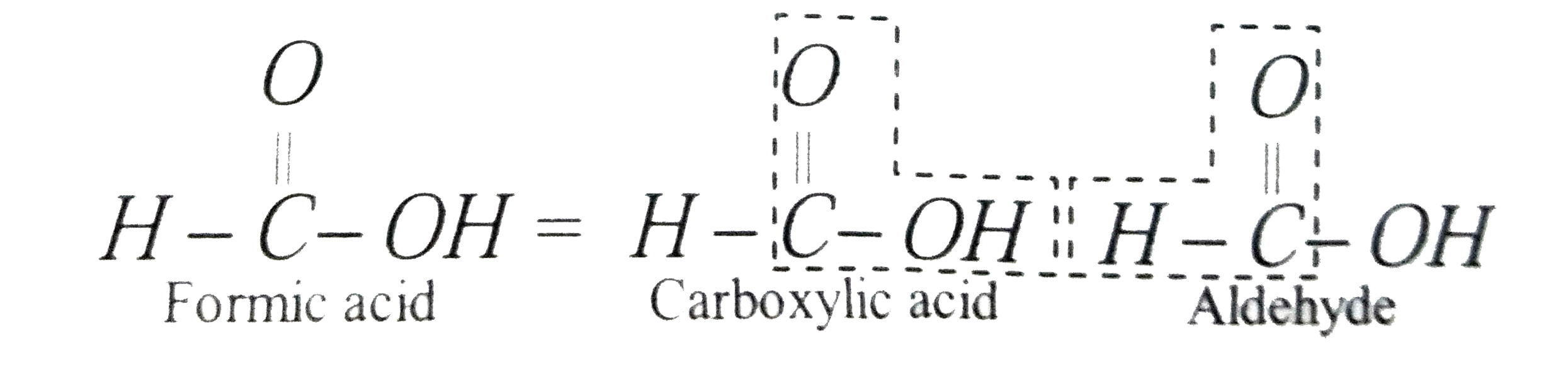
|
|
| 43. |
The case of dehydrohalogenation of alkyl halides with alcoholic KOH is |
|
Answer» `3^(@) LT 2^(@) lt 1^(@)` |
|
| 44. |
The carboxylic acid which does not undergo Hell Volhard Zelinsky reaction is : |
|
Answer» `CH_(3)COOH` |
|
| 45. |
The carboxylic acid of least acidic strength among the following is:- |
|
Answer» p-nitrobenzoic acid |
|
| 46. |
The carboxylic acid that reduces Tollen's reagent is |
|
Answer» ACETIC ACID |
|
| 47. |
The carboxylic acid group attached to porphyrin of heme in blood is |
|
Answer» `HCOO^(-)` |
|
| 48. |
The carbonyl compound producing an optically active product by reaction with LiAlH_(4) is |
|
Answer» PROPANONE |
|
| 49. |
The carbonate which does not leave a residue on heating is |
|
Answer» `Na_(2)CO_(3)` |
|