

Saved Bookmarks
This section includes 7 InterviewSolutions, each offering curated multiple-choice questions to sharpen your Current Affairs knowledge and support exam preparation. Choose a topic below to get started.
| 1. |
OF_2 is : |
|
Answer» Linear MOLECULE and sp-hybridised |
|
| 2. |
Of which of the following factors ,the rate of reacton depends? |
|
Answer» MOLECULAR MASS of reactant |
|
| 3. |
Of which of the following , glycol is an important constituent ? |
| Answer» Answer :A | |
| 4. |
OfthesestatementwhichstatementincorrectIn mostof thetransitionelementare "______" |
|
Answer» hexagonalclosepacked |
|
| 5. |
Of the two hydroxy organic compounds ROH and R'OH, the first one is basic and the other is acidic in behaviour. How is R differennt from R'? |
Answer» Solution :When R=alkyl, ROH behaves as a weak Bronsted base since it ACCEPTS a PROTON from strong acids such as HCl, `H_(2)SO_(4)`, ETC. 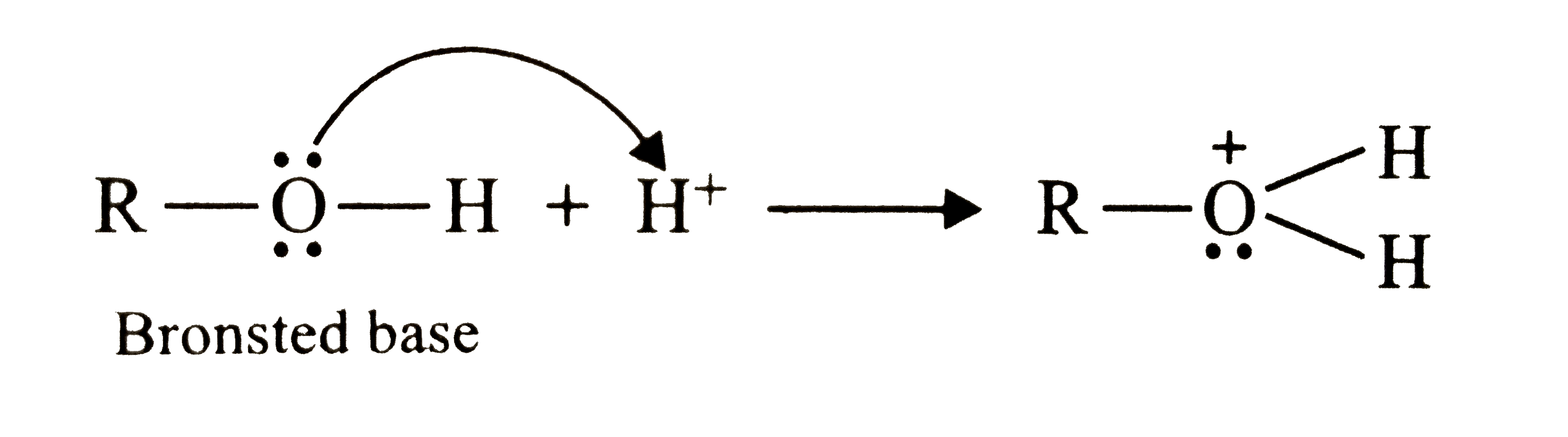 However, when R'=aryl, R'OH behaves, as a weak Bronsted acid since it donates a proton to strong bases such as Na, NaOH, etc. `UNDERSET("Bronsted acid")(R'-O-H)+NaOH to R'-O^(-)Na^(+)+H_(2)O` |
|
| 6. |
Of the two solvents H_2O and D_2O, NaCI dissolves : |
|
Answer» EQUALLY in both |
|
| 7. |
Of the two hydroxy organic compounds ROH and R'OH. The first one is basic and other is acidic in hebaviour. How is R different frm R'? |
| Answer» SOLUTION :R is ALIPHATIC while R. is AROMATIC. | |
| 8. |
Of the two bromoderivatives C_(6)H_(5)CH(CH_(3))Br and C_(6)H_(5)CH(C_(6)H_(5))Br, which one is more reactive in S_(N)1 substitution reaction and why? |
Answer» SOLUTION :In `S_(N)1` reaction, reactivity depends upon the stability of the intermediate carbocation. Thus, 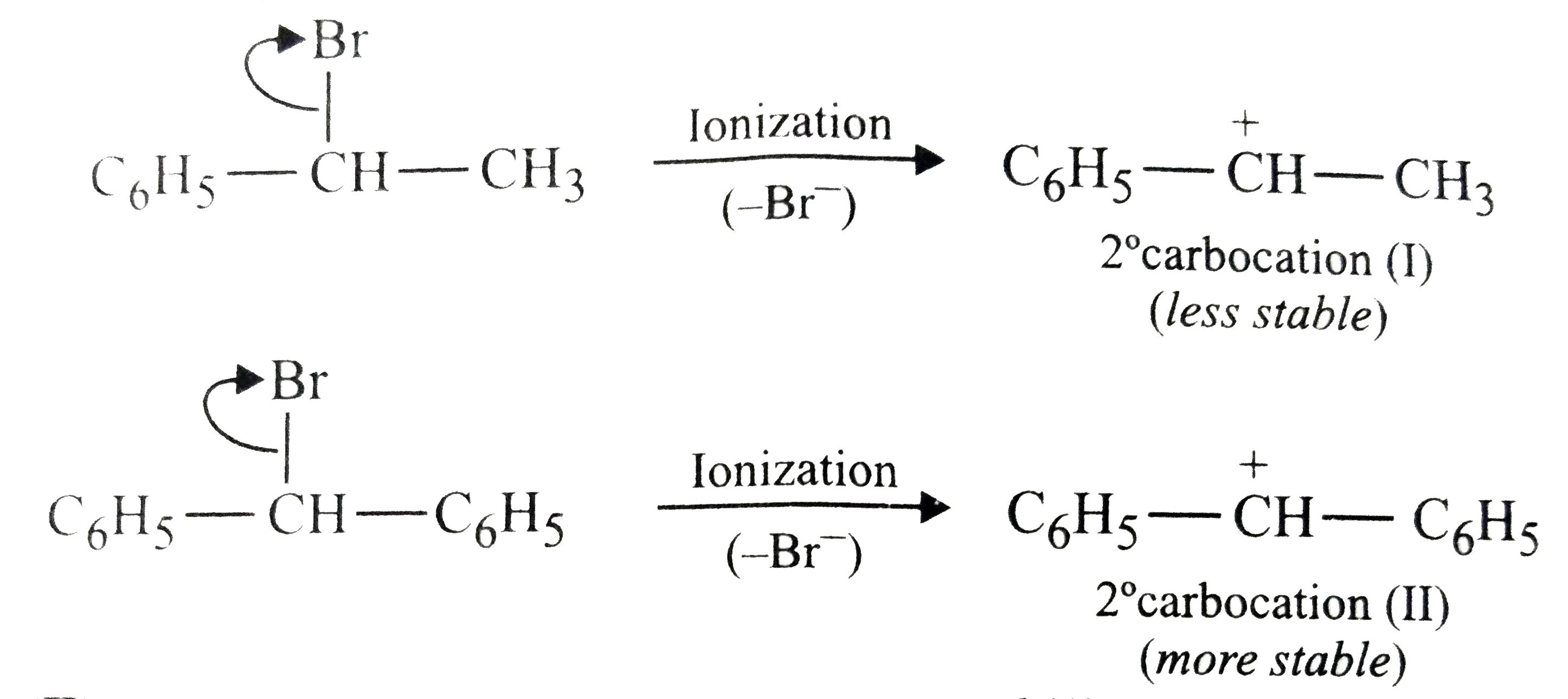 The carbocation (II) DERIVED from `C_(6)H_(5)CH(C_(6)H_(5))Br` is stabilized by +R-effect of the two `C_(6)H_(5)` groups the carbocation (I) derived from `C_(6)H_(5)CH(CH_(3))Br` is stabilized by +R-effect of one `C_(6)H_(5)` group and +I-effect of the `CH_(3)` group. since +R-effect is much STRONGER than +I-effect, therefore, carbocation (II) is more stable than carbocation (I). thus, `C_(6)H_(5)CH(C_(6)H_(5))Br` is more reactive than `C_(6)H_(5)CH(C_(6)H_(5))Br` is more reactive than `C_(6)H_(5)CH(CH_(3))Br` in `S_(N)1` substitution reaction. |
|
| 9. |
Which of the following are radioacitve? a. ._(48)Cd^(114)b. ._(49)In^(114)c. ._(50)Sn^(114) |
|
Answer» so `._(49)^(119)ln` unstable 49 odd No. |
|
| 10. |
Of the species PhSH, Ph underset(O)underset("||")(S)R, ph underset(O)underset("||")overset(O)overset("||")(S)R and Ph-underset(O)underset("||")overset(O)overset("||")(S)-OR the meta-substituted product is obtained from |
|
Answer» `PhSR` |
|
| 11. |
OF the isomeric hexanes, the isomers that give the minimum and maximum number of monochloro derivatives are respectively |
|
Answer» 3-methylpentane and 2,3-dimethylbutane `{:(""CH_(3)" "CH_(3),""CH_(3)),("|""|","|"),(underset("2,3-dimethylbutane")(CH_(3)-CH-CH-CH_(3)),underset("2-methylpentane")(CH_(3)-CH-CH_(2)-CH_(2)-CH_(3))):}` |
|
| 12. |
Of the possible structure of the molecular formula C_(5)H_(11)Br how many are opticllay active ? |
|
Answer» Solution :Optically ACTIVE structures are 1 `CH_(3)-CH_(2)-CH_(2)- underset("2-bromo pentane") underset(H) underset(|) overset(Br) overset(|)C-CH_(2)` 2. ` underset(2-"bromom 3-methyl butane") underset(H) underset(|)(CH_(3)-overset(CH_(3)) overset(|)CH-overset(Br) overset(|)C-CH_(3))` `C_(2)CH_(5)- overset(CH_(3)) overset(|) underset(2-"metyl 11-romom butane") underset(H) underset(|)C-CH_(2)-Br` |
|
| 13. |
Of the isomeric hexanes, the isomers that give the minimum and maximum number of monochloro derivatives are respectively. |
|
Answer» 2,3-dimethylbutane and n-hexane |
|
| 14. |
Of the given anions, the strongest bronsted base is |
|
Answer» `ClO^(-)` |
|
| 15. |
Of the four oxyacids of chlorine the strongest oxidising agent in dilute aqueous solution is |
|
Answer» `HClO_(4)` |
|
| 16. |
Of the following which one is classified as polyester polymer? |
|
Answer» TERYLENE 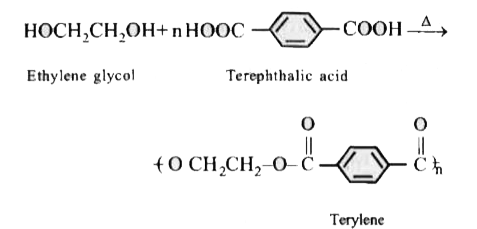
|
|
| 17. |
Of the following which one is classified as polyester polymer ? |
|
Answer» Nylon-6,6 |
|
| 18. |
Of the following which is the products formed when cyclohexanone undergoes aldol condensation followed by heating |
|
Answer»

|
|
| 19. |
Which one is a correct statementof the follwing- |
|
Answer» IONIC RADIUS of a METAL is same as its atomic radius |
|
| 20. |
Of the following , which is the product formed when cyclohexanone undergoes aldol condensation followed by heating ? |
|
Answer»
|
|
| 21. |
Of the following which is the product formed when cyclohexanone undergoes aldol condensation followed heating ? |
|
Answer»
|
|
| 22. |
Of the following, which is the product formed when cyclohexanone undergoes aldol condensation followed by heating? |
|
Answer»
|
|
| 23. |
Of the following , which has three electron bond in its structure |
|
Answer» Nitrous OXIDE |
|
| 24. |
Of the following, which has three electron bond in its structure ? |
|
Answer» Nitrous OXIDE |
|
| 25. |
Of the following which change will shift the reaction towards the product? I_(2(g))iff2I_((g)),DeltaH_(r)^(@)(298K)=+150kJ |
|
Answer» INCREASE in concentration of I |
|
| 26. |
Of the following which change will shift the reaction towards the prodict I_(2(g))hArr2I_((g)),DeltaH_(r)^(0)(298K)=+150kJ |
|
Answer» INCREASE in concentration of I |
|
| 28. |
Of the following transitions in hydrogen atom, the one which gives an absorption line of lowest frequency is : |
| Answer» Answer :B | |
| 30. |
Of the following, the metals that cannot be obtained by electrolysis of the aqueous solution of their salts are : |
|
Answer» Ag |
|
| 31. |
Of the following, the most acidic is |
|
Answer» <P>`As_(2)O_(3)` |
|
| 32. |
Of the following the metals that cannot be obtained by eletrolysis at the aqueous solution of their salts are |
|
Answer» Ag |
|
| 33. |
Of the following, the metal which cannot be obtained by electrolysis of the aqueous solution of their salts is |
|
Answer» Ag |
|
| 34. |
of the following statements about enzymes which ones are true (i) Enzymes lack in nucleophilic groups (ii)Enzymes are highly specific both in binding chiral substrates and in catalyzing their reactions. (iii) Enzymes catalyse chemical reactions by lowering the activation energy (iv) Pepsin is a proteolytic enzymes |
|
Answer» (i) and (IV) |
|
| 35. |
Of the following the ion with the smallest ionic radius is |
|
Answer» `K^(+)` |
|
| 36. |
Of the following sulphides which one is insoluble in dilute acids but soluble in alkalies |
|
Answer» `PBS` |
|
| 37. |
Of the following, the compound possessing optical isomerism |
|
Answer» `CH_(3)CH_(2)OH` |
|
| 38. |
Of the following reduction processes : (i) Fe_(2)O_(3) + C rarr Fe (ii) ZnO + C rarr Zn (iii) Ca_(3)(PO_(4))_(2) + C rarr P (iv) PbO + C rarr Pb Correct process are : |
|
Answer» i, ii, III & IV |
|
| 39. |
Of the following species, one which is non-existent: |
|
Answer» `XeF_(6)` |
|
| 40. |
Of the following sets, which one does not contain isoelectronic species ? |
|
Answer» `PO_(4)^(3-), SO_(4)^(2-), ClO_(4)^(-)` |
|
| 41. |
Of the following species the one having planar structure is |
|
Answer» `NH_(4)^(+)` |
|
| 42. |
Of the following radiations, the one most easily stopped by air is |
|
Answer» `alpha`-RAYS |
|
| 43. |
Of the following reactions, which will be most inappropriate? |
|
Answer» `ROH to OVERSET(+)(R)+O BAR(H)` |
|
| 44. |
of the following reduction process, correct processes are: |
|
Answer» <P>`Fe_(2)O_(3)+C to Fe` |
|
| 45. |
Of the following pairs, the one containing example of metalloid elements in the periodic table is |
|
Answer» SODIUM and potassium |
|
| 46. |
Of the following outer electronic configurations of atoms, the highest oxidation state is achieved by which one of them ? |
|
Answer» `(n-1)d^(8)ns^(2)` |
|
| 47. |
Of the following orders regarding basicity, which one is correct? |
|
Answer» `CH_(3)CH_(2) NH_(2) GT PhCONH_(2)gt CH_(3)CONH_(2)` |
|
| 48. |
Of the following nitrates that one gives nitrous oxide by thermal decomposition is |
|
Answer» `Pb(NO_(3))_(2)` |
|
| 49. |
Of the following outer electronic configurations of atoms, the highest oxidation state is achieved by which one of them? |
|
Answer» `(n-1)d^(3)NS^(2)` |
|
| 50. |
Of the following molecules, which have shape similar to CO_(2)? |
|
Answer» `HgCl_(2)` 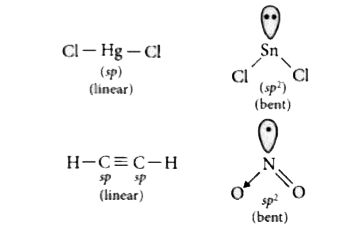
|
|


