

Saved Bookmarks
This section includes 7 InterviewSolutions, each offering curated multiple-choice questions to sharpen your Current Affairs knowledge and support exam preparation. Choose a topic below to get started.
| 1. |
Name the following compounds according to IUPAC system |
| Answer» SOLUTION :3- Chloromethyl-2- ISOPROPYL pentan-1 -O1 | |
| 2. |
Name the following compounds according to IUPAC system. |
Answer» SOLUTION :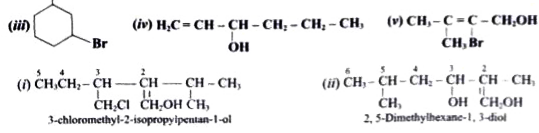 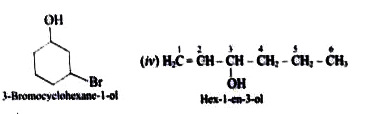
|
|
| 3. |
Name the following complex using IUPAC norms. [Co(en )_2 ("ONO")Cl]Cl |
| Answer» Solution :Monochlorobis (ETHANE ) -1,2-diamine nitrito -KO COBALT (III) chloride | |
| 4. |
Name the following complex using IUPAC norms: [Co(en)_(2)(ONO)Cl]Cl |
| Answer» SOLUTION :Chlorobis( ethane-1, 2-diamine )nitrito-O-cobalt(III) CHLORIDE. | |
| 5. |
Name the following co-ordination compounds according to IUPAC system of nomenclature : [Co(NH_3)_4 (H_2 O) Cl]Cl_2 |
| Answer» SOLUTION :Tetraammineaquachlorido COBALT (III) CHLORIDE | |
| 6. |
Name the following co-ordination compounds according to IUPAC system of nomenclature : [Cr(Cl_2(en)_2] Cl, (en= ethane -1,2-diammine) |
| Answer» SOLUTION :Dichloridobis (ethane-1,2-diamine) CHROMIUM (III) CHLORIDE. | |
| 7. |
Name the following amine according to IUPAC system: |
| Answer» SOLUTION : 3-Bromo 4-Nitroso-1-(N,N-dimethyl) BENZENAMINE | |
| 8. |
Name the flux used to remove iron impurity from molten copper matte. |
| Answer» SOLUTION :SILICA or `SiO_(2)`. | |
| 10. |
Name the first biodegradable polymer used for post operative stiches. |
|
Answer» Daxtran |
|
| 11. |
Name the factors which influence the stability of a complex. |
|
Answer» SOLUTION :NATURE of CENTRAL ion. Nature of LIGAND. |
|
| 12. |
Name the factors that affect adsorption. |
| Answer» Solution :(i) Temperature (II) Pressure (iii) NATURE of the gas and (iv) Nature of the ADSORBENT. | |
| 13. |
Name the factors responsible for the solubility of alcohol in water. |
|
Answer» Solution :The TWO factors RESPONSIBLE for the solubility are : (i) HYDROGEN BONDING. (ii) Size of alkyl/aryl GROUP. |
|
| 14. |
Name the factors responsible for the solubility of alcohols in water. |
|
Answer» Solution :SOLUBILITY of alcohols in water DEPENDS upon the following two factors: (i) Hydrogen bonding. O-H group in alcohol being polar forms H-bonds with `H_(2)O`. Greater the extent of H-bonding, higher is the solubility. For alcohols having comparable molecular masses, solubility increases as the number of OH groups increases, i.e., `underset("MOL. mass 88 g "mol^(-1))(CH_(3)CH_(2)CH_(2)CH_(2)CH_(2)OH) lt underset("Mol. mass "89g" "mol^(-1))(CH_(3)CH_(2)CHOHCH_(2)OH) lt underset("Mol. mass "92" g "mol^(-1))(HOCH_(2)CHOHCH_(2)OH)` (ii) Size of the alkyl/aryl group. higher the hydrocarbon part, lower is the extent of H-bonding and hence lower is the solubility. for EXAMPLE, solubility decreases in the order: `CH_(3)CH_(2)OH gt CH_(3)CH_(2)CH_(2)OH gt CH_(3)CH_(2)CH_(2)CH_(2)OH` |
|
| 15. |
Name the factor on which emf of a cell depends. |
|
Answer» Solution :Emf of a cell depends on following factors : (a) Nature of REACTANTS (b) CONCENTRATION of solution in TWO half cells (C) Temperature |
|
| 16. |
Name the enzymes present in the saliva of human beings. |
| Answer» SOLUTION :Amylases first HYDROLYSE STARCH to maltose and them to GLUCOSE. | |
| 17. |
Name the enzyme which is used to dissolve the blood clot. |
| Answer» SOLUTION :STREPTOKINASE. | |
| 18. |
Name the enzymes and write the reactions involved in the preparation of ethanol from sucrose by fermentation. |
|
Answer» Solution :`to` The enzymes invertase and zymase are used to prepare ethanol from SUCROSE by fermentation. `C_(12)H_(22)O_(11) OVERSET("Invertase")to underset("Glucose")( C_(6)H_(12)O_(6))+ underset("FRUCTOSE")(C_(6)H_(12)O_(6))` |
|
| 19. |
Name the enzyme which converts glucose into alcohol ? |
| Answer» SOLUTION :ZYMASE : `C_6H_12O_6overset("Zymase")to 2C_2H_5OH+2CO_2`. | |
| 20. |
Name the enzyme which converts (i) maltose into glucose (ii) glucose into alcohol |
|
Answer» SOLUTION :(i) MALTASE (II) ZYMASE |
|
| 22. |
Name the enzyme that is used to dissolve blood clots ? |
|
Answer» |
|
| 25. |
Name the enzyme due to which protein is converted into amino acid. |
|
Answer» ZYMASE |
|
| 26. |
The end product in the following sequence of reactions . |
|
Answer» `CH_4` |
|
| 27. |
Name the end product in the following series of reaction, CH_3COOHoverset(NH_3)rarr A overset(/_\)rarr B overset(P_2O_5)rarr C : |
|
Answer» `CH_4` |
|
| 28. |
Name the end product in the following series of reaction CH_(3)COOH overset(NH_(3))toA underset(P_(2)O_(5)) overset(Delta)toB |
|
Answer» `CH_(4)` |
|
| 29. |
Name the elements which are not really transition elements but are discussed with thenm. Why is it so ? |
| Answer» Solution :Zinc , CADMIUM and mercury have completely filled sets of d-orbitals, and therefore, are not really transition metals. However, they are often discussed with them because of the similarities of some of their properties of those of transitoin metals. MOREOVER, they are the end MEMBERS of these series. | |
| 30. |
Name the elements in the 3d-series that shows (i) maximum oxidation state (ii) is diamagnetic |
| Answer» SOLUTION :(i) MANGANESE or MN (II) Zinc or Zn. | |
| 31. |
Name the element which has highest electron affinity or electron gain enthalpy. |
| Answer» SOLUTION :CHLORINE (CL). | |
| 32. |
Name the element of group 17 present in Thyroxine hormone. |
| Answer» Solution :Iodine is the ELEMENT of group 17 PRESENT in Thyroxine hormone. | |
| 33. |
Name the element in the 3d series that (i) shows maximum oxidation state (ii)is diamagnetic |
| Answer» SOLUTION :(i) MANGANESE (II)ZINC | |
| 34. |
Name the electrophile produced in the reaction of benzene with benzoyl chloride in the presence of anhydrous AlCl_(3). Name the reaction also. |
Answer» SOLUTION : The NAME of the REACTION is Friedel-Crafts ACYLATION reaction. |
|
| 35. |
Name the electrophile produced in the reaction of benzene with benzoyl chloride in the presence of anhy. AlCl_(3). Name the reaction also. |
|
Answer» Solution :In the presnece of `AlCl_(3)` BENZOYL chloride produces the electrophile as under `C_(6)H_(5)COCl+AlCl_(3)+underset("Benzoylium cation")(C_(6)H_(5)CO^(+))+AlCl_(4)^(-)` The name of the reaction is FRIEDEL Craft.s reaction. |
|
| 36. |
Name the electrolytic process for the extraction of aluminium from Al_(2)O_(3). |
| Answer» SOLUTION :Hall-Heroult. | |
| 37. |
Name the electrolyte used in (i) dry cell (ii) mercury cell. |
| Answer» Solution :(i) Paste of `NH_(4)Cl` and `ZnCl_(2)` in the zinc cylinder and powdered `MnO_(2)+C` SURROUNDING the graphite ROD. (ii) Moist MERCURIC oxide (HGO) mixed with KOH. | |
| 40. |
Name the diseasescaused due tothedeficieny of vitamins A,E and B_(12). |
|
Answer» Solution :VITAMIN A deficieny causes xeropthalmia and night BLINDNESS. VitaminE deficiency causes increasedfragility of RBCS. Vitamin `B_(12)` deficieny causedc pemicious ANAEMIA. |
|
| 41. |
Name the diseases caused due to deficiencies of vitamin E. |
| Answer» Solution :The diseases caused DUE todeficiencies of vitamin E are WEAKNESS of muscles, abnormal GROWTH and deposition of TISSUE. | |
| 43. |
Name the disease caused by deficiency of vitamin D. |
|
Answer» NIGHT BLIND ness |
|
| 44. |
Name the disaccharide which on hydrolysis gives two molecules of glucose. |
| Answer» SOLUTION :MALTOSE. | |
| 45. |
Name the different types of organometallic compounds |
| Answer» Solution :`SIGMA` bonded organometallic compounds, `pi` bonded organometellic compounds and METAL carbonyls. | |
| 46. |
Name the different polymers based on the mode of polymerization. |
| Answer» SOLUTION :(i) ADDITION POLYMERS (II) CONDENSATION polymers. | |
| 47. |
Name the dicarboxylic acid usedin the manufacture of terylene. |
|
Answer» |
|
| 48. |
Name the depressant used in separation of ZnS from PbS by froth floatation process. |
| Answer» SOLUTION :SODIUM CYANIDE or NACN. | |
| 49. |
Name the deficiency disease resulting from lack of vitamins A and E in the diet. |
|
Answer» SOLUTION :(i) Deficiency of vitamin A CAUSES XEROPHTHALMIA. (ii) Deficiency of vitamin E causes loss of REPRODUCTIVE power. |
|
| 50. |
Namethediseasecausedbythedeficiency ofvitamin A. |
| Answer» SOLUTION :XEROPHTHALMIA. | |