Saved Bookmarks
This section includes 7 InterviewSolutions, each offering curated multiple-choice questions to sharpen your Current Affairs knowledge and support exam preparation. Choose a topic below to get started.
| 1. |
Metallic soaps are : |
|
Answer» Salts of FATTY acids with other metals EXCEPT Na,K |
|
| 2. |
Metallic silver can be obtained from AgCl by |
|
Answer» FUSING it with `Na_(2)CO_(3)` |
|
| 3. |
Metallic rhodium crystallizes in a face-centred cubic lattice with a unit-cell edge length of 3.803 A. Calculate the molar volume of rhodium including the empty spaces. |
|
Answer» |
|
| 4. |
Metallic radii of some transition elements are given below. Which of these elements will have highest density ? {:("Element",Fe,Co,Ni,Cu),("Metallic radii"//p m,126,125,125,128):}" |
| Answer» Solution :DENSITY `=` Mass `// ` volume . As we move from Fe to Cu, mass INCREASES and volume decreases. Hence, density increases `[Fe(7.87) , Co( 8.90) , Ni( 8.91) , Cu( 8.95)]`. Increases in mass in case of Cu DOMINATES over small increase involume. | |
| 5. |
Metallic radii of some transition elements are given below. Which of these elements will have highest density ? {:("Element " ,Fe,Co,Ni,Cu),("Metallic radii/pm",126,125,125,128):} |
|
Answer» Fe Volume As we move from Fe to Ni, mass increases and volume DECREASES. Therefore, density increases. In case of Cu, there is small increase in size but increase in mass being greater, overall effect is the increase in density. Hence, Cu has maximum density as shown below: Fe : 7.87. Co: 8.9, Ni : 8.91, Cu : 8.95. |
|
| 7. |
Metallic Mg has a hexagonal close-packed structure and a density of 1.74 g/cc. Assume Mg atoms to be spheres with radius r. Because Mg has a close-packed structure, 74.1% of the space is occupied by atoms. Calculate the volume of each atom and then find the atomic radius r. |
| Answer» SOLUTION :`1.72 XX 10^(-23) "CC", 1.6 xx 10^(-10) m` | |
| 8. |
Metallic mercury is obtained by roasting mercury (II) sulphide in a limited amount of air. Estimate the temperature range in which the standard reaction is product-facoured. HgS(s)+O_(2)(g) to Hg(l)+SO_(2)(g) DeltaH^(0)=-238.6 kJ/"mole" and DeltaS^(0)=+36.7 J/"mole".K. |
|
Answer» SOLUTION :Assume that `DeltaH` and `DeltaS` VALUES do not depend on temperature . As `DeltaH^(@)` is negative and `DeltaS^(@)` is positive using the equation `DeltaG^(@)=DeltaH^(@)=TDELTAS^(@)` `DeltaG^(@)` will be negative at all temperatures and so the reaction is product-favoured at all temperatures. Inn this problem, both the factors `DeltaH^(@)` and `DeltaS^(@)` are favourable to SPONTANEITY. |
|
| 9. |
Metallic magnesium is prepared by |
|
Answer» REDUCTION of MGO with cock |
|
| 10. |
Metallic lustre is due to |
|
Answer» high DENSITY of metals |
|
| 11. |
Metallic gold is frequently found in aluminosllicate rocks and it is finely dispersed among other minerals.It may be extracted by treating the crushed rock with aerated potassium cyanide solution.During this process metallic gold is slowly converted to [An(CN)_2]^(-) , which is soluble in water.After equilibrium has been reached.the aqueous phase is pumped off and the metallic gold is recovered from it by reacting the gold complex with zinc, which is converted to [Zn(CN)_4]^(2-). Gold in nature is frequently alloyed with silver which is also oxidised by aerated sodium cyanide solution.Silver occurs as native as well as sulphurised ore. The process described above in the passage is regarding : |
|
Answer» ore DRESSING |
|
| 12. |
Metallic gold is frequently found in aluminosllicate rocks and it is finely dispersed among other minerals.It may be extracted by treating the crushed rock with aerated potassium cyanide solution.During this process metallic gold is slowly converted to [An(CN)_2]^(-) , which is soluble in water.After equilibrium has been reached.the aqueous phase is pumped off and the metallic gold is recovered from it by reacting the gold complex with zinc, which is converted to [Zn(CN)_4]^(2-). Gold in nature is frequently alloyed with silver which is also oxidised by aerated sodium cyanide solution.Silver occurs as native as well as sulphurised ore. Which of the following statements is correct ? |
|
Answer» LEACHING of gold with `CN^-` is an OXIDATION reduction `2[Au(CN)_2]+Znto 2Audarr+[Zn(CN)_4]^(3-)`Zinc acts both as complexing and reducing reagent. |
|
| 13. |
Metallic gold frequently is found is aluminosilicate rocks and it is finely dispersed among other minerals it may be extracted by treating the crushed rock with aerated potassium cyanide solution. During this process metallic gold is slowly converted to [Au(CN)_(2)]^(-), which is soluble in water. After equilibrium has been reached, the aqueousis pumped off and the metallic gold is recovered form it by reacting the gold complex with zinc, which is converted to [Zn(CN)_(4)]^(2-) . Gold in nature is frequently alloyed with silver which is also oxidised by aerated sodium cyanide solution. Silver occurs as native as well as sulphurised ore. The process described above in the passage is regarding: |
|
Answer» ORE dressing |
|
| 14. |
Metallic gold is frequently found in aluminosllicate rocks and it is finely dispersed among other minerals.It may be extracted by treating the crushed rock with aerated potassium cyanide solution.During this process metallic gold is slowly converted to [An(CN)_2]^(-) , which is soluble in water.After equilibrium has been reached.the aqueous phase is pumped off and the metallic gold is recovered from it by reacting the gold complex with zinc, which is converted to [Zn(CN)_4]^(2-). Gold in nature is frequently alloyed with silver which is also oxidised by aerated sodium cyanide solution.Silver occurs as native as well as sulphurised ore. The correct reaction involved in the leaching of gold with dilute solution of NaCN is : |
|
Answer» `{:(4Au+8CN^(-)+2H_2O+O_2("air"),TO4[Au(CN)_2]^(-)+4OH^(-)),(4Au+8CN^(-)+2H_2O+O_2,to4[Au(CN)_2]^(-)+4OH^(-)):}` |
|
| 15. |
Metallic gold frequently is found is aluminosilicate rocks and it is finely dispersed among other minerals it may be extracted by treating the crushed rock with aerated potassium cyanide solution. During this process metallic gold is slowly converted to [Au(CN)_(2)]^(-), which is soluble in water. After equilibrium has been reached, the aqueousis pumped off and the metallic gold is recovered form it by reacting the gold complex with zinc, which is converted to [Zn(CN)_(4)]^(2-) . Gold in nature is frequently alloyed with silver which is also oxidised by aerated sodium cyanide solution. Silver occurs as native as well as sulphurised ore. Which of the following statement is correct? |
|
Answer» Leaching of gold with `CN^(-)` is an oxidation reaction |
|
| 16. |
Metallic gold frequently is found in aluminosilicate rocks and it is finely dispersed among other minerals. It may be extracted by treating the crushed rock with aerated sodium cyanide solution. During this process metallic gold is slowly converted t [Au(CN)_(2)]^(-), which is soluble in water. After equlibrium has been reached, the aqueous phase is pumped off and the metallic gold is recovered from it by reacting the gold complex with zinc, which is converted to [Zn(CN)_(4)]^(2-), Gold in nature is frequently alloyed with silver is also oxidised by aerated sodium cyanide solution. Which of the follwing is/are correct for cyanide process of extraction of gold? |
|
Answer» Sodium cynaide is sweet in taste and is also used in making chocolates |
|
| 17. |
Metallic gold frequently is found in aluminosilicate rocks and it is finely dispersed among other minerals. It may be extracted by treating the crushed rock with aerated sodium cyanide solution. During this process metallic gold is slowly converted t [Au(CN)_(2)]^(-), which is soluble in water. After equlibrium has been reached, the aqueous phase is pumped off and the metallic gold is recovered from it by reacting the gold complex with zinc, which is converted to [Zn(CN)_(4)]^(2-), Gold in nature is frequently alloyed with silver is also oxidised by aerated sodium cyanide solution. The correct ionic reaction for the process is//are: |
|
Answer» `AU+2CN^(-)rarrAr[(CN)_(2)]^(-)` |
|
| 18. |
Metallic gold ferquently is found is aluminosilicate rocks and it is finely dispersed among other minerals. It may be extracted by treating the crushed rock with aearated sodium cyanide solution. During this process metallic gold is slowly converted to [Au(CN)_(2)]^(-), Which is soluble in water. After equilibrium has been reached, the aqueous phase is pumped off and the metallic gold is recoverd form it by reacting the gold complex with zinc, whihc is converted tio [Zn(CN)_(4)]^(2-). Gold in nature is frequently alloyed with silver. which is also oxidised vy aerated sodium by aerated sodium cyanide solution The process described in the passage represents: |
|
Answer» ORE concentration |
|
| 19. |
Metallic gold ferquently is found is aluminosilicate rocks and it is finely dispersed among other minerals. It may be extracted by treating the crushed rock with aearated sodium cyanide solution. During this process metallic gold is slowly converted to [Au(CN)_(2)]^(-), Which is soluble in water. After equilibrium has been reached, the aqueous phase is pumped off and the metallic gold is recoverd form it by reacting the gold complex with zinc, whihc is converted tio [Zn(CN)_(4)]^(2-). Gold in nature is frequently alloyed with silver. which is also oxidised vy aerated sodium by aerated sodium cyanide solution There have been several to develop alternative gold extraction processs whihc could replace this one. This due to: |
|
Answer» Sodium cyanide solutions corrode mining machinery. |
|
| 20. |
Metallic gold crystallizes in the face-centred cubic lattice. The edge length of the cubic unit cell, a = 4.070 A. Calculate the closest distance between gold atoms and the density of gold. Atomic mass of Au = 197 amu. |
|
Answer» Solution :In a face-centred cubic CELL, radius `=(sqrt(2)a)/4`……………. (Eqn. 3) `therefore` the closed distance between two atoms = diameter `=2 xx (sqrt(2)a)/4 = a/sqrt(2)` `=(4.070)/sqrt(2) A = 2.878 A` Number of atoms in a face-centred unit cell = `8(1/8)+ 6(1/2)` Mass of 4 atoms PER unit cell `=4 xx 197` amu `=4 xx 197 xx (1.66 xx 10^(-24))g` `=1.308 xx 10^(-21) g` Volume of the unit cell `=a^(3)` `=(4.07 xx 10^(-8))^(3)` CC. `therefore` Density of gold `=(1.308 xx 10^(-21))/(4.07 xx 10^(-8))^(3) = 19.40 g//"cc"` |
|
| 21. |
Metallic gold crystallizes in fcc lattice. The length of the cubicunit cell is 4.07 Å(a) What is the closest distance between gold atoms ?(b) How many 'nearest neighbours' does each gold atom have at the distance calculated in (a) ?(c ) What is the density of gold ? (d) Prove that the packing fraction of gold is 0.74. |
|
Answer» Solution :(a) For fcc lattice nearst distance between TWO neighbours = 2r As we know `4r = sqrt(2)a` or`2r=(sqrt(2))/(2)a` `= (sqrt(2))/(2)xx4.07 Å` `= 2.88 Å` (b)If we consider a face centred gold ATOM, it has four comers and eight other adjacent face centre atoms present at `a//sqrt(2)` distance. Therefore, there are 12 nearest neighbours. (c ) Density `(rho) = (nM_(m))/(N_(o)xx a^(3))=(4xx197)/(6.023xx10^(23)xx(4.07xx10^(-8))^(3))=19.4` g/cc. (d) Packing fraction `= (4xx4//3pi R^(3))/((4r//sqrt(2))^(3))~~ 0.74` |
|
| 22. |
Metallic gold crystallises in fcc lattice. The length of the cubic unit cell is a = 4.07 Å (a) What is the closest distance between gold atoms. (b) How many "nearest neighbours" does each gold atom have at the distance calculated in (a). (c) What is the density of gold ? (d) Prove that the packing fraction of gold is 0.74. |
|
Answer» |
|
| 23. |
Metallic gold crystallizes in ccp lattice. The length of the cubic unit cell is 4.242 A^@. The closest distance between two atoms of gold |
|
Answer» `4A^@` |
|
| 24. |
Metallic gold crystallizes in body centred cubic lattcie. The coordination number of gold is : |
|
Answer» ZERO |
|
| 25. |
Metallic conduction depends on which of the following ? |
|
Answer» The NATURE of the METAL |
|
| 26. |
Metallic chromium crystallises in bee lattice. The edge length of unit cell is 2.87 A^(0) . Calculate (a) atomic radius and (b) density. |
| Answer» SOLUTION :`1.24 A^(@),7.3 G C c^(-1)` | |
| 27. |
Metallic Ba has a body-centred cubic structure (all atoms at the lattice points) and a density of 3.51 g/cc. Assume Ba atoms to be spheres. The spheres in a body-centred array occupy 68.0% of the total space. Find the atomic radius of Ba. |
| Answer» SOLUTION :`3.14 XX 10^(-8) CM` | |
| 28. |
Metallic bond is stronger in transition metals than alkali and alkaline earth metals because of : |
|
Answer» More NUMBER of ELECTRONS INCLUDING d-electrons |
|
| 29. |
Metalions which form the most stable complexes have each of the following properties except : |
|
Answer» small size |
|
| 30. |
Metal used for making joints in jewellery is: |
|
Answer» Zn |
|
| 31. |
Metal used in the extraction of Mn and Crfrom their oxides is |
|
Answer» Ag |
|
| 32. |
Metal that can be extracted by eletrolysis of its salt even from aqueous solutions |
|
Answer» Cu |
|
| 33. |
Metal sulphides occur mainly in rocks, but metal halides occur in lakes and sea. Why ? |
| Answer» Solution :METAL HALIDES have low lattice ENERGY and are genrally soluble in water. Metal SULPHIDES are almost insolublein water. | |
| 34. |
Metal salts, which respond to Borax bead test ? |
|
Answer» NICKEL salts |
|
| 35. |
Metal rod A is dipped in 0.1 M solution of ASO_(4). The salt is 95% dissociated at this dilution at 298 K. Calculate the electrode potential (E_(A^(2+)//A)^(@) = -0.76 V) |
|
Answer» SOLUTION :Salt is 95% ionised `[A^(2+)] = 95/100 xx 0.1 = 0.095 M` The ELECTRODE reaction is `A^(2+) + 2e^(-) to A(s)` Applying Nernst equation `E_(A^(2+)//A) = E_(A^(2+)//A)^(@) - (0.0591)/ n LOG 1/[A^(2+)]` `=-0.76 V - (0.0591)/2 log 1/(0.095)` `=-0.76V - 0.0295 [log 1000 - log 95]` `=-0.79021` V |
|
| 36. |
Metal reacts with sulphur to give: |
|
Answer» Sulphide |
|
| 37. |
Metal protected by a layer of its own oxide is : |
|
Answer» Au |
|
| 39. |
Metal oxides which decomposes on heating is |
| Answer» Solution :`2HgOoverset(Delta)rarr2Hg+O_(2)` | |
| 40. |
Metal nitrate (A) on heating decomposes, leaving a solid residue (B) which goes into solution with dilute HCI. The solution of (B) gives a white precipitate with ammonium carbonate solution. The precipitate (C) is dissolved in dilute HCI and the solution is treated with potassium chromate to get yellow precipitate (D). The solution (B) with dilute H_(2)SO_(4) also gives a white precipitate (E) insoluble in dilute HCl and nitric acid. The precipitate (E) is a part of a white pigment lithopone.QThe compound (E) is: |
|
Answer» `BaSO_(4)` |
|
| 41. |
Metal oxide is converted into metal by the _____ process. |
|
Answer» Calcination |
|
| 42. |
Metal (M) shows crimson red colour in flame test and its halide is deliquescent then metal (M) could be : |
|
Answer» Li |
|
| 44. |
Metal 'M' is a major component of many igneous minerals including mica and clays then M is: |
|
Answer» Al |
|
| 45. |
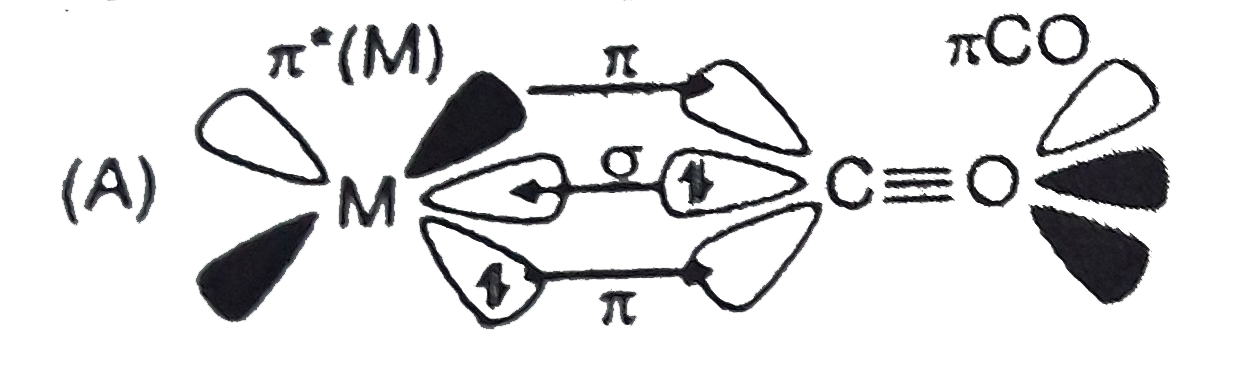
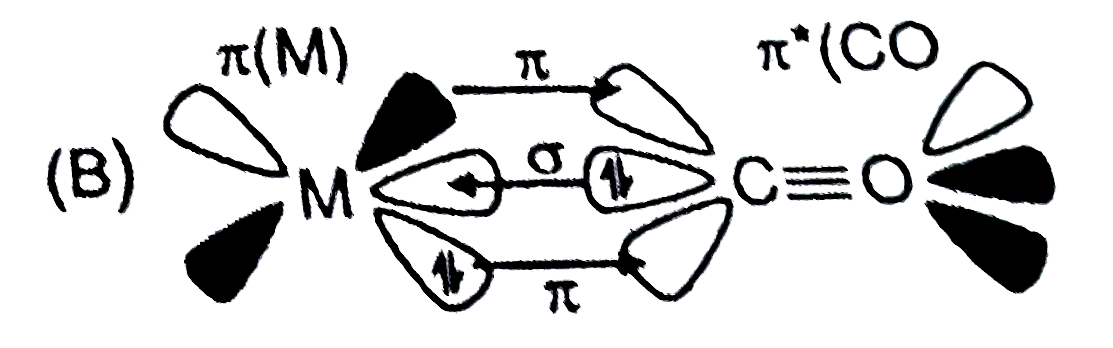
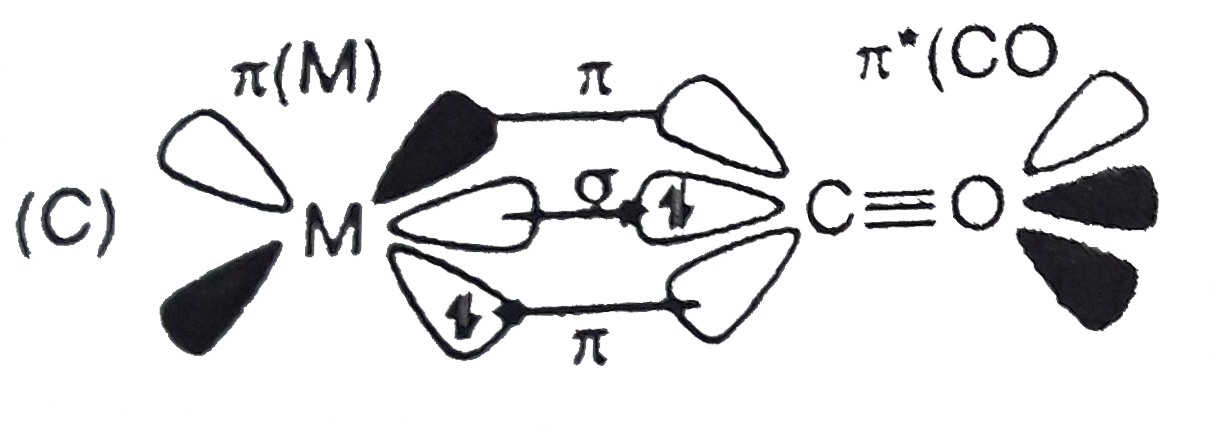
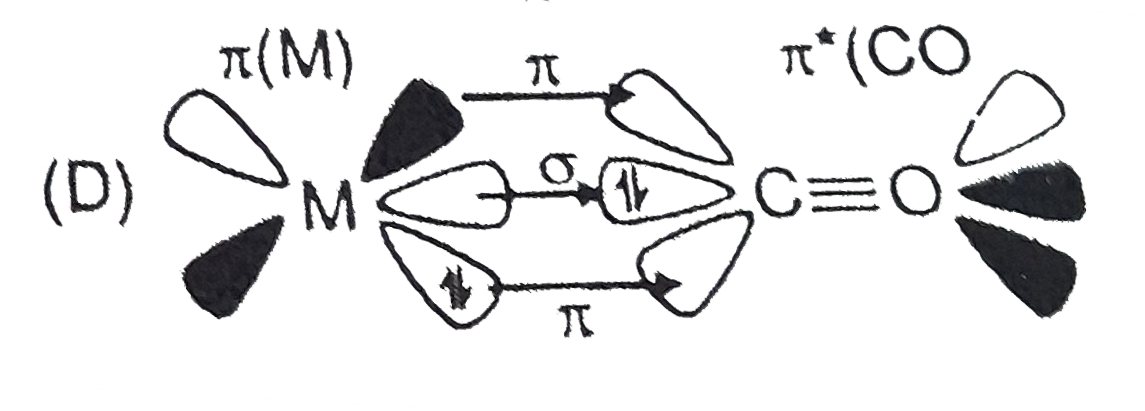
Metal 'M' forms as carbonyl compound in which it is present in its lower valence state. Which of the following bonding is possible is this metal carbonyl ? |
|
Answer»
|
|
| 46. |
Metal M and chlorine combine in different proportions to form two compound A and B the mass ratio M: Cl is 0.895:1 in A and 1.791:1 in B. what law of chemical combination is illustrated? |
| Answer» Solution :MASSES of METAL which COMBINE with 1 part of chlorine are in the ratio of 1:2, which is a simple ratio. Hence, law of multiple proportions is illustrated. | |
| 47. |
Metal M+"air" overset(delta)(to)Aoverset(H_(2)O)(to)Boverset(HCl)(to) White fumes, Metal M can be: |
|
Answer» `LE, Mgor Al` |
|
| 48. |
Metal lauryl sulphate acts as : |
|
Answer» Soap |
|
| 49. |
Metal-Isothiocyanato' is indicated by its chemical symbol as |
|
Answer» M-NCS |
|
| 50. |
Metal extracted only by electrolysis process is |
|
Answer» copper |
|