Saved Bookmarks
This section includes 7 InterviewSolutions, each offering curated multiple-choice questions to sharpen your Current Affairs knowledge and support exam preparation. Choose a topic below to get started.
| 1. |
Isomerismshownby aminesis / are |
|
Answer» chain |
|
| 2. |
KCl crystallizes in the same type of lattice as does NaCl. Given that (""^rNa^(+))/(""^rCl^(-))=0.5 and (""^rNa^(+))/(""^rK^(+))=0.7 |
|
Answer» |
|
| 3. |
Isomerism exhibited by [Cr(NH_(3))_(2) (H_(2)O)_(2)Cl_(2)]^(+) are :- |
|
Answer» IONISATION, optical |
|
| 4. |
KCl Crystallizes in the same type of lattice as does NaCl.Given that, (r_(Na^(+)))/(r_(Cl^(-)))=0.5and (r_(Na^(+)))/(r_(K^(+)))=0.7Calculate : (a)The ratio of the side of unit cell for KCl to that for NaCl and (b) The ratio of density of NaCl to that for KCl. |
|
Answer» |
|
| 5. |
KCl crystallizes in the same type of lattice as does NaCl. Given that r_(Na+)//r_(Cl-) = 0.55 and r_(Na+)//r+_(K-) = 0.74. Calculate the ratio of the side of the unit cell for KCl to that for NaCl. |
|
Answer» 1.125 |
|
| 6. |
Isomerism exhibited by ethylene glycol is ________. |
|
Answer» POSITION isomerism |
|
| 7. |
KCl crystallises in the same type of lattice as does NaCl. Given (r_(Na^(+)))/(r_(Cl^(-)))=0.5 and (r_(Na^(+)))/(r_(K^(+)))=0.7The ratio of the side of the unit cell for NaCl to that for KCl is |
|
Answer» `1:1.172` `r_(NA^(+))+r_(Cl^(-))=(a)/(2)` Given,`(r_(Na^(+)))/(r_(Cl^(-)))=0.5,(r_(Na^(+)))/(r_(K^(+)))=0.7` Thus we have ,`(r_(Na^(+))+r_(Cl^(-)))/(r_(Cl^(-)))=1.5` `(r_(K^(+)))/(r_(Cl^(-)))=(r_(K^(+)))/(r_(Na^(+))//0.5)=(0.5)/(r_(Na^(+))//r_(K^(+)))=(0.5)/(0.7)` Therefore,`(r_(K^(+))+r_(Cl^(-)))/(r_(Na^(+))+r_(Cl^(-)))=(1.2)/(0.7)xx(1)/(1.5)` `:.(a_(KCl//2))/(a_(NaCl//2))=(1.2)/(0.7xx1.5)=(a_(KCl))/(a_(NaCl))=1.143` or`(a_(NaCl))/(a_(KCl))=1:1.143` |
|
| 8. |
KCl cannot be used as a salt bridge for all the cell Cu(s) | CuSO_(4) (aq) | | AgNO_(3) (aq) |Ag(s) because |
|
Answer» `CuCl_(2)` gets PRECIPITATED |
|
| 9. |
KCl cannot be used as a salt bridge for the cell Cu(s) abs(CuSO_(4)(aq))abs(AgNO_(3)(aq)) Ag(s) because: |
|
Answer» `CuCl_(2)` GETS precipitated |
|
| 10. |
Isomerism exhibited by acetic acid and methyl formate is: |
|
Answer» Functional |
|
| 11. |
KCl cannot be used as a salt bridege for the cell Cu(s)|CuSO_(4)(aq.)||AgNo_(3)(aq.)|Ag(s) because |
|
Answer» `Cl_(2)` gas is evolved The cell terminals are at the extreme ends in this cell notation. and a single cerical bar indicates a phase boundary-sat between a SOLID terminal and the electrode solution. for example, the zinc electode is a solild while the `Zn^(2+)` ions (form `ZnSO_(4)`) are in solution. thus, we draw a line between `Zn` and `Zn^(2+)` to show the phase boundries. Note that there is also a line between the `ZnSO_(4)` solution and the `KCl` solution in the salt bridge because these two solutions are not mixed physically and therefore constitute two separate phases. |
|
| 12. |
Isomerisation exhibited by [Cr(NH_(3))_(2)(H_(2)O)_(2)Cl_(2)]^(+) are : |
|
Answer» ionisation, optical |
|
| 13. |
KCl can be used in salt bridge as an electrolyte in which of the following cells ? |
|
Answer» `Zn| ZnCl_2 ||AgNO_3 |Ag` |
|
| 14. |
KCIO_(3) on reaction with SO_(2) gives (A) and on reactionwith conc. H_(2)SO_(4) gives (B).(A) and (B) are |
|
Answer» `KCI,HCI_(4)` `3KCIO_(3)+3H_(2)SO_(4)rarr 3KHSO_(4)+3HCIO_(3)` `2HCIO_(3)rarr 2CIO_(2)+H_(2)O+[O]` `HCIO_(3)+[O]rarr HCIO_(4)` `3KCIO_(3)+3H_(2)SO_(4)rarr 3KHSO_(4)+UNDERSET((B)Product)HCIO_(4)+H_(2)O` |
|
| 16. |
Isomerism among compounds due to the migration of a proton is known as: |
|
Answer» Geometrical |
|
| 17. |
Isomer which are non super imposable mirror image are known as, |
|
Answer» antimeter |
|
| 18. |
Isoleucine is : |
|
Answer» Protein |
|
| 19. |
KCIO_3 on heative decomposes into KCI and O_2. If some MnO_2 is added the reaction goes much faster because : |
|
Answer» `MnO_2` DECOMPOSES to give OXYGEN |
|
| 20. |
Isoelectric point of a protein is related to : |
|
Answer» pH |
|
| 21. |
KCI + "conc" H_(2)SO_(4) + K_(2)Cr_(2)O_(7) overset(Delta) to (X) overset(NaOH) to(Y),(X)isreddishbrown coloured gassolublein NaOH forming (Y),(X) and (Y) are |
|
Answer» `Cr_(2)OCI_(2)Na_(2)CrO_(3)` |
|
| 22. |
KCl (aq) cannot be used as a salt bridge for the cell Cu(s)|CuSO_4(aq)||AgNO_3(aq)|Ag(s) because : |
|
Answer» `CuCI_2` is PRECIPITATED |
|
| 23. |
Isoelectric point is a |
|
Answer» SPECIFIC temperature |
|
| 24. |
K,Ca and Li metals may be arranged in the decreasing order of their standard electrode potentials as …………… . |
|
Answer» K, CA, LI |
|
| 25. |
Isoelctric point is defined as the pH at which : |
|
Answer» An amino acid BECOMES acidic |
|
| 26. |
K_c for A + B ⇌ C + D is 10 at 25^o C. If a container contains 1,2,3,4 mole per litre of A,B,C, and D respectively at 25^o C , the reaction shall : |
|
Answer» PROCEED from RIGHT to left |
|
| 27. |
KBr,on reaction with cone H_(2)SO_(4) give reddish brown gaswhich bleaches moistlimus paper .The evolved gas is |
|
Answer» Bromine<BR>Mixture of bromineand HBR `2HBr +H_(2)SO_(4) rarr Br_(2) + 2H_(2)+S O_(2)` |
|
| 28. |
Isocyanide test is used for the derection of : |
|
Answer» PRIMARY ALCOHOLS |
|
| 29. |
Isocyanide test is used to detect: |
|
Answer» PRIMARY alcohols |
|
| 30. |
KBr undergoes 80% dissociationin its 0.5M aqueoussolution.Calculatethe osmotic pressureof thissolutionat 287^(@)C. |
|
Answer» <BR> Solution :KBR DISSOCIATES as`KBr to K^(+) + Br^(-)` If `alpha` is the degree of dissociation , then `alpha= (i-1)/(m-1)` m = 2 , `alpha = 80% = 0.80` ` 0.80 = (i-1)/(2-1)` ` i=1 = 0.80` `i=0.80 + 1 = 1.80` ` pi = icRT` ` = 1.80 xx 0.5 xx 0.0821 xx300` ` = 22.167 ` ATM |
|
| 31. |
Isocyanidetest is usedfor the dectectionof |
|
Answer» primary ALCOHOLS |
|
| 32. |
KBr is 80% dissociated in aqueous solution of 0.5 m concentration (Given K_(f)=1.86 " K kg" mol^(-1)). The solution freezes at : |
|
Answer» 271.326 K i=1.28, DeltaT_(F)=iK_(f)m` ` =1.28xx(1.86 K KG mol^(-1))xx(0.5 mol kg^(-1))` =1.674 K. f.p. of solution=(273-1.674) = 271.326 K |
|
| 33. |
Isobutyric acid is obtained by oxidation of |
|
Answer» butanal |
|
| 34. |
KBr is 80 % dissociated in solution. The freezing point of a 0.5 molal solution is (K_(f) "water" = 1.86^(@)C/m) |
|
Answer» 273 K `Delta T_(F) = i K_(f) m = 1.80 XX 1.86 xx 0.5 = 1.674^(@)` `T_(f) = 273 - 1.674 = 271.326 K.` |
|
| 35. |
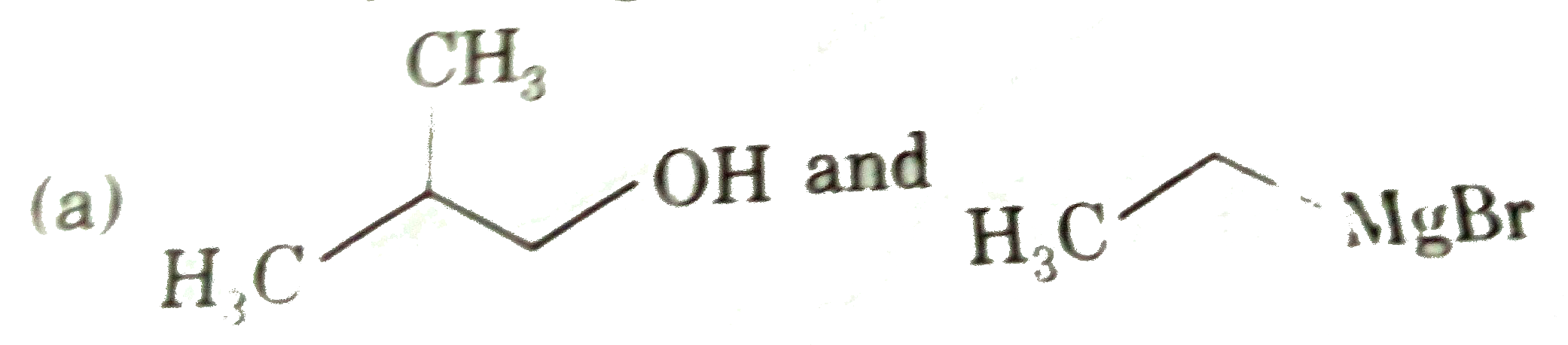
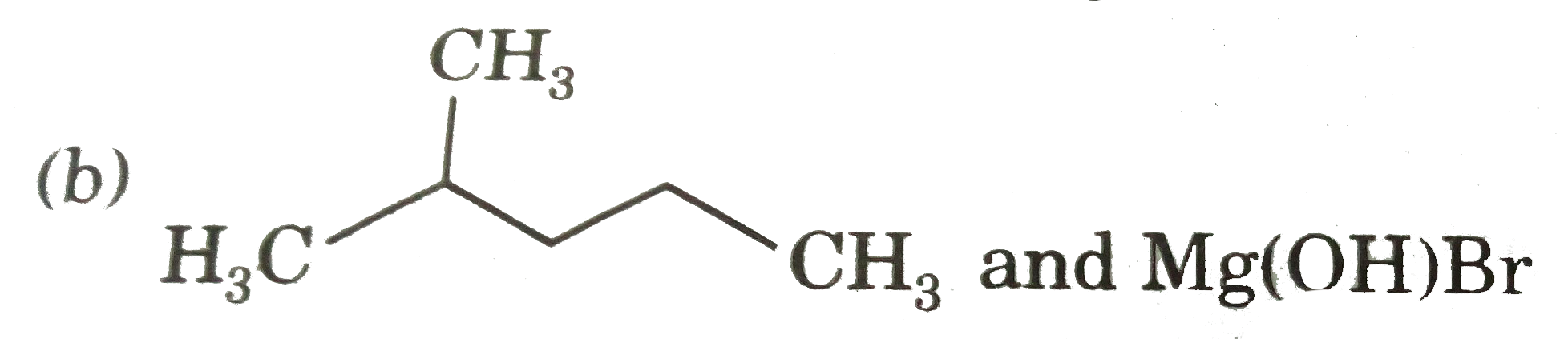
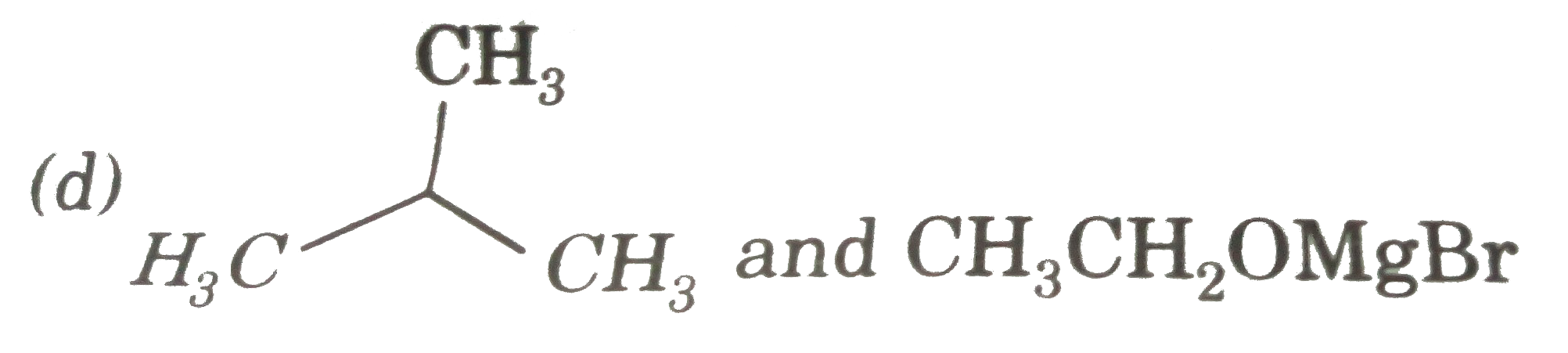
Isobytyl magesium bromide with dry ether and absolute alcohol gives : |
|
Answer»
|
|
| 36. |
KBr is 80% dissociated in aqueous solution of 0.5M concentration (Given K_(f) for water =1.86 K kg mol^(-1)). The solution freezes at |
|
Answer» 271.326 K |
|
| 37. |
Isobutylene reacts with HBr by peroxide effect gives |
|
Answer» `CH_(3)CH_(2)-CH_(2)-CH_(2)Br` |
|
| 38. |
KBr contains 32,9 % potassium by mass. If 6.40 g of Br_(2) is made to react with 3.60 g of potassium, the actual mass of potassium which reacted with Br_(2) is |
|
Answer» 3.14 g 67.1 g of bromin react with potassium = 32.9 g 6.40 g of bromine react with potassium `=((32.9)XX(6.40g))/((67.2g)) = 3.138 g = 3.14 g` |
|
| 39. |
Isobutylene is obtanied when |
|
Answer» Sod. T-butaxide is treated with methyl iodide 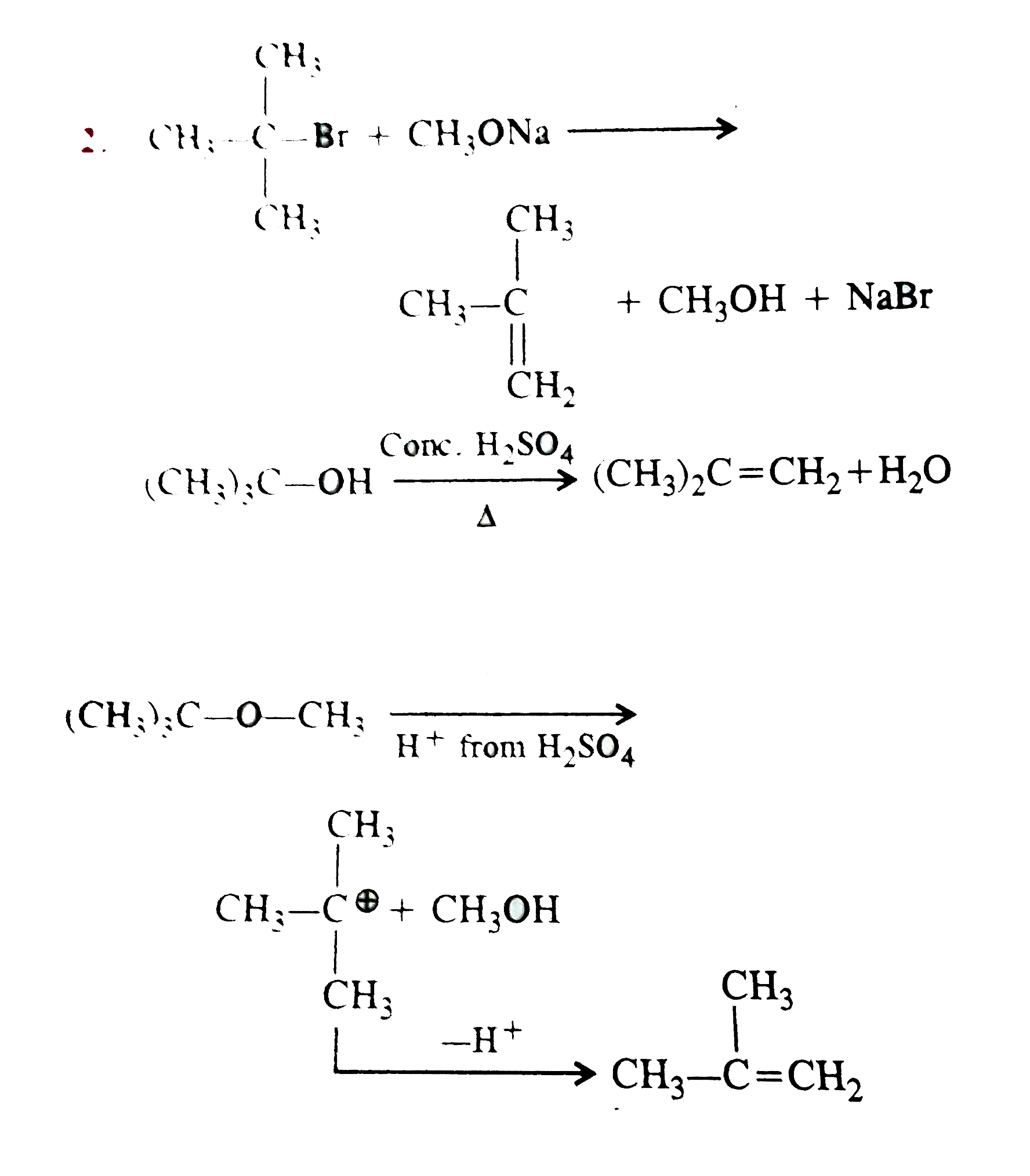
|
|
| 40. |
K_bfor the hydrolysis reaction : B^+ +H_2O hArr BOH +H^+ is 1.0xx10^(-6) the hydrolysis constant of the salt is : |
|
Answer» `10^(-6)` |
|
| 41. |
Isobutyl n-butyl ether is reacted with cold conc. HI gives, |
|
Answer» `CH_3CH_2CH_2CH_2I+(CH_3)_2CHCH_2OH` |
|
| 42. |
K_(b) for NH_(4)OH is 1.81xx10^(-5). The pH of 0.01 M NH_(4)Cl solution at 25^(@)C is : |
|
Answer» `4.82` |
|
| 43. |
K_b and K_f for water are respectively 0.52 and 1.80 kg "mol"^(-1)respectively. For an aqueous glycolic solution freezing point is 3.72^@ C. What is the boiling point of the solution ? |
|
Answer» Solution :DEPRESSION of freezing point =`Delta t_f =3.72^@C` `DeltaT_f = K_f XX m` , MOLALITY `m=DeltaT_f //K_f` =3.72/1.86 =2 mol `kg^(-1)` ELEVATION of BOILING point =`DeltaT_b=K_b xx m` `=0.52xx2=1.04^@C` Boiling point of the solution =100+1.04 =`101.04^@C` |
|
| 44. |
K_b for NH_4OH is 1.8 times 10^-5. Calculate the percentage of ionisation of 0.06 M ammonium hydroxide solution. |
| Answer» Solution :`a=SQRT(K_b/C)=sqrt((1 .8 times10^-5)/(6 times10^-2))=sqrt(3 times10^-4)=1.732 times10^-2=1.732 times10^-2 times100=1.732%` | |
| 45. |
Isobutyl magnesium bromide with dry ether and absolute alcohol gives: |
|
Answer»
|
|
| 46. |
K_(b) for "CC"l_(4) is 5.02. The boiling point of pure "CC"l_(4) is 76.8^(@)C. Calculate the boiling point of a 1 molal solution of naphthalene (C_(10)H_(8)) is "CC"l_(4) |
|
Answer» |
|
| 47. |
Isobutyl magnesiumbromidewithdry etherandabsoluteaocholgives : |
|
Answer» `(CH_(3))_(2)CH-CH_(2)Ohand CH_(3)CH_(2) MGBR` |
|
| 48. |
K_b for diethylether is 2.16 K kg "mol"^(-1). Calculate the molar mass of solute when 0.4g of solute present in 40 g of ether, increased the boiling point of ether by 0.17 K. |
|
Answer» Solution :WEIGHT of solute =w=0.4 g, Weight of solvent = W=40 g `K_b=2.16 "K KG mol"^(-1) , DeltaT_b`=0.17 K MOLAR mass of solute `=(wxxK_bxx1000)/(WDeltaT_b)=(0.4xx2.16xx1000)/(0.17xx40)=127 "g mol"^(-1)` |
|
| 49. |
Isobutyl chloride is: |
|
Answer» `CH_3CH_2CH_2CH_2Cl` |
|