

Saved Bookmarks
This section includes 7 InterviewSolutions, each offering curated multiple-choice questions to sharpen your Current Affairs knowledge and support exam preparation. Choose a topic below to get started.
| 1. |
Just after slow crystallisation the solution in contact with the crystal is: |
|
Answer» Dilute |
|
| 2. |
Is it advisable to use conc. HCI in place of dilute HCI for preparing original solution |
| Answer» Solution :CONC. HCl can be used but to ENSURE the PRECIPITATION of `PB^(2+)` as `PbCl_(2)` the solution is prepared in DIL. HCl as `PbCl_(2)` dissolved In conc. HCl due to complex formation. | |
| 3. |
Joule-Thomson coefficient (mu_pi) is given by : |
|
Answer» <P>`((delta T/(delta P))_H` |
|
| 4. |
..........is highest soluble in water. |
|
Answer» `pH_(3)` |
|
| 5. |
Joule Thomson coefficient is given by the expression |
|
Answer» <P>`((deltaT)/(deltaP))_(H)` |
|
| 6. |
Joule-Thomson coefficient ((delta T/(delta P))_H for an ideal gas is : |
|
Answer» ZERO |
|
| 7. |
Joule Thomson co-efficient for ideal gas is: |
|
Answer» Zero |
|
| 8. |
Is haemoglobin negatively or positively charged sol? |
| Answer» SOLUTION :POSITIVELY CHARGED | |
| 9. |
Jone.s reagent is: |
|
Answer» ACIDIFIED `KMnO_4` |
|
| 10. |
J.C. Slater proposed an empirical constant that represents the cumulative extent to which the other electrons of an atom shield (or screen) any particular electron from the nuclear charge. Thus, slater's screening contant sigma is as : Z^(**)=Z-sigma Here, Z is the atomic number of the atom, and hence is equal to the actual number of protons in the atom. the parameter Z^(**) is the effective nuclear charge, which according to is smaller than Z, since the electron in question is screened (shielded) from Z by an amount sigma. Conversely, an electron that is well shielded from the nuclear charge Z experiences a small effective nuclear charge Z^(**). The value of sigma for any one electron in a given electron configuration (i.e., in the presence of the other electrons of the atom in question) is calculated using a set of empirical rules developed by slater. according to these rules, the value of sigma for the electron in question is the cumulative total provided by the various other electrons of the atom. Q. According to Slater's rule, order of effective nuclear charge (Z^(**)) for last electron in case of Li, Na and K. |
|
Answer» `LI gt Na gt K` `""_(11)Na implies 11-(0.85xx8+1xx2)=11-8.8=2.2` `""_(19)K implies 19-(0.85xx8+1xx10)=19-16.8=2.2` |
|
| 11. |
Is [H_2C CH(C_6H_5)]_na homopolymer or copolymer ? Why ? |
| Answer» Solution :HOMOPOLYMER, because it is formed by POLYMERIZATION of ONE KIND of monomer species. | |
| 12. |
J.C. Slater proposed an empirical constant that represents the cumulative extent to which the other electrons of an atom shield (or screen) any particular electron from the nuclear charge. Thus, slater's screening contant sigma is as : Z^(**)=Z-sigma Here, Z is the atomic number of the atom, and hence is equal to the actual number of protons in the atom. the parameter Z^(**) is the effective nuclear charge, which according to is smaller than Z, since the electron in question is screened (shielded) from Z by an amount sigma. Conversely, an electron that is well shielded from the nuclear charge Z experiences a small effective nuclear charge Z^(**). The value of sigma for any one electron in a given electron configuration (i.e., in the presence of the other electrons of the atom in question) is calculated using a set of empirical rules developed by slater. according to these rules, the value of sigma for the electron in question is the cumulative total provided by the various other electrons of the atom. Q. Which of the following statement is correct? |
|
Answer» A 4S-orbital is filled EARLIER than a 3D-orbital because, `Z^(**)` for `3d gt Z^(**)` for 4s. |
|
| 13. |
Is (-CH_(2) - underset(Cl)underset(|)(CH))_(n) a homopolymer or copolymer ? |
| Answer» SOLUTION :HOMOPOLYMER. | |
| 14. |
_______is formed when potassium iodide is heated with conc. H_(2)SO_(4) |
|
Answer» Solution :`2KI+2H_(2)SO_(4)("CONC.")to2KHSO_(4)+2HI` `MnO_(2)+H_(2)SO_(4)toMnSO_(4)+H_(2)O(O)` `2HI+(O)toH_(2)O+I_(2)` `overset(""2KI+MnO_(2)+3H_(2)SO_(4)toI_(2)+MnSO_(4)+2H_(2)O+2KHSO_(4)"")` |
|
| 15. |
J.C. Slater proposed an empirical constant that represents the cumulative extent to which the other electrons of an atom shield (or screen) any particular electron from the nuclear charge. Thus, slater's screening contant sigma is as : Z^(**)=Z-sigma Here, Z is the atomic number of the atom, and hence is equal to the actual number of protons in the atom. the parameter Z^(**) is the effective nuclear charge, which according to is smaller than Z, since the electron in question is screened (shielded) from Z by an amount sigma. Conversely, an electron that is well shielded from the nuclear charge Z experiences a small effective nuclear charge Z^(**). The value of sigma for any one electron in a given electron configuration (i.e., in the presence of the other electrons of the atom in question) is calculated using a set of empirical rules developed by slater. according to these rules, the value of sigma for the electron in question is the cumulative total provided by the various other electrons of the atom. Q. The effective nuclear charge at the periphery of chromium atom [Z=24]: |
|
Answer» 4.25 so EXTRA electron now coming in `4s^(1)` orbital. `sigma=(1xx0.35)+(13xx0.85)+(10xx1.0)=21.40` `Z^(**)=Z-sigma=24.0-21.4=2.6` |
|
| 16. |
Javelle water is: |
|
Answer» AQUEOUS solution of NaOCl |
|
| 17. |
_____is formed when ethylamine is heated with CS_(2) in presence of HgCl_(2). |
| Answer» SOLUTION :Ethylisothiocyanate. | |
| 18. |
Jatinder a class XII student read the composition of the detergent which his mother was using for washing clothes. He found that besides the cleansing agent, the other ingredient of the detergent was polyphosphates. He told his mother about the pollution that detergents cause to our rivers and other waterways. After reading the above passage, answer the following questions : (i) What values are expressed by Jatinder? (ii) What is the cleansing agent usually present in domestic detergents? (iii) Why are polyphosphates added to detergents and how do they cause pollution? |
|
Answer» Solution :(i)Jatinder expressed CONCERN regarding protection of our rivers and other waterways from pollution. (II)Detergents are sodium or potassium salts of benzenesulphonic acid (iii)Polyphosphates are added to detergents to soften water. They form soluble complexes with `Cu^(2+)` and `Mg^(2+)` ions THEREBY making them ineffective. `2Ca^(2+)+ underset("Sod. hexametaphosphate")(Na_2[Na_4(PO_3)_6])to underset("Solublecomplex ")(Na_2[Ca_2(PO_3)_6])+4Na^(+)` `2Mg^(2+) + Na_2[Na_4(PO_3)_6] to underset("Soluble complex")(Na_2[Mg_2(PO_3)_6])+4Na^(+)` These polyphosphates nourish bacteria which grow excessively and deplete water of dissolved oxygenthus killing fish and other small AQUATIC animals. |
|
| 19. |
Is free enegy change of a cell reaction an intensive property or extensive property? |
| Answer» SOLUTION :EXTENSIVE PROPERTY. | |
| 20. |
..............is formed when NH_(3) is passed through a solution of calcium hypochlorite. |
| Answer» SOLUTION :`N_(2)` | |
| 21. |
Jahn-Teller effect is not observed in high spin complexes of |
|
Answer» `d^7` |
|
| 22. |
{:((i)"Zn - anode, Graphite - cathode with "MnO_(2),"(a) Lithium - ion battery"),("(ii) Zn amalgamated with mercury anode,",(b) " Leclanche cell"),("HgO mixed with graphite cathode",),("(iii) Spongy lead anode, plate bearing "PbO_(2),"(c )Mercury button cell"),("(iv) Porous graphite andoe "CoO_(2)" cathode","(d) Lead storage battery"):} |
|
Answer» `{:(A,B,C,D),(b,c,d,a):}` |
|
| 24. |
(i)Which one out of Fe^(2+)and Fe^(3+) ions is more paramagnetic and why(ii)Which of the following ions are expected to be coloured and whyFe(_2+), Mn^(2+), Cr^(3+), Cu(+) Sc^(3+), Ti^(4+) |
|
Answer» SOLUTION :`Fe^(3+)` is more paramagnetic than `(Fe^(2+)` as `Fe^(3+)`has five UNPAIRED electrons while `Fe^(2+)` possesses four unpaired electrons The ions of transition elements which possess unpaired electrons SHOW a characteristic colour, due to d-d transition`(n-1)d^(0)or(N-1)^(10)` configuration does not involve d-d transition and hence, is COLOURLESS. `Fe^(2+), Mn^(2+)` and `Cr^(3+)` are coloured while `Cu^(+), Sc^(3+)` and `Ti^(4+)` are colourless |
|
| 25. |
...............is defined as the energy difference of electronic configuration in the ligand field and the istropic field. |
|
Answer» |
|
| 26. |
(i)Why does leather get hardened after tanning ? (ii) On the basis of Hardy-Schulze rule explain why coagulating power of phosphate is higher than chloride. (iii) Do the vital functions of the body such as digestion get affected furing fever ? Explain your answer. |
|
Answer» SOLUTION :(i) Animal hides are colloidal in nature having positively charged particles. When SOAKED in tannin, which contains negatively charged collodal particles, mutual-coagulation OCCURS. (ii) According to hard-Schulze rule, greater the valency of the flocculating ion added, greater is its power to cause coaguolation or precipitation. Phosphate ion `(PO_(4)^(3-))` has greater charge than chloride ion `(Co^(-)).` HENCE, `PO_(4)^(3-)` ion has greater coagulationg power. |
|
| 27. |
(i)Why do we require artificial sweetening agents ? (ii)Sugar is the main source of energy as it produces energy on metabolic decomposition. But these days low calorie drinks are more popular, why ? |
| Answer» SOLUTION : To reduce CALORIE INTAKE and to PROTECT teeth from decaying, we need artificial sweeteners. | |
| 28. |
Is chemisorption reversible or irreversible? |
| Answer» SOLUTION :IRREVERSIBLE | |
| 29. |
(i)When silver nitrate solution is added to a salt solution of (A), a black precipitate is - obtained. (A) decolourizes acidified permanganate solution. Identify the acid radical in (A) (ii) On heating the salt, decripitation takes place. On heating a mixture of salt, manganese dioxide and conc. H_2SO_4, a greenish yellow gas is evolved. The gas evolved turned moist blue litmus red and then turned it colourless. On performing the flame test, the salt imparted a crimson red colour to the flame. Identify the cation and anion in the salt. |
|
Answer» Solution :(i) The acid radical must be sulphide . `S^(2-)+2AgNO_3toAg_2S+2NO_(3)^(-)` `5S^(2-)+2MnO_4^(-)+16Hto5S+2Mn^(2+)+8H_2O` (ii)The greenish yellow gas envoled is chlorine. `2CL^(-)+MnO_2+2H_2SO_4toMnSO_4+2H_2O+Cl_2+SO_4^(2-)` `Cl_2+H_2Oto 2HCl+(O)` Vegetable dyw(o)`to`Colorless OXIDATION product `:.` the acid radical in the salt is choride SINCE crimson red color is imparted the BASIC radical is strotium. |
|
| 30. |
Is CO_(2) a pollutant in true sense ? |
| Answer» SOLUTION :No, it is not a pollutant in real SENSE but once its CONCENTRATION is increased in environmental it start behaving as a pollutant. | |
| 31. |
Is [--CH_(2)-CH(C_(6)H_(5))--]_(n) a homo - polymer or a copolymer? |
Answer» SOLUTION :It is a homopolymer and the MONOMER from which it is obtained is STYRENE `C_(6)H_(5)CH=CH_(2)` 
|
|
| 32. |
(i)What is the nature of an antacid . Give two examples. (ii)How do omeprazole and lanspyrazole act as antacids ? |
| Answer» Solution :Substances which reduce the role of a HCI by preventing the interaction of histamine with the receptor PRESENT in the STOMACH WALL are called ANTACIDS. The most commonly used antacids are CIMETIDINE and ranitidine | |
| 33. |
Is (-CH_(2) - underset(CI) underset(|)(CH)-)_(n)a homophlymer or a copolymers ? |
| Answer» SOLUTION : It is a HOMOPOLYMER with MONOMER VINYL CHLORIDE. | |
| 34. |
Is [-CH_(2)-CH(C_(6)H_(5)-)]_(n)a homopolymer ora copolymer? |
| Answer» Solution :It is a HOMOPOLYMER and the monomer from which it is obtained is styrene`C_(6)H_(5)CH=CH_(2)`. | |
| 35. |
(i)What are main constituents of dettol ? (ii)What is tincture of iodine ? What is its use ? |
| Answer» SOLUTION :CHLOROXYLENOL and `ALPHA`-terpineol in a SUITABLE SOLVENT. | |
| 36. |
(i)What class of drug is Ranitidine? (ii) If water contains dissolved Ca^(2+) ions, out of soaps and synthetic detergents, which will you use for cleaning clothes? (iii) Which of the following is an antiseptic? 0.2% phenol, 1% phenol. |
|
Answer» Solution :(i)It is an ANTACID. (ii) In this case we USE syntheticdetergents because it give foam with hard water. (iii) 0.2% solution of PHENOL ACTS as antiseptic. |
|
| 37. |
Is [-CH_(2)-overset(CH_(3))overset(|)(CH)-]_(n) a homopolymer or copolymer? Give reason. |
Answer» SOLUTION :HOMOPOLYMERS, SINGLE REPEATING UNIT 
|
|
| 38. |
(i)What are barbiturates ? To which class of drugs do they belong ? (ii)With the help of an example, explain how do tranquillizers control the feeling of depression ? |
| Answer» Solution :5, 5-Derivatives of barbituric acid (OBTAINED by condensation of urea with malonic acid) are called BARBITURATES. They belong to the class of tranquillizers. They also act as sleep inducing agents. Some EXAMPLES of barbiturates are LUMINAL, veronal, seconal, etc. | |
| 39. |
Is carbon a satisfactory reducing agent for all metal oxides ? Explain. |
| Answer» SOLUTION :Carbon is not a satisfactory reducing agent for all metal OXIDES and this is because it cannot reduce the oxides of highly electropositive metals like `Ca, Na, Mg, AC` etc. Which are very stable in NATURE. | |
| 40. |
IUPAC name of [Co(H_2O)_6]Cl_2 is _____. |
| Answer» SOLUTION :tris (ethylenediamine cobalt (III) SULPHATE | |
| 41. |
Write the IUPAC same of [Co(en)_2Cl_2]SO_4 |
| Answer» SOLUTION :tris (ethylenediamine COBALT (III) SULPHATE | |
| 42. |
Is an octahedral crystal field, draw the figure to show splitting of d orbitals . |
|
Answer» Solution :Step 1 : In an isolated gaseous state, all the five d orbitals of the central metal ion are degenerate. Initially, the ligands form a spherical field ofnegative charge around the metal . In this filed, the energies of all the five d orbitals will increase due to the repulsion between the electrons of the metal and the ligand. Step 2 : The ligands are approaching the metal atom in actual bond directions. To illustrate this let us CONSIDER an octahedral field, in which the central metal ion is located at the origin and the six ligands are coming from the `+x`, `-x`, `+y`, `-y`, `+z` and `-z` directions as shown below. As shown in the figure, the orbitals lying ALONG the axes `dx^(2)-y^(2)` and `dz^(2)` orbitals will experience strong repulsion and raise in energy to a GREATER extent than the orbitals with lobes directed between the axes (`d_(xy)`, `d_(yz)` and `d_(zx)`). Thus the degenerate d orbitals now split into two sets and the process is called crystal field splitting. 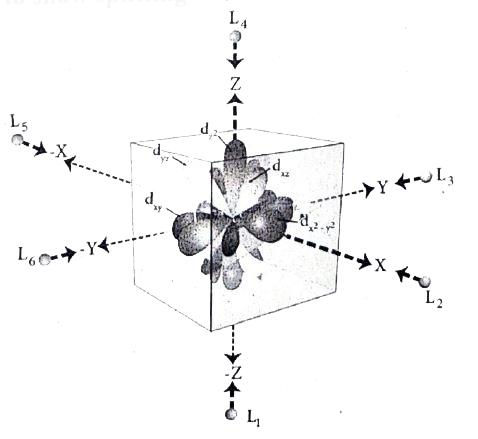 Step 3 : Up to this point the complex formation would not be favoured. However,when the ligands approach further, there will be an attraction between the negatively charged electron and the positively charfed metal ion, that results in a net decrease in energy. This decrease in energy in the driving FORCE for the complex formation. During crystal field splitting in octahedral field, in order to maintain the average energy of the orbitals (barycentre) constant, the energy of the orbitals `d_(x^(2)-y^(2))` and `d_(z^(2))` (represented as `e_(g)` orbitals) will increase by `3//5Delta_(0)` while that of the other three orbitals `d_(xy)`, `d_(yz)` and `d_(zx)` (represented as `t_(2g)` orbitals) decrease by `2//5Delta_(0)`. Here , `Delta_(0)` represents the crystal field splitting energy in the octahedral field. 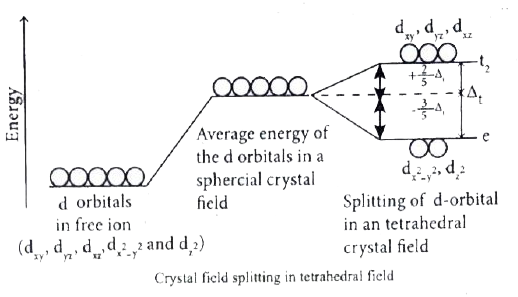
|
|
| 43. |
IUPAC nomenclature of {:(""CH_(3)""CH_(3)),("|""|"),(H_(3)C-C-CH=C-CH_(3)),("|"),(""CH_(3)):} |
|
Answer» 2, 4,4-trimethylpent-2-ene |
|
| 44. |
IUPAC nome of the following compound is(AAK_MCP_37_NEET_CHE_E37_005_Q01) |
|
Answer» 3-methylcyclohexanal |
|
| 46. |
IUPAC name of valeric acid |
|
Answer» Propionic ACID |
|
| 47. |
Is adsorption an exothermic or endothermic phenomenon ? |
| Answer» SOLUTION :EXOTHERMIC | |
| 48. |
..........is added toAl_2O_3in Hall -Heroult process for extractionof aluminiumto ..............the meltingpoint and to ...............the electrical conductivityof themelt. |
|
Answer» |
|
| 49. |
IUPAC names of monomers in Nylon-6,6 are |
|
Answer» ETHYLENE , GLYCOL , terephthalic ACID |
|