

Saved Bookmarks
This section includes 7 InterviewSolutions, each offering curated multiple-choice questions to sharpen your Current Affairs knowledge and support exam preparation. Choose a topic below to get started.
| 1. |
Instead of principal quantum number (n), azimuthal quantum number (l) & magnetic quantum number (m), a set of new quantum number s, t & u was introduced with similar logic but different values as defined below s = 1, 2, 3,.......oo all positive integral values. t = (s^(2) - 1^(2)), (s^(2) - 2^(2)), (s^(2) - 3^(2)).........No negative value u = - ((t + 1))/(2) "to" + ((t + 1))/(2) (including zero, if any) in integral steps. Each orbital can have maximum four electrons. (s + t) rule is defined, similar to (n + l) rule. Number of electrons that can be accommodated in s = 2 and s = 3 shell. |
|
Answer» `14, 38 According to `(s + t)` RULE INCREASING ORDER of energy 1s 2s 3s 4s 2F 5s `{:((i),"Number of electron in " s = 2,7 xx 4 = 28,,),(,"Number of electron in " s = 3,19 xx 4 = 76,"Hence (B)",):}` `{:((ii),"For " Z = 24,1s^(8) 2s^(8) 3s^(8) " i.e. number electrons (s) in " s = 2,t = 3 ""[2f^(@)] = 0,),(,"Hence" (C),,,):}` |
|
| 2. |
Instrument in which fuel energy is converted into electrical energy is known as. . . . . . |
| Answer» Solution :Fuel cell. | |
| 3. |
Inspite of long range order in the arrangement of particles why are the crystals usually not perfect? |
| Answer» Solution :This is because when crystallization TAKES place at EITHER fast or moderate rates, these particles MAY not get sufficient time to arrange themselves in a perfect order. Hence, crystals are not perfect. | |
| 4. |
Inspired by Alfred Werner (1866-1919), a KOTA student decided to reconduct a similar experiment on unknown salt samples of MCl_(3).xNH_(3). The student found that some of the chloride ions could be prdipitated as AgCl on adding silver nitrate solution. He found that this salt was of 4 years (based on colour). He labelled these complexes as A (yellow complex) B( purple complex), C (Green complex), D (violet complex). He found that moles of AgCl precipitated (per mole of salt) in one case was 3, one case it was 2, and in two cases it was one. He then measured the electrical conductivity of various salt solutions and found that D had the lowest value. He then measured the boiling point of solutions of A, B, C, D and found that B had the 2nd highest boiling point, Based on the above information, answer the following questions. The student took 2.675 g sample of A (Atomic weight of central atom=59) and dissolved it in water to form 1 L solution whose molar conductance was found to be 200" "Omega^(-1)cm^(2)mol^(-1) What is the specific conductance of the solution ? |
|
Answer» `2xx10^(-3) Omega^(-1)cm^(-1)` `M=((2.675)/(267.5))/(1)=0.01" M",Lambda_(m)=kxx(1000)/(M)` `K=(2000xx0.01)/(1000)=2xx10^(-3)` |
|
| 5. |
Inspired by Alfred Werner (1866-1919), a KOTA student decided to reconduct a similar experiment on unknown salt samples of MCl_(3).xNH_(3). The student found that some of the chloride ions could be prdipitated as AgCl on adding silver nitrate solution. He found that this salt was of 4 years (based on colour). He labelled these complexes as A (yellow complex) B( purple complex), C (Green complex), D (violet complex). He found that moles of AgCl precipitated (per mole of salt) in one case was 3, one case it was 2, and in two cases it was one. He then measured the electrical conductivity of various salt solutions and found that D had the lowest value. He then measured the boiling point of solutions of A, B, C, D and found that B had the 2nd highest boiling point, Based on the above information, answer the following questions. The order of electrical conductivity for the 4 complexes will be : |
|
Answer» `B GT A gt C gt D` |
|
| 6. |
Inspired by Alfred Werner (1866-1919), a KOTA student decided to reconduct a similar experiment on unknown salt samples of MCl_(3).xNH_(3). The student found that some of the chloride ions could be prdipitated as AgCl on adding silver nitrate solution. He found that this salt was of 4 years (based on colour). He labelled these complexes as A (yellow complex) B( purple complex), C (Green complex), D (violet complex). He found that moles of AgCl precipitated (per mole of salt) in one case was 3, one case it was 2, and in two cases it was one. He then measured the electrical conductivity of various salt solutions and found that D had the lowest value. He then measured the boiling point of solutions of A, B, C, D and found that B had the 2nd highest boiling point, Based on the above information, answer the following questions. What is the relationship between C and D (if C, had the lowest boiling point )? |
|
Answer» Ammoniated isomers |
|
| 7. |
Inspired by Alfred Werner (1866-1919), a KOTA student decided to reconduct a similar experiment on unknown salt samples of MCl_(3).xNH_(3). The student found that some of the chloride ions could be prdipitated as AgCl on adding silver nitrate solution. He found that this salt was of 4 years (based on colour). He labelled these complexes as A (yellow complex) B( purple complex), C (Green complex), D (violet complex). He found that moles of AgCl precipitated (per mole of salt) in one case was 3, one case it was 2, and in two cases it was one. He then measured the electrical conductivity of various salt solutions and found that D had the lowest value. He then measured the boiling point of solutions of A, B, C, D and found that B had the 2nd highest boiling point, Based on the above information, answer the following questions. If atomic number of M is 27, then number of N-M-N bond angles in A will be : |
|
Answer» 21 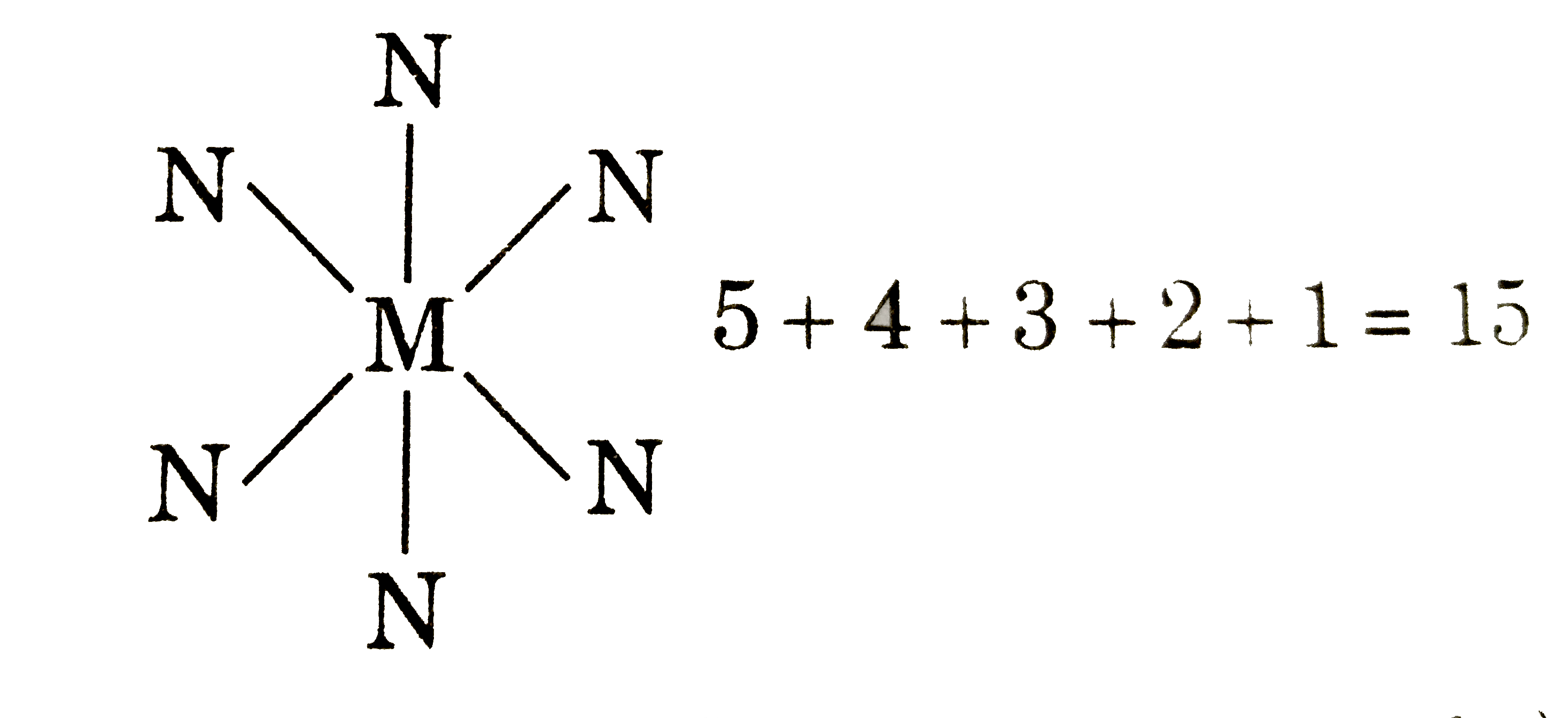
|
|
| 8. |
Inspired by Alfred Werner (1866-1919), a KOTA student decided to reconduct a similar experiment on unknown salt samples of MCl_(3).xNH_(3). The student found that some of the chloride ions could be prdipitated as AgCl on adding silver nitrate solution. He found that this salt was of 4 years (based on colour). He labelled these complexes as A (yellow complex) B( purple complex), C (Green complex), D (violet complex). He found that moles of AgCl precipitated (per mole of salt) in one case was 3, one case it was 2, and in two cases it was one. He then measured the electrical conductivity of various salt solutions and found that D had the lowest value. He then measured the boiling point of solutions of A, B, C, D and found that B had the 2nd highest boiling point, Based on the above information, answer the following questions. If all the complexes taken by the student were cystalline, then, what is the possible molecular formula of the complex having least boiling point? |
|
Answer» `MCl_(3).6NH_(3)` |
|
| 9. |
Insoluble component of starch in water constituting 80% to 85% of starch is composed of – |
|
Answer» `beta-D-` GLUCOSE, `C_(1)-C_(4)` and `C_(2)-C_(6)` linkages  STRUCTURE of Amylopectin which MAKE the starch insoluble. |
|
| 10. |
In______process, work is done at the expense of internal energy. |
|
Answer» Isothermal `THEREFORE DeltaE=W` i.e., WORK is DONE at the expenseof only INTERNAL energy and Q= for adiabatic process. |
|
| 11. |
Insecticide Gammexane is |
|
Answer» DDT 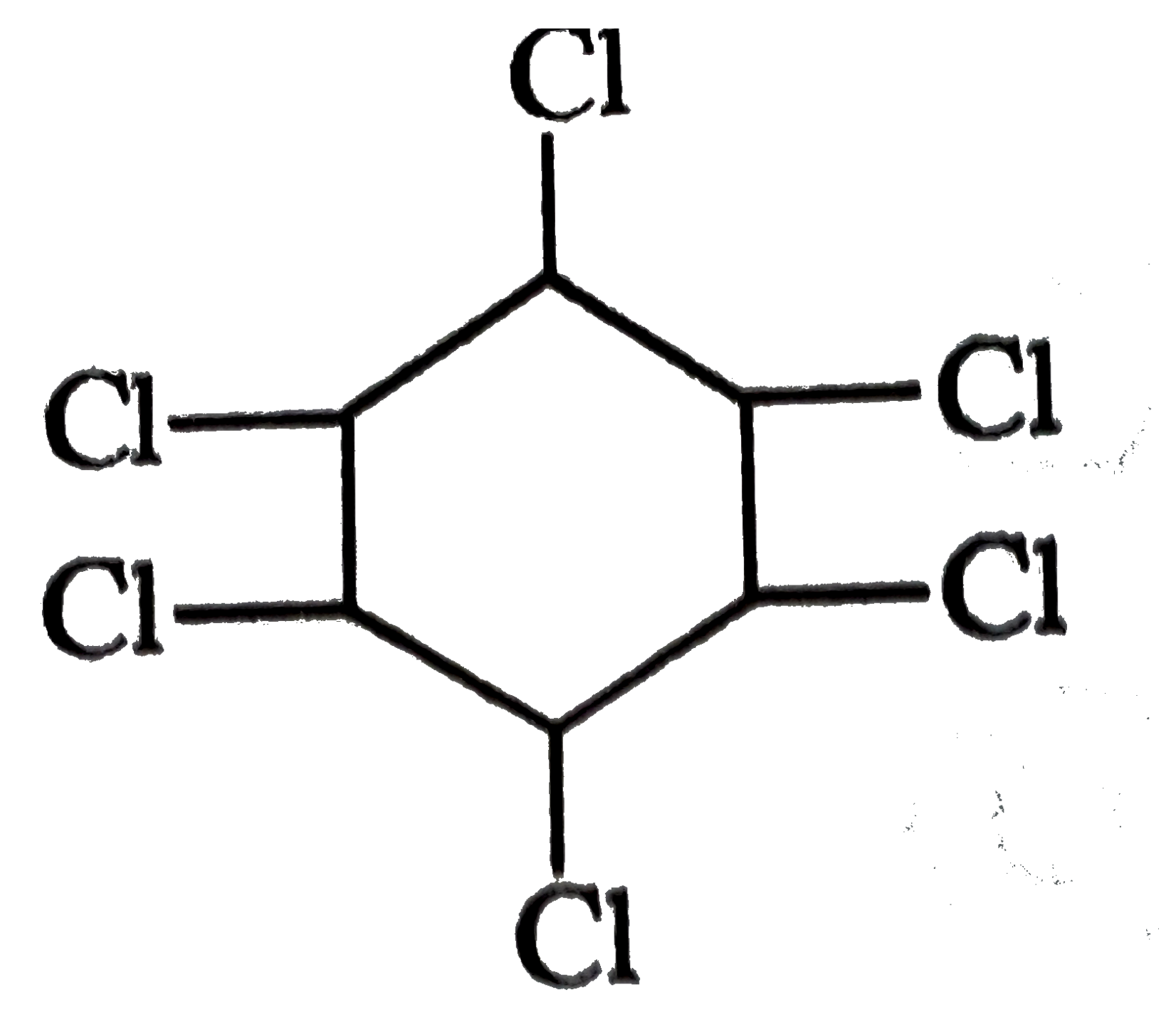
|
|
| 12. |
Inpresenceof conc. Alkali formaldehyde undergoes |
|
Answer» ALDOL condensation |
|
| 13. |
Inorganic benzene reacts with HCl to form a compound B_(3)N_(3)H_(9)Cl_(3) . The protonation occurs at :- |
|
Answer» B-atom |
|
| 14. |
In..........oxidation number of sulphur is +7. |
|
Answer» `H_(2)SO_(4)` |
|
| 15. |
Inorganic graphite and graphite have many similarties. Choose among the following, the property which is dissimilar. |
|
Answer» Layered structure, where LAYERS are INTER connected by weak van DER Waals' forces |
|
| 16. |
In..........oxoacid of sulphur has lone pair of electron on sulphur atom. |
|
Answer» `H_(2)SO_(3)` 
|
|
| 18. |
Innumerable number of galvanic cells can be constructed on the pattern of Daneill cell by taking combination of different half cells. Write the use of above cell |
| Answer» Solution :SHE is USED as the reference electrode to DETERMINE the electrode potential of other ELECTRODES. | |
| 19. |
Innumerable number of galvanic cells can be constructed on the pattern of Daneill cell by taking combination of different half cells. Write the name of the half represented by Pt(s)/H_2(g)/ H^+(aq) |
| Answer» SOLUTION :STANDARD HYDROGEN ELECTRODE (SHE) | |
| 20. |
Innumerable number of galvanic cells can be constructed on the pattern of Daneill cell by taking combination of different half cells. What is the potential of the above half cell at all temperatures? |
| Answer» SOLUTION :The POTENTIAL of SHE is ZERO. | |
| 21. |
Inner layer of blast furnace is made of ___________. |
|
Answer» GRAPHITE bricks |
|
| 22. |
Inner complexes are formed when __________ orbitals are used for hybridisation. |
|
Answer» ND |
|
| 23. |
Inner complex is also called |
|
Answer» SPIN FREE complex |
|
| 24. |
Inks, paints are considered as .......... |
| Answer» Solution : solid in liquid | |
| 25. |
Ink stains can be removed from clothes by treating them with which acid? |
|
Answer» |
|
| 26. |
Initiators that can be used in cationic polymerization is/are (a) KNH_(2) (b) H_(2)SO_(4) (c) BF_(3) with little amount of H_(2)O (d) t-butyl peroxide The correct answer is |
| Answer» Answer :C | |
| 27. |
Initiators that can be used in anionic polymerisation is/are (a) Potassium amide (b) n-butyl lithium (c) AlCl_(3) (d) H_(2)SO_(4) The correct answer is |
|
Answer» only a |
|
| 28. |
Initially, the root mean square ( rms) velocity of N_(2) molecules at certain temperature is u. If this temperature is doubled and all the nitrogen molecules dissociate into nitrogen atoms, then the rms velocity will be: |
|
Answer» 2u After dissociation, u. = `sqrt((3Rxx2T)/14)` `u/(u.)=sqrt(1/4),u/(u.)=1/2,u.=2u` |
|
| 29. |
Initial volume of H_(2) gas saturated with water vapour is confined under a piston in a container is 10 litres as shown in the given figure. the container also contains some liquid water. The total pressure over liquid water is 80cm of Hg. If now the piston is removed such that volume of container is doubled, then final total pressure over liqid water in the container is P. The vapour pressure of water is 20cm of Hg and volume of liquid is negligible. Calculate P//10......... |
|
Answer» `P_(2)=` Pressure of `H_(2)` gas `=(60xx10)/20` `P_(2)=30cm` of `Hg` Final total pressure over liquid water `(P)=30+20=50 cm` of `Hg` `P/10=50/10=5` |
|
| 30. |
Initial mass of a radioactive element is 40 g. How many grams of it would be left after 24 years, if its half-life period is 8 years |
|
Answer» 2 `N = (40)/(2^(3)) = (40)/(8) = 5` |
|
| 31. |
Initial concentration of the reactant is 1.0 M. The concentration becomes 0.9 M, 0.8 M and 0.7 M in 2 hours, 4 hours and 6 hours respectively. Then the oerder of reaction is |
| Answer» Answer :C | |
| 32. |
Initial concentration of reaction for nth order reaction is 'a' . Which of the following relations is correct about t_(1//2) of the reaction ? |
|
Answer» `LN t_(1//2)=ln("constant")-(n-1)log_(e)a` `t_(1//2)-k(1)/(a^(n-1))` `ln t_(1//2)=ln k -(n-1) log_(e)a`. |
|
| 33. |
Initial chemical reaction A_(2)underset(K_(-1))overset(K_(1))hArr2A, then (d[A])/(dt)………… |
|
Answer» `k_(1)[A]_(2)-k_(-1)[A]^(2)` Rate =`k_(1)[A_(2)]-k_(-1)[A]^(2)` `THEREFORE (1)/(2)(d[A])/(dt)=k_(1)[A_(2)]-k_(-1)[A]^(2)` `therefore (d[A])/(dt)=2k_(1)[A_(2)]-2k_(-1)[A]^(2)` |
|
| 34. |
InH_(2)-O_(2) fuel cell, at cathode the reduction takes place of the specie, which is |
|
Answer» `O^(-)` |
|
| 35. |
Information regarding the sequence of nucleotides in the chain of a nucleic acid is called its secondary structure. |
|
Answer» |
|
| 36. |
Information regarding the sequence of nucleotides in the chain of a nucleic acid is called |
|
Answer» PRIMARY Structure |
|
| 37. |
Information -1 : Principlal quantun number 'n' is defined as 1, 2, 3…. Information -2 : Azimaathal quantum number 'l' is defined as 0 to (n + 1) in integral steps of 1 Information -3 : Magnetic quantum number 'm' is defined as - l //2 to + l//2 Information -4 : Spin quantum number 's' has five possible values -2, -10, +1, +2 Information -5 : The sub-shell corresponding to l = 1, 2, 3, 4, 5..... designated as P, Q, R, S, T, U.... respectively. Information -6 : The values of m for a given value of l give the number of orbitals in a sub-shell Information -7 : The principles for filling electron in teh shells remains unchanged. On the basic of above informations, answer the following questions. The nuber of orbitals & the maximum of electrons that can be filled in a T sub-shell are respectively. |
|
Answer» `5,30` `{:(n = 1,n = 2,n = 3,),(l = 0"," 1"," 2,l = 0","1","2","3,l = 0","1","2","3","4,):}` Possible subshells - `{:(,1P,1Q,1R,2P,2Q,2R,2S,3P,3Q........,),(n + l =,1,2,3,2,3,4,5,3,4........,):}` Inceasing order of energy Each orbital has 5 ELECTRONS. `{:(,1P,1Q,2P,1R,2Q,3P,2R........),("Total electrons",5,10,5,15,10,5,):}` `{:("Type of subshell",1P,1Q,2P,1R,2Q,),("NUMBER of electrons accomodate by the given subshell",10,15,10,20,15,):}` Sol.(i) `II^(nd)` period will be start from atomic number 16 (Sulphur) Sol. (ii) Last electron from `Z = 50` to `Z = 65` will ENTER in 2R subshell Sol. (iii) For T subshell `l = 4`. Number of possible VALUES of `m = 5`, Total electron `= 25` |
|
| 38. |
Information -1 : Principlal quantun number 'n' is defined as 1, 2, 3…. Information -2 : Azimaathal quantum number 'l' is defined as 0 to (n + 1) in integral steps of 1 Information -3 : Magnetic quantum number 'm' is defined as - l //2 to + l//2 Information -4 : Spin quantum number 's' has five possible values -2, -10, +1, +2 Information -5 : The sub-shell corresponding to l = 1, 2, 3, 4, 5..... designated as P, Q, R, S, T, U.... respectively. Information -6 : The values of m for a given value of l give the number of orbitals in a sub-shell Information -7 : The principles for filling electron in teh shells remains unchanged. On the basic of above informations, answer the following questions. For the element having atomic number 51, last electron enters in |
|
Answer» 2Q `{:(n = 1,n = 2,n = 3,),(l = 0"," 1"," 2,l = 0","1","2","3,l = 0","1","2","3","4,):}` Possible subshells - `{:(,1P,1Q,1R,2P,2Q,2R,2S,3P,3Q........,),(n + l =,1,2,3,2,3,4,5,3,4........,):}` Inceasing order of energy Each orbital has 5 electrons. `{:(,1P,1Q,2P,1R,2Q,3P,2R........),("TOTAL electrons",5,10,5,15,10,5,):}` `{:("Type of subshell",1P,1Q,2P,1R,2Q,),("Number of electrons accomodate by the given subshell",10,15,10,20,15,):}` SOL.(i) `II^(nd)` period will be start from atomic number 16 (Sulphur) Sol. (ii) Last electron from `Z = 50` to `Z = 65` will ENTER in 2R subshell Sol. (iii) For T subshell `l = 4`. Number of possible values of `m = 5`, Total electron `= 25` |
|
| 39. |
Information -1 : Principlal quantun number 'n' is defined as 1, 2, 3…. Information -2 : Azimaathal quantum number 'l' is defined as 0 to (n + 1) in integral steps of 1 Information -3 : Magnetic quantum number 'm' is defined as - l //2 to + l//2 Information -4 : Spin quantum number 's' has five possible values -2, -10, +1, +2 Information -5 : The sub-shell corresponding to l = 1, 2, 3, 4, 5..... designated as P, Q, R, S, T, U.... respectively. Information -6 : The values of m for a given value of l give the number of orbitals in a sub-shell Information -7 : The principles for filling electron in teh shells remains unchanged. On the basic of above informations, answer the following questions. The second period would begin with - |
|
Answer» Phosphorus `{:(n = 1,n = 2,n = 3,),(l = 0"," 1"," 2,l = 0","1","2","3,l = 0","1","2","3","4,):}` Possible subshells - `{:(,1P,1Q,1R,2P,2Q,2R,2S,3P,3Q........,),(n + l =,1,2,3,2,3,4,5,3,4........,):}` Inceasing order of energy Each orbital has 5 electrons. `{:(,1P,1Q,2P,1R,2Q,3P,2R........),("TOTAL electrons",5,10,5,15,10,5,):}` `{:("Type of subshell",1P,1Q,2P,1R,2Q,),("Number of electrons accomodate by the given subshell",10,15,10,20,15,):}` Sol.(i) `II^(nd)` period will be start from atomic number 16 (Sulphur) Sol. (ii) LAST electron from `Z = 50` to `Z = 65` will enter in 2R subshell Sol. (iii) For T subshell `l = 4`. Number of possible VALUES of `m = 5`, Total electron `= 25` |
|
| 40. |
Informal, non-confrontationist and cooperative interaction among members of South East Asian Nations is also called----------. |
| Answer» SOLUTION :ASEAN WAY | |
| 42. |
Inertness of N_(2) gas is due to |
|
Answer» No vacant d-orbital |
|
| 43. |
Inert pair effect is prominent character of |
|
Answer» Na |
|
| 44. |
Inert gases such a helium behave like ideal gases over a wide range of temperature. However, they condense into the solid state at very low temperature It indicates that at very low temperature. It indicates that at very temperature there is a: |
|
Answer» WEAK ATTRACTIVE FORCE between the atoms |
|
| 45. |
Mixture of inert gases can be separated by |
|
Answer» Electrolysis of their COMPOUNDS |
|
| 46. |
Inert gases are least reactive due to :- |
|
Answer» Completely filled valence SHELL ELECTRONIC configuration |
|
| 47. |
Industrially acetylene is prepared by the hydrolysis of : |
| Answer» Answer :A | |
| 48. |
Industrial production of ethanol is done by which method ? |
|
Answer» GRIGNARD REAGENT |
|
| 49. |
Industrial production of acetaldehydes is done by |
|
Answer» OXIDATION of ethanol |
|