Saved Bookmarks
This section includes 7 InterviewSolutions, each offering curated multiple-choice questions to sharpen your Current Affairs knowledge and support exam preparation. Choose a topic below to get started.
| 1. |
In the last decades, most serious nuclear reactor accident created MIC gas tragedy in |
|
Answer» Russia (1990) and Bhopal (1996) |
|
| 2. |
In the Lassaigne's test the sulphur present in the organic compound first changes into? |
|
Answer» `Na_2SO_3` |
|
| 3. |
In the Lassaigne's test, one of the organic compounds gave red colour with FeCl_(3). Compound can be: |
|
Answer» `Na_(2)S` |
|
| 4. |
In the Lassaigne's test, one of the organic compound X gives blood red colour with FeCl_(3). Compound X, when fused with sodium metal forms compound Y. Molecular mass of compound Y is |
|
Answer» Molecular MASS of `NaSCN = 23+32+12+14 = 81` |
|
| 5. |
In the Lassaigne's test for the detection of nitrogen in an organic compound, the appearance of blue coloured compound is due to |
|
Answer» FERRIC FERRICYANIDE |
|
| 6. |
In the laboratory, sodium chloride is made by burning sodium in the atmosphere of chlorine. The salt obtained is yellow is colour. The cause of yellow colour is |
|
Answer» presence of`NA^(+)` ions in the crystal lattice |
|
| 7. |
In the following questions a statement of Assertin (A) followed by a statement of Reason (R) is give. Choose the correct answer out of the following choices. Assertion (A): |
|
Answer» (A) and (R) both are CORRECT statement and (R) is correct explanation for (A) |
|
| 8. |
In the laboratory method of preparation of dioxygen by thermal decomposition of potassium chlorate the catalyst used is |
|
Answer» IRON fillings |
|
| 9. |
In the laboratory, manganese (II) salt is oxidized to pemanganate ion in aqueous solution by |
|
Answer» Hydrogen peroxide `UNDERSET("peroxodisu lphate ion")(2Mn^(2)+S_(2)O_(8)^(2-)+8H_(2)O)rarr2MnO_(4)^(-)+10SO_(4)^(2-)+16H^(+)` |
|
| 10. |
In the laboratory, manganese (II) salt is oxidised to permanganate ion in aqueous solution by |
|
Answer» HYDROGEN peroxide `UNDERSET("Peroxodisulphate ion")(2Mn^(2+)+S_(2)O_(8)^(2-)+8H_(2)O) to 2MnO_(4)^(-)+10SO_(4)^(2-)+16H^(+)` |
|
| 11. |
In the following question, a statement of assertion is followed by a statement of reason . Mark the correct choice.Assertion :[Cu(NH_(3))_(4)]^(2+)is coloured while[Cu(CN)_(4)]^(3-)is colourless . Reason :[Cu(NH_(3))_(4)]^(2+) hasdsp^(2)hydridisation |
|
Answer» Both ASSERTION and reason are true and reason is the CORRECT explanation of assertion . |
|
| 12. |
In the laboratory, bromine can be obtained by heating a mixture of KBr and .......... with conc......... |
| Answer» SOLUTION :`MnO_2,H_2SO_4` | |
| 13. |
In the following question, a statement of assertion is followed by a statement of reason. Mark the correct choice. Assertion : Square planar complexes do not show optical isomerism. Reason : Optional isomerismis due to the absenceof elements of symmetry . |
|
Answer» Both assertion and reason are true and REASONIS the CORRECTEXPLANATION of assertion. |
|
| 14. |
In the lab students were asked to carry out the reaction between phenol and cons. HNO_3. But one student,'A' carried out the reaction between phenol and dil. HNO_3. Do you think that the student 'A' got the same result as others. Substantiate with suitable explanations. [Also write the chemical equations wherever necessary]. |
Answer» Solution :The student 'A' got a MIXTURE of o-nitrophenol and p-notrophenol, while OTHERS got 2,4-6-trinitrophenol (PICRIC ACID). 
|
|
| 15. |
In the following question, a statement of assertion is followed by a statement of reason. Mark the correct choice. Assertion : In any ionic solid [MX]with schottkydefects, the number of positive and negative ions are same. Reason :Equal number of cation and aniojn vacancies are present. |
|
Answer» Both assertion and REASON are TRUE and reason is the CORRECT explanation of assertion . |
|
| 16. |
In the known interhalogen compounds the maximum number of halogen atoms is: |
|
Answer» 4 |
|
| 17. |
In the following process of disproportionation 2CIO_(3)^(-)hArrCiO_(2)^(-)+CIO_(4)^(-) E_(CIO_(4)^(-)//CIO_(3)^(-))^(@)=+0.36V,E_(CIO_(3)^(-)//CIO_(2)^(-))^(@)=+0.33V If initial concentration of chloride ion was 0.1M, calculate the equilibrium concentration of perchlorate ion. |
|
Answer» Solution :The two reactions of the given reaction will be `CIO_(3)^(-)(aq)+H_(2)O(l)toCIO_(4)^(-)(aq)+2H^(+)(aq)+2e^(-)` `underline(""CI_(3)^(-)(aq)+2H^(+)(aq)+2e^(-)toCIO_(2)^(-)(aq)+H_(2)O(l)" ")` Adding `2CIO_(3)^(-)(aq)hArrCIO_(2)^(-)(aq)+CIO_(4)(aq)` `E_(CELL)^(@)=0.33-0.36=-0.03V` `E=E^(@)-(0.059)/(n)logQ` At equilibrium, `E=0,Q=K_(eq)`. also n=2, hence `0=-0.03-(0.059)/(2)logK_(eq)` or `logK_(eq)=-(0.03xx2)/(0.059)=-1=overline(1)` or `K_(eq)=0.1` `{:(,2CIO_(3)^(-)(aq),hArr,CIO_(3)^(-)(aq),+,CIO_(4)^(-)(aq)),("Initial conc.",0.1M,,0,,0),("At eqm.",0.1-2x,,x,,x):}` `K=(x xx x)/((0.1-2x)^(2))=0.1` or `(x)/(0.1-2x)=sqrt(0.1)=0.316` or `x=0.0316-0.632` or `1.632x=0.0316` or `x=0.0194M` |
|
| 18. |
In the following pairs which is represented correctly towards SN^2 reaction |
|
Answer»
|
|
| 19. |
In the following pairs, which undergoes S_(N^(2)) reaction more readily? |
|
Answer» SOLUTION :(a). I (B). I (C). I (d). I |
|
| 20. |
In the following pairs of halogen compounds which would undergo S_(N^(2)) reaction faster? |
Answer» Solution : It is a primary HALIDE and HENCE it is more REACTIVE in `S_(N^(2))` (II) As `I^(-)` is GOOD leaving group than  is more reactive in `S_(N^(2)) and S_(N^(1))` reactions is more reactive in `S_(N^(2)) and S_(N^(1))` reactions
|
|
| 21. |
In the following pairs of halogen compounds, which would undergo S_N2 reaction faster? |
Answer» Solution :(i)  . It is primary halide and therefore undergoes `S_N2` REACTION faster. . It is primary halide and therefore undergoes `S_N2` REACTION faster. (ii)  As iodine is a better leaving GROUP because of its large size, it will be released at a faster RATE in the presence of INCOMING nucleophile. |
|
| 22. |
In the following pairs of halogen compounds, which compound undergoes S_(N^(1)) reaction faster? |
|
Answer» Solution :The reactivity of a particular halogen compound towards `S_N^(1)` reaction depends upont he stability of the CARBOCATION formed as a result of ionisation. This is a slow step and is called rate determining step. The order of relative stabilities of different CARBOCATIONS is in the order: tertiarygtsecondarygtprimaryk. in the LIGHT of this, the order of reactivity in the two cases is explain. (i). The isomer (a) is a TERTIARY alkyl chloride while the other (b) is a secondary alkyl chloride. the isomer (a) is more reactive towards `S_(N^(1))` reaction since the tertiary carbocation formed carbocation formed in this case is more stable than the secondary carbocation which is likely to be formed in the other case. (ii). The isomer (a) is a secondary alkyl chloride while the other isomer (b) is primary in NATURE. the secondary alkyl chloride (a) is expected to react faster since the secondary carboaction formed is more stable than the primary carbocation which is likely to be formed in the other case. |
|
| 23. |
In the following pairs of halogen compounds, which compound undergoes faster S_N1 reaction? |
| Answer» SOLUTION :(i) A and (II) C UNDERGO FASTER `S_N1` | |
| 24. |
In the following pairs of halogen compounds, which compound undergoes faster S_(N)1 reaction? |
|
Answer» Solution :The `S_(N)1` reaction procceeds through Stable Carbocation intermediate. GREATER is the Stability of Carbocation, greater is the reactivity. Thus order of reactivity of alkyl HALIDE is : `3^(@)R-X gt 2^(@)R-X gt 1^(@)R-X` (i)  will REACT faster because will REACT faster because  is more stable. is more stable.(ii) 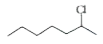 REACTS faster due to the greater stability of `2^(@)` - carbocation as compared to `1^(@)` - carbocation. REACTS faster due to the greater stability of `2^(@)` - carbocation as compared to `1^(@)` - carbocation.
|
|
| 25. |
In the following pair find the pair in which first compound do not form complex with NH_(3) and second give coloured complex with NH_(3) |
|
Answer» `CoCl_(2),ZnSO_(4)` `CuSO_(4)+4NH_(4)to[Cu(NH_(3))_(4)]SO_(4)` Blue colour. |
|
| 26. |
In the following oxyacid of sulphur the two sulphur atoms exhibit the oxidation numbers of + IV and - II |
|
Answer» `H_(2)S_(2)O_(2)` |
|
| 27. |
In the Kipp's apparatus, the reaction gets stopped on closing the outlet because |
|
Answer» Gas STARTS COMING out from top |
|
| 28. |
In the following ofpi bond the atomic orbitals overlap in such a way that |
|
Answer» their axes remain parallel to each other and PERPENDICULAR to the internuclear axis 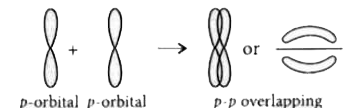
|
|
| 29. |
In the known interhalogen compound the maximum number of halogen atoms is |
|
Answer» O.N. of `I = + 7` O.N. of F = -1 `:. ` Sum of O.N.s `= + 7 -1 = + 6` |
|
| 30. |
In the following nuclear reactions ._(7)N^(14) + ._(2)He^(4) rarr ._(8)O^(17) + X_(1) and ._(13)Al^(27) + ._(1)D^(2) rarr ._(14)Si^(28) + X_(2) X_(1) and X_(2) are respectively |
|
Answer» `._(1)H^(1) and ._(0)n^(1)` |
|
| 31. |
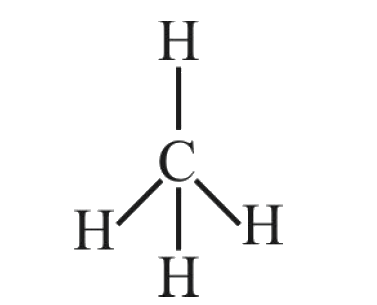
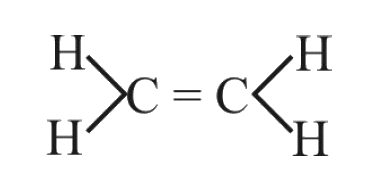
In the following molecules which one is having strongest C–H bond :- |
|
Answer»
|
|
| 32. |
In the Kjeldahl's method, the nitrogen in the organic compound in Kjeldhal's flask is converted to |
|
Answer» AMMONIUM sulphate |
|
| 33. |
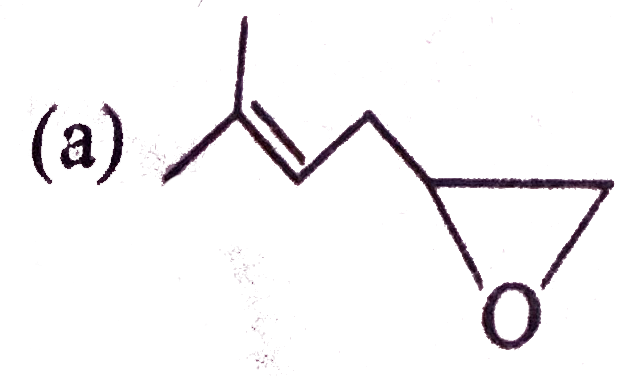
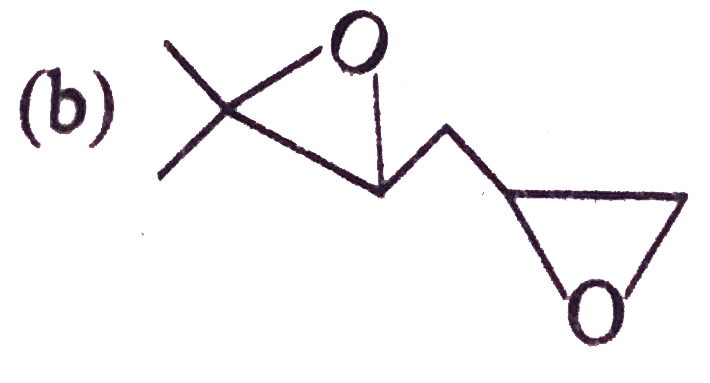
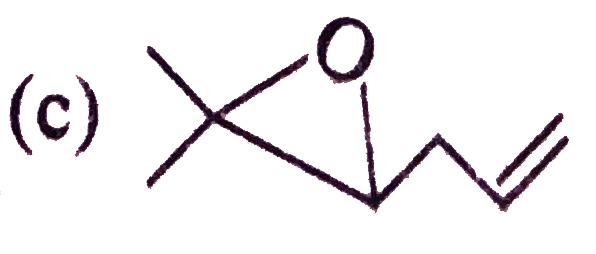
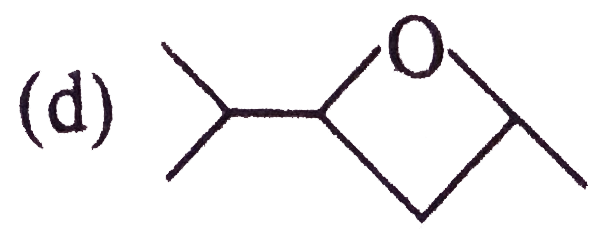
In the following Me_(2)C=CH-CH_(2)-CH=CH_(2)+C_(6)H_(5)CO_(3)H(1"equiv".) to X , X is |
|
Answer»
|
|
| 34. |
In the IUPAC version, the ligand OH^(-) is named as |
|
Answer» hydroxide |
|
| 35. |
In the following isotherm (Fig) |
|
Answer» `x/m ALPHA P^@` When point B is reached |
|
| 36. |
In the IUPAC system. PhCH_(2)CH_(2)CO_(2)H is named as: |
|
Answer» benzyl acetic ACID |
|
| 37. |
In the following ions : Mn^(3+),V^(3+),Cr^(3+),Ti^(4+) (Atomic no. : Mn = 25, V = 23, Cr = 24, Ti = 22) (a) Which ion is most stable in an aqueous solution ? (b) Which ion is the strongest oxidising agent ? (c) Which ion is colourless ? (d) Which ion has the highest number of unpaired electrons ? |
|
Answer» Solution :`Mn^(3+),V^(3+),Cr^(3+),Ti^(4+)` (a) `Cr^(3+)` has the highest negative electrode potential, THEREFORE, it is most stable. (b) `Mn^(3+)` has `d^(4)` configuration, it has the maximum TENDENCY to gain one electron to change into stable HALF filled configuration, `d.^(5)`. Therefore it is the strongest oxidising AGENT. (c) `Ti^(4+)` has no electrons in the d-orbital, therefore no absorption of light and hence colourless. (d) `Mn^(3+)` has `d^(4)` configuration. The electrons occupy different orbitals. It has the highest number of unpaired electrons among the four. |
|
| 38. |
In the IUPAC name of product .Y. is |
|
Answer» N - Methylpropan -2- AMINE 
|
|
| 39. |
In the following hypothetical reaction A+3B hArr 2C+D initial moles of A are twice that of B. If at equilibrium moles of B and C are equal. Percentage of B reacted is |
|
Answer» 0.6 a-3x=2x(condition given) `therefore x=(a)/(5)` The % of b reacted is `(3x)/(a)xx100=(3)/(a).(a)/(5)xx100=60%` |
|
| 40. |
In the following how many cations are forms hydroxide as precipitates in qualitative analysis Cr^(+3), Ni^(+2), Ba^(+2), Pb^(+2), Ag^(+), Hg_(2)^(+2) |
|
Answer» |
|
| 41. |
In the isolation of metals, reaction proces susually results in |
|
Answer» METAL SULPHIDE |
|
| 42. |
In the following how many cations are belongs to V group in qualitative salt analysis Ba^(+2), Mg^(+2), Pb^(+2), Cu^(+2), Sr^(+2), Sn^(+2) Ca^(+2) |
|
Answer» |
|
| 43. |
In the IUPAC system , "PhCH"_(2) CH_(2) CO_(2 )H is narmed as |
|
Answer» 3-phenylpropanoic ACID 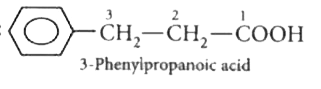
|
|
| 44. |
In the following how many cations are forms carbonate as precipitates in qualitative analysis Sr^(+2),Ni^(+2),Cr^(+3), Zn^(+2), Mn^(+2).Co^(+2), Al^(+3) |
|
Answer» |
|
| 45. |
In the isolation of metals, calcination process usually results in: |
|
Answer» metal hydroxide ` underset( "Limestone") (CaCO_3)OVERSET(DELTA)tounderset( "calciumoxide") (CaO +CO_2 uarr )` ` underset( "malachite ") ( CuCO_3.Cu (OH)_2 overset(Delta)to2CuO+H_2Ouarr+CO_2 uarr ` |
|
| 46. |
In the following group : -OAc(I),-OMe(II),-OSO_(2)(III),-OSO_(2)CF_(3)(IV) The order of leaving group ability is : |
|
Answer» `I GT II gt III gt IV` |
|
| 47. |
In the isolation of metals, calcination process usually results in ......... |
|
Answer» METAL carbonate |
|
| 48. |
In the following groups-Oac(I), - O Me(II) , -SO_2Me(III) OSO_2CF_3 (IV) , the order of leaving group ability is |
|
Answer» I gt II gt III gt IV |
|
| 49. |
In the isolation of fluorine , a number of difficulties were encountered. Which statement is correct : |
|
Answer» The potential requied for the discharge of the fluoride ions is the lowest (B) FLUORINE reacts with most glass vessels. (C ) Electrolysis of aqueous HF gives ozonized oxygen. |
|
| 50. |
In the following groups: -OA c (I),-Ome (II)-OSO_(2)(Me(III),-OSO_(2)CF_(3)(IV) the order of leaving group ability is |
|
Answer» IgtIIgtIIIgtIV |
|