

Saved Bookmarks
This section includes 7 InterviewSolutions, each offering curated multiple-choice questions to sharpen your Current Affairs knowledge and support exam preparation. Choose a topic below to get started.
| 1. |
In fire extinguisher, pyrene is |
|
Answer» `CO_(2)` `C Cl_(4)+H_(2)O to underset("Phosgene")(COCl_(2))+2HCl` |
|
| 2. |
In finklestein reaction alkyl chloride is converted in to |
|
Answer» R-F |
|
| 3. |
In fibrous proteins, polypeptide chains are held together by ………………… |
|
Answer» VAN dar Waal's FORCES The polypeptide chains in FIBROUS proteins are held by disulphide linkages and H-bonds. |
|
| 4. |
In fibrous proteins, polypeptide chains are held together by........ . |
|
Answer» a.van der Waals FORCES |
|
| 5. |
In ferrocene, hybridisation state of iron is |
|
Answer» `SP^(3)d^(2)` |
|
| 6. |
In fibreous proteins polypeptide chains are held together by ........ |
|
Answer» van der WAALS FORCES |
|
| 7. |
In [Fe(H_(2)O)_(6)]^(3+), [Fe(CN)_(6)]^(3-), [Fe(Cl)_(6)]^(3-) species, the hybridisation states of the Fe atoms are, respectively |
|
Answer» `d^(2)SP^(3), d^(2)sp^(3), sp^(3)d^(2)` 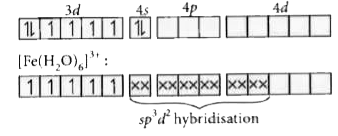 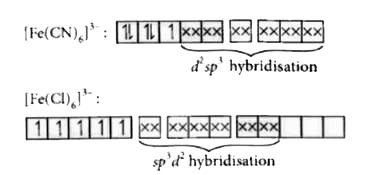
|
|
| 8. |
In fermentation by zymase , alcohol and CO_(2) are obtained from the following sugar |
|
Answer» Glucose |
|
| 9. |
In fermentation by zymase, alcohol and CO_2 are obtained from : |
|
Answer» Glucose |
|
| 10. |
In [Fe(edta)]^(-) number of 5 membered rings is |
Answer» 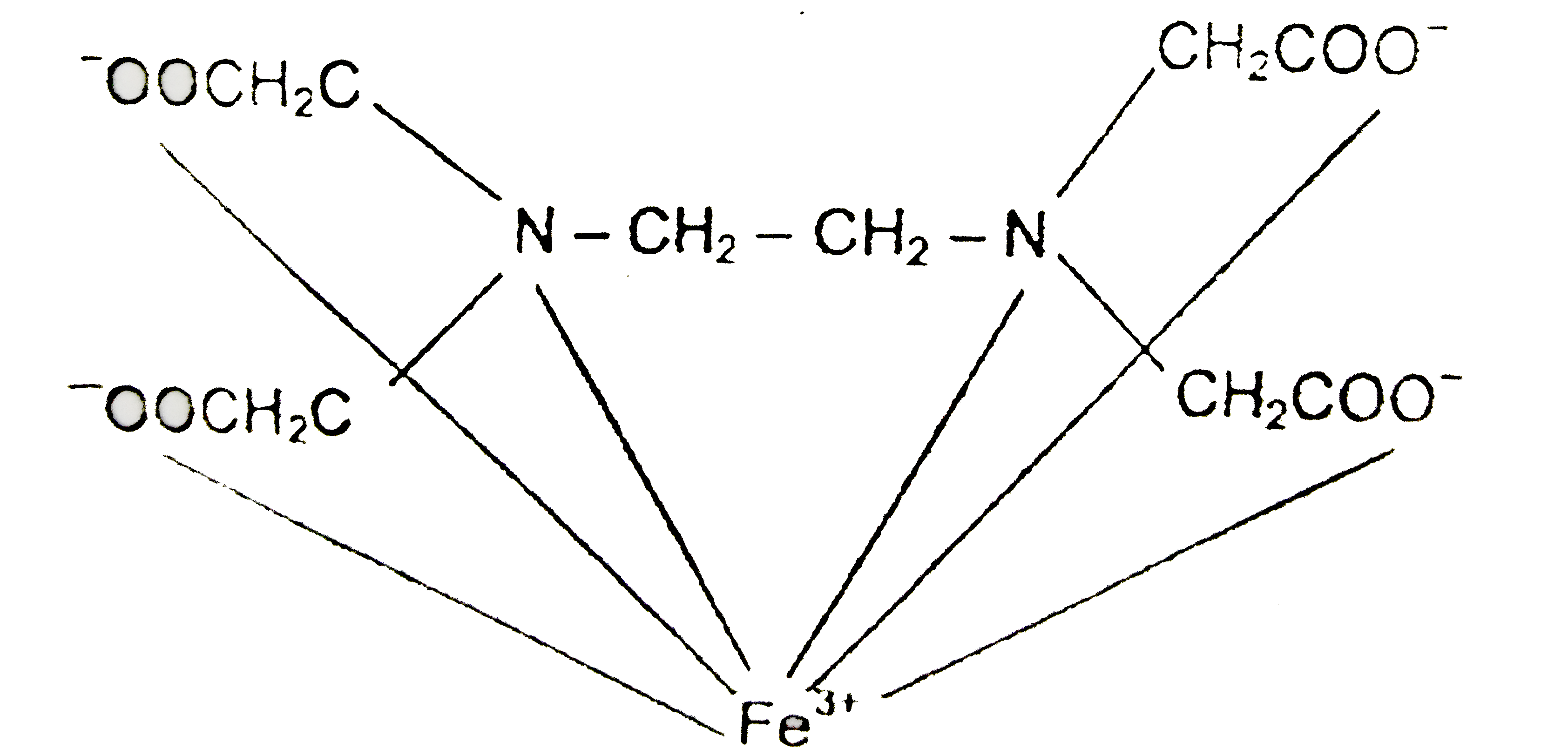
|
|
| 11. |
In Fe(CO)_5," the " Fe larr CO a bond results by the overlap between filled sp hybrid orbital of C - atomof CO molecule and vavant : |
|
Answer» `d^2 sp^3` |
|
| 12. |
In Fe(CO)_(5), the Fe-C bond possesses |
|
Answer» ionic character |
|
| 13. |
In Fe(CO)_(5), the F-C bond possesses : |
|
Answer» `PI-CHARACTER` only |
|
| 14. |
In Fe(CO)_5 , Fe-C bond possess |
|
Answer» SIGMA character only |
|
| 15. |
In Fe_3O_4 [Fe^(II) Fe_2^(III) O_4] O^(2-). Ions are arranged on ccp arrangement. If Fe^(2+)ions are arranged on tetrahedral voids and Fe^(3+) ions are arranged on octahedral voids, then how much portion of tetrahedral and octahedral voids occupied respectively? |
|
Answer» `1/4, 1/8` |
|
| 16. |
In Fe(CO) is Cr(CO)_(6), how many CO ligands can be replaced by NO? |
|
Answer» 3,3 |
|
| 17. |
In F.C.C the unit cell is shared equally by how many unit cells ? |
|
Answer» 10 |
|
| 18. |
In FCC crystal, which of the following shaded planes contains the following type of arrangement of atoms |
|
Answer»
|
|
| 19. |
In faintly alkaline solution, 4 moles of permanganate anion quantitatively oxidize thiosulphate anions to produce X moles of sulphate anion. The value of X |
|
Answer» 8 |
|
| 20. |
In Faraday-Tyndall effect the colloidally suspended particles |
|
Answer» TRACE out the PATH of STRONG BEAM of light |
|
| 21. |
In face centred cubic unit cell, what is the volume occupied? |
|
Answer» `4/3pir^3` Packing fraction or volume occupied brgt `Z_(ett) XX volume of C- atom = `Z_(eff)xx(4/3pir^3)/a^3` For FCC, `Z_(eff)=4=(4xx4/3pir^3)/a^3`(where,a=1) 
|
|
| 22. |
In face centred cubic unit cell edge length is |
|
Answer» `(4)/sqrt(3)R` `4r=sqrt(2)arArra=(4r)/sqrt(2)` |
|
| 23. |
In F.C.C. the unit cell is shared equally by how many unit cells ? |
|
Answer» 6 |
|
| 24. |
In face centred cubic (fcc) crystal lattice edge length of the unit cell is 400 pm. Find the diameter fo the greatest sphere which can be fitted into the interstitial void without the distortion of lattice. |
|
Answer» Solution :In fcc unit CELL : `4 R = SQRT(2)a` `therefore r=(a sqrt(2))/(4)=(400xxsqrt(2))/(4)=141.4p m` For octahedral void,`2(r + r^(1))=a` `therefore 2R^(1)=a - 2r` `= 400-2xx145` = 117.16 PM Hence diameter of greatest share = 117.6 pm. |
|
| 25. |
Inextractionof metal how many of thefollowingorescalcination process is involved .(i) Dolomite(ii) Malachite (iii) Calcite(iv) Copper pyrities (v) Sylcine(vi) Cryolite (vii) Siderite(viii) Iron pyrite(ix) Ar gentite |
|
Answer» |
|
| 26. |
In extraction of iron, the reaction taking place in the blast furnace at around 2000 K is ,________. |
|
Answer» `CaO+SiO_(2) to CaSiO_(3)` |
|
| 27. |
In extracting out the given solute by a given volume of an extracting liquid , the extraction is more complete if |
|
Answer» LESS number of installment of EXTRACTING liquid are used in larger volume taken in each installments. |
|
| 28. |
In extraction of gold, zinc actsas |
|
Answer» FLUX |
|
| 29. |
In extraction of copper, we use _________ |
|
Answer» COPPER glance |
|
| 30. |
In extraction of iron, limestone is used for |
|
Answer» Formation of slag |
|
| 31. |
In exothermic reaction |
|
Answer» `TRIANGLEE` is ZERO` |
|
| 32. |
In exoergic reaction, the total mass of products is ……………………….. than the total mass of reactants. |
|
Answer» |
|
| 35. |
In ether the active group is : |
|
Answer» OXYGEN |
|
| 36. |
In Etard reaction, conversion of toluene to benzaldehyde is brought about by using ________ as an oxidising agent. |
|
Answer» alk. `KMnO_(4)` |
|
| 37. |
In estrification, concentrated H_(2)SO_(4) acts as: |
|
Answer» CATALYST |
|
| 38. |
In estimation of carbonand hydrogen ,the saphnolite resin absorbs : |
|
Answer» `N_2` |
|
| 39. |
In esterification the reactivity of alcohols is : |
| Answer» Answer :B | |
| 40. |
In esterification reaction, the role of conc. H_(2)SO_(4) is |
|
Answer» To ACT as DEHYDRATING agent |
|
| 41. |
In esterification reaction the correct order of reactivity of alcohol is , |
|
Answer» `1^(0) gt 2^(0) gt 3^(0)` |
|
| 42. |
In esterification , the reactivity of alcohols is |
|
Answer» `1^(@) GT 2^(@) gt 3^(@)` |
|
| 43. |
In esterification reaction concentrated H_(2)SO_(4) act as |
|
Answer» DEHYDRATING AGENT |
|
| 44. |
In esterification, OH^(-) ion for making H_(2)O comes from |
|
Answer» Acids |
|
| 45. |
In esterification, OH^(-) Ion for making comes from |
|
Answer» ACID |
|
| 46. |
In esterification of an acid, the other reagent is |
|
Answer» ALCOHOL |
|
| 47. |
In esterification of an acid, the other reagent is : |
|
Answer» ALDEHYDE |
|
| 48. |
,In equlibrium CH_(3)COOH+H_(2)OhArrCH_(3)COO+H_(2)^(+)O The equlibrium constnt may change when |
|
Answer» `CH_(3)COO^(-)` are added |
|
| 49. |
In esterification , concentrated H_(2) SO_(4) acts as |
|
Answer» CATALYST |
|


