

Saved Bookmarks
This section includes 7 InterviewSolutions, each offering curated multiple-choice questions to sharpen your Current Affairs knowledge and support exam preparation. Choose a topic below to get started.
| 1. |
In a reaction , A+Brarr Product , rate is doubled, and rate increases by a factor of 8 when the concentrations of both the reactants (A and B ) are doubled , rate law for the reaction can be written as - |
|
Answer» rate = k [A] [B] `R=k[A]^(alpha)[B]^(BETA)""...[1]` `2r=k[A]^(alpha)[2B]^(beta)""...[2]` `8R=k[2A]^(alpha)[2B]^(beta)""...[3]` Now , by dividing EQUATION (1) by equation (2) we get `(r)/(2r)=(k[A]^(alpha)[B]^(beta))/(k[A]^(alpha)[2B]^(beta))` or, `(1)/(2)=(1)/(2^(beta))` or, `2^(1)=2^(beta) " or, "beta=1` Again by dividing equation (2) by equation (3) we get `(2r)/(8r)=(k[A]^(alpha).[2B]^(beta))/(k[2A]^(alpha).[2B]^(beta))` or, `(1)/(2^(2))=(1)/(2^(alpha)) " or, " 2^(2)=2^(alpha)` or,`alpha=2` So, rate equation will be : `r=k[A]^(2).[B]` |
|
| 2. |
In a reaction, A+B toProduct, rate is doubled when the concentration of B is doubled, and rate increases by a factor of 8 when the concentrations of both the reactants (A and B) are doubled, rate law for the reaction can be written as |
|
Answer» `"RATE"=K[A]^(2)[B]` |
|
| 3. |
In a reaction ,A + B toProduct , rate is doubled when the concentration of B is doubled ,and rate increases by a factor of 8 when the concentrations of both the reactants (A and B) are doubled , rate law for the reaction can be written as |
|
Answer» RATE = `K[A] [B]^(2)` 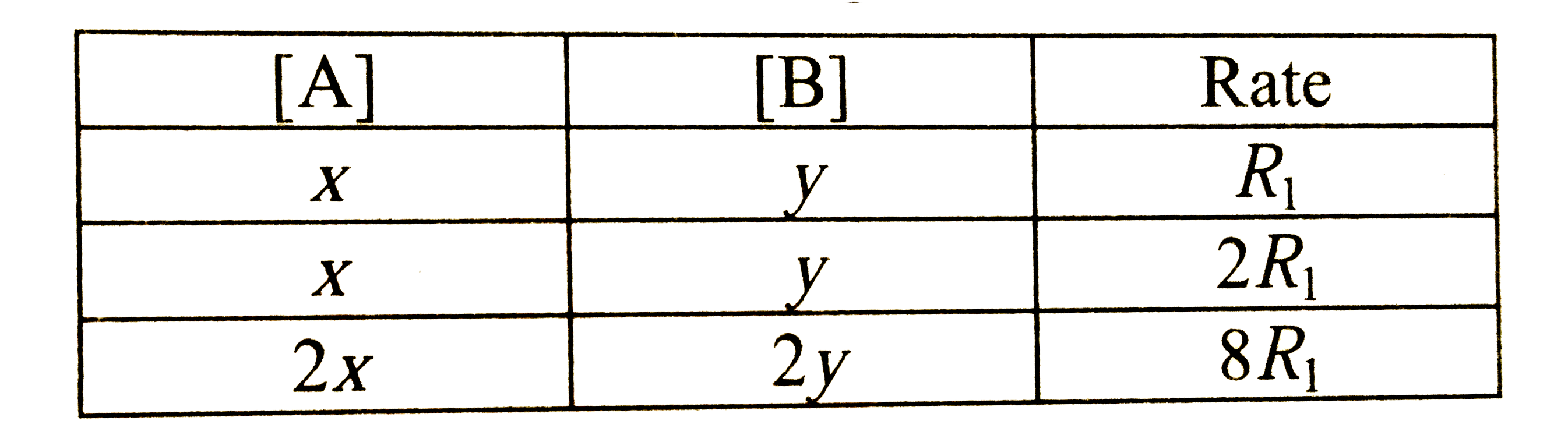 That MEANS order of reaction with respect to B is 1 and w.r.t. A is 2 Hence , Rate = `k [A]^(2) [B]^(1)` |
|
| 4. |
In a reaction ,A + B to C, the rate expression is R = K[A] [B]^(2) . If the concentration of both the reactants is doubled at constant volume then the rate of reaction will be |
|
Answer» Eight TIMES Rate = R = `K[A][B]^(2)` If [A] = [2A] and [B] = [2B] then new Rate = `R' = K[2A] [2B]^(2)` `(R')/(R) = (K[2A][2B]^(2))/(K[A][B]^(2)) implies (R')/(R) = 8 implies R = ' = 8R`. |
|
| 5. |
In a reaction :A+B hArr C+D, the initial concentrations of A and B were 0.9 mol dm^(-3)each.At equilibrium, the concentration of D was found to be 0.6 mol dm^(-3). What is the value of equilibrium constant for the reaction ? |
|
Answer» 3 |
|
| 6. |
In a reaction, A + 2B hArr 2C, 2.0 mole of A, 3.0 mole of B and 2.0 mole of C are placed in a 2.0 L flask and the equilibrium concentration of C is 0.5 mol/L. The equilibrium constant (K) for the reaction is |
|
Answer» 0.073  `K_(E )=((0.5)^(2))/((1.25)(2)^(2))=0.05` |
|
| 7. |
In a reaction A + 2B to products, the molecularity of the reaction is |
|
Answer» 3 |
|
| 8. |
In a reaction, 5g of ethyl acetate is hydrolysed per litre in presence of dil . HCl in 300 minutes. If the reactant to be reduced to 2.5g? |
|
Answer» a=`22g L^(-1), (a-x)=(22-5)=17 gL^(-1), t=300 min`. For the first order reaction, `k=(2.303)/t log a/(a-x) = 2.303/(300 "min") log (22g L^(-1))/(17 gL^(-1))` `=2.303/(300 "min") log 1.2941 = 2.303/(300 "min") xx 0.1120 = 8.6 xx 10^(-4) min^(-1)` |
|
| 9. |
In a reaction, 5g ethyl acetate is hydrolysed per litre in the presence of dil HCl in 300 minutes. If the reaction is of first order and the initial concentration of ethyl acetate is 22g//"L", calculate the rate constant of the reaction. |
|
Answer» |
|
| 10. |
In a reaction 4 moles of electrons are tranferred to one mole of HNO_(3) when acted as an oxidant .The possible reduction product is |
|
Answer» (1/2) MOLE of `N_(2)` |
|
| 11. |
In a reaction ,2Ato products ,the concentration of A decreases from 0.5 mol L^(-1) to 0.4 mol L^(1) in 10 minutes.Calculate the rate during this interval. |
|
Answer» SOLUTION :Reaction 2A `to` Product, Time =10 minute `THEREFORE Deltat=10 "minute:-0 "minute" =10 "minute"` `Rate=-(1)/(2)(DELTA[A])/(Deltat)` `=-((0.4-0.5)mol L^(-1))/(2XX10 m)` `+(0.1)/(2xx10),ol L^(-1) m^(-1)` `=5.0 xx10^(-3) mol L^(-1) m^(-1)` |
|
| 12. |
In a reaction, 2AtoProducts, the concentration of A decreases from 0.5" mol L"^(-1) to 0.4" mol L"^(-1) in 10 minutes. Calculate the rate during this interval. |
| Answer» Solution :Average rate `=-(1)/(2)(Delta[A])/(DELTAT)=-(1)/(2)([A]_(2)-[A_(1)])/(t_(2)-t_(1))=-(1)/(2)(0.4"M"-0.5" M")/(10" MIN")=-(1)/(2)(-0.1"M")/(10" min")=5XX10^(-3)" M min"^(-1).` | |
| 13. |
In a reaction ,2Ato product, the concentration of A decreases from 0.5 mol L^(-1)to0.4 mol L^(-1)in 10 minutes. Calculate therate during this interval. |
|
Answer» SOLUTION :Average RATE =-1/2(Delta[A])/(Delta)=-1/2([A_2]-[A_1])/(Deltat)=-1/2 ((0.4-0.5))/10` `=-1/2((-0.1)/10)=0.1/20=1/200=0.0`05` |
|
| 14. |
In a reaction 2Ararr Products: the concentration of A decreases from 0.5 mol litre^-1 to 0.4 mol litre^-1 in 10 minutes. The rate of reaction during this interval is: |
|
Answer» `0.05M min^-1` |
|
| 15. |
In a reaction 2A toProducts, the concentration of A decreases from 0.5 mol L^(-1) in 10 minutes. Calculate the rate during this interval. |
| Answer» SOLUTION :Average rate = `(-Delta[A])/(2Deltat)=1/2((0.4-0.5)/10)=5xx10^(-3) M "min"^(-1)` | |
| 16. |
In a reaction, 2A to Products, the concentration of A decreases from 0.5 mol L^(-1) to 0.4 mol L^(-1) in 10 minutes. Calculate the rate during this interval . |
|
Answer» Solution :AVERAGE RATE `=-(1)/(2) (DELTA[A])/(Delta t)= -(1)/(2)([A]_(2)-[A]_(1))/(t_(2)-t_(1))` `= -(1)/(2) xx (0.4M-0.5M)/("10 minutes")= -(1)/(2) xx (-0.1M)/("10 minutes")=5xx10^(-3)" mole minutes"^(-1)`. |
|
| 17. |
In a reaction , 2A rarr products , the concentration of A decreases from 0.5 "mol L"^(-1) to 0.4 "mol L"^(-1) in 10 minutes . Calculate the rate during this interval. |
|
Answer» SOLUTION :AVERAGE rate `=1/2(Delta[A])/(Deltat)=1/2([A]_2-[A]_1)/(t_2-t_1)` `=-1/2((0.4M-0.5M)/(10MIN))=-1/2((-0.1M)/(10min))=5xx10^(-3) "M MIN"^(-1)` |
|
| 18. |
In a reaction, 2A rarr products, the concentration of A decreases from 0.5 "mol L"^(-1) to 0.4 "mol L"^(-1) in 10 minutes. Calculate the rate during this interval ? |
|
Answer» Solution :Average rate `=-(1)/(2)(Delta [A])/(Delta L)` `=-(1)/(2)([A]_(2)-[A]_(1))/(t_(2)-t_(1))` `=-(1)/(2)((0.4-0.5)/(10))` `=-(1)/(2)((-0.1)/(10))` `= 0.005 "MOL L"^(-1)"MIN"^(-1)` `= 5xx10^(-3)"M min"^(-1)`. |
|
| 19. |
In a reaction 2A product, the concentration of A decreases from 0.5 mol L-1 to 0.4 mol L-1 in 10 minutes. Calculate the rate during this interval. |
| Answer» Solution :AVERAGE RATE= `-1/2 (Delta[A])/(Delta t)=-1/2[([A]_3-[A]_1)/(Deltat_2-t_1)]= -1/2[(0.4 - 0.5)/10]=0.005 MOL L^-1 mi N^(-1) = 5 times 10^-3 mol L^-1 mi n^(-1)` | |
| 20. |
In a reaction2A+btoA_(2)B the reaction A will disappear at |
|
Answer» HALF the rate at which B disappears |
|
| 21. |
In a radioactive decay, an emitted electron comes from |
|
Answer» Nucleus of the atom |
|
| 22. |
In a quantitative determination of iron in an ore, an analyst converted 0.42 g of the ore into its ferrous form . This required 42.00 mL of 0.1 N solution of KMnO_(4) for titration. How many moles of KMnO_(4) were used for titration ? (Fe =56) |
|
Answer» Solution :In this problem `FE^(2+)` is oxidised to `Fe^(3+)` by `KMnO_(4)` Moles of `KMnO_(4) =("equivalents")/("factor relating mo.wt and eq.wt")""...(Eqn.6ii)` ` = (0.0042)/5 = 0.00084` mole . Note : Thus we see how the equations 1 to 7 have been put into USE in the PROBLEMS given above . However , application of these euations and the ability to use them come only from PRACTICE. The STUDENTS are advised to apply the said rules in as many problems as possible ] . |
|
| 23. |
In a radioactive decay, an emitted electron comes from : |
|
Answer» inner ORBITAL of the atom |
|
| 24. |
In a quantitative determination of iron in an ore, an analyst converted 0.42 g of the ore into its ferrous form . This required 42.00 mL of 0.1 N solution of KMnO_(4) for titration. What is the molarity of KMnO_(4) solution used ? |
|
Answer» Solution :In this problem `Fe^(2+)` is oxidised to `Fe^(3+)` by `KMnO_(4)` Molarity of `KMnO_(4) = ("normality")/("factor relating mol.wt and eq.wt")` i.e., change in ON ....(Eqn .6i) ` =(0.1)/5 = 0.02 M ` `{UNDERSET(+7)(MnO_(4)^(-))to underset(+2) (MN^(2+))}` |
|
| 25. |
In a given reaction _ZX^A rightarrow _(Z+1)Y^A rightarrow_(Z-1)K^(A-4) rightarrow _(Z-1)K^(A-4) Radioactive radiations are emitted in the sequence of |
|
Answer» `ALPHA,BETA,gamma` `_(Z)^(A)Poverset(-beta)to""_(Z+1)^(A)Qoverset(-alpha)to""_(Z-1)^(A-4)Roverset(gamma)to""_(Z-1)^(A-4)S` |
|
| 26. |
In a quantitative determination of iron in an ore, an analyst converted 0.42 g of the ore into its ferrous form . This required 42.00 mL of 0.1 N solution of KMnO_(4) for titration. What is the percentage of iron in the ore? |
|
Answer» SOLUTION :In this PROBLEM `Fe^(2+)` is oxidised to `Fe^(3+)` by `KMnO_(4)` ` % " of iron" = (0.2352)/(0.42) xx 100 = 56.00 % ` |
|
| 27. |
In a quantitative determination of iron in an ore, an analyst converted 0.42 g of the ore into its ferrous form . This required 42.00 mL of 0.1 N solution of KMnO_(4) for titration. How many grams of iron were present in the sample ? |
|
Answer» Solution :In this problem `Fe^(2+)` is oxidised to `Fe^(3+)` by `KMnO_(4)` Wt.of IRON = equivalent `xx` eq.wt ...(Eqn.4) ` = 0.0042 xx 56 =0.2352 g` `{Fe^(2+)toFe^(3+):. "of Fe"=("at.wt")/("change in ON")=56/1 = 56}`. |
|
| 28. |
In a quantitative determination of iron in an ore, an analyst converted 0.42 g of the ore into its ferrous form . This required 42.00 mL of 0.1 N solution of KMnO_(4) for titration.How many equivalents of iron were present in the sample of the ore taken for analysis ? |
|
Answer» Solution :In this PROBLEM `FE^(2+)` is oxidised to `Fe^(3+)` by `KMnO_(4)` Equivalent of Fe present in the SAMPLE. ` = ("m.e of"KMnO_(4)"solution")/1000` ...(eqn.3) ` =(4.2)/1000 = 0.0042 ` |
|
| 29. |
In a quantitative determination of iron in an ore, an analyst converted 0.42 g of the ore into its ferrous form . This required 42.00 mL of 0.1 N solution of KMnO_(4) for titration. How many milliequivalents of KMnO_(4) does 42.00 mL of 0.1N solution represent ? |
|
Answer» SOLUTION :In this PROBLEM `Fe^(2+)` is oxidised to `Fe^(3+)` by `KMnO_(4)` (i) m.e of `KMnO_(4)` solution =`0.1 xx42 =4.2 "" ….(Eqn 1)` |
|
| 30. |
In a pseudo first order reaction of hydrolysis of an ester in H_2O, the following results were obtained : Calculate the average rate of reaction between the time interval 30 to60 sec. |
| Answer» Solution :AVERAGE RATE during 30-60 SEC. `=(0.17-0.31)/(60-30)=4.67xx10^(-3) "MOL L"^(-1) "sec"^(-1)` | |
| 31. |
In a pseudo first order reaction of hydrolysis of an ester in H_2O, the following results were obtained : Calculate the pseudo first order rate constant for the hydrolysis of ester. |
|
Answer» Solution :`K_30=2.303/t "log"([A]_0)/([A])=2.303/30 "log"0.55/0.31` `K_60=2.303/60 "log"0.55/0.17` `K_90=2.303/90"log"0.55/0.085` AVERAGE `K=1.98xx10^(-2) "sec"^(-1)` |
|
| 32. |
In a pseudo first order hydrolysis of ester in water the following results were obtained : {:(t//s,0,30,60,90),("[Ester]M",0.55,0.31,0.17,0.085):} Calculate the pseudo first order rate constant for the hydrolysis of ester. |
| Answer» Solution :`k = 1.98 XX 10^(-2) SEC^(-1)` | |
| 33. |
In a pseudo first order hydrolysis of ester in water the following results were obtained : {:(t//s,0,30,60,90),("[Ester]M",0.55,0.31,0.17,0.085):} Calculate the average rate of reaction between the time interval 30 to 60 seconds. |
| Answer» SOLUTION :`4.67 xx 10^(-3)MS^(-1)` | |
| 34. |
In a pseudo first order hydrolysis of an ester in water, the following results were obtained : {:("t/s",,,0,,,30,,,60,,,90),(["Ester"]//"mol L"^(-1),,,0.55,,,0.31,,,0.17,,,0.085):} (i) Calculate the average rate of reaction between the time interval 30 to 60 seconds. (ii) Calculate the pseudo first order rate constant for the hydrolysis of ester. |
|
Answer» Solution :(i) AVERAGE rate during the interval 30-60 sec. `=(C_(2)-C_(1))/(t_(2)-t_(1))=(0.31-0.17)/(60-30)=(0.14)/(30)" MOL L"^(-1)s^(-1)=4.67xx10^(-3)" mol L"^(-1)s^(-1)` (II) `k'=(2.303)/(t)log""([A_(0)])/([A])" in which "[A_(0)]=0.55" M"` `t=30" sec",k'=(2.303)/(30s)log""(0.55)/(0.31)=1.91xx10^(-2)s^(-1)` `t=60" sec",k'=(2.303)/(60s)log""(0.55)/(0.17)=1.96xx10^(-2)s^(-1)` `t=90" sec",k'=(2.303)/(90s)log""(0.55)/(0.085)=2.07xx10^(-2)s^(-1)` Average `k'=(1.91+1.96+2.07)/(3)xx10^(-2)=1.98xx10^(-2)s^(-1).` |
|
| 35. |
In a pseudo first order hydrolysis of ester in water, the following results were obtained. i) Calculate the average rate of reaction between the time interval 30 to 60 seconds. ii) Calcualte the pseudo first order rate constant for the hydrolysis of ester. |
|
Answer» SOLUTION :Average rate of reaction = `("Change in molar concentration")/("Change in time INTERVAL")` `=(0.17 - 0.31)/(60-30) = (-0.14M)/(30s) = -4.67 xx 10^(-3)MS^(-1)` the rate constant, `K=(2.303)/t log[A_(0)]/[A], [A_(0)]=0.55 M` For t=30s , `k_(1)=2.303/(30s) log[0.55]/[0.31]= 2.303/(30s) xx 0.249 = 1.91 xx 10^(2)s^(-1)`. For t=60s, `k_(2) = 2.303/(60s) log [0.55]/[0.31]=2.303/(60s)xx0.5099 = 1.96 xx 10^(-2)s^(-1)` For t=60s , `k_(2)=2.303/(60s), k_(2) = 2.303/(60s)log[0.55]/[0.17]=2.303/(60s) xx 0.5099 = 1.96 xx 10^(-2)s^(-1)`. For t=90 s, `k_(3)=2.303/(90S)log[0.55]/[0.085]=2.303/(90s) xx 0.811 = 2.07 xx 10^(-2)s^(-1)`. Average rate constant (k) = `(k_(1)+k_(2)+k_(3))/(3) = (1.91 + 1.96+2.07)/(3) xx 10^(-2)s^(-1)` `=1.98 xx 10^(-2)s^(-1)`. |
|
| 36. |
In a pseudo first order hydrolysis of an ester in water, and following results were obtained: (i) Calculate the average rate of reaction between the time interval 30 to 60 seconds. (ii) Calculate the pseudo first order rate constant for the hydrolysis of ester. |
|
Answer» SOLUTION :(i) Average rate during the INTERVAL `30-60` seconds `=(C_(2)-C_(1))/(t_(2)-t_(1))=(0.31-0.17)/(60-30)=(0.14)/(30)" MOL L"^(-1)s^(-1)=4.67xx10^(-3)" mol L"^(-1)s^(-1)` (ii) `k=(2.303)/(t)"log"([A_(0)])/([A])` in which `[A_(0)]=0.55M` At t = 30 seconds, `k=(2.303)/(30s)"log"(0.55)/(0.31)=1.91xx10^(-2)s^(-1)` At t = 60 seconds,`k=(2.303)/(60S)"log" (0.55)/(0.17)=1.96xx10^(-2)s^(-1)` At t = 90 seconds, `k=(2.303)/(90s)"log"(0.55)/(0.085)=2.07xx10^(-2)s^(-1)` Average `k=(1.91+1.96+2.07)/(3)xx10^(-2)=1.98xx10^(-2)s^(-1)`. |
|
| 37. |
In a protein, variousaminoacidsliked togetherby ……… |
|
Answer» Peptidebond |
|
| 38. |
In a protein molecule various amino acids are linked together by : |
|
Answer» `beta`-glycosidic BOND |
|
| 39. |
In a protein ,the different type of attractions that exist are(A) H bonding(B) hydrophobic(C ) ionic(D) covalent |
|
Answer» B, C and D only |
|
| 40. |
In a protein molecule various amino acids are linked together by |
|
Answer» peptide BOND |
|
| 41. |
In a protein molecule various amino acids are linked together by- |
|
Answer» `ALPHA`-GLYCOSIDIC BOND |
|
| 42. |
In a process for producing acetic acid, oxygen gas is bubbledinto acetaldehyde containing manganesed (II) acetate(catalyst under pressure at 60^(@) C . 2 CH_(3) CHO + O_(2) to 2CH_(3) COOHIn a laboratorytest of thisreaction20 g of CH_(3) CHO and 10 g of O_(2) were putinto a reaction vessel . (a)Howmanygrams of CH_(3) COOH can be produced ?(b) Howmany grams of the excess reactant remain after thereaction is complete ? |
|
Answer» Solution :`{:(" "(20//40)""(10//32)""0". . . .initial mole" ),(2 CH_(3)CHO""+O_(2)""to ""2 CH_(3) CO OH),( ""0""(0.3125-0.2272)""0.4545". . . . final mole" ),(""=0.0853):}` (a) `CH_(3) CHO`is the limitingreagent and hence amount of `CH_(3) C O O H` produced ` = 0 . 4545 xx 60 G`= 27 . 27 g (b)Amount of `O_(2)" LEFT " = 0 . 853 xx 32 ` = 2 . 73 g |
|
| 43. |
In a protein molecule amino acids are linked together by: |
|
Answer» PEPTIDE BOND |
|
| 44. |
In a primitive cubic lattice, the percentage of void volume is |
|
Answer» 52.36% Empty or void volume = 100 - 52.36 = 47.64% |
|
| 45. |
In a polluted lake, the index of pollution is |
|
Answer» BOD and Daphnia |
|
| 46. |
In a polymer sample 30% of molecules have a molecular mass 20,000 , 40 % have 30,000 and the rest 60,000 . What is the weight average molecular mass of the polymer |
|
Answer» 40300 |
|
| 47. |
In a photoelectric effect, the energy of the photon striking a metallic surface is 5.6xx10^(-19)J. The kinetic energy of the ejected electron is 12.0xx10^(-20)J .The work function is |
|
Answer» `6.4 XX 10^(-19) J` |
|
| 48. |
In a pesudo first order hydrolysis of ester in water, the following results were obtained. {:("1",0,30,60,90),("[Ester]mol L"^(-1),0.55,0.31,0.17,0.085):}Calculate the pseudo first order rate constant for the hydrolysis of ester. |
|
Answer» Solution :For a PSEUDO FIRST order reaction, `k=(2.303)/(t)"log"([R]_(0))/([R])` For, `t = 303` `k_(1)=(2.303)/(t)"log"(0.55)/(0.31)` `=1.911xx10^(-2)s^(-1)` For, `t = 603` `k_(2)=(2.303)/(60)"log"(0.55)/(0.17)` `=1.957xx10^(-2)s^(-1)`, For, `t = 90 s` `k_(3)=(2.303)/(90)"log"(0.55)/(0.085)` `=2.075xx10^(-2)s^(-1)`. Then, average rate constant, `k=(k_(1)+k_(2)+k_(3))/(3)` `=((1.911xx10^(-2))+(1.957xx10^(-2))(2.075xx10^(-2)))/(3)` `= 1.98xx10^(-2)s^(-1)`. |
|
| 49. |
In a pesudo first order hydrolysis of ester in water, the following results were obtained. {:("1",0,30,60,90),("[Ester]mol L"^(-1),0.55,0.31,0.17,0.085):} Calculate the average rate of reaction between the time interval 30 to 60 seconds. |
|
Answer» Solution :AVERAGE rate of reaction between the time interval, 30 to 60 SECONDS `=("d[ESTER]")/(dt)` `=(0.31-0.17)/(60-30)=(0.14)/(30)` `=4.67xx10^(-3)"mol L"^(-1)s^(-1)`. |
|
| 50. |
In a periodic table the basic character of oxides |
|
Answer» increases from LEFT to right and decreases from TOP to bottom |
|